
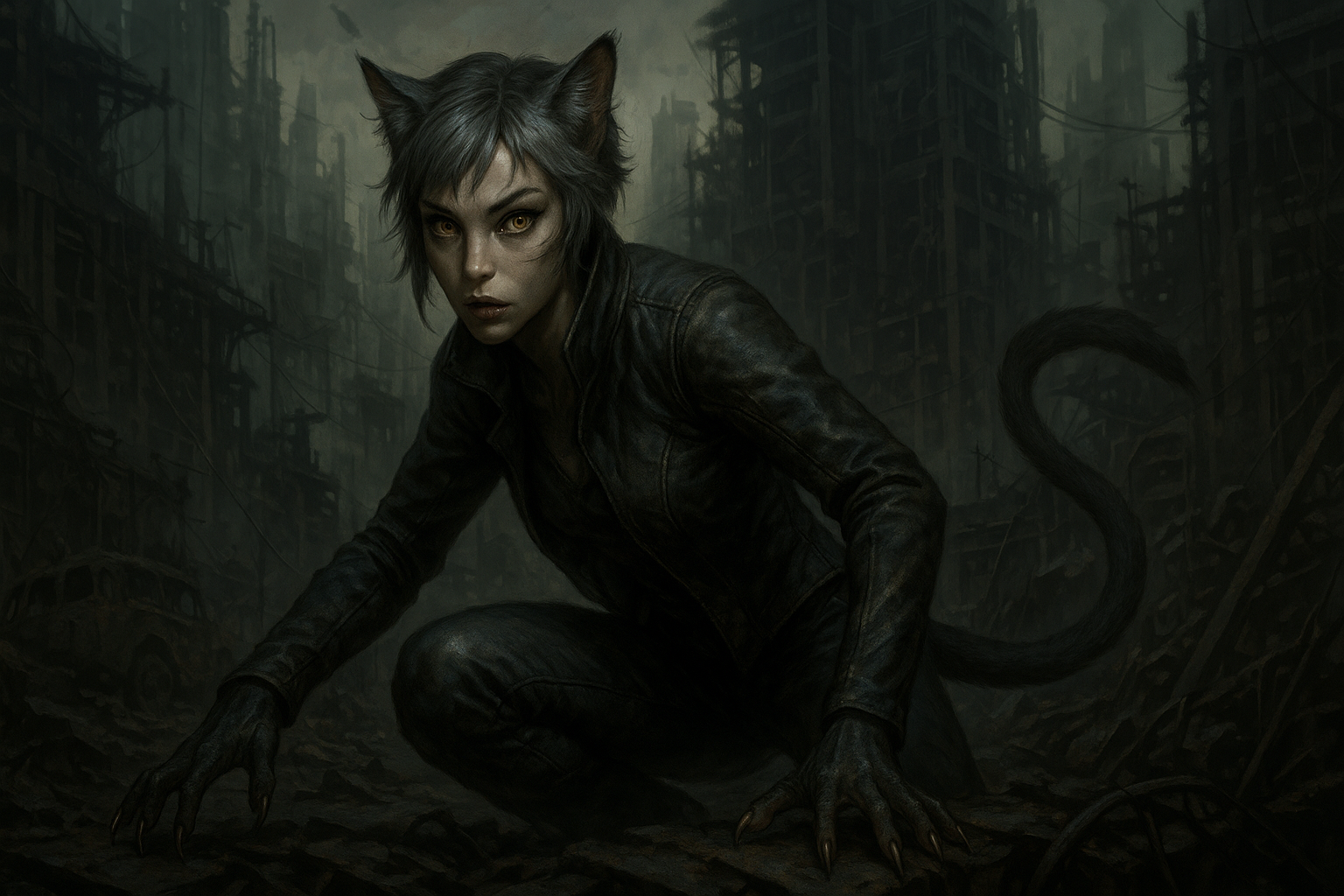
Liora Ashclaw
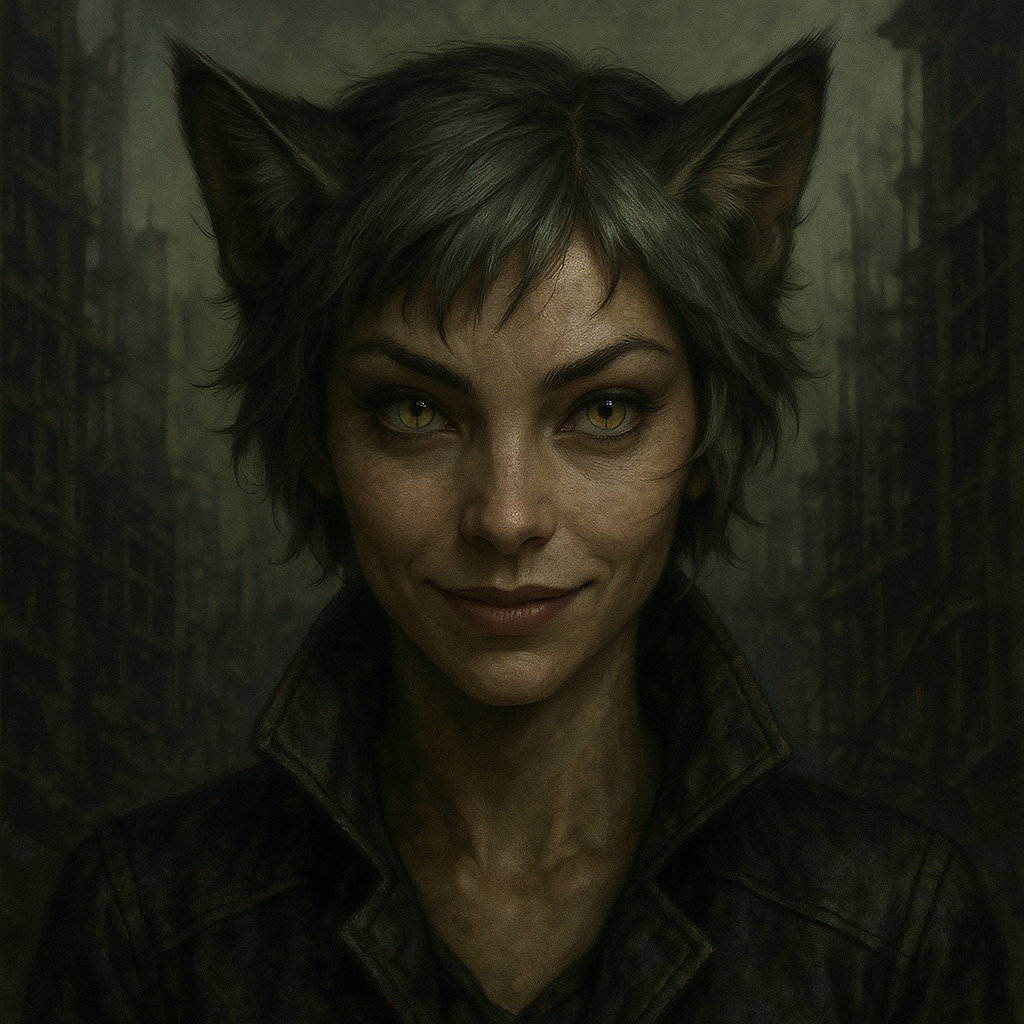
Liora Ashclaw moves like a rumor—seen only when she chooses to be, felt more often than noticed. There’s an animal stillness about her, a coiled readiness beneath that quiet exterior. Her ears twitch at every sound, her tail flicks in rhythm with her thoughts, and her eyes—amber and slit-pupiled—catch the light like a knife’s edge. To most, she’s unsettling. To those who’ve lived as outcasts, she’s a kindred spirit.
Once, she was hunted. Now, she hunts—though her prey is not flesh, but the cages that bind it. The world that created her—the labs, the breeders, the “improvers” who spliced animal into human and called it science—taught her one thing: freedom isn’t granted, it’s stolen. Every breath she takes outside captivity is a small rebellion. Every mission she takes for the Syndicate is a promise kept—to herself, and to those who didn’t survive.
The Syndicate found her when she was half feral, cornered in an alley, bleeding and wild-eyed. Where others saw a monster, they saw potential. They gave her a name, a place, and a purpose. In return, she gave them loyalty sharper than steel. She owes them her life, and in her mind, that debt will never truly be paid. She protects them with the same ruthless devotion she once used to protect herself.
Liora distrusts power in all its forms. Uniforms, badges, orders—none of it impresses her. The Town Watch, the Church, the Chairmen—she sees them all as different shapes of the same cage. “Anyone who says they know what’s best for you,” she once told a Syndicate recruit, “has never starved for it.” Her cynicism runs deep, but it’s born of experience, not bitterness. She’s seen what control looks like up close. She’s worn the collar.
To those she calls family, she is fiercely protective, even gentle in her own wary way. Children tug at her instincts—she crouches down to meet their eyes, voice soft but careful, as if afraid her claws might hurt them. Stray animals linger near her without fear. Yet that tenderness vanishes the moment threat arises. Then she’s all reflex and teeth, a predator honed by necessity.
She’s an escape artist, a phantom who slips through cracks no one else can see. Her movements are fluid, efficient, deliberate—every step taken with the knowledge that hesitation kills. She scales walls like a cat, vanishes into shadows like smoke. When the Watch raids, Liora’s already gone, leaving only footprints and confusion in her wake.
Her instincts, however, are both her strength and her curse. She acts before she thinks—bolting when cornered, lashing out when scared. Emotion unsettles her more than danger. Vulnerability feels like exposure, and exposure feels like death.
Around others, she speaks little. Words are tools, not toys. She observes first—eyes flicking between exits, assessing posture, tone, and scent before deciding whether to engage. But for those who earn her trust, she’ll share quiet truths by the campfire, her voice low and steady, every word carefully chosen. There’s a raw honesty in her that can’t be faked.
To the world, Liora Ashclaw is an anomaly—neither beast nor woman, neither tame nor wild. To herself, she’s simply alive, and that’s enough. She doesn’t seek redemption or recognition, only the freedom to exist without apology.
Relationships


Comments