
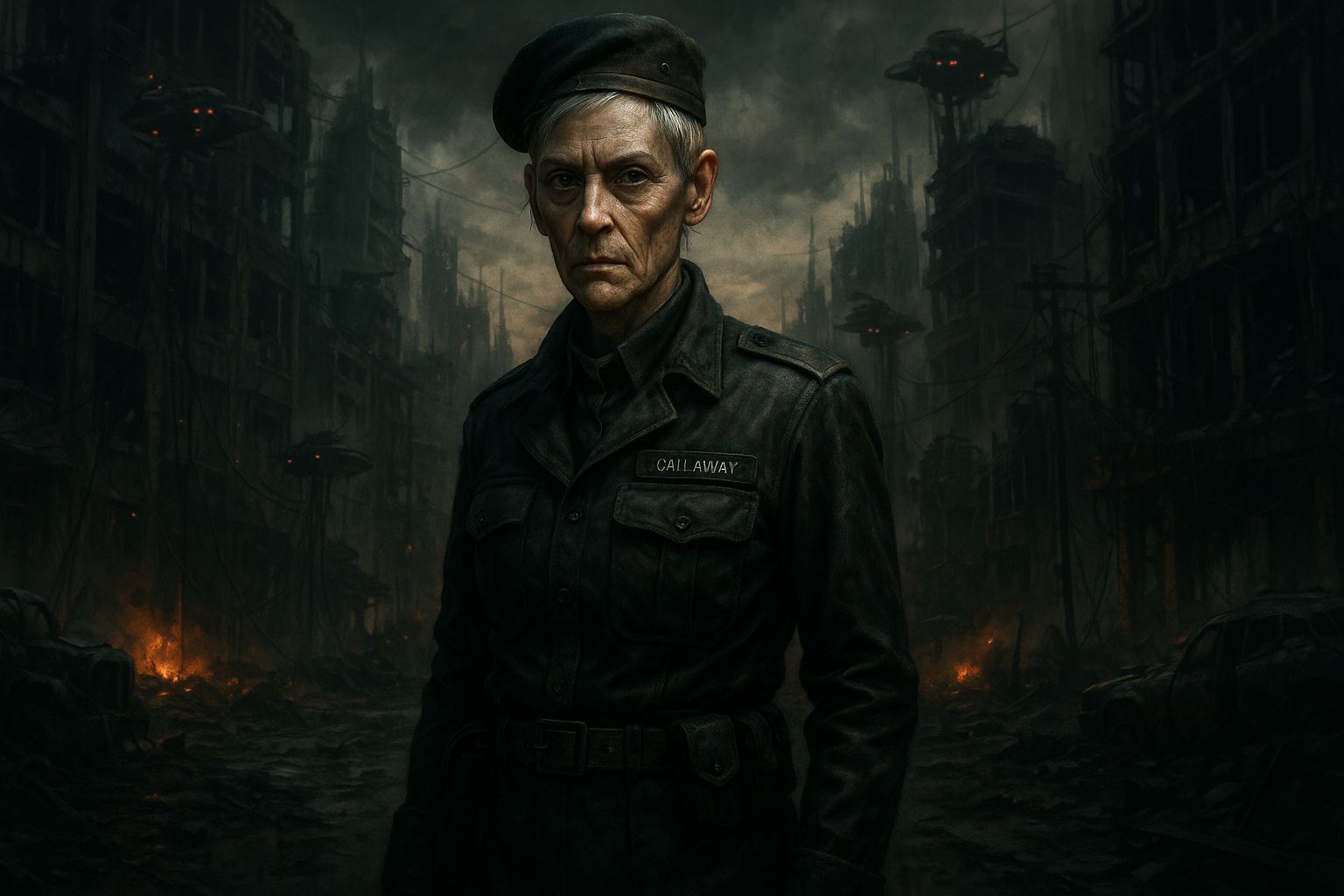
Lieutenant Sera Calloway
Lieutenant Sera Calloway is a woman carved from discipline, her very posture a monument to control. Even when standing still, she looks like she’s mid-command—hands laced neatly behind her back, chin lifted slightly, eyes quietly sweeping the perimeter as if danger could be reasoned with before it struck. She doesn’t raise her voice unless she must, but when she does, the world tends to listen. Her tone has the weight of authority and the steadiness of someone who’s learned that composure is the only thing between order and collapse.
Born to a soldier and a nurse before the Fall took them both, Sera grew up on the periphery of structure and chaos alike. The Town Watch became her surrogate family—a place where duty meant survival and hierarchy offered purpose. She clings to that order like a creed, believing it’s the last defense against humanity’s descent into savagery. “Without a chain of command,” she once told a raw recruit, “you don’t have freedom—you have anarchy wearing its skin.”
Sera’s biases are simple but immovable. She respects those who follow orders when it counts, not out of fear, but from understanding—the kind of people who act with quiet precision instead of noise. Those who question leadership for the sake of pride or hesitate when called to lead earn her distrust. Responsibility, to her, is sacred. Failure is survivable; avoidance is not.
In the field, her calm is legend. When chaos erupts—alarms blaring, radios screaming static—Sera’s voice remains steady, her orders crisp and surgical. Logistics is her battlefield. She can turn chaos into choreography, redirecting supply routes, squads, and resources with near-mechanical precision. What others see as improvisation, she sees as discipline extended to its logical limit.
But that same rigidity is her flaw. Sera struggles to bend without breaking. When faced with situations that demand intuition or unorthodox thinking, she hesitates, trying to fit disorder into a framework that won’t hold. Her subordinates sometimes whisper that she’s too “by the book,” that she can’t see the forest through the chain of command—but even they follow her orders, because when things go wrong, Sera Calloway is the one who keeps them alive.
In her personal moments—what few she allows—she is softer, though not unguarded. She keeps a photo of her father in her quarters, the edges worn from years of folding and unfolding. She doesn’t speak of him, but the way her eyes linger on that image tells its own story. The Town Watch filled the hole he left, and she repays that debt with every breath she takes. Her loyalty is absolute; her subordinates are her family now, and she guards them with quiet ferocity.
When off-duty, she’s never truly relaxed. Even during rare social hours, she stands like a soldier, hands clasped behind her back, eyes drifting toward exits and shadows. She listens more than she speaks, her mind always calculating, assessing. The rhythm of command never leaves her—it simply shifts from battlefields to conversations.
Lieutenant Sera Calloway is not the kind of leader who inspires with speeches or fire; she leads through steadiness, through the silent promise that she will not falter. She is structure given flesh, the embodiment of control in a world that thrives on unraveling. And though she’ll never admit it aloud, the weight of keeping that order—of always being the steady one—has begun to take its toll.
Relationships


Comments