
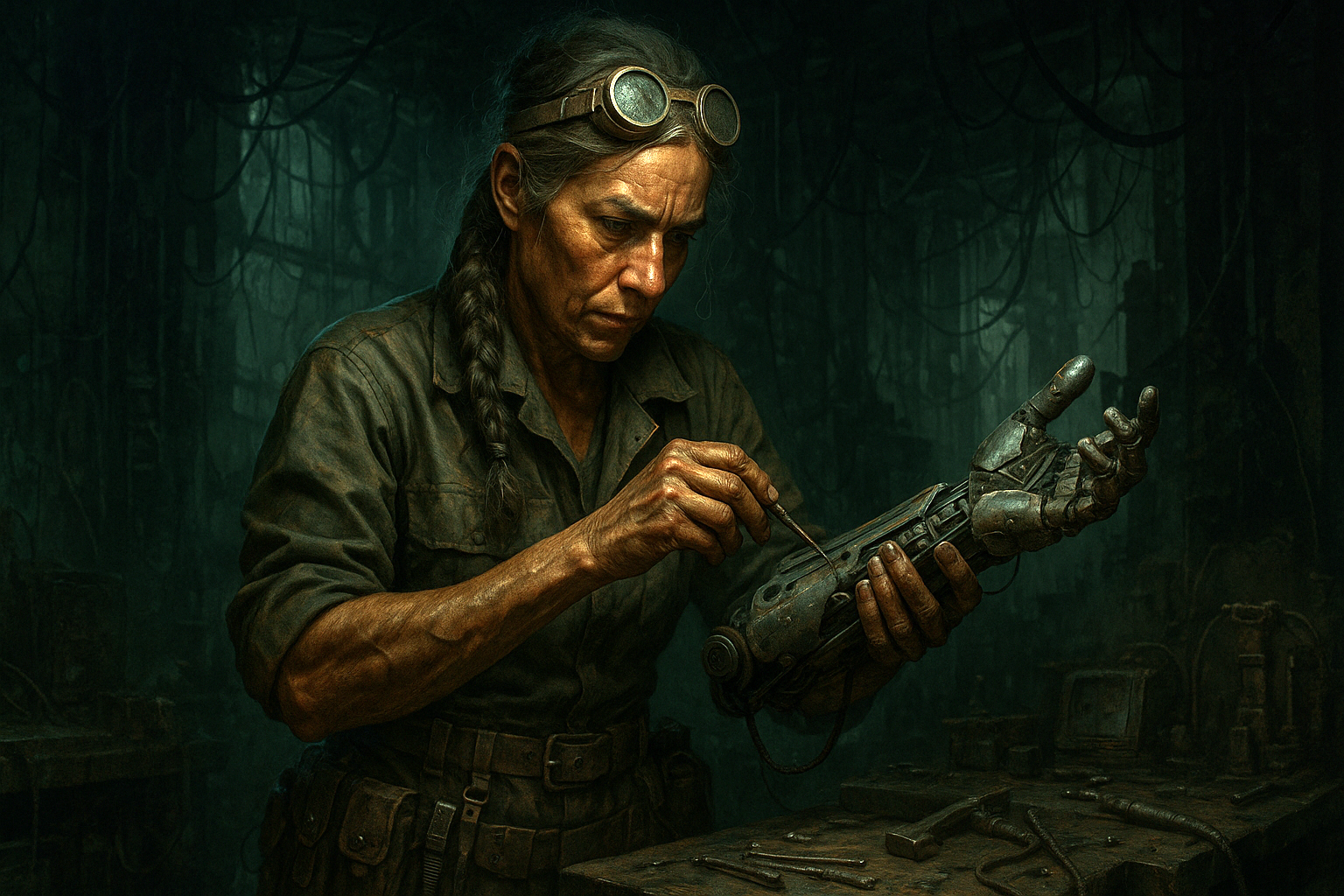
Kessa Merrick
Kessa Merrick has the steady patience of a machine that never breaks—but one that hums with quiet purpose rather than cold efficiency. In Camp Hope, where chaos often feels like the natural state of things, she is a rare constant: calm under fire, tools always at hand, eyes sharp as rivets. Where others argue philosophy, Kessa builds solutions. Where others pray, she repairs.
She is not the kind of woman who fills a room with noise or presence. Her power lies in precision, in the quiet authority of competence. When a generator is down or a prosthetic joint fails, people don’t panic—they look for Kessa. They know she’ll come walking in with a coil of wire in one hand and a wrench in the other, squint once at the damage, and mutter, “All right, let’s see what’s actually broken.” She’s the kind of engineer who listens before she acts, and when she finally does speak, people listen back.
Kessa has no patience for grand speeches or spiritual platitudes. Politicians and preachers alike tend to wilt under her gaze—a look that seems to peel away rhetoric and expose the bare truth beneath. She’s spent her life surrounded by systems that fail, machines that break, and people who depend on them. For her, engineering isn’t about prestige; it’s about survival. “Build what matters,” she says. And she means it.
Those who work under her quickly learn her rhythms. She’s not warm in the traditional sense, but there’s a quiet protectiveness in the way she treats her crew. She believes people grow strongest when they wrestle with their problems, so her mentorship is a mix of trust and challenge. “If I fix it for you,” she tells her apprentices, “you won’t learn how to fix it next time.” And yet, when that next time comes and everything’s falling apart, she’s already there beside them, tightening bolts without a word.
Her skill lies in making machines that fit people—not forcing people to fit the machine. Her work in adaptive technology has changed lives in Camp Hope. Veterans walk again because of her prosthetics; miners use tools shaped to their hands, not the other way around. Every hinge, every wire, every careful weld carries her signature precision and her philosophy: that engineering is the physical language of hope.
Despite her reputation for control, Kessa’s flaw is an invisible one. She cannot bring herself to ask for help. To her, delegation feels like weakness; she carries every burden alone until the weight nearly crushes her. Even her closest friends have seen her push through exhaustion with a trembling hand still holding a wrench. She’ll mutter, “Just one more adjustment,” even when she hasn’t slept in days.
Her greatest soft spot is her son, Valiteen. She raised him in the shadow of her workbench, teaching him to think before he speaks and fix before he complains. He’s her legacy—the one creation she fears she got both perfectly right and dangerously wrong. Valiteen is brilliant, responsible, and far too young to carry as much as he does. Kessa worries, but she keeps her fears to herself, choosing instead to show love through quiet acts: a repaired buckle, a packed lunch, a wordless squeeze on the shoulder.
Kessa Merrick is the backbone of any room she walks into, the kind of person whose steadiness others mistake for detachment. But in truth, she cares more deeply than most—about people, about systems, about the fragile web that keeps Camp Hope alive. She believes progress isn’t born from speeches or faith, but from hands that work and minds that refuse to quit.
If there’s a storm outside, she’ll be the one keeping the lights on. Not because anyone asked her to—but because that’s just what she does.
Relationships




Comments