
The Arcane Accord of Gauldowhynna
Political event
47/1
The Arcane Accord of Gauldowhynna marks a watershed moment in early Bechtlarite diplomacy and the stabilization of imperial–elven relations. Signed in the Great Hall of Verdancy, this pact established a formal exchange of magical theory, alchemical study, and natural philosophy between the scholars of Gauldowhynna and the academicians of Bechtlaruun. What began as a gesture of goodwill quickly evolved into a structured partnership that elevated the Bechtlarite Empire’s influence across the arcane sciences. The Accord granted Bechtlarite scholars unprecedented access to Gauldowhynna’s ancestral archives and spirit-tree observatories, while Gauldowhynna Verdancy circles gained access to Bechtlarite mechanist laboratories and the empire’s growing lexicon of artificial and bound-energy research. While lauded publicly as a symbol of unity and shared enlightenment, the Accord quietly shifted the balance of magical policy toward the empire. In the decades that followed, Bechtlarite administrative oversight increasingly dictated the ethical and experimental boundaries of Gauldowhynna study, planting the first seeds of dependency that would later define the elves’ uneasy relationship with human academia.
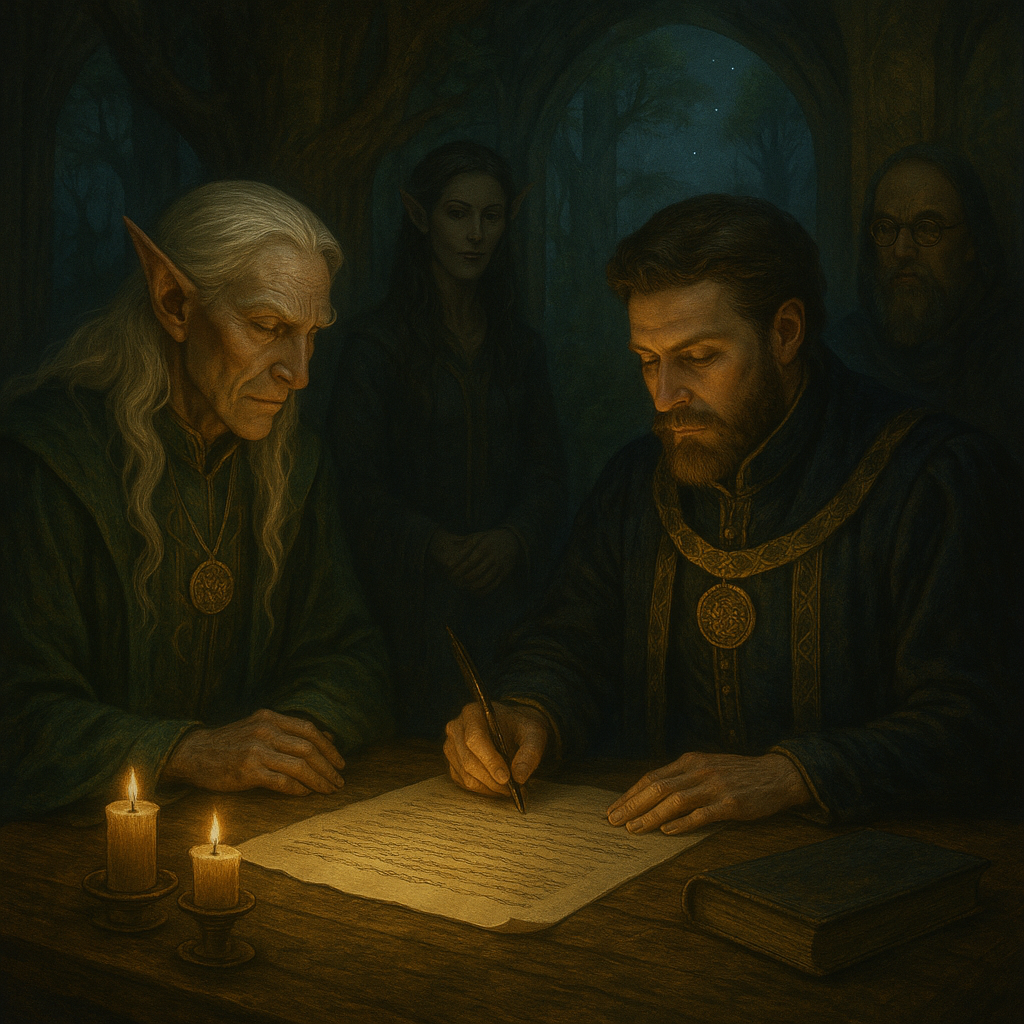
The Arcane Accord of Gauldowhynna stands as one of the most consequential diplomatic and academic treaties of the Age of Restoration. Signed in the Great Hall of Verdancy, beneath the living canopy of the Spirit-Tree Yvralan, the Accord marked not only a fragile peace but a profound transformation in the nature of interspecies cooperation, and manipulation. At the time of its signing, both empires stood at precarious crossroads. The Bechtlarite Empire, under the cold discipline of Sovereign Kaedric Thorn, had begun to emerge from the disarray that followed the death of Pendræd Armuun. Thorn’s consolidation of military power had stabilized internal borders, but the Empire’s cultural and scientific vigor waned under martial austerity. Thorn, ever the pragmatist, understood that strength could not rely solely on the sword. In his view, reclaiming Bechtlaruun’s lost ascendancy required mastery not only of industry but of knowledge, particularly the forgotten arts that had once shaped Cairne itself, meanwhile, Queen Sharvisal of the Gaul Do Shah, faced her own crisis. The Gauldowhynna Elves suffered from growing schisms among their Verdancy Circles. Her council, split between isolationists who favored retreat into the wild reaches and reformists who sought cooperation with the mortal realms, teetered toward civil division. To Sharvisal, alliance with the resurgent Bechtlarites offered a lifeline, a means of preservation masked as parity. The ceremony in 267 AR was a spectacle unlike any before. The Great Hall of Verdancy, an immense natural cathedral grown from living roots and suffused with bioluminescent moss, hosted both human dignitaries and elven sages in an atmosphere of cautious optimism. Witnesses spoke of Sovereign Thorn, clad in his black-and-gold ceremonial armor, and Queen Sharvisal, draped in woven emeralds and silver leaves, seated opposite one another across a living table of oak that flowered as the treaty was signed. Between them stood High Arcanist Meredin Thol, a scholar-soldier and Thorn’s trusted advisor, and Elder Sage Thaelen Ver’dross. The two men, adversaries turned collaborators, would come to embody the promise and peril of the Accord itself. To the Empire, the Accord was a triumph of intellect over mysticism. Bechtlarite scholars framed the partnership as the civilization of the arcane, heralding a new age of reason and empirical mastery. Official doctrine under Thorn’s administration emphasized “rational stewardship”, the belief that human oversight was necessary to prevent the destructive excesses of unrestrained elven magic. In private, however, Thorn and his ministers viewed the agreement as a subtle annexation, a means to domesticate Gauldowhynna’s surviving arcane heritage without the risk of open conquest. The Bechtlarite Ministry of Enlightened Doctrine (later known as the The University of Arcane Arts) quietly dispatched administrators to the new academy, where they began cataloging and reclassifying Verdancy rituals under human taxonomies. Over time, the empire’s definitions of what constituted “ethical study” replaced the elves’ ancient covenants, binding the circles in bureaucratic constraint. Among the elves, opinions were fractured. The Reformists, led by Queen Sharvisal, saw the Accord as a bridge to survival, an opportunity to regain purpose through collaboration and the infusion of Bechtlarite technological rigor. They believed that through disciplined partnership, the spiritual decay of the Verdancy might be reversed. The Isolationists, however, viewed the treaty as a betrayal. To them, it was an act of desperation and submission, a ceding of sovereignty over the very soul of their people. They warned that Thorn’s order was a shroud, not a light, and that the humans’ hunger for structure would suffocate the living art of magic itself. Their warnings proved prophetic. Within a generation, the elves’ research was increasingly audited by imperial scholars, and the once-revered title of Verdant Sage became synonymous with “Imperial Researcher.” Elven identity, long bound to the natural balance, began to erode under Bechtlarite classification and control.


Grove of Shah
Elf
The History of Cairne (article)