
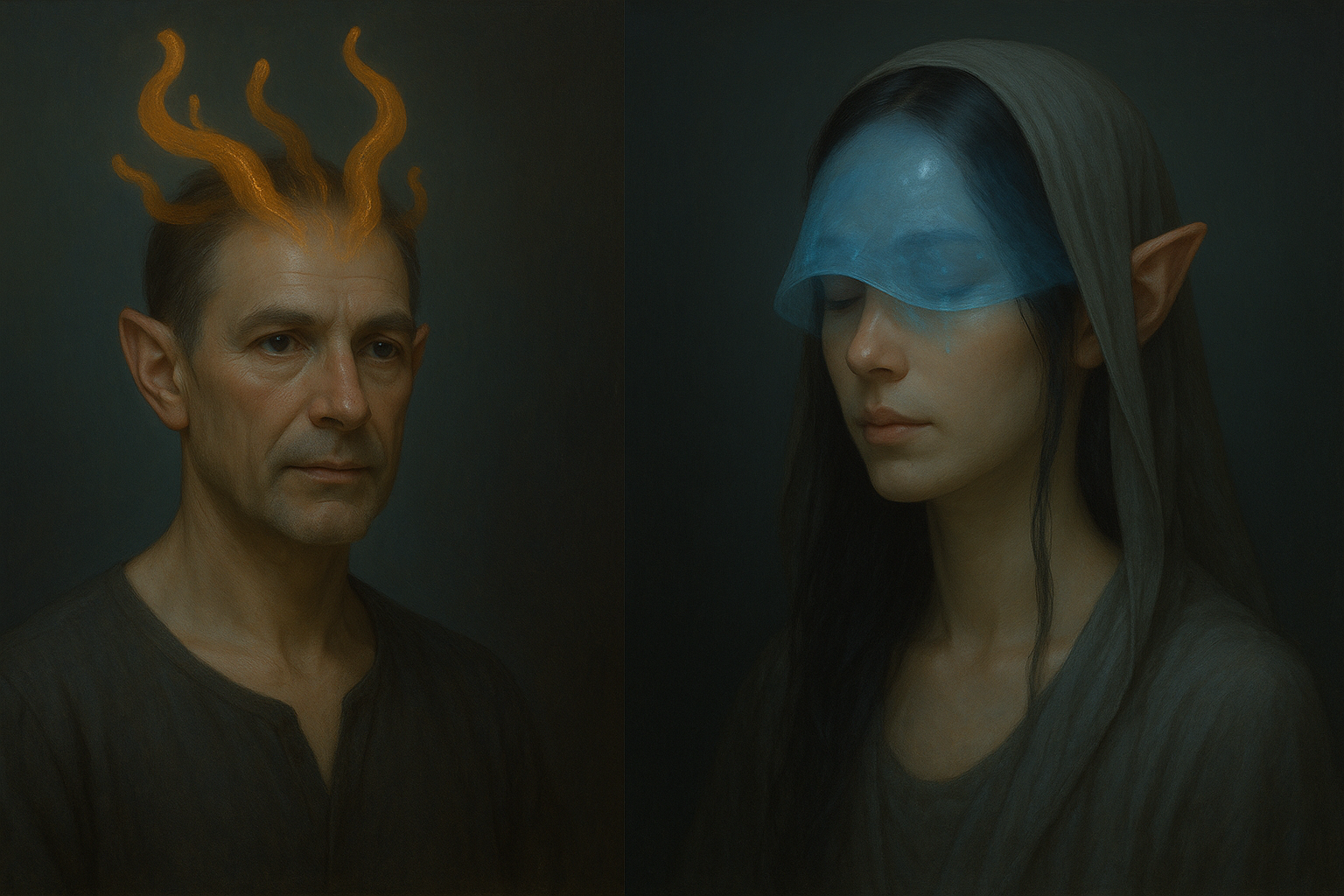
Luminari
The Hidden Children of the Deep Light
The Luminari are an ancient, reclusive people who evolved far beneath Cairne’s surface during the centuries following the Blight. Their appearance is striking yet serene, softened melanin, enlarged luminous eyes, and areas of natural translucency that give them an almost inner glow. Each Luminari forms a lifelong bond with a bioluminescent symbiotic organism known as a Luminid, which manifests across the face and crown in fluid, living shapes unique to the individual. These manifestations, Crownform, Veilform, Haloform, and Tendrilform, reflect the host’s nature, emotional resonance, and inner strengths.
Graceful, introspective, and profoundly communal, the Luminari built a quiet civilization of stone, resonance, and light deep below the world. After centuries hidden from surface turmoil, they have begun to re-emerge, cautiously, curiously, and with a gentle wisdom shaped by long years in darkness. Neither wholly mystical nor entirely biological, the Luminari embody the enduring balance between emotion, light, and the living world around them.
Basic Information
Anatomy
The Luminari possess a physiology distinct from all other surface peoples, shaped by twenty-five generations of subterranean life and their unique bond with the living bioluminescent symbiotes known as Luminids. While they remain broadly humanoid, subtle adaptations, emotional attunement, and luminescent traits set them apart.
Luminari bodies are compact, graceful, and finely balanced, built for navigating narrow caverns, maintaining quiet movement, and enduring low-light conditions. They lack the muscle bulk of Hiversteadians or the angular density of dwarves, relying instead on:
- Efficient musculature optimized for agility
- Light bone structure with slight elasticity
- High proprioceptive awareness, especially in Tendrilform individuals
Their physical presence is gentle but poised, with an economy of motion that feels almost meditative.
Biological Traits
Softened Melanin Profile
Luminari skin exhibits a smooth, uniform melanin distribution, resulting in fewer tonal variations or blemishes. This adaptation reduces visual contrast in low-light environments.
Translucency Zones
Due to generations underground and the influence of Luminid bonding, certain areas of the body show partial translucency, allowing internal glow to subtly radiate outward:
- forehead
- cheekbones
- temples
- clavicles
- upper sternum
These regions glow faintly under emotional stimuli or when the Luminid is active.
Texture & Temperature
Their dermis is:
- slightly cooler to the touch
- smoother than human skin
- less prone to scarring
This reflects both biological adaptation and the Luminid’s ongoing cellular maintenance.
Enlarged Irises & Pupils
To adapt to low-light caverns, Luminari developed:
- large, luminous irises
- highly responsive pupils
- enhanced rod density for night vision
Their gaze appears soft, luminous, and soulful, often reflecting a glow from their symbiote.
Tapetum-Like Reflectivity
A reflective layer behind the retina assists their low-light vision, producing a subtle gleam when light catches their eyes.
Ears
Elongated, gently pointed, and semi-translucent, reflecting their subterranean sensory needs.
- Slightly more cartilage flexibility
- Heightened sensitivity to vibration
- Capable of directional filtering in complex echo environments
Their ears often move subtly in response to changes in resonance or emotional states.
Respiratory & Metabolic Adaptations
Luminari respiration is efficient, reflecting deep-earth oxygen cycles.
- Lower resting heart rate
- Slower, deeper breathing
- High tolerance for humidity and fungal particulates
- Enhanced olfactory sense to detect unsafe spores
Their metabolism favors slow, sustained energy release rather than bursts of exertion.
Enhanced Emotional Neurocircuitry
Evolution + Luminid interaction reinforced neural pathways tied to:
- empathy
- pattern recognition
- emotional resonance
- dream vividness
This does not grant telepathy, but they are extraordinarily sensitive to microexpressions and emotional cues.
Luminid Interface Node
Every Luminari has a biologically distinct region at the center of the forehead, a subdermal neurovascular nexus where the Luminid bonds.
This structure is unique to their species.
Skeletal Structure
Luminari bones are slightly more flexible than humans’, with:
- higher collagen content
- lower fracture risk
- more efficient shock absorption
Their skeletal elasticity evolved to navigate tight stone passages and survive cavern tremors.
Musculature
Lean, strong, and tuned for precision:
- high slow-twitch muscle prevalence
- extremely controlled micro-movements
- exceptional balance
This contributes to their fluid, quiet walking style.
Voice & Acoustics
Due to the echo-heavy environments of their home:
- their voices tend toward soft, melodic resonance
- their range is slightly lower than humans
- they often speak slowly and precisely
Haloforms, in particular, are capable of producing harmonic overtones used in communal rituals.
Genetics and Reproduction
The Luminari represent a rare instance of a humanoid species whose evolution diverged sharply from their surface ancestors due to prolonged subterranean isolation and co-evolution with a bioluminescent symbiote. Their genetics illustrate both natural adaptations and the long-term influence of Luminid bonding on physiology and inheritance.
Luminari reproduction is biologically similar to humans, though fertility rates are lower than human averages, due to nutritional limitations underground, cultural emphasis on emotional readiness, and slow metabolic rhythms.
A Luminari couple typically produces 1–2 children per lifetime, though larger families exist.
Gestation length is approximately 11 months, slightly longer than humans due to, lower average maternal calorie intake, slow but steady fetal development, and unique neural and ocular formation in the fetus.
Pregnant Luminari often experience faint bioluminescence in their translucency zones, believed culturally to be a “shared glow.”
Because of low birth rates and high emotional expectations:
- parenthood is deeply honored
- communities assist with child-rearing
- emotional harmony in parents is prioritized
- Veilforms mediate tensions to protect developing infants
- Luminari population growth is extremely slow
This contributed to their secrecy:
they cannot afford war or high mortality.
There are three unusual hereditary traits:
1. The Paleflare Trait
Translucency so pronounced that the bones faintly silhouette under bright light.
2. Dual-Resonant Children
Rare infants with unusually strong emotional fields; they attract Luminids early (around age 8–10).
3. The Mirror-Eyed Line
Irises that reflect not just light, but subtle emotional signatures of nearby individuals.
These traits are culturally significant and sometimes mythologized.
Growth Rate & Stages
Luminari develop more slowly and more gracefully than surface peoples. Their physiology, emotional architecture, and eventual symbiotic bond with a Luminid shape each phase of life, producing a species that ages with intention, depth, and luminous subtlety.
I. Infancy (0–3 years)
Characteristics
- Born with extremely large pupils and nearly translucent skin
- Soft skeletal structure; highly flexible
- Low vocalization; use of humming and resonance reactions over crying
- Strong attachment to caregivers and communal presence
- Sleep cycles longer than humans
Cognitive Traits
Early Luminari infants display heightened emotional attunement, not through supernatural means, but through a more sensitive limbic system:
- They calm in the presence of stable emotional fields
- They become distressed by disharmony
- Veilforms often serve as caretakers for newborns
Developmental Notes
During this age, infants show brief flickers of bioluminescence beneath the skin, this is not a Luminid, but nascent vascular reflectivity.
II. Early Childhood (3–7 years)
Physical Changes
- Eyes develop full low-light capability
- Translucency zones become more defined
- Height increases slowly; long-limbed refinement begins
Behavior
Children at this age:
- Move gently, often imitating adults
- Are fascinated by light, stone patterns, and echoes
- Display strong communal instincts
Luminari children rarely fight; emotional conflict is processed through structured expression and guidance from adults.
III. Middle Childhood (7–12 years)
Identity Development
This stage is marked by:
- deepening emotional awareness
- refinement of motor control
- early signs of their future manifestation (though subtle)
Mild Precursor Traits
Some children begin to show precursor patterns that hint at their future Luminid type:
- Crownform precursors: preference for order, structured play
- Veilform precursors: strong empathy, reflective silence
- Haloform precursors: pattern-focused learning, rhythm sensitivity
- Tendrilform precursors: heightened sense of danger, exploratory behavior
These are tendencies, not certainties.
Social Structure
Children in this age group are raised collectively:
- Educated in resonance halls
- Exposed to emotional balancing practices
- Encouraged to explore creative expression
IV. The Bonding Age (12–16 years)
The Most Defining Phase of a Luminari Life
During this time, each young Luminari undergoes the Coming of Resonance, where a dormant Luminid awakens in response to their emotional identity.
What Happens Biologically
- Neural pathways reach structural maturity
- The bonding nexus (forehead) becomes electrically active
- Emotional rhythms stabilize
- Luminid filaments connect to the host’s dermal and neural structures
What Happens Socially
Bonding is treated with profound reverence.
- Each youth enters a one-month “Quieting” period
- They meditate and reflect on who they are
- Elders guide them but do not influence the outcome
When the Luminid appears, its form begins as a faint shape, gradually solidifying into:
- Crownform
- Veilform
- Haloform
- Tendrilform
The manifestation fully matures within 12–18 months.
Emotional Impact
Bonding is euphoric but overwhelming.
It marks adulthood, as the symbiote introduces new levels of awareness, clarity, and stability.
V. Early Adulthood (16–40 years)
Physical Condition
Luminari adults remain lean and luminous:
- excellent reflexes
- stable metabolisms
- slow aging signs
They appear youthful well into their 70s.
Role Development
Manifestation influences their societal paths:
- Crownforms: leadership, structure, guardianship
- Veilforms: healing, diplomacy, emotional guidance
- Haloforms: philosophy, pattern analysis, teaching
- Tendrilforms: scouting, exploration, guardianship of tunnels
Traits
- deepened sense of purpose
- strong emotional regulation
- high communal participation
VI. Mature Adulthood (40–90 years)
Traits of This Stage
- subtle glow intensifies
- manifestation becomes smoother and more defined
- emotional wisdom deepens
- reaction times slow only slightly
Community Role
This is when many Luminari contribute their life’s greatest works:
- resonance sculptures
- light-weavings
- philosophical treatises
- tunnel mapping
- bioluminescent engineering
They become anchors of stability.
VII. Elderhood (90–140+ years)
Physical Changes
Visible signs of aging:
- slight dimming of translucency zones
- slower movement
- softening of posture
- paler lips and ear-tips
But they remain elegant and calm.
Manifestation Change
Aging Luminids:
- grow softer in shape
- glow less intense
- shift to cooler hues
This is called The Gentle Fade.
Cultural Role
Elders are not rulers, they are mirrors.
Their counsel is deeply respected, but never enforced.
VIII. The Dimming (Final Life Stage)
Often beginning around age 130–150.
Physical Signs
- manifestation becomes faint
- skin translucency increases
- emotional energy wanes
- sleep cycles lengthen
The Last Glow
Shortly before death, a Luminari experiences:
- a sudden, brief surge of luminosity
- increased clarity
- a final emotional resonance
This is believed to be the Luminid releasing its stored harmonics back into the world.
Aftermath
The Luminid detaches and enters a dormant phase, waiting generations for a new bond.
It does not bond immediately, it seeks a host whose emotional resonance aligns.
Ecology and Habitats
The Luminari inhabit a vast network of subterranean caverns, bioluminescent ecosystems, and carefully curated fungal forests far beneath the surface of Cairne. Their environment is not accidental: it is a biological, cultural, and architectural symbiosis built across generations. The Luminari do not merely live underground, they have become a part of a self-sustaining deep-earth ecosystem unlike any other.
The Luminari dwell in a region called the Shallowdeep, a series of interconnected caverns that sit too deep to be discovered by surface mining. These regions are buffered from Blight-tainted air and enriched by mineral veins and underground water flows. The caverns extend horizontally for miles, with vertical shafts connecting multiple “strata districts.”
Dietary Needs and Habits
Luminari diets evolved from necessity, ecology, and cultural philosophy. Living far beneath Cairne’s surface, they developed a cuisine centered around fungi, roots, mineral-rich water, and small subterranean fauna. Their metabolism is slow but efficient, requiring less caloric intake than surface species, yet demanding more steady micronutrient support. The result is a deliberate, balanced, deeply ritualized diet tied to emotional equilibrium as much as physical health.
Biological Cycle
Unlike surface species whose biological cycles follow seasons, daylight, and temperature shifts, the Luminari evolved in a deep-earth environment with no seasonal change, stable temperatures, and a fundamentally different kind of environmental rhythm, one centered around:
- subterranean water shifts
- fungal growth cycles
- seismic resonance
- emotional harmonics within communities
- Luminid glow patterns
Their biological cycle reflects a life lived according to internal clocks, emotional rhythms, and the pulsing ecology of the Shallowdeep.
Luminari do not measure days by sunlight.
They use the Resonance Cycle: a natural oscillation of deep-earth vibration that waxes and wanes in a regular 28-hour pattern.
Morning Equivalent: The Quiet Rise
- Luminari awaken as resonance stabilizes.
- Luminids glow faintly.
- Emotional clarity is highest.
- Meditation and Quieting Cup are consumed.
Midday Equivalent: The Bright Pulse
- Highest metabolic activity.
- Luminids glow brightest.
- Physical labor and learning occur now.
Evening Equivalent: The Soft Dimming
- Metabolism slows.
- Speech is softer, more reflective.
- Communal meals occur.
Night Equivalent: The Deep Silence
- Caverns fall still.
- Luminids dim most dramatically.
- Dreams are vivid and symbolic.
- Emotional processing peaks.
This rhythm governs energy levels, mood stability, digestion, and sleep cycles.
Behaviour
Luminari behavior is profoundly shaped by three forces:
- Subterranean survival pressures, silence, attentiveness, gentle movement.
- Luminid symbiosis, emotional resonance, glow responses, mutual harmonizing.
- Collective cultural evolution, cooperation, introspection, respect for emotional honesty.
This creates a species whose conduct is calm, deliberate, sensitive, and harmonized, yet not passive. Beneath their quiet demeanor lies emotional depth, perceptive intelligence, and a powerful instinct for communal harmony.
Luminari move with minimal sound, their steps consciously placed, motions smooth and fluid, no sudden gestures unless in danger, and breathing controlled and measured. This is an adaptation to cavern acoustics as well as emotional courtesy.
They do not hide emotions; their Luminids make secrecy nearly impossible.
Emotion affects their glow intensity causing color shifting, movement of Veilform filaments, flare of Crownforms, rhythm of Haloforms, or the tremor of Tendrilforms. Dishonesty becomes visually detectable, so Luminari speak truth carefully, avoid deception, and prefer gentle phrasing.
Luminari identity begins with community, not the self.
They behave as though:
“A person alone is an idea; a person with others is reality.”
They prioritize:
- empathy
- mediation
- mutual assistance
- emotional safety
2. Cooperative Problem Solving
Luminari rarely argue. Instead, they:
- present feelings, not accusations
- ask clarifying questions
- work toward consensus
This doesn’t mean they lack opinions, they simply value harmony over victory.
3. Nonverbal Communication
A significant portion of their communication is visual-glow-based or gestural:
- slow hand signs
- head tilts indicating acceptance or reservation
- shifting illumination
- posture adjustments
This makes cross-species communication challenging at first.
Luminari instinctively avoid emotional extremes, their goal most often being steady emotional resonance.
Additional Information
Social Structure
The Luminari maintain one of the most stable, cooperative, and non-hierarchical societies in Cairne. Their social structure evolved over centuries underground, shaped by emotional resonance, Luminid symbiosis, and the survival demands of a closed ecosystem. Their culture is not egalitarian by ideology, but by necessity. Every individual contributes, every voice is heard, and every manifestation type holds a vital place in communal equilibrium.
I. Core Principles of Luminari Society
There are three foundational beliefs:
1. “Harmony before hierarchy.”
Power structures disrupt emotional balance. Consensus strengthens it.
2. “No one stands alone.”
Individuals exist as part of a living resonance network. Community is not optional, it is survival.
3. “Every light has a shape.”
Each manifestation reflects inner essence and dictates one’s natural role in society.
Their social structure grows organically from these values.
II. The Fourfold Social Framework (Based on Manifestation)
While not castes, manifestations naturally determine social function. Not by force, by aptitude.
1. Crownforms: The Stabilizers
Role: Anchors of social and political structure
Traits: Calm, dependable, logical, steady
Duties:
- mediate disputes
- anchor group emotions during crisis
- maintain long-term planning
- oversee safety of homes and public spaces
Crownforms are not rulers, they’re structural supports.
The community leans on them for steadiness, not authority.
2. Veilforms: The Empaths and Storyweavers
Role: Emotional health, cultural continuity, interpersonal guidance
Traits: Insightful, compassionate, intuitive
Duties:
- heal emotional wounds
- assist during grief, trauma, or conflict
- preserve oral history and myths
- counsel families, youth, and leaders
Veilforms maintain harmony by ensuring emotional clarity.
3. Haloforms: The Thinkers and Pattern-Keepers
Role: Philosophy, education, science, and resonance mapping
Traits: Analytical, perceptive, curious
Duties:
- teach children
- study echo patterns and cavern shifts
- maintain structural knowledge
- create long-term strategies
They are the intellectual backbone of society.
4. Tendrilforms: The Explorers and Guardians
Role: Navigation, scouting, protection
Traits: Instinctive, alert, adaptive
Duties:
- map tunnels and caverns
- detect threats before they approach
- escort travelers
- oversee dangerous tasks like mining or excavation
They serve as the Luminari equivalent of rangers or scouts.
III. Governance: The Quadrate Council (The Fourfold Voice)
The Luminari do not have monarchs, chiefs, or elected officials.
They have The Quadrate Council, formed by representatives of each manifestation type.
How it works:
- Each of the four manifestations selects 2–4 representatives.
- These individuals serve temporarily (typically 1–3 Resonance Cycles).
- They are chosen communally based on trust, wisdom, and emotional steadiness.
- The council exists to interpret community needs, not enforce laws.
Decision-Making Method: Consensus Harmony
Decisions require:
- Crownform stability
- Veilform emotional clarity
- Haloform logical approval
- Tendrilform risk analysis
If one manifestation disagrees, the council delays the decision until harmony is achieved.
This produces slow but extremely stable governance.
IV. Family & Kinship Structure
1. Communal Parenthood
Luminari do not have standard, human style families.
Children are raised by “circles”, small communal groups made up of adults of all manifestation types.
A child typically bonds most strongly with:
- the Veilform who guides their emotional growth
- the Haloform who teaches them
- the Crownform who protects them
- the Tendrilform who shows them the world’s boundaries
Biological parents are important, but not primary.
2. Pair-Bonding
Luminari form romantic or sexual relationships based on emotional synchrony, not possession.
Bond traits:
- slow-developing
- deeply trusting
- long-lasting
- often lifelong, but not always exclusive
Many Luminari never pair bond and instead form resonance-companionships, emotionally intimate non-romantic partnerships.
3. Elder Reverence
Elders are not rulers but living memory.
They are:
- consulted regularly
- protected ritually
- honored at every communal meal
Their dimming glow symbolizes approaching unity with ancestral resonance.
V. Work & Role Distribution
Everyone contributes.
Tasks are based on:
- manifestation type
- personal skill
- emotional suitability
- communal need
There is no social stigma attached to labor jobs or high-skill roles, all are equally valued.
Typical roles include:
- fungal gardeners
- engineers
- sculptors
- cartographers
- educators
- mediators
- explorers
- builders
- Luminid caretakers
VI. Laws & Justice: The Way of Restoration
The Luminari have no punitive justice system.
They follow restorative resonance, governed by Veilforms and Crownforms.
When harm is done:
Step 1: Clarification
Veilforms help uncover emotional roots.
Step 2: Stabilization
Crownforms anchor community resonance.
Step 3: Restoration Task
The offender performs tasks that:
- repair physical damage
- restore emotional trust
- provide communal benefit
Step 4: Harmonization Ritual
Both parties participate in a ceremony affirming the restoration of resonance.
Violence is exceedingly rare, and exile is almost never used, only for complete emotional instability or corruption.
VII. Social Etiquette & Norms
1. Silence Is Respect
Quiet pauses between sentences are expected.
Breaking silence abruptly is considered rude.
2. Glow Etiquette
It is impolite to:
- stare at someone’s Luminid during emotional distress
- mimic another’s glow pattern
- brighten your glow aggressively
3. Shared Meals
Meals begin in silence.
Speaking too early indicates emotional impatience.
4. Collective Responsibility
If a Luminari becomes unstable, the whole community contributes to stabilizing them.
VIII. Conflict Resolution
Conflict is resolved through triad mediation:
- A Veilform guides emotional truth
- A Haloform analyzes practical concerns
- A Crownform stabilizes conversation
Tendrilforms participate only if danger is involved. This keeps disagreements peaceful and productive.
IX. Social Mobility
Manifestation determines role tendencies, not fixed paths.
For example:
- A Crownform may become a sculptor.
- A Veilform may research echo-pattern science.
- A Haloform might be a musician.
- A Tendrilform could become a child educator.
Roles are fluid, and there is no shame in changing paths.
X. Social Identity
To the Luminari, identity is defined by:
- manifestation
- emotional resonance pattern
- contribution to community
- harmonious relationships
- Luminid glow signature
Individualism is respected, but always within communal context.
Facial characteristics
The Luminari face is the most recognizable aspect of their appearance, beautiful, alien, subtle, and shaped by centuries underground. Their features reflect both genetic adaptation and symbiote-driven development, giving them a distinct ethereal quality without resembling angels or fae. Every Luminari face expresses a quiet radiance, as though sculpted by shadow and light in equal measure.
I. Overall Facial Silhouette
1. Smooth, Gentle Contours
- Jawlines are soft rather than angular
- Cheekbones subtly pronounced
- Brow ridges reduced
These features evolved due to a lack of sunlight-driven hormonal variation and the need for expressive neutrality in a communal emotional-resonance culture.
2. Subtle Narrowing Toward the Chin
Most Luminari faces taper slightly, giving them an elegant, flowing profile.
3. Softened Symmetry
They exhibit unusually high bilateral symmetry, enhanced by generations of stable environmental pressures and low genetic drift.
II. Skin Qualities
1. Soft-Lit Translucency
Key areas have heightened translucency:
- forehead
- cheekbones
- temples
- bridge of the nose
- sternum (not face, but contributing to the “glow”)
These areas reveal hints of:
- faint vascular lines
- pale luminal threads
- soft internal bioluminescence
This translucency creates the impression that light emanates through the skin rather than resting upon it.
2. Even Melanin Distribution
Unlike surface species, Luminari melanin is:
- subtle
- evenly distributed
- rarely freckled or patchy
It creates a smooth, uninterrupted complexion, often compared to polished stone.
3. Low Oil Production
Their skin appears matte and velvety because:
- cavern air lacks UV exposure
- oil production adapted downward
This gives them a “soft-focus” natural look.
III. Eyes
The eyes are the most striking Luminari feature.
1. Enlarged Irises
- occupy 60–70% of the visible eye
- adapted for low-light environments
- give them a dreamlike intensity
Iris colors vary widely but often include:
- silvered amber
- deep violet
- shimmering blue
- pale gold
- muted jade
Many eyes contain bioluminescent flecks that shimmer faintly during emotional peaks.
2. Enlarged Pupils
Pupils are naturally large, adjusting slowly to sudden light shifts.
In darkness, they grow enormous, producing an almost lunar appearance.
IV. Nose & Mouth Structure
1. Streamlined Nose Bridge
To conserve energy and adapt to stable underground climates:
- nasal passages are narrower
- the bridge is smooth and softly sculpted
- nostrils flare minimally
2. Soft, Rounded Lips
Adapted for clear, gentle enunciation in echo-prone spaces:
- upper lip slightly fuller
- corners downturn subtly in resting state, creating a contemplative expression
Smiles are small, restrained, and incredibly meaningful.
V. Ears
While influenced by genetics rather than Luminid symbiosis:
1. Slight Pointing
Luminari ears often show:
- gentle, upward tilt
- mild elongation
- a taper that feels graceful rather than elven
This trait enhances sound localization in acoustically complex caverns.
VI. Hair Characteristics
1. Soft, Silken Texture
Due to low UV exposure and subterranean humidity.
2. Muted, Natural Colors
Common hair colors include:
- ash brown
- slate black
- muted auburn
- deep charcoal
- stone-blonde
Rarely: pale silver or bioluminescent sheen (considered spiritually significant).
3. Smooth Growth Pattern
Hair grows with fewer kinks or curls, often straight or gently wavy.
VII. Symbiotic Facial Interplay
The Luminid accentuates and transforms facial features in subtle, beautiful ways.
1. Luminid Glow Enhances Bone Structure
Glow often:
- outlines cheekbones
- fills temples
- highlights brows or jawline
- produces soft gradients across the forehead
Each manifestation interacts differently:
• Crownforms
Highlight structural strength; illuminate along the brow ridge.
• Veilforms
Cloak eyes in shifting luminescent veils; soften every contour.
• Haloforms
Throw gentle ring-light reflections across the face, creating celestial softness.
• Tendrilforms
Trace along the jaw, temples, or hairline, creating a sense of movement.
Geographic Origin and Distribution
The Luminari are a subterranean people whose distribution is shaped by geology, cavern ecology, and emotional stability rather than territory, conquest, or expansion. Their settlements exist in enclaves hidden beneath Cairne’s surface, connected by ancient tunnels, groundwater channels, and long, spiraling descent paths known only to their explorers.
Though they are few in number compared to surface populations, their underground network is vast, quiet, and meticulously curated.
The Shallowdeep (Primary Inhabited Zone)
Depth: 200–500 meters beneath the surface
This is where most Luminari settlements exist.
Primary Enclaves in the Shallowdeep
While their locations remain secret to surface peoples, the Luminari recognize several major Shallowdeep territories:
• The Silten Halls
Closest to the surface, home to Tendrilform scouts and explorers.
Often the first to encounter outsiders.
• Ves’Miral (The Heart Cavern)
Cultural and spiritual center; here lie the oldest Luminid sanctuaries.
• The Quiet Spiral
A vast helix-shaped cavern system known for acoustic perfection.
Most Veilform healers train here.
• The Deepglass Terraces
A series of stepped caverns lined with shimmering mineral deposits.
Haloforms study resonance patterns here.
The Lower Veins (Resource & Research Zones)
Depth: 500–900 meters
These are less populated and used for fungal megafarms, mineral harvesting, hydrothermal energy.
Here are the secreted away, Luminid dormancy chambers and long-term meditation retreats.
The Deepdark (Forbidden Zone)
Depth: Below 900 meters
The Luminari rarely descend here except under dire need.
Perception and Sensory Capabilities
Adapted to a lightless subterranean world, the Luminari developed senses that exceed the standard humanoid range. Their perception is a fusion of natural biological evolution, Luminid augmentation, and emotional synchronicity, resulting in a sensory profile that is beautifully alien without veering into the supernatural.
Their abilities are not “magic” but refined biological engineering through symbiosis and environmental pressure.
Low-Light Mastery
Luminari vision is optimized for the dark:
- enlarged irises
- high rod-cell concentration
- slow adaptive response to light shifts
- enhanced motion detection
They see well in almost total darkness, perceiving:
- outlines
- faint glows
- heat gradients
- soft movement trails
However, they are sensitive to:
- sudden bright light
- direct sunlight
- flame flicker
Many must shield their eyes on first reaching the surface.
Symbiotic and Parasitic organisms
The Luminid
The bioluminescent symbiote of the Luminari, living light, memory, and resonance
The Luminid is a soft-bodied, translucent, bioluminescent organism native to Cairne’s subterranean ecosystem. It is not a parasite, nor a magical entity, but a highly specialized mutualistic symbiote that forms a lifelong bond with the Luminari. Its presence is so integrated into Luminari biology, psychology, and culture that the two species are often mistaken for a single organism.
I. Origins of the Luminid
The exact origin of the Luminids predates the Blight and may reach back to Cairne’s primordial era. Several theories exist:
1. The Symbiotic Evolution Theory
Luminids evolved as a parasitic fungus-creature hybrid that became mutualistic over millennia, bonding with early proto-Luminari ancestors.
2. The Deep-Earth Chimera Theory
They may be a naturally occurring fusion of:
- soft-bodied jelly/plankton-like organisms,
- fungal mycelial networks,
- mineral-responsive resonance filaments.
3. The Primordial Echo Theory (Favored by Haloform scholars)
Suggests the Luminids were born from the raw residue of early gods' creation, not divine themselves, but shaped by divine chaos.
Regardless of origin, the organism displays remarkable biological sophistication and emotional attunement.
II. Physical Structure
The Luminid is amorphous and translucent, with a smooth, almost glassy texture. Beneath its surface ripple:
- bioluminescent currents
- resonance-sensitive threads
- gelatinous flow layers
- a decentralized neural matrix
It has no bones, no fixed anatomy, and no distinct organs. Instead, its structure shifts depending on:
- its host’s emotions
- maturity stage
- manifestation form
- environmental stimuli
III. Biological Properties
1. Decentralized Neural Network
The Luminid has a mesh-like neural structure that:
- processes emotional data
- reacts to environmental stimuli
- communicates via bioelectric pulses
This network mirrors the Luminari’s brainwave rhythms, allowing near-perfect synchrony.
2. Bioluminescence
Its glow is produced by:
- enzyme-triggered reactions
- mineralized proteins
- resonance amplification from cavern vibrations
Glow color corresponds to:
- emotional states
- host biology
- maturity
- environmental factors
3. Emotional Conductivity
The Luminid amplifies and interprets emotional signals, contributing to:
- Luminari communication
- emotional regulation
- communal resonance
This is not telepathy, but refined neuro-empathic feedback.
4. Mechanical Formation Ability
Despite being soft-bodied, the Luminid can form:
- antlerlike structures (Crownform)
- veils or curtains (Veilform)
- drifting rings or spores (Haloform)
- trailing tendrils (Tendrilform)
These formations are extrusions that harden or soften at will through controlled protein crystallization.
IV. Attachment Process
Phase 1: Seeking
A dormant Luminid awakens in the presence of an adolescent Luminari experiencing emotional/neurological resonance indicative of maturity.
Phase 2: Contact
The Luminid gently attaches to the central forehead (the “resonance nexus”).
This process:
- is painless
- leaves only a faint surface mark at first
- begins bonding immediately
Phase 3: Integration (1–3 days)
The Luminid spreads across the head and temples, weaving filaments under the skin’s uppermost layer.
During this time:
- the host experiences vivid dreams
- emotional clarity increases
- initial glow patterns emerge
Phase 4: Manifestation (1–2 weeks)
The Luminid expresses its final form based on:
- innate host personality
- emotional resonance pattern
- subconscious identity traits
Once manifested, the form does not radically change, but it can shift subtly throughout life.
V. Symbiotic Benefits to the Host
1. Emotional Stabilization
The Luminid regulates stress by moderating the host’s neurochemical responses.
2. Enhanced Sensory Processing
Provides the Luminari with:
- improved spatial awareness
- glow-perception
- vibrational sensitivity
- emotional insight
3. Resonance Communication
Helps the Luminari interpret:
- microexpressions
- tonal shifts
- emotional pulses of others
4. Bioluminescent Expression
Offers a nonverbal language essential to Luminari culture.
5. Neural Harmonization
Reduces cognitive noise, improving:
- focus
- memory
- meditative clarity
VI. Mutual Benefits to the Luminid
1. Nutrient Absorption
Receives:
- trace neurochemicals
- body heat
- mineral-rich sweat
- emotional electrochemical pulses
2. Stability & Protection
Gets:
- a mobile, protected environment
- a constant energy source
- emotional stimuli it cannot survive without
3. Cyclical Renewal
The host’s emotions drive the Luminid’s glow cycle, which is essential for its health.
VII. Manifestation Types & Luminid Behavior
Crownform Luminids
Rigid structural extrusions designed to stabilize emotional fields.
Veilform Luminids
Emotional diffusers; they curtain light in soft reactive waves.
Haloform Luminids
Float slightly above the skin, reacting to vibrations and resonance patterns.
Tendrilform Luminids
Highly mobile filaments sensing air pressure and movement.
Each type displays unique behaviors, such as pulsing, drifting, or sweeping movements.
VIII. Life Cycle of a Luminid
1. Dormancy
Lasts years or decades until proximity to a suitable host awakens it.
2. Awakening
Triggered by hormonal and emotional cues of youth undergoing maturation.
3. Bonding
Forms a lifelong connection.
4. Maturation
Grows in complexity, bioluminescent richness, and structural development.
5. Harmonization
Occurs in adulthood; Luminid and host become a unified emotional-sensory entity.
6. Echo Phase (Late Life)
The Luminid’s glow softens; patterns become slower and more rhythmic.
7. Release
Upon host death, the Luminid detaches and enters dormancy again.
It does not die with the host, it waits.
Some Luminids may bond with multiple hosts across centuries.
IX. Communication Capabilities
Luminids communicate via:
- glow pulses
- bioelectric signals
- bioluminescent color shifts
- resonance vibration
They communicate with:
- their host
- other Luminids
- underground fungal networks
This makes them partly a biological information network.
X. Luminid Intelligence
Luminids are not sapient but exhibit:
- problem-solving behavior
- emotional inference
- associative memory
- environmental awareness
They function like highly advanced cephalopods, except emotionally rather than cognitively driven.
XI. Risks & Vulnerabilities
1. Overstimulation
Extreme emotional turmoil can overwhelm the symbiote.
2. Bright Light Damage
Direct sunlight or intense flame can scorch its surface layers.
3. High-Toxin Environments
Harsh chemicals disrupt its bioluminescent proteins.
4. Severance
Removal is almost always fatal to the host and traumatic to the Luminid.
XII. Cultural Standing
The Luminid is viewed as:
- a sacred companion
- a mirror of the soul
- a living rite of passage
- a trusted emotional guide
To harm one is among the greatest taboos in Luminari society.
No Luminari believes themselves “complete” until their symbiote has bonded.
THE LUMINARI MANIFESTATION CODEX
As preserved by the Resonant Order of Maellen Thryss
Translated for surface scholars by the Confluence of Circlestone
The Luminari Manifestation Codex is the most widely studied and revered body of knowledge in Luminari culture, for it concerns the sacred union between the people and their Luminids, the symbiotic beings whose expressions reflect the emotional, psychological, and spiritual essence of their hosts. Though manifestations fall into four recognizable families, no two are ever truly alike. The Codex teaches that a Luminid does not reveal what a person wishes to be, but what they already are in their quietest self. These expressions shift across life, evolve under pressure, and often deepen with maturity. Each family carries its own symbolism, emotional root, and signature language of light.
I. THE CROWNFORM FAMILY
Symbolism: Resolve, certainty, stewardship, clarity.
Emotional Root: Stability under pressure.
Crownforms arise in those whose identity does not scatter under weight but sharpens. Their light grows upward or outward in structures that resemble antlers, branches, crystals, or geometric arcs. Crownforms are the keepers of steadiness in Luminari culture, individuals whose presence quiets a room and whose glow calms emotional storms. Among them exist several recognizable manifestations.
Branching Crowns are regarded as gentle arbiters. Their antler-like curves suggest patience and enduring strength, a resonance often found in mediators, counselors, and diplomats. When tension rises, a Branching Crown brightens gradually, guiding others toward temperance. Shard Crowns, in contrast, form sharp, angular crystalline shapes. Their hosts are survivors: individuals forged in hardship, who possess a hardened clarity that has been tested by trauma. Their manifestations are not signs of anger or fragility, but of refined resilience. Looping Crowns, marked by spirals, rings, or interlocking arcs, tend to express strategic minds. These individuals perceive complexity instinctively and often excel as planners, tacticians, or puzzle-solvers. Radiant Crowns project their light outward in a more expansive halo, marking charismatic leaders, teachers, or those whose purpose is to illuminate others. Finally, Metamorphic Crowns are exceptionally rare, their shape shifting slowly over years as the host undergoes profound internal evolution. Such individuals often become elders or philosophical guides whose identity continues to refine itself through decades of introspection.
II. THE VEILFORM FAMILY
Symbolism: Emotion, empathy, creativity, memory.
Emotional Root: Fluidity and inner depth.
Veilforms are expressions of emotional permeability, those who feel deeply and listen with more than their ears. Their manifestations often trail like drifting fabrics, subtle tendrils, or curtains of glowing mist. The Confluence teaches that Veilforms carry the stories of the people, for their light is shaped by empathetic resonance.
Mist Veils are the softest of these forms, creating a thin, fog-like aura that shifts with the host’s emotional tides. Mist Veil individuals are dreamers, visionaries, and idea-weavers; their glow often dances faintly when lost in imagination. Threaded Veils weave themselves into luminous filaments like strands of story or memory, commonly found in archivists, listeners, and storykeepers. These individuals excel at emotional interpretation and frequently serve in roles requiring gentle counsel. Cascade Veils drape like shawls of falling light and often belong to ritual leaders or healers whose presence alone soothes communal tension. Fractured Veils, rare and hauntingly beautiful, manifest as floating shards or panels of separated light, symbolizing a life of deep emotional layering. They emerge in individuals who have endured and reassembled themselves, becoming walking testaments to survival and reintegration. Pulse Veils shift their rhythm like a beating heart, brighter in emotional crescendos and softer in reflection; singers, performers, and spiritual conduits often carry these expressions.
III. THE HALOFORM FAMILY
Symbolism: Thought, unity, resonance, insight.
Emotional Root: Contemplation.
Haloforms manifest in individuals whose minds turn inward and outward simultaneously, perceiving patterns in emotion, logic, and the quiet architecture of events. Their Luminids orbit the host with synchronous precision, forming rings, spheres, or drifting constellations.
Bead Halos consist of multiple luminous spheres that glide in coordinated arcs around the host’s head, marking scholars, archivists, or those who filter the world into carefully curated knowledge. Ring Halos shape themselves into a single unbroken circle, signifying the unity of thought and purpose found in philosophers, spiritual guides, or resonance practitioners. Constellation Halos drift in asymmetrical patterns like stars, their hosts often being abstract thinkers, mystics, mathematicians, or individuals who see connection where others see distance. Pulse Halos expand and contract subtly, mirroring the host’s meditation rhythm; these are frequently observed in individuals whose insight arises from breathwork, introspection, or a deep connection to the unseen patterns of the world. Ascendant Halos, the rarest of all Haloforms, lift multiple spheres vertically above the head, marking individuals whose perception pushes against the boundaries of what is known. Prophets, visionaries, and those whose insights verge on the transcendent carry such manifestations.
IV. THE TENDRILFORM FAMILY
Symbolism: Adaptability, instinct, survival, motion.
Emotional Root: Sensory awareness and responsiveness.
Tendrilforms emerge in those whose interaction with the world begins not with thought or emotion but with instinct, quick, perceptive, physically attuned reactions that allow them to navigate both danger and subtlety.
Vine Tendrils resemble organic, plantlike limbs that drift around the head and shoulders, marking trackers, pathfinders, and individuals deeply connected to the geography of their environment. Ribbon Tendrils flow in wide, aurora-like sheets of light, often possessed by dancers, diplomats, or those whose primary communication is movement and grace. Spine Tendrils are thicker, glowing structures that pulse with steady internal light; their hosts tend to be guardians, scouts, or individuals exquisitely sensitive to threats. Flow Tendrils taper into extremely thin strands that drift like smoke, marking individuals who read emotional states through body language, posture, and unconscious cues. Flicker Tendrils, sharp and darting with sudden motion, arise in trauma survivors or those with heightened sensory awareness; the Luminari view these not as signs of instability but as expressions of a nervous system honed to survive what others could not.
V. HYBRID MANIFESTATIONS
Hybrid forms occur when a person’s emotional landscape overlaps strongly between two families. Crown-Veil hybrids create structured empathy, often becoming powerful negotiators or communal guides. Tendril-Veil hybrids interpret emotion as motion, reading and expressing the unspoken through their luminous drift. Halo-Crown hybrids emphasize structured intellect, balancing reason with presence, while Halo-Veil hybrids form intuitive bridges between logic and feeling. Hybrids are rare and deeply respected; they symbolize the unity of different modes of being and often serve as bridges between Circles or even between enclaves.
VI. UNSTABLE AND SHIFTING MANIFESTATIONS
Luminid expression is not static. When a Luminari undergoes profound trauma, revelation, spiritual transformation, or psychological unraveling, their manifestations may dull, fracture, shift color, or even change families temporarily. These shifts are not treated as illness but as evolution in progress. The Luminari believe the Luminid speaks truth through change, revealing internal transitions long before the host fully understands them. Elders often say that a shifting Luminid is like a chrysalis: uncertain in form, beautiful in motion, waiting for the next self to emerge.
RARE MANIFESTATIONS
The Triform Radiance
- Displays simultaneous traits from three families (usually Crown, Veil, and Halo).
- Symbolizes vast emotional, intellectual, and spiritual resonance.
- Extremely rare, only two recorded in history.
- Individuals often become cultural stewards but carry heavy personal burdens.
- Colors shift in layered harmonies, reflecting internal complexity.
The Broken Lattice
- Luminid fractures into many floating shards or motes of light.
- Represents deep internal reorganization following trauma or revelation.
- Eventually reassembles into a new pattern reflecting growth.
- Individuals may become exceptional healers or withdraw into solitude.
- Treated with reverence and silence, never approached abruptly.
The Void Halo
- Emits no visible light; instead creates a subtle distortion in the air.
- Symbolizes profound introspection and inward resonance.
- Rare and controversial due to resemblance to Volrishtad shadow effects.
- Produces a supernatural calm around the individual.
- Studied cautiously by resonance scholars.
The Silent Bloom
- Luminid expands into petal- or wing-like shapes that remain perfectly still.
- Recorded only once in ancient history.
- Believed to mark peaceful death, transcendence, or spiritual completion.
- Considered a sacred and mysterious phenomenon.
LEGENDARY MANIFESTATIONS
The Crown of Echoes
- Dozens of thin arcs extend outward, each carrying faint sound vibrations.
- Said to allow perception of emotional resonance across great distances.
- Associated with guiding communities through disaster.
- Recorded only in deep mythic history (e.g., Vaelen Thryss).
- Symbolizes unity, foresight, and harmonic leadership.
Ascendant Halos (extreme Haloform)
- Vertical stacks of spheres drifting upward over the head.
- Extremely rare and linked to prophetic insight.
- Considered a sign that the individual “sees beyond the veil.”
- Studied respectfully but cautiously.
UNSTABLE / SHIFTING MANIFESTATIONS
General Shifting States
- Triggered by trauma, awakening, major life transitions, or psychological unraveling.
- Luminid may:
- dull,
- dim,
- shift colors,
- drift between families,
- or fracture temporarily.
- Not considered illness, viewed as metamorphosis.
The Flickering Rift
- Alternating bursts of intense light and deep dimming.
- Reflects internal contradictions: conflicting convictions or dual identities.
- Highly unstable resonance fields; requires guidance from Veilform healers.
- Not forbidden, but studied in closed circles.
- Individuals temporarily removed from Confluence decisions.
FORBIDDEN MANIFESTATIONS
The Severed Light
- The Luminid ceases resonance contact but remains physically attached.
- Glow disappears entirely; emotional connection collapses.
- Triggered by profound betrayal, grief, or emotional devastation.
- Considered the gravest emergency in Luminari society.
- Healing is communal and intensive; replication of this state is forbidden.
- Myth: hosts remain “hollow” if severance becomes permanent (officially rejected).
HYBRID MANIFESTATIONS
Hybrid manifestations arise when the emotional architecture of a Luminari cannot be encompassed by a single family. While not legendary in rarity, these forms carry profound symbolic and practical significance. Hybrids do not “mix” traits superficially; rather, the Luminid must resolve multiple dominant emotional frequencies at once, resulting in expressions that bridge archetypes.
Hybrids are seen as embodiments of harmony, conflict, or duality made luminous. While not inherently superior, they often demonstrate capacities that single-family manifestations cannot achieve.
I. THE CROWN–VEIL HYBRID
“Structured Empathy”
Symbolism: Compassion held with clarity; emotional insight guided by discipline.
Emotional Root: Steadiness shaped by empathy, and empathy strengthened by resolve.
Crown–Veil hybrids appear in individuals who feel deeply but do not become overwhelmed. They combine the stabilizing presence of Crownforms with the receptive fluidity of Veilforms. Their manifestations often resemble branching or geometric structures threaded with drifting filaments of light.
Capabilities & Tendencies
- Emotional translators: They can articulate the feelings of others with precision, often bridging conflicts within Circles.
- Stabilizing healers: Their presence calms the distressed while maintaining direction and purpose.
- Empathic leadership: They lead through understanding, not authority; communities often seek them during social strain.
- Balanced resonance: Their Luminids can maintain glow stability even in chaotic environments, something pure Veilforms cannot.
Cultural Role
They are frequently chosen as Confluence attendants, marriage counselors, mediators of disputes, and guides to individuals undergoing shifting manifestations.
II. THE VEIL–TENDRIL HYBRID
“Emotional Motion”
Symbolism: Feelings expressed through instinct; empathy manifested through movement.
Emotional Root: Deep emotional intuition paired with heightened sensory responsiveness.
The Veil–Tendril hybrid is one of the most visually dynamic forms. Fluid veils cascade into drifting tendrils that move not randomly, but responsively, reacting to emotions in the room as much as to the host’s own.
Capabilities & Tendencies
- Kinesthetic empathy: They understand emotions physically, reading tension in breath, posture, and even ambient resonance.
- Reactive protectors: Tendrils sharpen when others feel threatened, softening when safety returns.
- Performative communicators: Many become dancers, ritual interpreters, or ceremonial guides whose movement becomes a language.
- Danger sensitivity: They perceive danger before logic identifies it, true instinctual empathy.
Cultural Role
These hybrids often serve as ritual performers, guardian-healers, or emotional scouts who detect communal unrest before it manifests verbally.
III. THE CROWN–HALO HYBRID
“Structured Intellect”
Symbolism: Insight shaped into purpose; clarity elevated into philosophy.
Emotional Root: Resolve expressed through contemplation, and contemplation anchored by discipline.
These hybrids blend the upward, stabilizing structures of Crownforms with the orbiting geometries of Haloforms. Light may rise and rotate, forming shapes that are simultaneously architectural and celestial.
Capabilities & Tendencies
- Systems thinkers: They see the structure of problems, emotional, political, scientific, with rare lucidity.
- Moral frameworks: Their leadership is ethical and principled, grounded in internal codes.
- Long-term strategists: They excel in planning at generational scales, guiding enclaves across decades.
- Resonance architects: Their Luminids help stabilize large communal resonance fields; they often assist in constructing resonance chambers.
Cultural Role
They become philosopher-leaders, resonance builders, historians of cycles, and architects of societal reform.
IV. THE HALO–VEIL HYBRID
“Intuitive Bridges of Thought and Emotion”
Symbolism: Insight softened by empathy; memory interwoven with understanding.
Emotional Root: Thought guided by emotional truth; emotional truth understood through contemplation.
These hybrids manifest as drifting veils with orbiting lights embedded within, like stars within clouds. Their Luminids behave as interpreters of nuance.
Capabilities & Tendencies
- Emotional logic: They can reason through feelings in ways that baffle pure scholars and pure empaths alike.
- Memory interpreters: They help individuals reframe past experiences, linking insight to healing.
- Story-philosophers: Their teachings often become parables or luminous narratives.
- Adaptive learners: They absorb knowledge both intellectually and emotionally.
Cultural Role
These hybrids often become teachers, oral historians, cognitive healers, and keepers of ancestral resonance traditions.
V. ADDITIONAL (RARE) HYBRID POSSIBILITIES
While less common, other hybrid pairings have been documented in the deep archives, though these forms exist at the boundaries of known resonance patterns.
1. Halo–Tendril Hybrid (“Instinctive Insight”)
- Combines contemplation with sensory alertness.
- Tendrils rotate or oscillate in subtle rhythmic patterns.
- Hosts can detect patterns in motion, breath, and ambient danger.
- Often scouts, navigators, or resonance interpreters during expeditions.
2. Crown–Tendril Hybrid (“Disciplined Instinct”)
- The rarest of the functional hybrids.
- Merges stability with reactive sensitivity.
- Individuals are calm under pressure but explosively responsive when needed.
- Often rise as guardians or protectors of Circlestone’s deep chambers.
3. Tri-Hybrid Emergence (“Tri-Resonant Forms”)
- Not as complete as the legendary Triform Radiance.
- Combines dominant traits from three families, but unevenly.
- Typically temporary, forming during major psychological transitions.
- Considered a sign that the individual stands on the threshold of transformation.
VI. WHAT HYBRIDS REPRESENT IN LUMINARI PHILOSOPHY
To the Luminari, hybrid manifestations symbolize more than emotional complexity, they represent internal unity. Pure-form manifestations are seen as clarity of self; hybrids are seen as harmony of multiplicity, an individual whose soul contains more than one dominant truth.
Hybrids often:
- bridge ideological divides
- resolve ancient disputes between Circles
- sense shifts in resonance others cannot
- embody dual or multifaceted destinies
- produce children with unusually flexible resonance patterns
Hybrids are never elevated as elites, but they are often entrusted with work requiring both gentleness and strength.
Civilization and Culture
Naming Traditions
Luminari names are not arbitrary labels, they are expressions of emotional resonance. A name is considered a person’s “first glow,” a reflection of who they are at birth and who they may become. Their naming culture is quiet, intimate, symbolic, and deeply tied to sound. Names are chosen for how they feel when spoken, not for their literal meaning.
A full Luminari name typically includes:
- Given Name: chosen at birth
- Resonance Name: earned upon Luminid bonding
- Circle-Line Name: identifies communal lineage, not biological family
- Optional Glow-Title: granted for deeds, emotional mastery, or rare manifestations
Not all Luminari carry all four at once.
Examples of Full Luminari Names
Veilform Example
Mirael Vaessa of Quiet Spiral, Soft-Voice
Crownform Example
Raloth Vorin of the Heart Cavern, Stone-Singer
Haloform Example
Ilura Orael of the Seventh Glow
Tendrilform Example
Veshin Navari of the Silten Halls
Major Organizations
Luminari society is decentralized, consensus-driven, and deeply communal. As a result, their organizations are not political factions but functional circles, each responsible for essential roles across their subterranean enclaves.
Membership is based on personal resonance, manifestation type, skill, and emotional aptitude, never wealth, status, or ambition.
Below are the major, widely recognized organizations that shape Luminari civilization.
I. The Quadrate Council
Governance Circle: Balance, decision-making, and communal harmony
The closest thing the Luminari have to a governing body.
Purpose
- interpret community needs
- create consensus-driven guidance
- facilitate inter-enclave cooperation
- maintain emotional and social balance
Structure
Comprised of representatives from all four manifestations:
- Crownform Anchors (stability & structure)
- Veilform Shepherds (emotional harmony)
- Haloform Scribes (data & resonance logic)
- Tendrilform Wardens (risk & exploration insight)
Membership rotates every few Resonance Cycles to avoid stagnation or authority consolidation.
Philosophy
“No voice should rise above others; all voices rise together.”
II. The Circle of Veils
Healing, emotional stewardship, cultural memory
This is the largest and most influential organization, composed primarily of Veilforms but open to all who show emotional clarity and empathy.
Roles
- counsel individuals and families
- mediate disputes
- guide bonding rituals
- preserve oral histories
- oversee Naming Ceremonies
- support those undergoing grief, trauma, or dimming
Special Subgroups
- The Gentlehands: healers trained in touch-based resonance therapy
- The Whisperkeepers: memory-preservers and storytellers
- The Dimlight Companions: caretakers for the elderly during dimming
Symbol
A soft, trailing ribbon of light.
III. The Crownwardens
Structural guardians, civic planners, stabilizers of resonance
An organization of Crownforms who maintain physical and emotional stability across enclaves.
Responsibilities
- supervise cavern architecture and safety
- assess structural resonance of chambers
- reinforce tunnels
- manage emergency collapse protocols
- anchor large gatherings with stabilizing emotional fields
Philosophy
Structure is emotional safety. A warden’s calm is the foundation of the enclave.
IV. The Luminid Sanctum Collective
Caretakers, researchers, archivists of Luminid biology
Dedicated to the study, preservation, and stewardship of Luminids.
Activities
- maintain dormant Luminid nurseries
- monitor symbiote health
- research glow patterns and chromatic development
- study lineage resonance across generations
- intervene in rare cases of Luminid sickness or corruption
Membership
Mostly Haloforms and Veilforms, though Tendrilforms assist with field retrieval.
Sacred Role
They oversee the Release Rites when a Luminid detaches after the host’s death.
V. The Echo Cartographers
Explorers, surveyors, tunnel mappers, resonance analysts
A highly respected Tendrilform- and Haloform-led organization.
Purpose
To explore, map, and monitor the vast subterranean expanse beneath Cairne.
Capabilities
- detect seismic instability
- identify new caverns
- maintain safe travel routes
- record multi-layered echo data
- locate new fungal ecosystems
Notable Tools
- resonance rods
- glowing markstones
- vibrational journals
- echo-harmonics crystals
Their maps are works of art, often resembling flowing musical scores.
VI. The Glowgarden Stewards
Agricultural guild, fungal cultivation, resource management
This organization sustains the Luminari diet and ecosystem.
Responsibilities
- cultivate glow-fungi forests
- maintain hydroterrace root gardens
- purify water via mineral beds
- balance nutrient cycles
- create sustainable foraging systems
Specializations
- Glowshapers (manipulate fungal growth direction)
- Mycelium Weavers (soil and fungal ecology experts)
- Herbwardens (medicinal fungus and algae specialists)
Philosophy
Food is resonance. Nutrition is community.
VII. The Chorus of Seven Lights
Spiritual & philosophical organization: ritualists, mystics, resonance theorists
Not a religion, but an ancient contemplative circle.
Focus
- study emotional resonance
- guide communal gatherings
- interpret glow patterns during rites
- maintain sacred echo-chambers
- teach harmonic breathing and meditative songs
Beliefs
They hold that the seven fundamental glow frequencies correspond to seven emotional truths:
- stillness
- joy
- grief
- unity
- compassion
- courage
- clarity
Membership is voluntary and often lifelong.
VIII. The Stillborne Hands
Defense, rescue, crisis-response organization
Despite being peaceful, the Luminari recognize the dangers of the underground.
Formed primarily of Tendrilforms, supplemented by courageous Crownforms.
Duties
- respond to collapses
- rescue lost explorers
- confront subterranean predators
- escort envoys to the surface
- defend enclaves without killing
Their combat style is defensive, evasive, and nonlethal.
Motto
“We strike only the stone, never the heart.”
Beauty Ideals
Beauty among the Luminari is not defined by symmetry alone, nor by physical perfection, nor by ornamentation. Instead, it emerges from emotional resonance, luminescent expression, and the gentle interplay of light and shadow upon their features.
For the Luminari, beauty is not just seen, it is felt.
Average Technological Level
The Luminari do not pursue technology for conquest, expansion, or power. Instead, their innovations arise from necessity, harmony, and the optimization of subterranean ecology. Their tools and systems integrate seamlessly into natural caverns, relying heavily on:
- resonance physics
- bioluminescent organisms
- mineral acoustics
- sculpted stonework
- fungal biotechnology
- Luminid-influenced neuro-emotive design
To surface cultures, their technology may appear mystical, but it is grounded in natural engineering refined over centuries.
They are neither “primitive” nor “advanced” by surface standards; they occupy a parallel branch of technological evolution.
Common Etiquette Rules
Luminari etiquette is shaped by three forces:
- Silence and acoustics of the deep earth
- Emotional transparency created by Luminid glow-resonance
- A cultural devotion to harmony and nonaggression
As a result, their etiquette is soft, deliberate, and deeply attuned to emotional states. Every gesture is gentle. Every pause is meaningful. Every interaction seeks to preserve mutual calm.
To the Luminari, etiquette is not a set of rules, it is a manifestation of inner harmony.
Culture and Cultural Heritage
“We are the glow that remembers.”
The Luminari culture is built atop three pillars:
- Emotional resonance as both language and philosophy
- Bioluminescent symbiosis as identity
- Subterranean survival as a shaping force for aesthetics, technology, and social structure
Over 250 years underground transformed a small, frightened remnant into a luminous people with a culture that values silence, harmony, memory, community, and the beauty of stillness. They do not define themselves by what they fled, but by what they built in the shadows.
I. Cultural Identity: "The Children of Quiet Light"
The Luminari see themselves as:
- preservers of harmony
- artists who shape emotion into light
- mediators between chaos and calm
- stewards of the deep earth
- bearers of stories carried in glow and echo
Their heritage is not rooted in conquest or dominance, but in collective emotional mastery. The Luminid symbiote is considered the spiritual completion of their identity, “the second soul awakening.”
Their philosophy:
“A person without harmony is unlit.”
II. Origins of Cultural Identity
The Luminari trace their ancestry to a pre-Blight surface culture long forgotten, one that prized contemplation, ritual, and communal life. When the Blight struck Cairne, they fled underground, thinking it temporary.
Generations passed.
The surface was lost.
The deep earth shaped them anew.
Their culture carries echoes of:
- ancient surface songs, now reinterpreted through resonance
- old symbols, reshaped into glow-calligraphy
- former rituals, simplified into breath, light, and echo
Their modern culture is not a broken remnant, it is an evolved reinterpretation of who they once were.
III. Core Cultural Values
1. Harmony (Ithala)
Emotional balance is the foundation of identity.
A chaotic glow is not shameful, but a call for care.
2. Communality
Children are raised by the Circle-Families, not parents.
Individualism is respected, but always contextualized within community needs.
3. Silence as Sacred
Silence is never empty, it is a shared resource.
It allows emotional resonance to settle and communication to flourish.
4. Memory as Light
They preserve history through:
- echo-chambers
- glow-script murals
- rhythmic storytelling
- Luminid-guided recollections
To forget the past is to dim one’s glow.
5. Nonviolence
Life underground taught them the cost of aggression.
Conflict is ritualized, defused, or redirected, not fought.
IV. Social Cohesion & Communal Structures
Circle-Families
Childrearing units based on emotional compatibility, not genetics.
Craft Circles
Groups dedicated to:
- fungal gardening
- resonance engineering
- glow-art
- hydroterrace cultivation
Elder Luminaries
Spiritual guides whose dimming glow is revered as wisdom.
The Resonant Orders
Cultural-mystical groups devoted to:
- emotional healing
- echo-archives
- Luminid study
- conflict resolution
Not religious, but spiritually significant.
V. Art, Expression, and Aesthetics
1. Glow-Calligraphy
Writing with bioluminescent inks in flowing emotional scripts.
2. Echo-Sculpting
Stonework designed to create specific harmonics when touched or approached.
3. Luminid Harmonies
Performances where performers synchronize glow with song.
4. Veil-Dances
Dancers with Veilform manifestations create drifting curtains of living light.
5. Mythic Dramas
Narratives performed in shifting shadows, lit only by fungi and Luminids.
VI. Festivals & Ritual Life
1. The Bonding Feast
A celebration of a youth’s Luminid attachment, one of the most important milestones of life.
2. Day of the First Echo
Honors the ancestral moment when the Luminari discovered resonance-mapping and made survival underground possible.
3. Night of Dimming Lights
A remembrance ritual for beloved elders who have died.
4. The Spiral of Awakening
A periodic ritual of renewal, where entire enclaves recalibrate their emotional harmony.
VII. Spirituality & Worldview
The Luminari are not traditionally religious, they perceive spirituality through:
- emotional honesty
- interconnectedness
- luminous expression
- the cycles of growth and dimming
- the guiding presence of their Luminids
However, they hold ancient myths of:
- The First Glow: a primordial being who taught harmony
- The Deep Listener: a spirit said to hear every echo in the earth
- The Forgotten Sky: a symbol of curiosity and longing for the world above
Their spirituality is experiential, not doctrinal.
Common Customs, Traditions and Rituals
Luminari customs developed organically during centuries underground. They are gentle, rhythmic, emotionally aware, and subtly spiritual, rooted in silence, resonance, and bioluminescent expression. Rather than rigid rules, traditions are habitual harmonies, intended to maintain emotional well-being and communal stability.
I. The Custom of the First Glow (Morning Ritual)
Each morning, a Luminari wakes by allowing their glow to brighten slowly in a gentle pulse. This is called the First Glow, a sign that they are present and emotionally stable. A dim or wavering First Glow alerts the household to check on the individual. It is considered rude to speak to someone before their First Glow has settled.
II. The Soft Meal Tradition
Meals among the Luminari are quiet gatherings. Customs include:
- sitting in a loose circle
- taking three synchronized breaths
- dimming glow to a soft ambient level
- eating slowly to maintain emotional clarity
Talking during meals is rare; it is reserved for matters of communal importance. Food is a shared ritual, not a social event.
III. The Resonance Check (Daily Emotional Alignment)
Families, Circles, and work groups begin each day with a short resonance check:
- members sit or stand together
- align their breathing
- match glow pulses for a few seconds
- silently acknowledge each other’s emotional state
This prevents misunderstandings and improves cooperation. Refusing a resonance check is interpreted as distress or conflict.
IV. The Echo Exchange (Polite Conversation Ritual)
When beginning a conversation, Luminari often perform a subtle Echo Exchange:
- one person hums a short tonal phrase
- the other responds with a matching tone
It replaces greetings like “hello,” and carries emotional nuance. A mismatched reply signals concern, apology, or desire for privacy.
V. Glow-Bowing (Respect Gesture)
A universal gesture of respect:
- lower the head
- brighten the glow slightly
- then dim it in a soft sweep
Used when:
- thanking someone
- acknowledging elders
- accepting a gift
- ending a conversation respectfully
Deep glow-bows are reserved for solemn or sacred situations.
VI. The Tradition of Gentle Footsteps
Because sound travels far underground, Luminari walk with:
- soft foot placement
- careful weight distribution
- minimal rhythmic noise
Parents teach children the Three-Step Lesson to avoid disturbing caverns:
- Step with awareness.
- Move with breath.
- Let the world remain quiet.
Stepping loudly is the closest thing they have to a social faux pas.
Traditions Around Birth & Children
1. The Three-Lights Welcome
A newborn is presented beneath three glow-fungi of different hues. The pattern they cast on the child’s skin helps choose the birth name.
2. Communal Cradles
Children sleep together in warm, softly lit communal chambers. The glow of many infants creates a “constellation of beginnings.”
3. The Quiet Games
Luminari children learn games centered on:
- balance
- silent movement
- glow-pattern mimicry
No loud or competitive games exist.
Customs Around Age & Elderhood
1. The Slow Year
When elders begin to dim noticeably, they enter the Slow Year, reducing responsibilities and increasing meditation.
2. Glow-Farewell
After death, their Luminid detaches and dissolves into soft light; the community gathers to share a synchronized dimming.
3. Echo-Listenings
Elders’ recorded stories in echo-chambers are visited ritually during communal decisions.
Traditions of Courtesy Toward Outsiders
These customs have evolved recently:
- dimming glow to nonthreatening levels
- avoiding resonance checks unless invited
- offering fungus-lanterns to ease them into low-light living
- using spoken greetings instead of echo-exchanges
- stepping aside so outsiders can adjust to cavern acoustics
To the Luminari, adapting their customs to others is an act of compassion.
Common Taboos
“To break harmony is to dim the world.”
Because Luminari society depends on emotional stability, subtle communication, and bioluminescent expression, their taboos are tightly tied to:
- resonance integrity
- personal autonomy
- communal trust
- the sanctity of silence
- the inviolability of the Luminid bond
Breaking a taboo is not just socially shameful, it is spiritually dissonant, often believed to damage one’s internal glow.
I. Taboos Around the Luminid Symbiote
These are the most serious of all. The Luminid is considered the second soul.
1. Touching Another’s Luminid
Equivalent to violating someone’s mind and emotional core.
Only healers, bonded partners, or the individual themselves may touch it.
2. Attempting to Remove or Alter a Luminid
Considered a violent desecration.
Only in extreme medical necessity will a healer interfere.
3. Mimicking the Glow of Another’s Luminid
An act of deception, emotional theft, or mockery.
This is viewed as blasphemous.
4. Exposing a Child’s Luminid Before Time
Children only bond at adolescence.
Forcing early bonding is strictly forbidden.
II. Emotional & Social Taboos
Because emotions are visible through glow, dishonest emotional behavior is deeply taboo.
1. Emotional Dishonesty
Pretending to feel something one does not is considered toxic and destabilizing.
2. Suppressing Glow During Conflict
Dimming intentionally to hide anger or malice is seen as cowardly.
3. Displaying Aggressive Light
Rapid, sharp pulses meant to intimidate are considered a form of assault.
4. Raising One’s Voice in Anger
The strongest social violation short of violence.
Echoes magnify anger into the entire enclave.
5. Interrupting Silence
Breaking a reflective silence without absolute necessity is deeply rude.
III. Taboos of Personal Space and Touch
1. Intruding Into Glow-Space
Standing too close or blocking someone’s glow is invasive.
2. Touch Without Harmony
Physical contact without emotional alignment is taboo, even nonsexual.
3. Physical Restraint or Force
Considered a near-unforgivable breach.
The Luminari equate restraint with domination.
4. Sudden Movement
Jerky or rapid gestures are alarming and improper unless danger is imminent.
IV. Communication Taboos
1. Speaking Over Another’s Glow
Interrupting someone’s glow-pulse rhythm is worse than interrupting speech.
2. Mimicking Voice Tone to Mock
Tone is sacred; mockery is destabilizing.
3. False Echoes
Giving a false or deliberately misleading tonal greeting is seen as treacherous.
4. Forcing Resonance
Trying to force shared resonance (like alignment breathing) with someone unwilling is akin to psychic intrusion.
V. Taboos Concerning Elders
1. Disturbing an Elder During Dimming
As they approach the end of life, elders require silence and reverence.
2. Brightening Around the Dimming
A bright glow in a dimming chamber is considered disrespectful and cruel.
3. Interrupting an Elder’s Story
Echo-stories from elders are sacred repositories of culture.
VI. Community & Structural Taboos
1. Altering Cavern Stone Without Permission
Stonework is functional, sacred, and acoustically critical.
Unauthorized carving or vibration work is dangerous and taboo.
2. Contaminating Glow-Farms
Glow-fungi are crucial for survival.
Damaging or tampering with them is a serious offense.
3. Mining Metal Aggressively
The earth is considered alive through resonance.
To wound it carelessly is a cultural sacrilege.
4. Blocking or Jamming Resonance Lines
Equivalent to cutting off communication between enclaves, treated as sabotage.
VII. Taboos Around Outsiders
These have evolved only recently.
1. Forcing Glow-Synchronization on Non-Luminari
Considered invasive and dangerously intimate.
2. Revealing Inner Caverns Without Consensus
Surface people cannot be shown sacred chambers without Confluence approval.
3. Teaching Resonance Techniques to Outsiders
Some knowledge must remain internal for security and identity.
4. Displaying Bright Aggressive Glow to Outsiders
Seen as a declaration of hostility.
VIII. Sexual & Romantic Taboos
Luminari are emotionally transparent, so nothing about love or intimacy is hidden, but some actions are forbidden.
1. Glow-Deception in Courtship
Fake emotional glow is the highest romantic betrayal.
2. Sharing Shadows With Multiple Partners Without Consent
The “Sharing of Shadows” is profound and intimate; dishonesty around it is taboo.
3. Attempting Bonding Before Emotional Maturity
Forced emotional resonance in youths is a violation.
4. Using Glow to Manipulate Attraction
A form of emotional coercion.
IX. Punishments for Breaking Taboos
The Luminari do not punish physically. Consequences are emotional and communal:
- temporary dimming exile (symbolic solitude for emotional recalibration)
- restricted resonance communication
- removal from craft circles
- mandatory guidance by Veilform mediators
- for severe violations: glow-quarantine, where interaction is limited until harmony is restored
The goal is always rehabilitation, never retribution.
XI. The Forbidden Four (Cultural Absolutes)
These are the highest taboos, whispered more than spoken:
1. Attempting to bond an outside to a Luminid
This is seen as the ultimate subversion of the entire culture and everything they stand for.
2. Violating a Luminid
The deepest desecration.
3. Making a Child Fear Their Glow
A cultural soul-wound; children must never believe their light is wrong.
4. Silence in Malice
Purposefully withholding glow, emotion, or voice to cause harm, the ultimate act of cruelty among a people built on resonance.
History
The Luminari trace their origins back to the earliest centuries of Cairne’s creation, when the gods were still chaotic, unshaped beings whose careless brilliance birthed both wonders and accidents. In the age before language or law, one such divine accident occurred: a pulse of celestial resonance, an echo of raw creation, struck an isolated human tribe. These early people, called the Aureliat, were ordinary by form but unusually sensitive to sound and light. The resonance transformed them subtly across generations, heightening their ability to perceive emotional tone, stabilizing their temperaments, and granting them a faint bioluminescent drift in their eyes and skin during strong feeling. The Aureliat became known among early civilizations as contemplatives and peace-bringers, a small but respected culture that lived on the quiet forested ridges of eastern Cairne, where they built soft-spoken, monastic communities devoted to harmony, breath ritual, and the interpretation of celestial light. They were not warriors, scholars, or artisans of renown; instead, they acted as mediators, wandering healers, and keepers of oral tradition. Their culture remained small because their gifts were subtle, and because they held no ambition for empire. Still, they preserved an ancient myth: that their ancestors were “touched by the echo of the Maker’s First Breath,” a poetic phrase only much later understood to describe their celestial mutation.
When the Blight came, the Aureliat were among the least prepared. They had no armies, no steelworks, no defenses beyond their calm philosophy. Their villages were among the first to burn. Survivors scattered into the forests, losing whole family lines to storms of spoiled air and twisted beasts. A single elder, named Shaleen of the Bright Pulse, led a desperate migration eastward, following old resonance-mapping practices to locate caverns untouched by the corruption above. Beneath the earth, the Aureliat discovered something extraordinary: a species of translucent, jelly-like organism clinging to mineral vents. These creatures, later called Luminids, responded to emotional frequency, brightening when comforted, dimming when agitated. At first, the Aureliat feared them, but they soon learned the creatures were harmless and unusually empathetic. As weeks turned into months and the refugees struggled with fear, loss, and disorientation, the Luminids began voluntarily attaching to their foreheads during sleep, providing a soothing warmth and emotional regulation that saved many from despair. What began as accident became symbiosis. Within a generation, the Aureliat had evolved into something new, the Luminari, a people whose emotional resonance and bioluminescent expressions were amplified and stabilized by their symbiotic partners.
Life underground reshaped them profoundly. The silence of stone caverns became the framework for their etiquette and social harmony. Limited space and constant danger of collapse taught them gentle movement and careful speech. The need for emotional stability, magnified by their bond with the Luminids, wove resonance into every aspect of their culture. Over centuries, they refined fungal agriculture, resonance-based architecture, and bioluminescent communication systems. Their bodies adapted too: enlarged pupils, smoother melanin distribution, slight translucency of skin, and a compact, graceful phenotype well suited to low light and close quarters. They preserved fragments of their old surface lore, but interpreted it now through glow and echo, their ancient celestial mutation fully realized in their luminous new existence. Though they survived, they never forgot the sky. Echo-stories of the surface became their mythology of longing, the “Lost Above,” a place of impossible brightness.
Only in the last few years did deep tremors, shifting Blight currents, and accidental encounters with surface explorers reveal that Cairne had changed again. The Luminari’s carefully preserved isolation could no longer guarantee safety. Fungal ecosystems they relied on began collapsing in pockets. Outside voices reached them, confused, frightened, sometimes hostile, yet undeniably alive. And the Confluence determined that perhaps the purpose of their long quietude was ending. They would not return as conquerors or supplicants, but as mediators and caretakers, shaped by centuries of luminous harmony. Now, emerging cautiously into a fractured world still scarred by the Blight, the Luminari walk the surface once more, not to reclaim what was lost, but to offer what was preserved: calm, resonance, and the glow of a people forged in darkness and born from the quiet accidents of the divine.
Historical Figures
Among the earliest ancestors of the Luminari, none is spoken of with more reverence than Aureston Vale, the “First Listener,” a mystic from the ancient Aureliat tribe whose sensitivity to the celestial resonance marked the first known expression of their divine mutation. Legend tells that he wandered the starlit forests alone, hearing harmonies where others heard silence, and teaching that the world breathed in hidden patterns. It was Aureston who first articulated the idea that emotion itself carried frequency, a philosophy that would later become the foundation of Luminari culture. Though his own powers were subtle, his teachings endured as the Aureliat’s earliest scrolls of emotional harmony. Centuries later, as the Blight began to tear Cairne apart, another figure emerged from the Aureliat’s twilight: Shaleen of the Bright Pulse, the last great elder of the surface Aureliat and the woman who saved her people from extinction. When their forest sanctuaries burned, it was Shaleen’s instinct for resonance-mapping and her relentless calm that guided a starving remnant into the deep, long-forgotten caverns beneath the eastern ridges. She is said to have discovered the Luminids entirely by accident, collapsing in grief beside a mineral vent, only to awaken with one of the strange creatures resting on her brow, its warmth steadying her sorrow. Shaleen’s leadership during that first desperate migration is recorded in echo-chambers as a quiet triumph, her voice resonating still in ceremonial halls whenever her people recount their survival.
Generations after Shaleen, when the Luminari were still learning to live with their symbiotic partners, a visionary named Maellen Thryss transformed their society by interpreting the Luminid bond not as a miracle of chance, but as a partnership of becoming. Maellen believed that the Luminid did not alter the Luminari, but revealed what they had always been capable of. She studied light rhythms, glow behavior, emotional waves, and the psycho-biological feedback between host and symbiote, becoming the first formal scholar of resonance. Her writings formed the basis of Luminari ethics, etiquette, and emotional practice. She systematized the Breath Rituals, established Circle-Family structures, and demonstrated that community harmony reduced Luminid distress and strengthened bioluminescent communication. After her death, the Confluence named her the Mother of Resonance, and every enclave still preserves at least one echo-recording of her final teachings.
Much later, during a period known as the Era of Tension, when competing enclaves began to expand through the tunnels and subtle conflicts arose over territory, one of the most important peaceweavers in Luminari history stepped forward: Vorinen Quala, a Crownform whose steady glow and unshakeable calm earned her the title Stone-Singer. Vorinen believed resonance itself could govern and mediate disputes. She pioneered the method of glow-synchronization for conflict resolution, slowed the expansion of territorial fractures, and unified the Circlestone enclaves beneath a single cooperative structure, the Confluence. Her diplomatic legacy defines modern Luminari politics, and her stone-carved resonance halls remain architectural masterpieces.
In contrast to Vorinen’s outward leadership, another elder emerged whose influence was quieter but no less transformative: Eshira Deepwave, a Haloform whose studies of subterranean ecosystems and cavern acoustics shaped Luminari survival for centuries. Eshira developed the early forms of resonance-based mapping technology still used today, charted the deep echo-lines that connected enclaves, and discovered several of the largest hydroterrace chambers. Her work allowed Luminari cities to stabilize their agricultural systems and to avoid dangerous Blight seepage from upper chambers. Many consider her the spiritual heir to Aureston Vale; others simply call her the Cartographer of Silence.
When tremors and ecological shifts signaled that the Blight above was changing, ushering in the modern age, a new historical figure rose to prominence: Seradin Lumehart, the first Luminari in over two centuries to argue that remaining underground was no longer safe nor sustainable. Seradin was born with unusually bright, multi-hued glow fluctuations, a rare trait some believed echoed the myth of the Elder of Three Glows. Though controversial at first, he demonstrated keen clarity in predicting seismic instability, fungal collapse patterns, and changes in atmospheric flow through the vent systems. He persuaded the Confluence to begin exploratory contact with the surface. Seradin’s team made the first peaceful encounter between Luminari and surface explorers, preventing a panic that could have ended in bloodshed. Today, he is widely regarded as the Harbinger of Return, a figure whose courage and foresight shaped their reemergence.
The current era of the Luminari is strongly shaped as well by Alaris Vey, a Veilform elder whose mastery of emotional diplomacy guides the enclaves in their initial engagements with surface politics. While not yet enshrined in long echo-chambers like her predecessors, her influence grows each day as she teaches the art of resonance negotiation to younger Luminari preparing to represent their people among the fractured nations of Cairne. She is the bridge between ancient quietude and the unsteady brightness of the world above.
Common Myths and Legends
“In the beginning, we were the echo. In the end, we will be the light.”
Among the Luminari, myths are not told in loud halls or exuberant gatherings but whispered in glow-lit chambers, traced with bioluminescent inks, or sung in the soft resonance of voices that understand silence as deeply as sound. Their legends are not grand tales of war or conquest; they are stories of becoming, of harmony, of tragedy softened into wisdom. Though shaped by centuries underground, they reach back to the celestial accident that marked the Aureliat as a people apart, long before the Blight drove them into the stone womb of the world.
One foundational legend, inked in the oldest glow-murals, recalls The Echo of the Maker’s Breath, the moment when a stray pulse of divine resonance rippled across creation. The story claims that this celestial vibration, newborn and uncontrolled, struck a quiet valley where the proto-Aureliat lived. It resonated through their bones, softened their tempers, brightened their eyes, and taught them to feel emotion as a harmonious force rather than a storm. The legend insists that they were not chosen, but caught in the wake of divine infancy, a beautiful accident that shaped their destiny. Many Luminari still believe their calm nature and luminous gifts are echoes of that first celestial hum, a reminder that creation itself began with a moment of resonance.
Another treasured myth is that of The First Listener, Aureston Vale, who wandered beneath the stars in an age when the sky was clear and the heavens sang softly to those who dared listen. It is said that Aureston heard music in wind, grief in river stones, and laughter in shifting leaves. He taught that emotion was not wild or shameful but a frequency that could be shaped with breath and intention. The Luminari still tell children that Aureston listens from the other side of silence, guiding those who pause long enough to hear him. Veilforms often whisper that he was the first to dim his glow purposefully, creating the gesture of soft humility still practiced today.
The most solemn tale is the legend of Shaleen of the Bright Pulse, whose leadership saved the Aureliat during the Blight. In the mythic retelling, Shaleen is guided not by reason alone but by the subterranean heart of Cairne itself. Some stories claim the earth answered her despair with a soft pulse, much like a heartbeat, that drew her into the caverns. Others say she followed a disembodied echo that knew the shape of safety. When she collapsed in exhaustion beside a glowing mineral vent and awoke with a Luminid resting against her brow, the myth frames it not as biology but as destiny: light finding light. In Luminari storytelling, Shaleen becomes a prophetess who bridged the world above and the world within, her pulse forever intertwined with the luminous creatures who would redefine her people.
A favorite legend among children is the tale of The Elder of Three Glows, a mysterious figure said to have lived during the earliest generations underground. According to the story, this Luminari’s glow shifted through three distinct colors in a single breath, gold, blue, and violet, each representing a different emotional truth. The Elder could soothe conflict with a single exhale, predict collapse by sensing stress in stone resonance, and comfort Luminids with his presence alone. Some tales paint him as an enlightened sage; others whisper he was a sign of imbalance in the early days of adaptation. Modern scientists dismiss the story as symbolic, but storytellers insist that when a child’s glow flickers unpredictably, the Elder is watching, waiting for the next soul who carries three shades of truth.
One of the most haunting myths is that of The Listener in the Deep, a spiritual figure believed to dwell in the lowest caverns where echoes last longest. The Listener is neither benevolent nor malevolent, rather, they are the embodiment of every unspoken emotion, every forgotten grief, every echo that never found a voice. Luminari who struggle with repressed feelings are said to hear faint murmurs when they sleep: soft reminders that the Listener is approaching, urging them to release what is hidden. Veilforms often interpret this myth in their work, teaching that silence can heal but also conceal, and that harmony is never achieved by burying the self too deeply.
Another legend, cherished by Glowpainters, is The Story of the Fallen Star-Child, which claims that once, before even Aureston’s time, a star descended to Cairne seeking to learn the meaning of emotion. The Star-Child walked among early humans but could not understand why they wept or laughed. Frustrated, it returned to the heavens, but a shard of its light remained, embedding itself in the earth. This shard, according to the myth, eventually became the Luminids: living pieces of celestial curiosity that bond to mortals to experience emotion vicariously. Though purely symbolic, this myth shapes the Luminari belief that their symbiotic partners are not tools or pets, but fellow seekers of meaning.
There is also the legend of The Dimming Walk, a tale shared in hushed tones among elders. It recounts a time when a great sorrow spread through an enclave, something lost, something unsaid, and the entire community dimmed without reason. Fearing for their harmony, a wandering elder guided them in a slow walk through twisting caverns, humming a pulse meant to unify their hearts. By the time they returned, their glow had rebalanced. This story forms the basis of the modern Resonance Walk, a weekly custom meant to ensure emotional stability. Many elders warn that if the Dimming Walk is ever forgotten, the people may again lose their inner light.
A more hopeful tale is The Return of Surface Dawn, a prophecy that foretells a day when the Luminari will walk beneath the sky unharmed and bring balance to fractured nations. It describes them emerging not as conquerors but as harmonizers, their glow softening conflict and illuminating truths that have long been buried. Some believe this myth began as a way to comfort children during hard years underground; others see it now as a sign that their recent return to the surface is not coincidence but destiny. Seradin Lumehart, who first argued for reemergence, is often quietly compared to the figure in this prophecy.
Interspecies Relations and Assumptions
I. BECHTLARITE
Reaction:
Fascination mixed with opportunity.
The Becht are the most likely to want to study, catalog, or monetize the Luminari.
To them, the Luminids represent:
- a new biological technology
- an energy source
- a potential neurological interface
- a possible path to emotional stability among restless workers
What concerns the Luminari:
Bechtlarite ambition.
They fear being dissected, literally and culturally.
Potential Alliance:
Carefully controlled research exchanges with Haloforms.
Potential Conflict:
Black market attempts to capture a Luminid.
II. HIVERSTEADIAN
Reaction:
Immediate caution, then strategic curiosity.
Hiversteadians analyze everything through a military lens:
- Could Luminids enhance soldiers?
- Are they psychic weapons?
- Do Tendrilforms detect ambushes?
- Are Crownforms command assets?
Luminari Concern:
Becoming an armament.
III. ONGOMMU TAE
Reaction:
Deep spiritual acceptance.
The Ongommu Tae believe in cycles, nourishment, growth, and emotional balance.
The Luminari fit perfectly into their worldview.
Veilforms especially will fascinate them, seen as “soul readers.”
Potential Alliance:
Symbiotic exchange of knowledge:
Ongommu Tae agricultural wisdom ↔ Luminari emotional attunement.
Conflict Potential: Very low.
The Luminari might find their first true friends here.
IV. VENTRYTE
Reaction:
Cautious curiosity, eventual admiration.
The Ventryte value:
- personal agency
- self-governance
- community through mutual respect
- rejecting imposed hierarchy
The Luminari emphasis on emotional autonomy and consensual bonding resonates strongly.
Potential Alliance:
Veilforms may integrate into Ventryte mediative circles.
Haloforms may assist in communal conflict resolution.
Conflict Potential:
Ventryte will fiercely protect Luminari from exploitation. They could easily become unexpected allies.
V. GAULDOWHYNNA ELVES
Reaction:
Unpredictable and volatile.
Their shattered psyches mean:
- Some will see the Luminari as holy visions
- Some will react violently to bright light (triggering trauma)
- Some may attempt to consume or destroy Luminids
- Others may seek bonding in desperation, potentially producing corrupted forms
Luminari Stance:
Avoidance at all costs. Gauldowhynna exposure is a recipe for Broken Bonds and lethal misunderstandings.
VI. CULVARKT DWARVES
Reaction:
Respect and caution.
Culvarkts appreciate engineering, structure, and order.
Crownforms in particular earn admiration: they see “shape made manifest.”
Potential Alliance:
Joint subterranean expeditions.
Haloforms + Culvarkt engineers = unmatched problem-solving pairings.
Conflict Potential:
If the Luminari refuse to share Luminid biology, Culvarkt scholars may grow frustrated.
VII. FOUVEINIAN DWARVES
Reaction:
Deep suspicion.
They live underground, meaning the Luminari emerge in their backyard.
Concerns:
- Are the Luminari invaders?
- Are their lights lures for ambush predators?
- Are they mutated deep-cave remnants?
- Are they the cause of seismic shifts?
Potential Conflict:
Border skirmishes in the deep.
Fouveinians might try to seal tunnels or destroy Luminid clusters.
Long-term Potential:
If trust is earned, the Fouveinians might come to see Luminari as stabilizing allies.
VIII. BONEDANCERS
Reaction:
Cold scientific interest.
Bonedancers are fascinated by:
- the neural integration
- the bio-luminescent energy
- the emotional resonance patterns
But they cannot feel empathy, so they cannot bond with Luminids.
This drives a mix of:
- jealousy
- scientific obsession
- existential curiosity
Potential Conflict:
Bonedancers may attempt to “reverse engineer” the Luminids through dangerous experimentation.
The Luminari fear them deeply.
IX. SAHAHIMU PEOPLES
Reaction:
Recognition.
The Sahahimu have ancient myths about:
“Those who glow with the leftover tears of the gods.”
They may see the Luminari as:
- cousins in divine remnancy
- manifestations of primal forces
- mirrors of their own strange origins
Potential Alliance:
Shared spiritual perspective.Shared reverence for ancestral echoes.
Potential Conflict:
Territorial disputes if Luminari approach sacred Sahahimu lands without caution.
X. SEANACHAISIAN
Reaction:
Mixed sorrow and fascination.
The remnants of their fae heritage make them highly sensitive:
- Veilforms evoke grief
- Tendrilforms trigger instinctive fear
- Crownforms evoke respect
- Haloforms remind them of old enchantments
Potential Alliance:
If trust is earned, a Seanachaisian-Luminari cultural exchange could be profoundly healing.
XI. VOLRISHTAD
Reaction:
Cautious spiritual interest.
They may believe the Luminari’s light:
- balances their darkness
- reveals truths in shadows
- threatens the Void
- can be woven into shadow magic
Potential Alliance:
Shadow and light rituals; fascinating cultural synthesis.
Conflict Potential:
If a corrupted Luminid appears, they may believe it is a Void-born omen.
XII. OUGHAM
Reaction:
Immediate curiosity and resonance.
Their hive-mind senses the emotional signal of Luminids strongly.
Tendrilforms and Ougham empath-leaders may form an immediate rapport.
Potential Alliance:
Shared nonverbal communication.
Shared subterranean affinity.
Shared organic evolution stories.
Conflict Potential:
Almost none, unless someone externally manipulates perception.
157–173 cm
45–66 kg



Comments