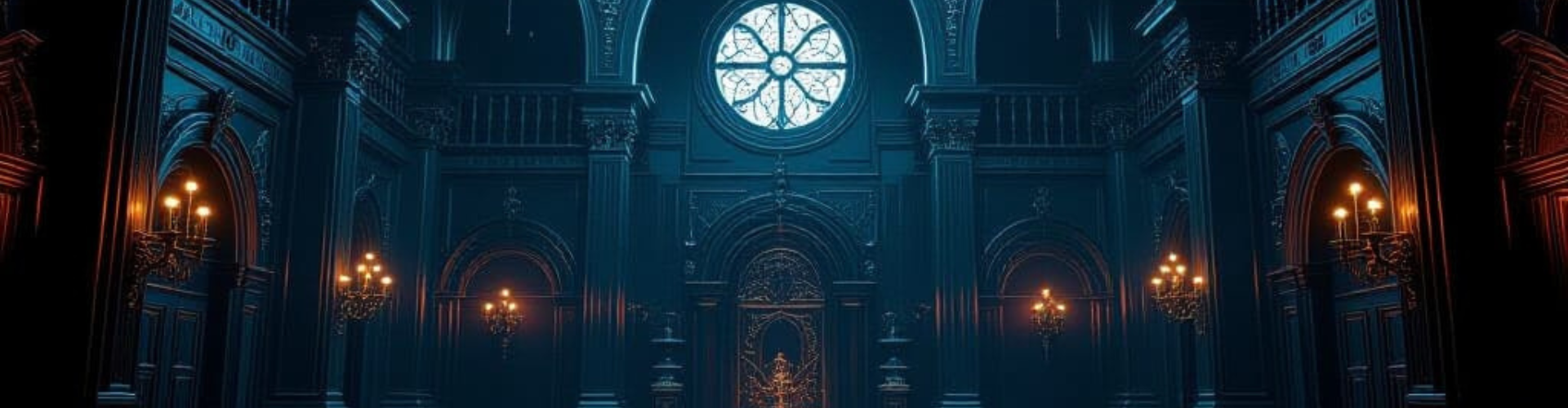
Hall of Grief
Environmental Effects
The chamber is unnaturally cool and dry, resisting mold despite deep burial.
A faint, rhythmic echo resonates from the carvings when silence is maintained, almost like breathing.
Some claim the walls “drink sound”—spoken words fall flat, as if absorbed.
Connected Rooms
Collapsed hallway to the east (believed to lead to ritual antechambers).
South passage to the Moonmore archives.
Narrow stairwell rising to a collapsed tower.
Purpose / Function
Original purpose: It was a mourning hall for the Kiwta before and during The Triad Wars. When the species joined forces in the later part of the War it became a multi-species mourning hall, where all could grieve the dead of the Triad Wars without distinction.
Later: A sacred vault of memory, where names were recited in the silence of carved faces. The loss of life from the Triad Wars is never forgotten.
Now: A ruin, studied by archaeologists.
Design
Shape: Circular chamber, 40 m across, domed ceiling.
Materials: Black volcanic stone lined with pale quartz veins that shimmer under torchlight.
Walls: Covered in reliefs of hundreds of humanoid figures—faceless, with hands clasped or lifted in grief.
Entries
One grand entryway with fractured stone doors carved in mirrored spirals.
No windows; artificial light required.
A secondary sealed shaft suggests ritual-only access.
Sensory & Appearance
Sight: Endless rows of faceless figures, some eroded to near smoothness.
Sound: Dampened acoustics; silence seems heavy, pressing against the chest.
Smell: Dry stone, faint metallic tang (quartz veins bleed iron).
Feel: Temperature drops abruptly upon entry.
Denizens
Currently uninhabited. It was once freely visited by the Ta-, Pecou, and Kiwta. Though, formal ceremonies only happen once a decade during the Week of Ashes.
Contents & Furnishings
Carved benches set into the walls.
Central basin, dry and cracked—once filled with either water, oil, or ash.
Fragments of ritual torches and shattered ceramic offerings.
Valuables
Archaeologists uncovered bronze amulets and fragments of inscriptions in mixed Ta, Pecou, and Kiwta scripts. They think the sealed passage leads to a sealed reliquary hidden beneath the central basin.
Hazards & Traps
Collapsing stone: unstable ceiling sections.
Thin quartz dust: if disturbed, it causes coughing fits and disorientation.
Psychological hazard: prolonged silence in the chamber causes sensory unease; some report auditory hallucinations.
Special Properties
Sound-absorbing walls (debated: advanced acoustic design or magical resonance).
Alterations
Secondary carvings suggest later visitors etched names or sigils over the faceless figures.
Some faces have been deliberately defaced (ironically deepening their facelessness).
A collapsed entry suggests intentional sealing after its abandonment.
Archaeologists believe the etched names, sigils and the defacement was done in fear, not deliberate desecrations. They think this happened to remember those lost to the Shadow Star Bloom in between The Week of Ashes observances.
Architecture
Style is Kiwta with the early names written in Kìwten. More recent names are in Taalli, Pecouian, and Našvan, with a few architectural additives in Ta and Pecou symbolic geometry.
Roof dome aligns with a celestial markers.
Mourners’ carvings are deliberately faceless, representing grief without identity.
History
Built before the Triad Wars, the Kiwta honored their dead here which eventually led to the Week of Ashes. The Triad Wars saw names on the walls increase significantly. When the species began working together late in the war, it became a neutral mourning star.
During the height of the Shadow Star Bloom’s attack (before it wiped out all) many names were scratched on the walls in haste. After the three species, it became a ruin. It has been rediscovered by human archaeologists during the first Moonmore excavations.
Table of Contents
The Last Gathering
The Silent Choir


Comments