
Planetary Sphere
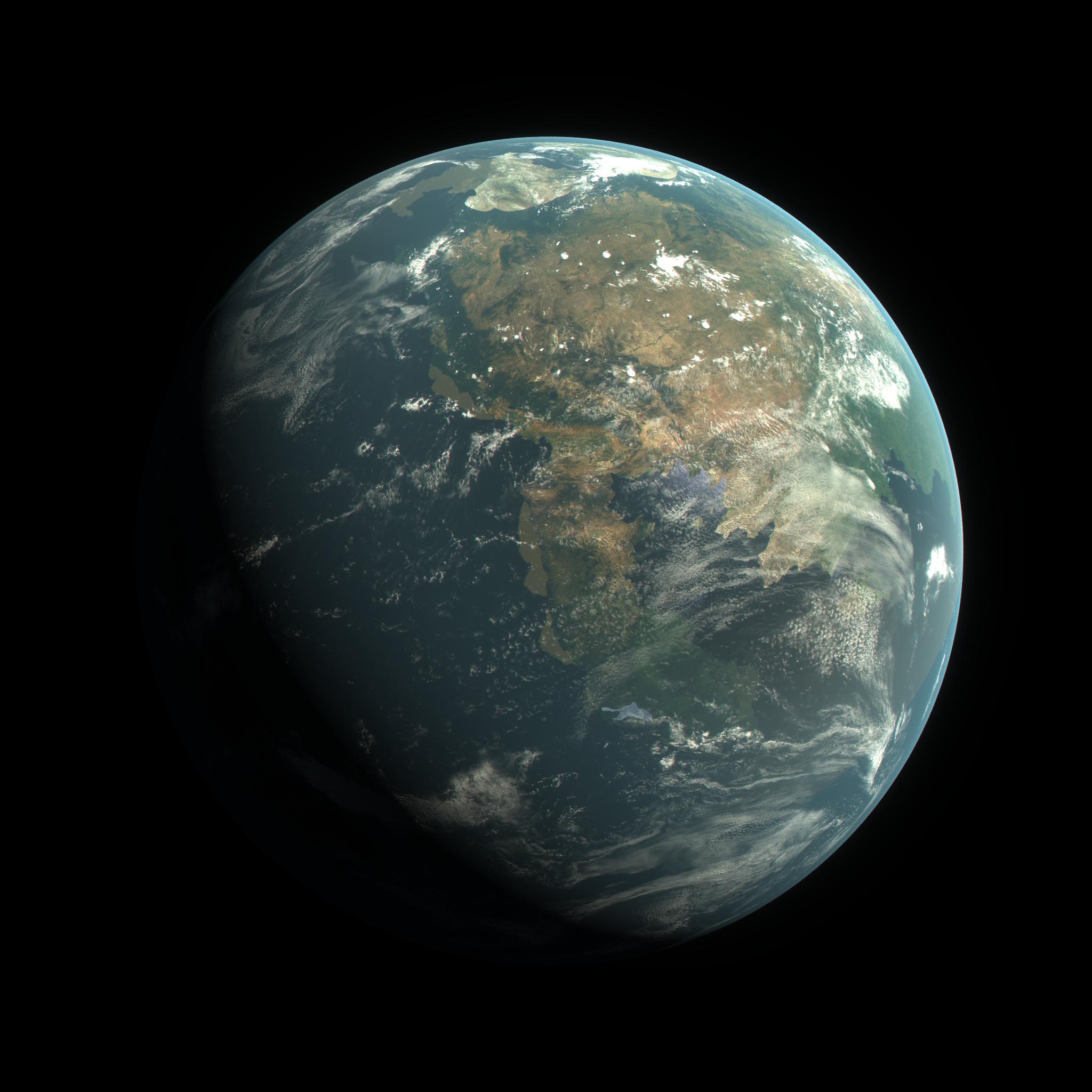
A Planetary Sphere is a large, rounded astronomical body that orbits around a solar star, stellar remnant, or solar dwarf, while not one itself. They are often known as Spheres among academic circles, "planets" to amatuer cosmic scholars, or simply "worlds" to the general public. Within the field of cosmologeia, there are several types of planetary spheres, each with their own unique features.
Manifestation
Barren Spheres
The first and most common type of planetary sphere is known as a Barren Spheres. This classification is given to spheres that lack any semblance of a life-sustaining biome. It is believed by academics that few of these spheres ever possessed the ability to support life. Others were clearly Oasis or Garden Spheres which, due to some unknown cataclysm, were rendered lifeless. Some cosmologists have even argued that this dead worlds can be terra-formed with powerful primal mageia to reignite their ability to support a thriving biome. The discovery of dormant Tarrasques found near the core of several lifeless Barren Spheres have lent credence to this theory, as it presents compelling evidence that all spheres were originally shaped with the possibility of supporting life.
Embryonic Spheres
These barren spheres are much smaller to other spheres throughout the Cosmos, while still being too large to be classified as an asteroid or moon. It is believed by many scholars that these diminutive worlds lacked to the necessary amount of materia when forming to achieve life-sustaining proportions.
Chthonic Spheres
Similar to Embryonic Spheres, but existing at the other end of the cosmic spectrum are Chthonic Spheres. These worlds were once Gaseous Oases or Gaseous Gardens that, through some unknown means, lost their atmosphere. Now these diminutive spheres of super condensed materia slowly drift through the Cosmos, a mere shadow of their former glory.
Oasis Spheres
The most common life-sustaining worlds are known as Oasis Spheres, as they are beautiful pockets of life in an otherwise vast desert of nothing. The majority of creatures found throughout the Cosmos are indigenous to Oasis Spheres. These beings shaped by the natural forces of primal mageia in concordance with their environments. The many flora and fauna of Earth, excluding Humans, are an excellent example of such creatures.
Oasis spheres possess very little ambient mageia, with the vast majority of it being stored in their cores. As a result, many scholars refer to those worlds as "Dead Magic Planets". This, however, is a gross over-simplification. Oasis spheres do possess an abundance of mageia, yet almost every particle is consumed by the native life. These worlds are, in fact, the ideal model of a planetary sphere. While they are mundane, they are also far more stable in a cosmic sense.
Due to their dependency on mageia, monstrosities rarely, if ever, appear naturally on Oasis Spheres. The only exceptions to this cosmic consensus seem the many individual Tarrasques which slumber near the core of each sphere in the Cosmos.
Gaseous Oases
Enormous spheres composed of thick atmospheres of gases blanketing dense cores of super-condensed materia, these strange worlds are home to life capable of perpetual flight and built to resist the overwhelming gravity from their mass. Complex ecosystems do develop on these "gas giants" but they rarely produce advanced sapient species capable of extra-planetary exploration.
Glacial Oases
Similar to their gaseous siblings, Glacial Oases are massive planets of ice and water with small cores of frozen materia. Compared to the "gas giants", these icy worlds are home to a much wider array of life, both aquatic and terrestrial. With a greater abundance of resources and a more stable biome, aquatic life on these worlds can, and often do, develop sapiences and intricate social structures. As all life throughout the cosmos begins with water, these frigid planets are often home to the oldest civilizations in all of Existence. The surface of these spheres, however prove too harsh to support anything more than rudimentary plant life and simple animal species.
Primal Oases
Of the infinite spheres within the vast Cosmos capable of sustaining mortal life, the staggering majority are uninfluenced by external forces. They are known as Primal Oasis Spheres. While Aemaphia is not one of these Primal Oases, Cosmic Scholars have observed many similarities worlds and noted commonalities in lifeforms. The overwhelming majority of lifeforms in these Primal Oases spheres are simple flora and fauna. Often, the first sentient lifeforms to develop are intelligent Plants such as Treants and Myconids. These lifeforms become wardens of their sphere, developing a complex understanding of Primal Mageia. In rare situations, rather than cooperate, the Treants and Myconids will compete for resources to the point of extinction. In such tragic circumstances, another species will likely rise to apex status and reach magical understanding. However, without external influence, these desperate isolated species are very unlikely to succeed. Thus these spheres will unfortunately end up as Barren Spheres.
Time on Oasis Spheres
The rotation and rate of revolutions for Oasis Spheres are unique to each individual world. Some are similar to a Concordant Year, while others are vastly different. The closer a planetary sphere is to its solar star, the shorter it's rotation. Earth, for example is the third world from its solar star which gives it an average rotation of one-fourth of a Concordant Year, while Mars has a rotation of one-half of a Concordant Year. Both worlds, while each being capable of supporting life, are considered too small in mass to be considered "concordant"
Garden Spheres
Unlike the countless Oasis Spheres within the Cosmos, such as Earth, which are formed by the slow natural forces of existence alone, Garden Spheres such as Aemaphia were sculpted according to the enigmatic designs of the ancient Proto-Dragons and their interpretation of ineffable will of Concordance. Consequently, Garden Spheres feature a number of unique and catered qualities that help these worlds thrive.
Water Gardens
Of the numerous Garden Spheres within the Cosmos, the most common are known as Water Gardens. This is due to the fact that the surface of these worlds are almost always 60 to 80 percent covered in life-giving water. On average, Water Gardens are larger than most Primal Oases and further from their solar star. Each Garden Sphere possesses an axial tilt of 32°, considerably more extreme than Earth's 23°. This tilt generates a wider variety in weather phenomena and seasonal extremes. Furthermore, Water Gardens possess unique features such as twin ice veils known as Polar Diadems that protect the planet from cosmic dangers such a solar radiation or meteroids. Water Spheres also benefit from a dense Cirrostratus layer in its uppermost atmosphere which better regulates heat and enriches the air. For Garden Spheres like Aemaphia, where clear and drastic magical tampering has occurred, the native flora and fauna will likewise exhibit additional magical properties to better adapt to this discordant external influences. This explains the existence of monsters, megaflora, and megafauna throughout Aemaphia.
Gaseous Gardens
Similar is design to the "gas giants" of the oasis classification, these enormous worlds are set further from their solar star and have been altered to better allow for complex life to flourish despite their unique structures. Much more rare than their Water Garden siblings, Gaseous Gardens are little explored. What mysteries await their intrepid explores who dare their hazy borders?
Time on Garden Spheres
One day for any Garden Sphere is measured as a single revolution of the planet on its gravitational axis as it continues its endless solar rotation. Each of these planetary revolutions takes exactly thirty-two hours. Another unique element of Aemaphia, as well as all other Garden Spheres, is the measurement of miniscule time, such as seconds, minutes, or hours. Under Concordant Temporal Measurements, one hour is measured at eighty minutes and one minute is measured at eighty seconds. When calculated against our own solar rotation, this means a single Aemaphian solar rotation is the equivalent of roughly 24,576 earthly hours, or nearly two years, nine months, three weeks and three days. This precise Draconic reordering is how Cosmic Scholars can easily differentiate an Oasis Sphere from the Garden Sphere even via telescopic observation. All Garden Spheres have the same solar rotation.
As so little is knonw about Gaseous Gardens, scholars can only speculate about their rotations. It is hypothesized that given their theortetical size, these worlds would have rotations of twelve concordant years, if not countless decades more.

Comments