
Zen and the Art of Spelljammer Maintenance
Spelljamming is the primary means by which you will traverse our grand corner of the Astral Sea. It is an ancient tradition whose origins have been long lost to time, but that doesn't mean that all of its tricks have been taught. The term "spelljamming" itself refers to the helming of spelljammer, or a ship that has been equipped with a Spelljamming Helm.
"Oh no, not again."
The Astral Sea
The Astral Plane is the realm of thought and dream, where astral visitors travel as disembodied souls to reach the Outer Planes. It is a great silvery sea, the same above and below, with swirling wisps of white and gray streaking among motes of light like distant stars. Most of the Astral Sea is a vast, empty expanse, with wildspace systems scattered hundreds-of-trillions of miles apart. Visitors occasionally stumble upon the petrified corpse of a dead god or other chunks of rock drifting forever in the silvery void. Much more commonplace are color pools — magical pools of colored light that flicker like radiant, spinning coins — or storms of dangerous, displacing psychic wind.
Creatures that have physically entered the Astral Plane don’t age, breathe, or suffer from hunger or thirst. For this reason, humanoids that live on the Astral Plane (such as the githyanki) establish outposts on other planes, often the Material Plane, so their children can grow to maturity before joining their people the ageless expanse.
The volatility and mutable nature of the Astral Plane makes most forms of teleportation and magical travel between two "places" in the Astral Sea difficult. However, a free floating traveler in the Astral Plane can move about by simply thinking about moving, though distance has little meaning as, metaphysically speaking, being "here" in the Astral Sea is only different from being "there" in the Astral Sea because you think it is. One need only to think of a destination and intuit the path to find it; even an abstract idea of a destination, such as "the nearest available restroom" or "second nearest githyanki outpost", is enough to divine the direction. In combat, for the sake of mechanics, a creature’s floating speed (in feet) is equal to 3 × its highest Spellcasting score (Intelligence, Wisdom, or Charisma). The smarter, wiser, or more commanding a creature is, the more easily it can control its movement by act of will.
Planar travelers and refugees from other planes wander the expanses of the Astral Plane. The most prominent denizens of the Astral Plane are the githyanki, an outcast race of reavers that sail sleek astral ships, slaughter astral travelers, and raid planes touched by the Astral. Their capitol city, Tu’narath, floats through the Astral Plane on a chunk of rock that is actually the body of a dead god.
Celestials, fiends, and mortal explorers often scour the Astral Plane for color pools leading to desired destinations. Characters who linger for too long in the silver sea might have an encounter with one or more wandering angels, demons, devils, night hags, yugoloths, or other planar travelers.
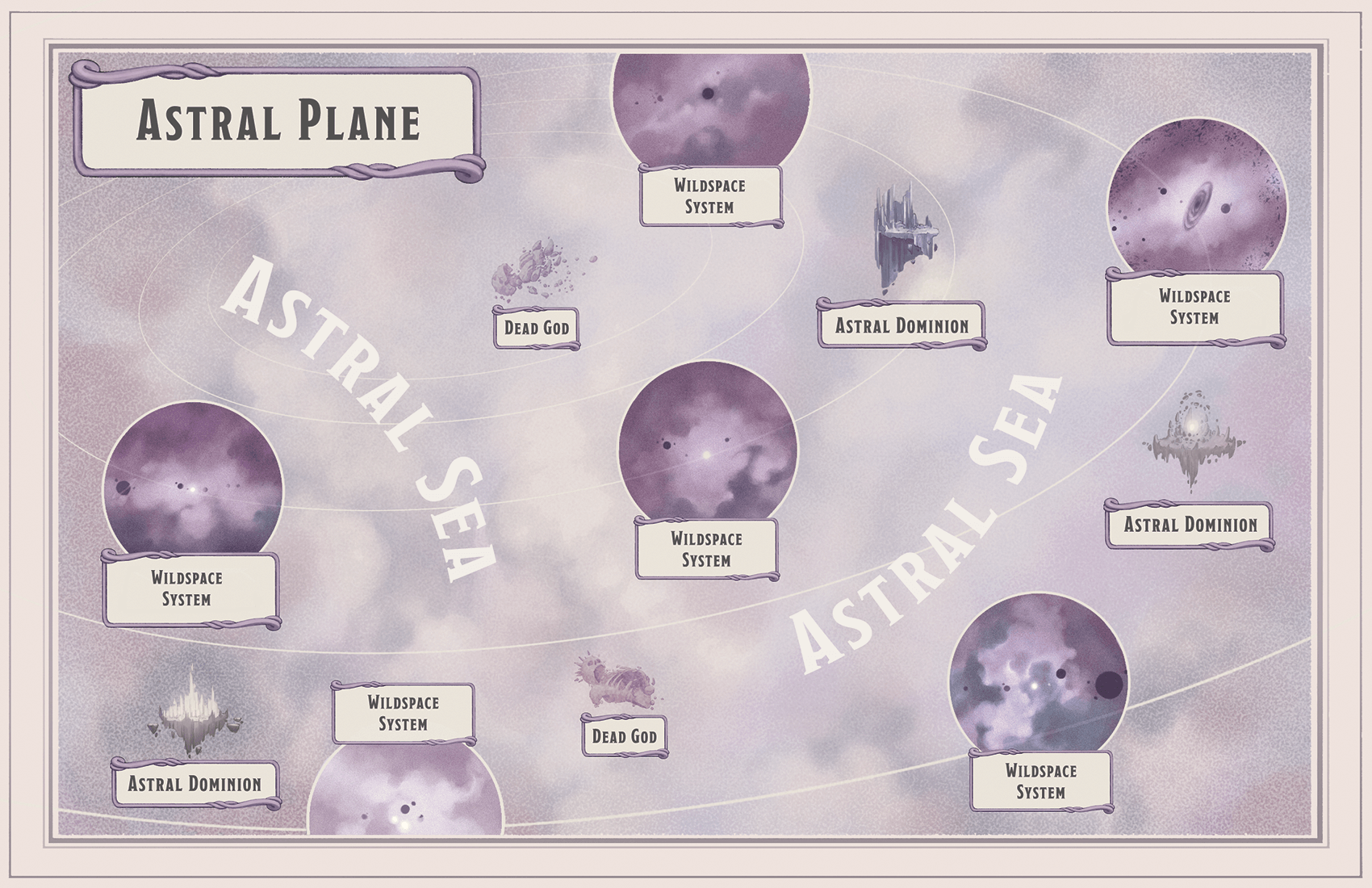
A creature or ship that wants to travel from one wildspace system to another must cross the Astral Sea unless it has some other magical means of traveling from one world in the multiverse to another.
Wildspace systems aren’t fixed in certain locations in the multiverse. Because they’re constantly in motion, like corks bobbing in water, no reliable devices exist to help plot a course from one wildspace system to another. Fortunately for travelers, the nature of the Astral Sea makes such journeys relatively easy.
The Astral Sea does not have gravity or air. However, in the Astral Sea a creature can survive indefinitely, never aging or breathing and never feeling hunger or thirst.
Wildspace Systems
Wildspace is where the Astral Plane overlaps with that system's Material Plane. Creatures and objects in wildspace age normally and exist on both planes simultaneously. This overlap enables creatures to use spells such as teleport and teleportation circle to travel from wildspace to a nearby world, or vice versa, and from world to world.
Many wildspace systems have names; for example, Realmspace is a wildspace system that contains, among other things, the planet Toril—home of the Forgotten Realms and the Sword Coast.
Though the distances between objects within a wildspace are small compared to the space between wildspaces themselves, world-to-world travel requires a spelljamming ship, a teleport spell, or some other kind of magic because of the still extreme distances within a wildspace system. Generally speaking, the distance from the center of a wildspace to its most distant object is the same as the distance from that same most-distant-object to the edge of the wildspace "bubble". Within the system, the distance between nearby planets can range from hundreds of millions of miles to dozens of thousands of millions of miles.
Spelljamming Ships
As the ships themselves are not usually otherwise magical, there is no shortage of variants on the archetypes listed in the sidebar, but procuring a Spelljamming Helm and installing it can be an expensive endeavor. Generally, Ship Statistics are as follows:
Armor Class. This represents how difficult your ship is to damage, whether by the ship being more or less difficult to hit or its hull being especially durable to attacks.
Damage Threshold. This is the minimum amount of damage any single attack must deal before the damage can affect the ship's Hit Points. If an attack does not meet this threshold, then the attack will not deal any direct damage, but if it does meet this threshold, then the full damage of the attack can be applied.
Hit Points. This represents the overall health of your ship as a whole. Should your ship's Hit Point total ever reach 0, your ship will be destroyed.
Base Speed. This is your ship's combat and in-atmosphere speed, given both in feet per 6 seconds and in miles per hour.
Cargo Rating. This represents your ship's overall weight capacity: crew, passengers, and cargo. Though your ship can very likely carry a weight beyond its base rating, any additional weight after the capacity will inversely affect your ship's speed and incur limitation and penalties to your maneuvering capabilities.
Crew Rating. This represents your ship's capacity for accommodating living, breathing creatures. Though while in the Astral Sea no creature needs to eat, drink, or sleep to survive, they do need to breathe and a lighter population will go through their supply of air more slowly than a population beyond a ship's standard crew rating.
Dimensions. The longest dimensions of your ship will be given here, usually as measurements of the ship's keel (the length along the keel of the ship), beam (the width across the keel of the ship), and height (the height from the bottom of the ship to the tallest point).
Base Cost. Prices will always vary, from port to port and from buyer to seller, but this value is what you can usually expect a reputable merchant to bargain for.
Traveling on a Spelljammer
For the sake of mechanical simplicity, we will describe how your ship can move through space with the following conditions:
Landed. Not all spelljamming ships can land on a surface, but those that can gain this condition when they securely touch down and come to rest. Additionally, a crashed ship is considered "landed". Your ship's speed is 0 and attacks made against your ship are made at advantage.
Docked. All spelljamming ships have a means of docking. Your ship's speed is 0 and attacks made against your ship are made at advantage.
Afloat (On Water). Not all spelljamming ships can float on water. Your ship has it's Base Speed multiplied by a factor of 2 atop the water, or if your ship has sails, by a factor proportional to the wind speed. This would allow for your ship to traverse an ocean over the course of almost 2 weeks.
Aloft (In Atmosphere). While within atmosphere, your ship has it's Base Speed multiplied by a factor of 4 through the air. This will allow for your ship to break straight through the planet's 10-mile thick breathable atmosphere and enter wildspace in less than half an hour.
Engaged. When in wildspace or the astral sea, while within 1 mile of any object weighing at least 1 ton, your spelljamming ship's speed cannot benefit from the In Space or Adrift conditions. When in combat, while within 1000 feet of a hostile spelljamming ship, your spelljamming ship's speed cannot benefit from the Afloat or Aloft conditions.
In Space (In Wildspace). While in a system's wildspace, your spelljamming ship has it's Base Speed multiplied by a factor of 500,000. This will allow your ship to cover 1 Astronomical Unit (the average distance between the Sun and Earth) over the course of about 2 days, meaning that your ship could travel from the Sun to the edge of the real Solar System over the course of 8 months.
Adrift (In the Astral Sea). While out in the Astral Sea, your spelljamming ship has it's Base Speed multiplied by a factor of 250,000,000,000. This means that your ship could travel the Astral equivalent of a Lightyear over about 5 hours and the Astral equivalent of a Parsec within 18 hours. A journey from Earth to Proxima Centari would take a day, going from Earth to the Galactic Center would take almost 9 years, from the Milkyway Galaxy to Andromeda would take almost 2000 years.
Life aboard a Spelljammer
Many ventures out into the Astral Sea are exceptionally lengthy, between traveling through the silver sea itself and the often even longer stints through a system's wildspace, living aboard a spelljammer comes with its own challenges and unique experiences.
Chartering your Spelljammer
At the end of the day, out in the great silvery unknown, your spelljamming ship is your nation, and every nation needs its founding documents -- that is your ship's Charter. A charter is an agreement between the owner of the vessel, any passengers, patrons, financiers, and it's crew (sometimes even the ship itself). This agreement outlines Officer responsibilities and crew assignments, as well as compensation; even pirates and raiders build and sign charters for their ships. Charters also usually create budgets for contracting crewmen beyond those that originally signed the charter. Crewmen are usually contracted with daily rates of about 1 GP per day, with especially experienced crewmen charging higher rates. Mages, while not entirely rare, are highly desired and usually charge around 12 GP per day with the expectation that they may take on Mending, Healing, Air Bubble, or spelljamming duties. Hazard pay rates and additional compensation for unexpected extensions to a venture are also outlined in a charter. Contracted Officers usually charge at least 75 GP per day, though it is uncommon for experienced Officers not to be a commissioned part of the ship's charter to begin with. Commissioned Officers usually forgo a daily rate in exchange for a share of the venture's profit, essentially better investing themselves in the ship's success. In fact, it is not unheard of for contracted crewmen on mercantile ships to negotiate for fractional shares; pirates and raiders tend to offer shares as compensation in leau of daily rates altogether.
Crew & Officers
Maintaining order and a clear command structure is important to the success of any venture, whether it be as dangerous as a military operation or as mundane as a passenger transport. To simplify and organize ship hierarchies, we will say that most spelljamming charters utilize the following terms.
Passengers
For these purposes, the term "passenger" includes any and all creatures on the ship that don't fall into the other categories. Primarily passengers are considered passengers, but the term also covers any prisoners, stowaways, and quarries. Seasoned smugglers often refer to their stowaway passengers as "breathing cargo." Since resources on a ship are limited (food, water, and air), and passengers consume resources and contribute to the degradation of the ship's atmosphere, passengers are considered exceptionally expensive cargo.
Crewmen
The term "crewmen" refers to any creature in the employ or service of the ship. Non-Player Character crewmen can be Sidekicks made from CR 1/2 creatures, as per Tasha's Cauldron of Everything, or monsters of CR at most half of the Party Level.
Officers
The "officers" aboard a ship are usually elevated crewmen on merchant vessels or commissioned officers on military ships. Senior Officers coordinate duties for the whole ship, while Petty Officers usually man Deck Department responsibilities.
Chief Officer. The "Chief Officer" or "First Officer" (often called "First Mate") is the most senior officer on the ship, second to the Captain. The Chief is usually responsible for daily operations and managing the ship's cargo.
Navigation Officer. The Navigation Officer, or "Second Officer", is junior only to the First. The Navigation Officer is usually responsible for Navigation, plotting wildspace routes, etc. Since Navigation in the Astral Sea is so inseparably connected to the spelljammer, it is extremely rare for the Navigator to not be the ship's primary spelljammer. In a similar fashion, because it is even less common for a First Officer or Captain to be a mage without the Navigator also being a mage, the Second Officer often assumes the responsibility as head of the Mage Deck Department as the Mage Officer (provided that the crew isn't large enough to warrant a more junior officer taking the position).
Security Officer. The Security Officer, or "Third Officer", is the third most senior officer beneath the Captain. The Security Officer is usually responsible for the safety and security of the ship, her crew, and the general maintenance or repair of the ship. Depending on the constituency of the ship's crew and their abilities, either the Security Officer or the Navigator can take the position of the Head Surgeon or head of the Medical Deck Department.
Crew Officer. The Crew Officer, or "First Rating", is the fourth most senior position beneath the Captain. Often called the "Boatswain", this officer works most closely with the general crew, handling and organizing duty and watch assignments, and coordinating maintenance. The Crew Officer usually assumes the mantle of head of the Steward Deck Department. On smaller ships, the Boatswain more directly assumes the role of head of the Engineering (Carpentry, Masonry, or Metallurgical, depending on the composition of the ship's hull; Wood, Stone, and Metal respectively) Deck Department.
Deck Departments
For the sake of role-play and canon, most regular ship duties are organized under particular Deck Departments with most ships hosting at least Navigation, Security, and Stewarding Deck Departments. On larger ships, smaller or more specific departments such as Mage, Medical, and Engineering are headed by petty officers, while smaller ships have their senior officers assume the duties of these Deck Department Heads.
Mechanically, the Deck Department assignment for each of your crewmen will be based on whichever assignment most conveniently corresponds with how they contribute to the ship's Crew Statistics and whatever task your are trying to complete.
Commanders
While technically still "officers" under the charters of most ships, Captains, Commanders, and Admirals represent the highest level of command aboard any given ship, mercantile or military. These titles are especially confusing when you consider that all three are also military ranks, meaning that the captain of a ship might not necessarily hold the rank of captain, and in some terrible circumstances, a commissioned officer of the rank of captain might be acting in the capacity of and referred to as an Admiral.
Captain. Regardless of rank or any other standing, the individual in command of a ship is referred to as Captain. The Captain of a ship is it's highest and most senior officer, usually with the most experience, and acts as the director, executor, and adjudicator of the ship's charter and the representative of the ship's owner. Usually, a Captain's orders and directives can only be contradicted by a unanimous dissent by their officers.
Commander. For very large ships with large compliments, or for small groups of smaller ships, a Commander acts as the superior executor, potentially coordinating multiple captains and dozens of officers. Private Commanders usually oversee convoys of cargo ships, while military Commanders command squadrons of warships.
Admiral. Whether private or military, admirals oversee large, organized fleets: pirate fleets, privateers, mercenaries, trade networks, etc.
"I should go. I should go. I should go."
Ship Statistics & Crew Checks
An average spelljamming ship's journey across the Astral Sea and through a wildspace system can take weeks, or even months. Naturally, this means a lot of down time for a Ship's crew, though down time does not mean idle hands. Regardless of whether your crewmen are NPC Sidekicks or higher CR Monsters, each crewman should be "assigned" to a Deck Department that most closely aligns with their role. Depending on their assignment and their highest statistic, your crewman will contribute to a series of weekly Crew Checks to improve conditions aboard the ship. There are 6 Ship Statistics:
Combat Readiness. This represents how prepared or practiced your crew is for combat. Higher levels of Combat Readiness give a bonus on your crew's rolls to hit and their damage.
Operations & Management. This represents the logistical wellness of your ship and its resources. Higher levels of this Statistic improve how efficient your crewmen are when using resources or preparing Rations.
Navigation & Spelljamming. This represents how synchronized your spelljammers are both with each other and with the ship itself. Higher levels of this Statistic grant a bonus to your ship's Base Speed.
Safety & Security. This represents the health and security of your crew and the ship as a whole. Higher levels of this Statistic provide a bonus to your crew's personal Skill Checks.
Ship Maintenance. This represents the care given to the Ship itself and its accoutrements. Higher levels of Ship Maintenance directly correlate to how many Hit Points your hull and weapons can regain each week.
Crew Morale. This represents your crew's general attitude and perception of the ship as a whole. Higher levels of Crew Morale improve your crewmen's Saving Throws.
To represent your Officers' selection of priorities, the DC for each Crew Check depends on the order their taken: the first check will have a easy DC of 5, the second will have a modest DC of 10, and so on so that the final Crew Check of the week will have an impossible DC of 30. Successes improve each respective statistic and failures damage them, resulting bonuses as high as +5 and penalties as low as -5.
Crew Assignments & NPC Classes
Each of your crewmen contribute to a Crew Check by providing a bonus to the Crew Check roll depending on their Assignment (or Class) and their highest statistic. Spelljamming is considered a different duty station simply by the merit of where a normal mage's duties might require them to cast spells on a regular basis (such as healing spells, mending, or fabricate) a spelljamming mage must direct all of their focus, concentration, and attention to helming the ship for hours and hours on end. Taking a break forces the ship to stop, so most mages who accept an assignment on the spelljamming helm expect significant compensation.
Generally speaking, depending on the crewman's statistics and your selection of their most appropriate NPC Sidekick Class (Warrior, Expert, or Spellcaster), your crewmen will contribute to your ship in the following fashion:
- Warriors with high Strength will support the Combat Readiness and Ship Maintenance Crew Statistics.
- Warriors with high Dexterity will support the Combat Readiness and Safety & Security Crew Statistics.
- Warriors with high Constitution will support the Combat Readiness and Crew Morale Crew Statistics.
- Experts with high Dexterity will support the Safety & Security and Ship Maintenance Crew Statistics.
- Experts with high Intelligence will support the Operations & Management and Navigation & Spelljamming Crew Statistics.
- Experts with high Charisma will support the Safety & Security and Crew Morale Crew Statistics.
- Spellcasters with high Intelligence will support the Navigation & Spelljamming and Ship Maintenance Crew Statistics.
- Spellcasters with high Wisdom will support the Operations & Management and Safety & Security Crew Statistics.
- Spellcasters with high Charisma will support the Ship Maintenance and Crew Morale Crew Statistics.
Spellcasters assigned to serve Spelljamming duty will be treated as a separate class as spelljammers are compensated differently and have starkly different responsibilities than other general spellcasters.
On the Astral Sea
Distances between systems in the Astral Sea are extremely vast, and the nature of the sea itself is fluid and ever-changing. While creatures in the Astral Sea do not experience aging, hunger, thirst, or the need to breathe, life out in the beyond is strange and full of down time while the ship's spelljammer follows their intuition to a destination that itself is floating off among the silver currents of thought. The distances between wildspaces can exceed billions of miles, and with most spelljamming Ships keeping cruising speeds of trillions of miles-per-day, expeditions to distant spaces can take weeks, months, and sometimes even years.
Using a Spelljamming Helm
When a magic-user (or mage) attunes to a Spelljamming Helm it is common for the spelljammer to experience a kind of "phantom-limb-syndrome" sensation as their senses are expanded to include the entirety of the connected ship. The spelljammer gains the ability to see and hear from any one location on their ship that they choose. Further, while on the astral sea the spelljammer can feel the general form, size, and velocity of every object up to a mile around -- particularly great spelljammers can even make out the finer details, after all, an asteroid feels different from a spelljamming ship. This sense is an important part of traveling through the Astral Sea as the spelljammer's subconscious feels upcoming objects and subtly adjusts the ship's course to avoid objects that could damage the hull. This sensation of all things within a mile around the ship can be briefly extended when the ship is in a wildspace. When in a wildspace, the spelljammer can take an action to focus and intuit the general motion and position of all bodies capable of generating their own radial gravity field within the system. This brief snapshot can give the spelljammer a vague idea of where's what and how to get there, but additional navigators can cut down travel times by using orbital mechanics and divination to calculate the most efficient trajectory for the ship to meet a particular body. This assistance is modeled as the result of the Navigation & Spelljamming Crew Statistic.
In the Astral Sea, a spelljammer need only to imagine their destination and understand which way to drive their ship. However, not all paths are straight lines and not all straight lines stay straight in the Astral Sea. An experienced spelljammer will maintain additional focus on their destination while they're moving and use how the path changes over time to help guide them through the silver space, avoiding obstacles and effectively cutting their travel time down over their greener counterparts.
Moving a spelljamming ship is matter of will for a spelljammer, mind over matter, however, there is one particular way that matter overrides mind: all movement must be parallel to the keel of the ship. Perfectly lateral movement left and right (Sway) and superior and inferior movements up and down (Heave) are mechanically disabled and only possible through the use of tugs to push your ship in those directions.
Spelljamming shifts are often long and thankless, but ending a shift is as easy as 1-2-3! An active spelljammer can willingly transfer attunement to their Spelljamming Helm by touching a willing creature and willing it to them. Alternatively, should an individual attempt to take control of a Spelljamming Helm away from an unwilling user, the two mages engage in a spelljammer duel: a contested Constitution check will decide who gains control of the chair and who gains a level of exhaustion.
In a Wildspace System
In stark contrast to the peace of the Astral Sea, life within a wildspace is extremely perilous. All creatures feels the effects of time once within a system's sphere: aging, hunger, thirst, and breath. There are millions of miles between a system's center and it's edge and while within a wildspace a common spelljammer can cover 100,000 miles-per-day. That said, a common spelljamming ship and her crew can usually expect to spend weeks traveling to a remote planet from the space's edge, and then days traveling between worlds. All this makes aimless treasure hunting almost entirely too expensive a venture to bother with, and simultaneously makes hiding out from authority in an uncharted space exceptionally potent.
Food and Water Rations
In the Astral Sea crewmen do not require food, water, sleep, or air to survive (though old habits die hard). However, in a wildspace all bets are off, and the odds long. The average wildspace system has a width of a couple to a dozen Astronomical Units, meaning that traveling from the edge of a system to its remote bodies could take days to weeks, let alone any journey to a systems more core bodies, and there are no rest stops along the way.
A standard daily food ration costs 1 GP and weight 2 lbs, though they are hardly desirable meals when eaten for dozens of days straight. Cheaper rations cost less, taste worse, but also weigh less, while more expensive rations may boost morale at the expense of greater cargo weight. Water on the other hand is very heavy by volume, and quite laborious to collect and process and bring aboard a spelljammer. A standard daily ration of water (or another equivalently hydrating solution) weighs 5 lbs and costs 1 GP. A Space Galleon has a Crew Rating of 20, meaning that it can comfortably accommodate a crew of 20 breathing souls. An expedition on a Space Galleon expecting to spend a month in a wildspace with a full crew compliment would need to procure 1200 lbs (0.6 tons) of food and 3000 lbs (1.5 tons) of water for a cost 1200 GP.
Employing a crewman possessed of the appropriate tool proficiencies can help to improve the conditions of your ship's sustenance.
Atmosphere
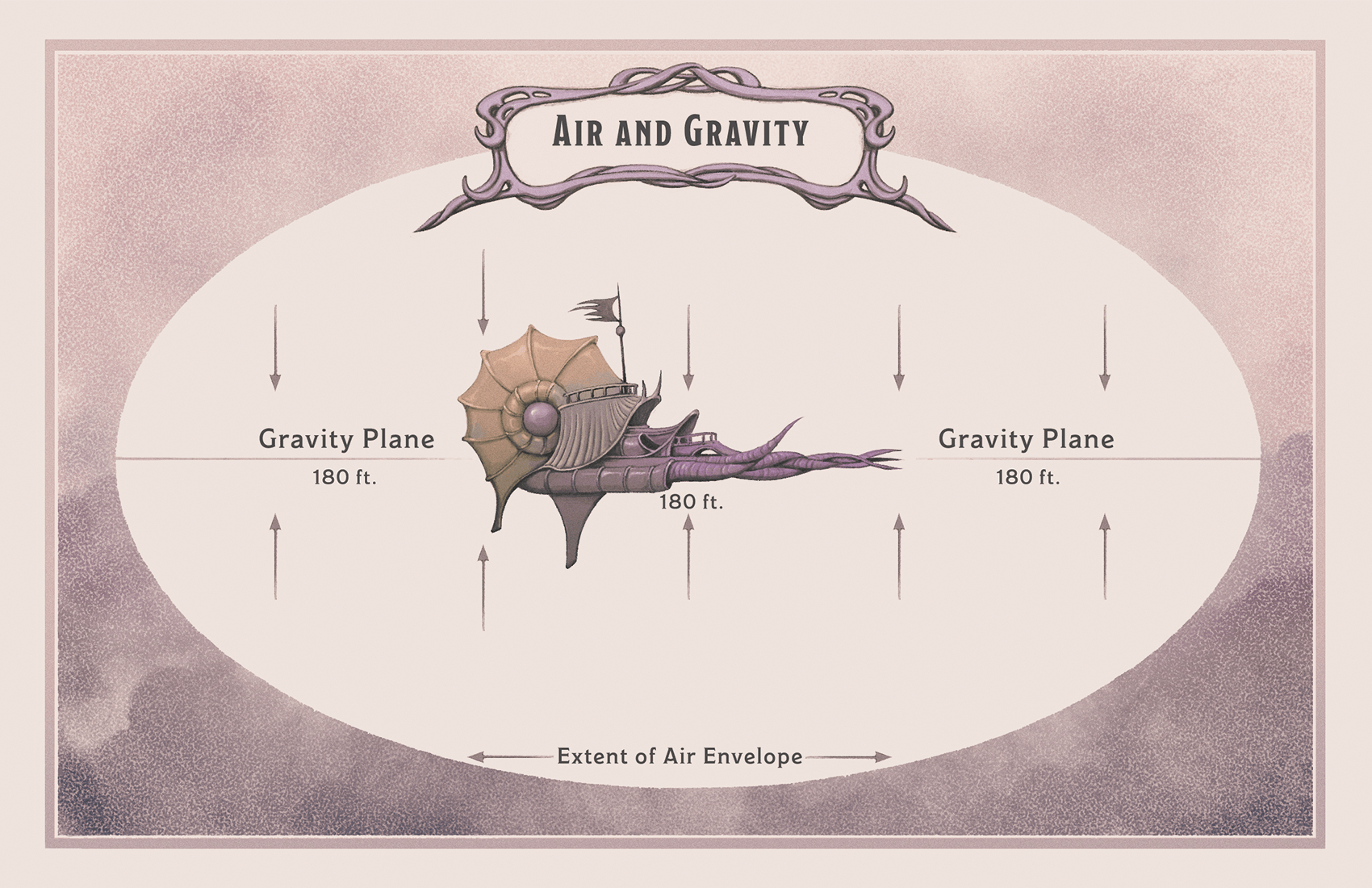
While in wildspace, all creatures and objects with weight retain an envelope of air around them depending on their size which lasts until it is depleted. This envelope roughly takes the shape of a ovoid bubble around the creature or object, with its boundary the same distance away from the surface of the creature or object as that creature or object is thick in that direction. Generally, a breathing creature will cycle through their personal envelope of air over the course of 1 minute. Since this is very little time to do anything of consequence, most creatures choosing to enter wildspace do so aboard a spelljammer.
The Air Envelope around a spelljammer is the limiting factor for the ship's Crew Rating. A ship with a full all-breathing crew will cycle through the ship's air envelope entirely over the course of 120 days. A ship with a crew numbering fewer than the ship's Crew Rating will deplete their air supply more slowly, while a ship with more crewmembers than their Crew Rating will deplete their breathable air more quickly; simply multiply the standard 120 days by the ratio of the ship's Crew Rating to the ship's total crew. Mechanically, this ship's air supply will transition between the following conditions:
Fresh Air. This is the highest quality of air and is completely breathable. Under nominal conditions, a ship's fresh air supply lasts for 40 days.
Stale Air. At the start of the 41st day of the crew breathing Fresh Air the air aboard the ship will become stale. A creature breathing stale air cannot remove any points of exhaustion. Under normal circumstances a ship's stale air supply lasts for 40 days.
Foul Air. At the start of the 81st day (or the 41st day of having Stale Air) the air aboard the ship will become foul. A creature breathing foul air still cannot remove any points of exhaustion and gains the poisoned condition. Under normal conditions a ship's foul air supply lasts for 40 days.
Toxic Air. At the start of the 121st day (or 41st day of having Foul Air), the air will become toxic to the crew. A creature that tries to breathe toxic air will begin to suffocate.
Overlapping Air Envelopes
When two bodies overlap their air envelopes, the envelopes merge and become the same quality as the air that was surrounding the body whose envelope had the greater volume. For example, a smaller ship with stale air overlapping envelopes with a larger ship that has foul air will have it's air supply depleted to foul upon the envelopes merging and once the two ships separate both ships will redevelop their own distinct envelopes, now with the same foul quality air. The only bodies whose air envelopes don't deplete are those of planets, who, without extensive intervention, constantly refresh their air supply to their characteristic quality -- these air envelopes are colloquially called "atmospheres".
Gravity Planes
The reason Air Envelopes follow their sources is because of gravity. Bodies weighing less than 1 ton only generate enough gravity to pull and maintain their air pockets. Bodies weighing greater than 1 ton begin to generate a Gravity Plane -- a plane through their center of gravity that is parallel to their two longest perpendicular cross-sections that extends to the edges of their Air Envelope. Uniquely this does mean that a body falling off the side of a spelljammer will fall through the Gravity Plane and oscillate down and other down until stopped. Bodies weighing at least 37,500,000,000,000,000 (37.5 thousand-million-million) tons become spherical and begin to generate radial gravity perpendicular to their surface. Bodies outside the envelope do not experience any recognizable effect of gravity, but bodies within the bubble will accelerate toward the surface, or "fall".
Gravity Levels
For the sake of gameplay, we will simplify most cases into the following possibilities:
Zero Gravity. Creatures without flying speeds on a surface that does not weight enough to generate a Gravity Plane, or while freely floating in zero gravity, all melee attacks (except for piercing damage attacks) are made at disadvantage. Additionally, creatures without flying speeds can only move by collecting themselves on a surface and then high jumping away from that surface. A creature moving in this manner cannot change direction or stop until they reach a new surface; in the meantime, each turn the creature moves in a straight line a distance equal to their high jump height. There is no fall damage.
Low Gravity. On a surface with low gravity, all terrain is considered difficult, but all jump heights and distances are doubled, creatures can fall twice as far before suffering fall damage, and fall damage is halved. Ranged weapon attacks have their ranges doubled.
Standard Gravity. This is standard gravity. Creatures engage with their movements and fall damage normally.
Heavy Gravity. All terrain on a surface with heavy gravity is considered difficult and creatures cannot jump or fly. Fall damage is doubled and creatures can only fall half the normal distance before they suffer it. Ranged weapon attacks have their ranges halved and melee attacks are made with disadvantage. Bludgeoning and slashing damage is doubled.
Extreme Gravity. Extreme gravity is deadly. While on a surface with extreme gravity, your speed is equal to your Strength Score and you cannot jump or fly. Fall damage is triggered at a quarter the distance and multiplied by 4. Every turn a creature spends on a surface with extreme gravity grants them a point of exhaustion.
Interacting Gravity Planes
The Gravity Planes of two bodies remain distinct until the two bodies come into direct contact with each other, such as during a collision, at which point the gravity plane of the heavier body dominates and overwrites the other. When spelljamming ships are concerned the "effective weight" is used to decide which gravity plane dominates: the weight of the ship multiplied by the percent of Hull HP the ship has remaining. For bodies that generate radial Gravity Fields, the more massive object's gravity dominates as soon as their Air Envelopes interact. When the two bodies separate their individual Gravity Planes will reestablish themselves. When a spelljammer lands on the surface of a planet or docks with a heavier station, precautions will need to be taken for any ventral decks beneath the ship's Gravity Plane and their cargo.
Spelljammer Combat
Combat involving a spelljammer ship is a delicate dance of deliberate group action and individual heroism, of both crew and officers. Ship mounted weapons often take multiple actions to load, aim, and fire, while personal weapons aren't necessarily useful at ship-weapon ranges. To keep combat from becoming overwhelming for both players and DMs, combat will be broken up into Initiative Phases: Group Initiative and Individual Initiative.
Initiative Phases
When combat begins all creatures involved will roll Initiative normally, but depending on the situation they will potentially act on another creature's initiative.
Ship Initiative. This is the default initiative for spelljammer combat as most often such a combat begins with opposing forces separated by large distances and unable to directly interact or engage. During this group initiative phase all allied creatures on the same ship act simultaneously on the spelljammer's initiative. A creature must be aboard a ship to join its initiative.
Deployment Initiative. When a spelljamming ship has closed the distance to their target and intends to board the opposing vessel or otherwise deploy from their home ship, deployed creatures enter this group initiative phase: all allied deployed creatures act on the same initiative as the group's designated leader, usually highest ranked officer or rating in their group. A common example of this phase in use is the following situation: two spelljamming ships are engaged in a close-ranged ship-to-ship combat, close enough that crewmen from one ship can board the enemy vessel. In this situation the Captain may deploy with one group of crewmen and engage the opposing crew on their deck while the First Mate might deploy with another group of crewmen and hunt for the opposing spelljammer. The crew deployed with the Captain will act on the Captain's initiative, while the crew deployed with the First Mate will act on the the First Mate's initiative. The crew of the opposing ship will act on the Captain's initiative while Officers will act on their own individual initiatives. A creature must be in a group and able to understand the group's leader to join its initiative.
Individual Initiative. This is the classic D&D initiative rule; when combat erupts into chaos or actions become particularly uncoordinated, this phase can be imposed on combatants by the DM.
As a free action, at the start of its turn, any creature can elect to change their initiative phase to any other. If a creature changes its initiative phase, it must wait until its next turn to change again.
"Initiative Stacking" can sometimes be necessary when engaging in mutinous activities, subterfuge, or other situations. If a creature joins a group and enters into Deployment Initiative with said group, and the group leader yields their initiative to another group's leader or a ship, then the original creature can engage in actions under the highest level of initiative as though they entered into that level of initiative, and can automatically leave that initiative when their lower-level group leader leaves the higher initiative. However, no two creatures can be in the same initiative group if they are knowingly hostile with one-another.
Spelljammer Collisions
A spelljammer can run their ship into another object or a creature by moving the ship into the target’s space. When a spelljamming ship crashes into something that weighs less than 1 ton, only the target takes the damage, but if the target could reasonably damage the ship or weighs more than 1 ton, both the ship and the creature or object it struck take bludgeoning damage based on the speed of the ship compared to the target.
The damage can be calculated as 1d10 for each 5 feet of movement the ship traveled in a straight line before colliding with the target and each 5 feet of movement the target traveled in a straight line toward the ship. Meaning that if two bodies collided after one ship traveled 100 feet toward the other over the last two of its turns and the other ship traveled 30 feet towards the first (while it also moved 15 feet laterally relative to the first ship) over its last turn, then the two ships would both suffer (20+6)d10 bludgeoning damage. If the ship runs into something that doesn’t have hit points (such as a planet or a moon), apply the damage only to the ship.
The ship stops after crashing into something that weighs significantly more than the ship or is otherwise an immovable creature or object; otherwise, the ship can continue moving if it has any movement left, and whatever it struck moves to the nearest unoccupied space that isn’t in the ship’s path. After resolving the effect of the crash, determine whether the ship’s gravity plane is suppressed. If the suppression of a ship’s gravity plane would cause the creatures on or inside that ship to fall, they fall in whatever direction is appropriate for the sudden change in gravity.
Mounted Weapons
Casting spells and firing off ranged attacks are not useless in spelljammer combat, however, the ship's mounted weapons are by far the most powerful. Most ships have a standard number of weapon mount sites (though modifications can be made for a sizable fee). For the longest time the weapons of spelljamming combat were simple ballistae and mangonels, as these weapons were relatively light and demanded only static footprints when compared to the traditional front-loading cannons of naval warfare. However, recent diplomatic developments between the Giff and Dohwar have provided greater access to smaller, lighter, and rear-loading cannons, called Breechloaders. Their ammunition being hunks of metal and require the storage and maintenance of barrels of volatile "blackpowder", these weapons have not exploded in popularity, though they have been found to be exceptionally destructive.
"That means Sir Isaac Newton is the deadliest son-of-a-bitch in space. Now! Serviceman Burnside! What is Newton's First Law?"
Crafting & Repair
As long as you have the materials, your crew will work over the week to repair any damage to your ship's hull or weapons per your Ship Maintenance statistic. In port, you can berth your ship in a drydock and pay for your ship's hull and weapons to be repaired, 10 gp per 1 HP each day (meaning that it would cost 20 gp to repair 2 HP ).
Employing Spellcasters who can Fabricate or Mend, or Experts with appropriate tool proficiencies will allow your crew to craft ammunition and other items. Crafting recipes are included on the item's page and are unaffected by the Operations & Maintenance Crew Statistic.
