Biology
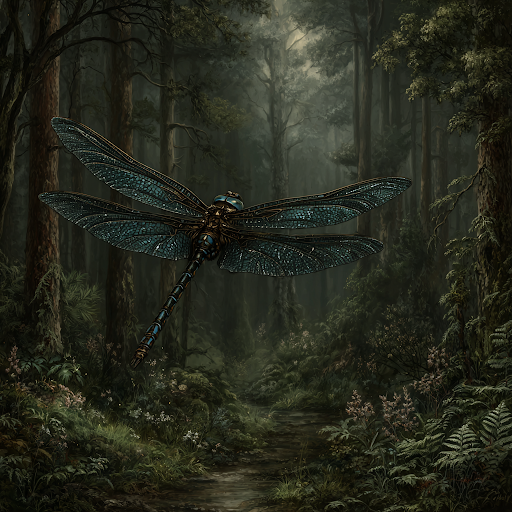
The willowfly is the size and weight of a larger dog. Just like their smaller dragonfly kin, they have six spindly legs for perching rather than walking. With two pairs of wings on a thin body, which allows them to both hover and fly backwards. It is a creature which is agile enough, that the most legendary among them have dodged bullets.
Right above their thorax, they have two massive orbs for eyes. These colourful globes allow them to see in three hundred degrees, and through various different saturations of vision. Making them impossible to sneak up upon, without magic.
Unlike dragonflies, this insectoid’s tail does not just look cruel. Within it, the creature carries a keratin based stinger which is filled with a numbing venom. While this poison is not potent enough to be lethal to a mortal, it can mess up one's balance and remove the feeling of physical sensation. This stinger can be fired out of the tail like a blowgun, and the effects of the poison lasts between four to six hours.
Fun fact: many apothecaries price these stringers as natural pain relievers. Especially for patients in need of lighter surgery.
Psychology
This insectoid is normally a docile and peaceful creature. It is not aggressive towards mortals, and while it is not recommended as they have the properties to be deadly, one could pet them if careful.
They are, however, solitary creatures, which do not like their own ilk. One may still find dozens of them patrolling rivers together, which is mainly due to a collective instinct of protecting their eggs.
Without eggs nearby, the willowflies often end up in dominance duels, between males and males and females against females. These duels are carried out like aerial shows. Where they fly towards each other and perform various complicated manoeuvers, to scare their rivals away.
Ecology
Willowflies are predators that hunt lesser insectoids, especially pests such as bloatflies and larger mosquitos. They can also take fish and feast on carcasses.
This makes the willowfly an important part of their ecological systems, as they rinse out creatures which may harm the abundance of local flora. Their role as opportunistic scavengers also makes them cleansers of possible diseases, as they devour and exterminate bacteria and viruses.
Even in death, they are purposeful to the soil. Unlike most creatures that slowly decay, the willowfly curls itself up with its death-throes and starts to produce an internal chemical which mummifies them. Turning them into a white and powdery cocoon, which renews the earth when the wind scatters their ashes.
Habitat
The Willowflies were first discovered within the Penumbra Woodlands -- a temperate northern region of the Golden Dunes, protected from the deserts by a vast mountain range. These kinds of temperate forests are perfect for the willowfly to thrive, but they have also been found in a plethora of wetlands. Both warmer and colder than the warm pinewoods, from which they are believed to originally hail from.



Comments