
Pent-up Emotions
Grief, a Foreign Word
Please note: This story is a continuous, multi-chapter narrative. You can find the correct order in the right sidebar. All texts were originally written in German and translated into English using AI. I asked the AI to preserve the original stylistic flair wherever possible.
I’m only now finding the time to record the events of the past few days—there’s been considerable unrest in the camp. When Bernard and I drove away from the site where we found the truck, he stopped about half a kilometer down the road and stared straight ahead. I feared more trees might be blocking the road and followed his gaze—but there was nothing. When I spoke to him, he answered without turning his head. He couldn’t understand how we could remain so calculating. In his view, we should have been shocked, driven mad with fear, acting irrationally. I turned his words over in my mind and replied with the most logical thing I could think of: humans want to survive, and only when there’s no way out does the mind allow us to escape into madness, shock, or irrational terror. As long as there’s even a glimmer of hope, the will to survive keeps us tethered and leads us forward.
After I said that, he did turn to look at me. His eyes held despair, and I wondered silently whether he had a family outside the forest—a wife, children? I hoped not. I didn’t know what to say when he looked at me like that, and I think I gave him a rather distorted smile—unconvincing, probably, because he turned his gaze back to the road.
I wanted to give him hope, because I realized I’m not as strong alone as I am with him beside me. Not that I’d ever admit that to him. He’s a figure of authority among the workers—they respect him, trust him. I can’t claim the same. If he faltered, everything would fall apart. I placed a hand on his shoulder to offer reassurance, but he stiffened. So I withdrew it. I’ve never been in a situation like this. Physical closeness didn’t seem appropriate—perhaps it would have been different if he were a woman—but even that is unfamiliar to me. I’ve always been alone, always relied on my own strength. I left my childhood home to escape the working class, studied, climbed the ranks of academia—I never had time for human relationships. Looking back, I must admit I’ve never had a companion, a best friend, if one can call it that. I’ve never needed one. Everyone else was always competition.
Bernard, however, is no scientist. He’s not competition. And I value him in a way I don’t fully understand. So we both stared into the void.
I don’t know how much time passed, but eventually his clenched fingers released the steering wheel, and he leaned back, head tilted slightly. I turned to him, unsure what would come next. He placed both hands on his face and slowly dragged them down over his cheeks to his chin, as if trying to wipe something away. I can’t explain it any other way. And then we made a plan. It sounds ridiculous, I know, but that’s exactly what happened. We had to coordinate—no one could say anything to the workers or assistants that might be misinterpreted. How do you tell fifty people that the forest has turned against them and may be actively killing?
Our plan was simple in the end: the next day, everyone—without exception—would march on foot to the new forest boundary. A few hardened workers would drive ahead with Bernard to recover the bodies and cut the truck down from the trees—assuming the forest allowed it. If the forest turned aggressive, retreat would be the top priority. The men handling the bodies would also be responsible for making sure no one ran off in panic or ignorance. Yes, we had to consider treating people like prisoners. I don’t like it, but if it becomes necessary, we’ll do it. Well, to be honest, that’s Bernard’s position, and I’ve adopted it. I don’t care if a few flee, but Bernard seems to have a soft heart—and more remarkably, he seems to know every worker by name. That makes it personal for him, and therefore complicated.
Once everyone has seen the situation for themselves, we’ll bring the bodies back to camp and bury them with ceremony. That was Bernard’s idea too. The look he gave me when I said a ceremony was too much effort made me feel awkward. I actually tried to excuse myself with something like, “I have no personal connection to the deceased; it’s different for their colleagues.”
I’m not sure he believed me, but objectively, it’s true—except for Matthei.
Once our plan was set, he started the engine and drove on. We agreed that he would speak, and I, as expedition leader, would simply lend his words authority. That suited me well, since I honestly have no idea how to speak to these people. Enthusing a hall full of scientists with new findings and research ideas is no problem—but this? I can’t imagine it. They probably wouldn’t even understand me.
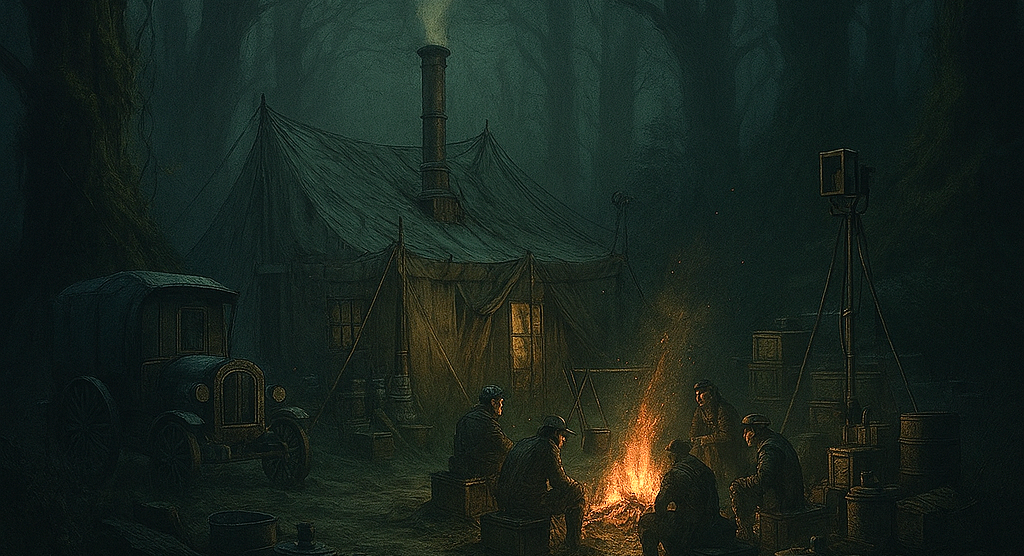
We arrived at camp, and everything seemed so normal. In the distance, I could hear the sounds of heavy labor. Some workers were hauling sawn tree trunks to the collection point for transport. From the kitchen drifted the smell of fried eggs. Bernard and I looked at each other, as if silently asking whether we were really about to shatter this peace. Then he stepped out with a serious expression and said we would gather after dinner to share the news.
The hours until evening dragged for me, and when the time finally came, I was jittery. I hadn’t been this nervous even during my final exams. Bernard came to fetch me, and we walked together to the center of camp. Everyone had already gathered, waiting for us. Bernard had torches placed around the square so it was well lit. Clearly, some already knew—guards stood around a small square platform we were to climb. It seemed unnecessary. The crowd murmured quietly, and even I could read uncertainty in their eyes and gestures.
Bernard didn’t waste time with an introduction, as I would have. He spoke in short, clipped sentences. The first reaction was laughter. But when he didn’t laugh, most fell silent. There were shouts—“This is a joke, right?” and “Why don’t we just cut our way back?” Bernard’s answers were as pragmatic as I’ve come to expect, and they deflated many of the questions.
But when someone asked what we were supposed to do now, things got tense. Bernard spoke of the researchers who had returned, and of my theory that the city might hold the key to our situation. What I hadn’t anticipated was that the blame would suddenly fall on me. Someone even threw a shoe at my head, and the crowd turned into a mob. Now I understood the guards—and was grateful for them.
While I held my head and tried to get back on my feet, Bernard and his guards somehow managed to calm the crowd. He announced that we would recover and bury the dead. That anyone who wished to stay in camp was free to do so, but anyone who wanted to join us on the journey to the city was welcome. He gave a nearly sentimental speech about unity, working hand in hand, and so on… I only caught fragments of it—the shoe had been reinforced with metal. In the end, the people calmed down and returned peacefully to their tents.
Bernard helped me up and examined the wound on my head. He took me to the kitchen, which surprised me, and handed me off to Abby. I had the feeling the two of them knew each other well—they spoke on a personal level that’s not typical. She calls him by his first name. And though she’s a bold, intrusive, and frankly rude woman, I must admit she’s a skilled nurse. She seems to have some medical training—she was able to treat and stitch the wound.
The entire camp set out the next morning after breakfast. Bernard drove ahead with his trusted men to the truck; the rest marched the two kilometers on foot. When we reached the new forest boundary, reactions were mixed. The impaled vehicle and the bodies had been brought down and no longer looked quite so surreal. Bernard had spoken only of an accident the night before, offering no details—which, as it turned out, had been very helpful.
Still, two men suddenly broke away and tried to run into the trees. What happened next nearly undid all our careful preparation.
The guards reacted too slowly, and one of the fleeing men managed to get farther—but not for long. He entered a section of the forest that had been slowly filling with mist since our arrival. Then everything happened very quickly. Roots or tentacle-like branches shot out from all directions, impaling him, lifting him into the air, and leaving him hanging like a grim monument. I saw it happen—fast, thank God.
The people around us reacted in all kinds of ways: shock, panic, vomiting, even crying. I, on the other hand, felt that familiar tingling again. My curiosity had returned. I must find out why the forest is capable of something like this.
In any case, Bernard and his men pushed the crowd back, away from the scene—and yes, it did feel a bit like escorting prisoners back to camp. Bernard retrieved the new body from its grim display without crossing a certain invisible threshold. They had ropes with hooks or something similar, which they used to pull the corpse toward them. I couldn’t see the details clearly.
The march back was filled with grief and heavy silence. I had to make an effort to wear a suitably somber expression—didn’t want to stand out. But truthfully, the dead didn’t affect me much. Maybe I’m cold-hearted. Maybe it would be different if I’d known them better. But I didn’t.
Back at camp, we prepared for the burial ceremony. Again, I was glad Bernard took charge. I think his speech for the deceased, the remembrance and all that, moved many. I just stood beside him and nodded solemnly. Honestly, I can’t even recall what he said—such speeches are just noise and smoke. The ceremony lasted over ninety minutes. Each body was buried with care; people stepped up to the grave and placed a flower, a scrap of paper with words of remembrance, or a handful of earth on the roughly assembled coffin. Of course, I joined in. But I was relieved when the whole spectacle was finally over. Still, it seems to have helped the others say goodbye.
After everything was done—including the funeral feast, which I’ll never understand—I found Bernard sitting on the stacked logs at the edge of camp, staring into the distance. I considered leaving him alone, but couldn’t bring myself to do it. So I clumsily climbed up and sat beside him. He glanced at me briefly, and I saw that he had been crying. A deeply unsettling sight. He gave a crooked smile and said that crying can be quite liberating.
I asked him if he expected anything from me in response, secretly hoping there was something I could do—and more importantly, that he’d say it. But he just shook his head, tired, and looked back into the distance. I think we sat there in silence for at least half an hour. It was strangely pleasant.
When I eventually spoke, he interrupted me and said that after everything we’d been through, first names were “fine now,” and offered me his hand. I took it gladly and shook it firmly.
Then he stood and helped me up. He climbed down and then helped me down as well. We stood between the forest and the stacked logs; the torchlight didn’t reach this far. I don’t know what it was, but his hand held mine just a moment too long, and I felt a flutter in my stomach. Then he let go abruptly and wished me a good night. I stood there for a while, completely confused by that brief moment.
I know the phenomenon—men growing close to one another, especially in difficult situations that demand trust and camaraderie. But I’ve never counted myself among such men. Until now, the idea of becoming close to someone of the same sex has always felt surreal to me—honestly, even repulsive. Well, I’ve never had much interest in women either, but that’s another matter.
Surely it’s the circumstances that are drawing Bernard and me closer. We have to rely on each other.
I am not homosexual—nor platonically inclined!
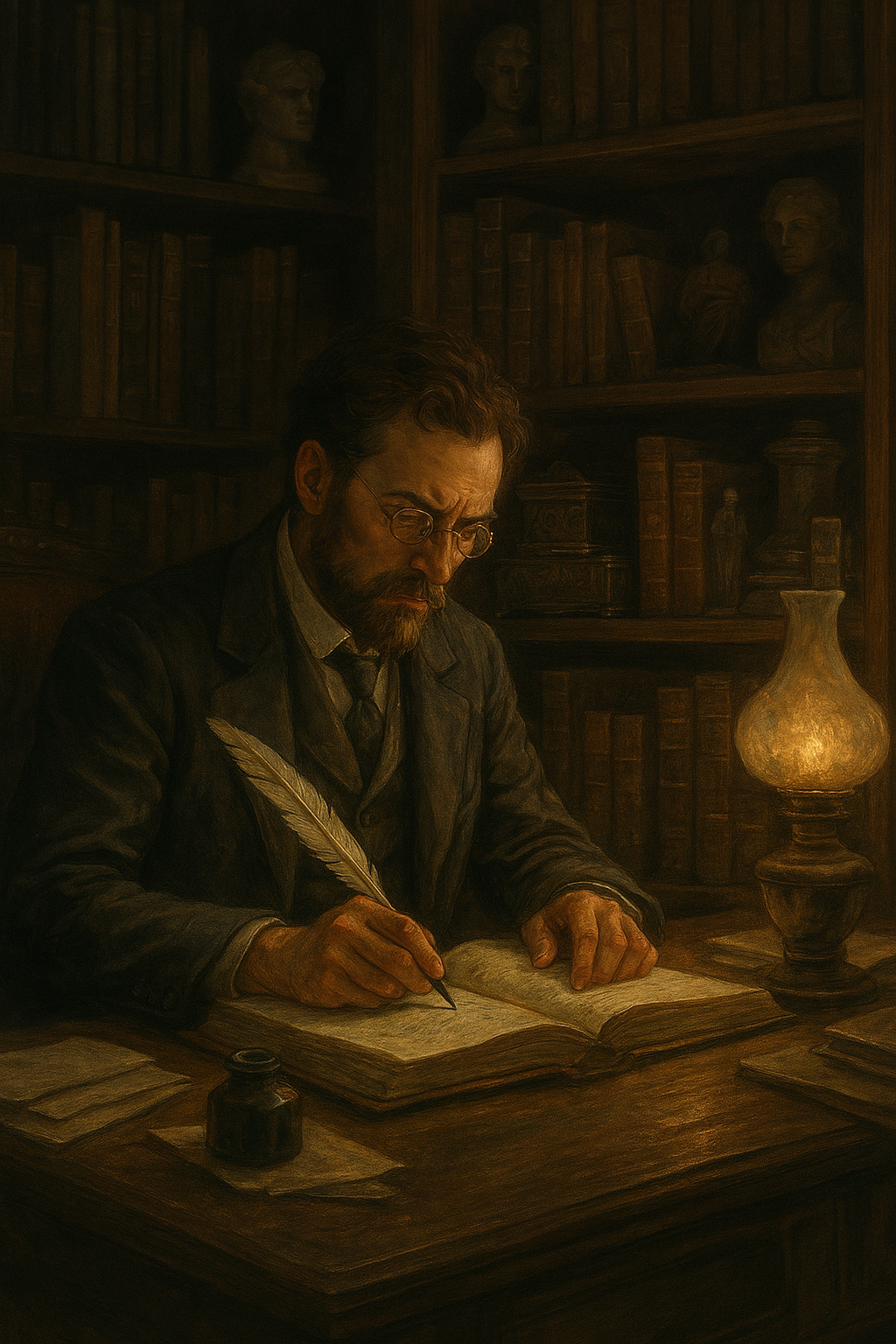
by Microsoft Copilot

It is getting more and more interesting...