
Paw Fu

GM-Info!
Work in progress!
Slightly NSFW!
FEATURED
Paw Fu is a kick-based fighting discipline practised by the rabbitfolk of Greenvale, with its centre in Hoppsala. It serves as physical training, self-defence, and a method of mental discipline. The style emphasises balance, leg strength, timing, and awareness of terrain. Paw Fu prepares rabbitfolk to protect themselves, escape danger, and support others during crisis. Training follows a strict age structure. Young rabbitfolk learn its foundations early in life, then return to advanced study as adolescents. Mastery is rare and not required. Most practitioners carry only the basics into adulthood. The rabbitfolk do not need an army, just enough people to have a defence against raiders and beasts.
"If your feet stop moving, you already made a mistake."
Origins of Paw Fu
Paw Fu traces its roots to the Softpaw clan, a rabbitfolk lineage known for long-distance travel and surface scouting. Several generations ago, members of the clan journeyed far east across Alana and reached Han. There, they encountered monks living in the Golden City, a remote settlement hidden among Han's high northeastern mountains. The Softpaw travellers studied movement, breath control, and disciplined combat under these monks. They brought the teachings home in adapted form, reshaped to fit rabbitfolk bodies, tunnel environments, and community values. Over time, these teachings became Paw Fu.Philosophy and Purpose
Paw Fu teaches control first, and force second. Practitioners learn to read motion, maintain footing, and protect others rather than dominate an opponent. Strikes aim to disable movement, create space, or break pursuit. Mental discipline stands equal to physical skill. Students train attention, patience, and cooperation. Paw Fu discourages solo heroics. Success depends on awareness of foes, allies, and surroundings.
The Softpaw Clan
The Softpaw clan guards the formal teaching of Paw Fu. Clan members serve as instructors, judges, and challenge keepers at the monastery. They do not rule Hoppsala, but their role earns deep respect, as their training provides the security the rabbitfolk need. Softpaw teachers live modestly. They rotate between monastery duty and service in Hoppsala as scouts, trainers, or advisors. No teacher holds permanent authority over the style.The Softpaw Monastery
The Softpaw Monastery stands halfway up the Thunderhead Range south of Hoppsala. It clings to a narrow shelf above broken stone paths and cold streams. The site includes training yards, stone halls, rope bridges, and sheltered pools. The monastery is never marked on maps. Young rabbitfolk receive only general directions before each training phase. Finding the cloister forms the first lesson. Paw Fu training is not obligatory, though, but once young rabbitfolk reach the monastery, they usually stay to the end of the designated term and only return to their families after.
Softpaw Monastery (anim) by Tillerz using MJ
Finding the Cloister

Paw Fu Scholars 3 by Tillerz using MJ
Students between five and eight years old must locate the monastery without escort. Elders give broad guidance and time limits, then release the children in small groups. The route requires navigation, listening, and cooperation. The journey tests calm thinking, speed alone does not help when you do not know where to go. Groups that argue or rush often fail, but can try again the following year.
The Cloister Trials
Reaching the monastery does not grant entry. Older scholars of the cloister stage a series of challenges along the final ascent. These include narrow climbs, controlled jumps, cold water crossings, short dives, problem-solving tasks, and direct challenges the young rabbitfolk can only overcome as a team. No challenge requires strength alone. Each demands planning, shared effort, and trust. Students who attempt to solve problems alone are turned back.Early Training, Ages 5 to 8
Early instruction focuses on movement. Children learn to land safely, kick without overextending, and recover balance after slips or falls. Lessons remain short and structured around play. Students train in groups. Exercises reward coordination and awareness of others. At the end of the training, young rabbitfolk are able to jump, balance, and fall while ending in a stable stance that would allow them to act or escape. No formal ranks exist at this stage.
"Protect the slowest one. That is the real test."
Advanced Training, Ages 15 to 18
Adolescents return to the monastery for deeper study. Training includes combat application, terrain use, and stress control. Students practise fighting on uneven ground, in shallow water, and in confined spaces. Mental discipline becomes central. Instructors test patience, restraint, and decision-making under pressure. Some students choose to stop after this phase. Others continue informally throughout adulthood.
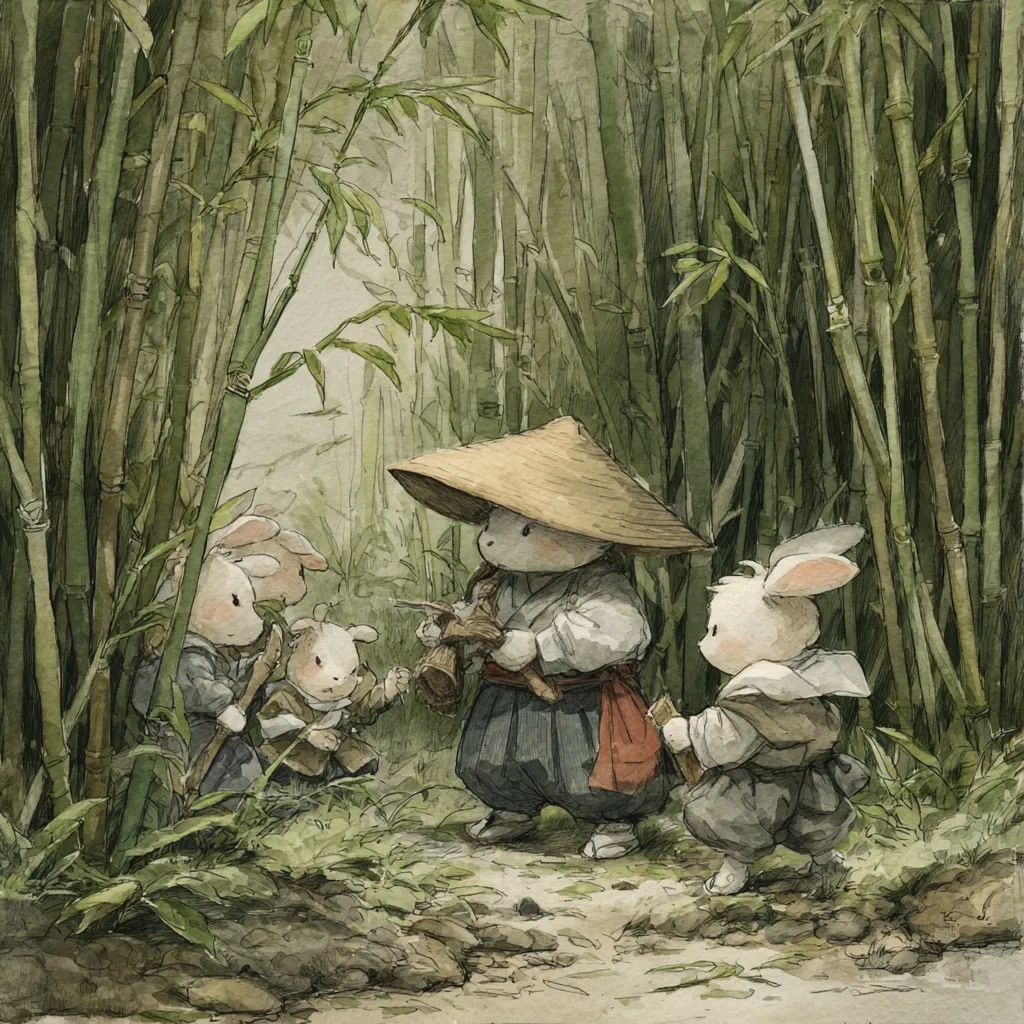
Paw Fu Scholars 2 by Tillerz using MJ
Techniques and Style
Paw Fu relies on kicks, sweeps, pivots, and rapid repositioning. Hands serve for balance, deflection, and support. Practitioners learn to fight while retreating or guiding opponents away from vulnerable rabbitfolk or vital locations. The style favours low stances and sudden changes in height. This suits rabbitfolk anatomy and tunnel environments.
Paw Fu Scholars 1 (anim) by Tillerz using MJ
Defense Techniques
- Softpaw Guard: A low balanced stance that keeps the center of mass stable and ready to move in any direction.
- Hollow Step: A short retreating step that draws an attacker forward while keeping footing secure.
- Wall Turn: A pivot that uses nearby surfaces or tight space to redirect force without meeting it directly.
- Ground Sense Shift: A weight transfer that avoids slips, loose soil, or sudden drops during movement.
- Wind Slip: A sideways evade timed to pass just outside an incoming strike or grab.
- Sweep Avoidance: A small hop combined with leg withdrawal to avoid low attacks aimed at balance.
- Paw Brace: A controlled plant of foot and hand to absorb impact and prevent a fall.
- Crowd Screen: Positioning that places the practitioner between a threat and another person without striking.
- Flow Break: A brief contact using shin or foot to interrupt movement without causing injury.
- Still Step Reset: A pause and stance correction used to regain control after sudden movement or pressure.
- Exit Line: A practiced path of retreat that clears space and opens a safe route away from danger.
- Shared Guard: A paired stance that allows two practitioners to cover angles and protect each other while withdrawing.
Ranks and Recognition
Paw Fu uses no public titles. Teachers recognise progress privately. A student may receive permission to teach basics, assist in trials, or act as a route guide for younger groups. Only the Softpaw clan may name a full instructor.Role in Rabbitfolk Society
Paw Fu supports daily life. Many rabbitfolk never use it in conflict. Its value lies in preparedness, coordination, and calm response during emergencies. Scouts, runners, and guards benefit most from its training. Elders value the discipline it instils in youth.
Relations to Han and the Golden City
Contact with Han remains rare. The Softpaw clan preserves fragments of teachings learned there, but no direct path to the Golden City exists in current records. Some techniques and meditative practices still reflect eastern influence. The monastery keeps a sealed chamber containing travel notes and exercises attributed to the original journey. They are filed as "Steps Beyond the Known Hills".
WFRP4e Rules
Who Can Use Paw Fu: Any character trained at the Softpaw Monastery may use Paw Fu techniques. Rabbitfolk gain the most benefit. Non-rabbitfolk suffer penalties unless specifically trained. Skills Used: Melee (Brawling), Athletics, Dodge, Perception Weapons: Unarmed only. Paw Fu may not be combined with weapons. Counts as non-lethal unless the GM rules otherwise. Core Rules:- Paw Fu attacks always use Melee (Brawling).
- Paw Fu attacks may not use the Strike Mighty Blow Talent.
- Paw Fu attacks gain +10 if the attacker moved at least 2 yards this round.
- Paw Fu attacks suffer -10 if the attacker is wearing Medium or Heavy Armour.

Cypher System Rules
Who Can Use Paw Fu: Characters trained in Paw Fu treat it as a specialised unarmed combat style. Type of Combat: Speed-based. Uses kicks, sweeps, repositioning. Core Benefits: All Paw Fu attacks are Speed-based. Paw Fu attacks deal 3 damage. Paw Fu attacks ignore Armor from worn gear rated 1 or lower. Defensive Movement: Once per round, after a successful Speed defence roll, the character may move an immediate short distance. This movement does not trigger attacks. Exhaustion Control: When a Paw Fu attack hits, the target must succeed on a Might defence task or become Hindered for one round. If already Hindered, the target instead becomes Prone. Crowd Management: When attacking a target adjacent to another enemy, the Paw Fu user may ease the attack by one step if they moved this round. This represents flowing through a group rather than focusing on a single foe. Terrain Interaction: Tasks involving balance, footing, or fighting on slopes are eased by one step. Enemies fighting Paw Fu users on uneven terrain have their attacks hindered by one step if they failed a Speed defence roll in the previous round. Limits Paw Fu cannot be used while wearing armor that provides more than 2 Armor. Paw Fu cannot be used while Immobilised or Restrained.Optional Shared Rule for Both Systems
Softpaw Restraint: If the Paw Fu practitioner reduces a target to Prone and Fatigued (WFRP4e) or Prone and Hindered (Cypher), they may choose to end the fight cleanly. The target cannot re-engage for the rest of the scene unless directly attacked. This reflects the monastery’s teaching. Stop when the danger ends.This is GM information



This is wonderful and made me smile today.