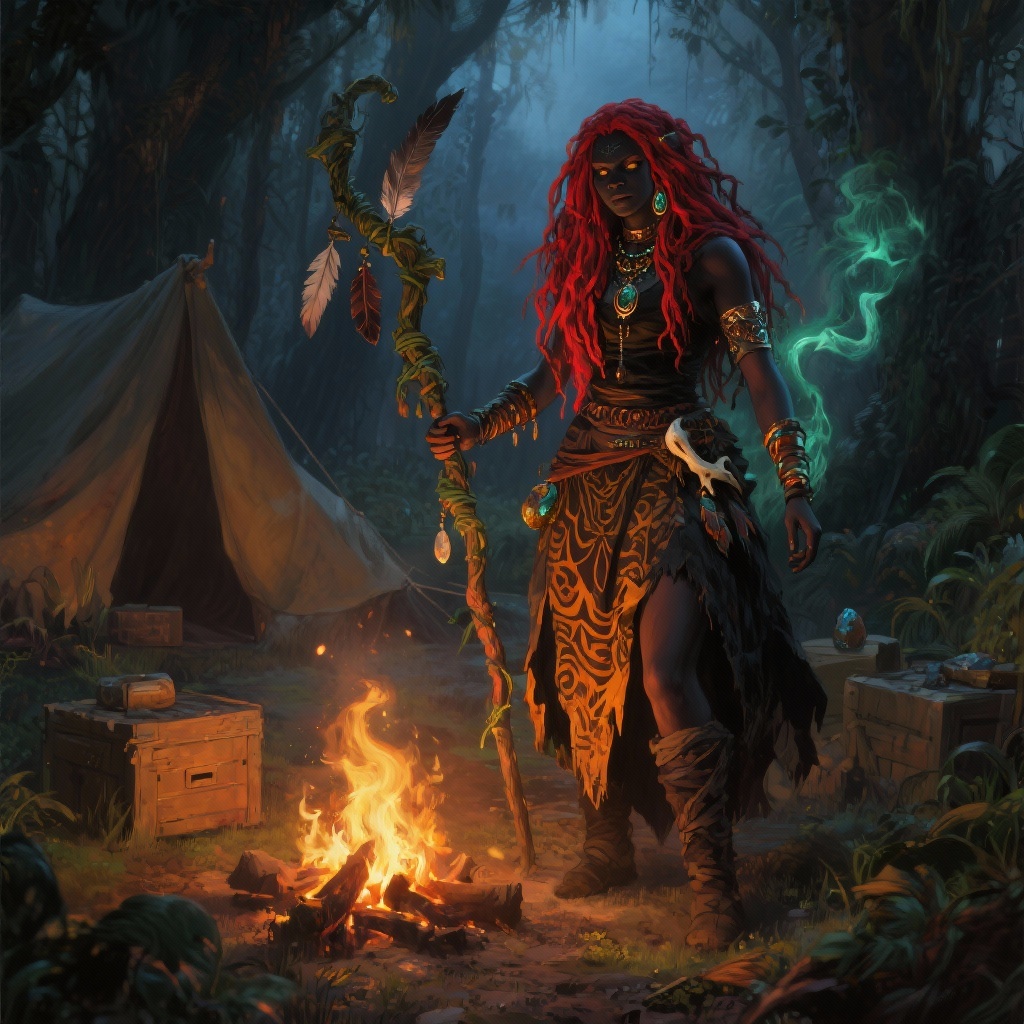
Sahira Quen’Tal — The Witch of Tzintava
Sahira Quen’Tal came to Cezorus from the deep jungles of Tzintava, a land where the canopy swallows the sky and every shadow is thick with spirits older than any Cezorian chronicle. In her homeland she had been a witch of no small reputation, a charm-binder and bone-reader whose people sought her counsel in matters of sickness, lost omens, and the shifting moods of the jungle’s countless dwellers. She belonged to a lineage whose roots sank deep into the soil of the Quen’Tal river-basin — a clan known for its guardianship of sacred groves and its fierce protection of the Firevine orchards that produced the crimson pigments for which the region was famed.
Her life changed when the first Cezorian prospectors arrived.
At first they came quietly, with maps and polite words, promising mutual benefit and “partnerships” that would bring prosperity to both nations. But their camps grew, and their tools grew louder. Soon the jungle around her clan’s sacred groves echoed with the unfamiliar screams of Mana-Tech survey rigs biting into the earth. Forest paths once trodden only by hunters and spirits were hacked into broad extraction roads. Rivers that had run crystal for generations turned cloudy from runoff. And the Church of the Lifestar, ever eager to “civilise”, condemned the clan’s spirit-rites as heathenism.
Sahira witnessed all of this with tightening fury, but the moment that shattered her patience came with the collapse of a foreign-built mining pit. Her younger sister had been among those coerced into labour there — part of a contractual arrangement the Cezorians insisted was legal and mutually agreed upon. When the pit buckled, the contractors shrugged and declared it an “acceptable loss”. The Crown in Leolin Bay sent condolences, but nothing more. No investigations. No reparations.
A part of Sahira’s heart sealed itself shut that day.
Her rage did not thunder; it simmered, dark and controlled, like a jungle night waiting for a storm. She carried her sister’s memory like a blade and vowed silently that Cezorus would one day be made to feel the wounds it inflicted so casually on others.
When she travelled north, she did so alone. She carried few belongings beyond the vine-woven totems of her craft and the long dreadlocks she had dyed in mourning red from the pigment of crushed Firevine stalks. Her arrival in Cezorus caused whispers — a foreign witch with bone charms clattering at her waist, her dark skin and striking hair marking her unmistakably as Tzintavain. She welcomed the whispers. Let them stare. Let them be reminded of the people they had harmed.
Sahira’s path crossed with the Briar not by accident but by instinct. She heard rumours of bandits attacking Mana-Tech caravans, of miners rising against exploitative contracts, of saboteurs burning the outer holdings of distant Consortia. She recognised pain disguised as rebellion. She found in their stories an echo of her homeland’s suffering, and she followed that echo until it led her to the Root.
Meeting Kial Mayers was a study in contrasts: his fervour burning like wildfire, hers steady like a banked coal. She recognised immediately that he was misguided, broken, and dangerously malleable — but also that he had the makings of a symbol. If his anger could be directed, if his growing rebellion could be steered, then perhaps Cezorus would be forced at last to confront the cost of its expansionism.
She joined the Root with clear eyes and no illusions. She did not believe in Kial’s dream of a “people’s army,” nor in his delusions of destiny. But she believed in his ability to break things, to shake the complacency of a nation perched atop stolen wealth. Sahira saw opportunity in the Briar — a blunt, imperfect instrument, but an instrument nonetheless. She vowed to use it until the moment it ceased to be useful.
Among the Root, Sahira became both outsider and conscience. She tolerated the Rookfell sisters, whose blunt pragmatism she found refreshingly honest amid the madness swirling around Kial. She watched Jareth Calwen with wary fascination, sensing in him a chaos not unlike a dangerous spirit whose intentions shift by the hour. She pitied Lilah Meristre and offered her small kindnesses when Xix’s watchful gaze drifted elsewhere.
And Xix—
Xix she recognised, not in its nature but in its hunger. The demon was unlike anything she had known in Tzintava, yet something in its presence reminded her of the oldest jungle spirits: patient, predatory, wearing civility like a thin mask. She did not trust it, but she understood it. She understood predators.
Still, Sahira was no zealot. She would not throw her life away for Kial’s doomed charge toward Leolin Bay. She would not die to topple a Crown that had already carved its price into her homeland’s soil. She sought instead a balancing of scales — for the pain of Tzintava to echo back into the heart of Cezorus. If chaos could force the nation to withdraw, to repent, to compensate, then she would see that chaos birthed.
She has no delusions about the Briar’s end. Movements like this burn bright and die screaming. When that time comes, she intends to walk away from the ashes with her purpose fulfilled, not buried beneath it.
Social
Contacts & Relations
SAHIRA QUEN’TAL — Relationship with the Root
- Kial Mayers — The Founder of the Briar — Sees him as a dangerously unbalanced man with a spark of genuine conviction. She values his influence but fears his delusions.
- Rex and Tann Rookfell — The Mercenary Sisters — Understands them instantly: paid blades, nothing more. She respects their professionalism but expects them to vanish the moment things turn dire.
- Lilah Meristre — Views the girl with quiet pity; sees her as a trapped fledgling who deserves protection, though she refuses to express it.
- Jareth Calwen — Regards him with wary contempt. His brilliance is undeniable, but so is his madness. She believes he will be their downfall.
- Xix — senses something profoundly wrong. She cannot name it, but she feels a spiritual dissonance around Xix that makes her skin crawl.