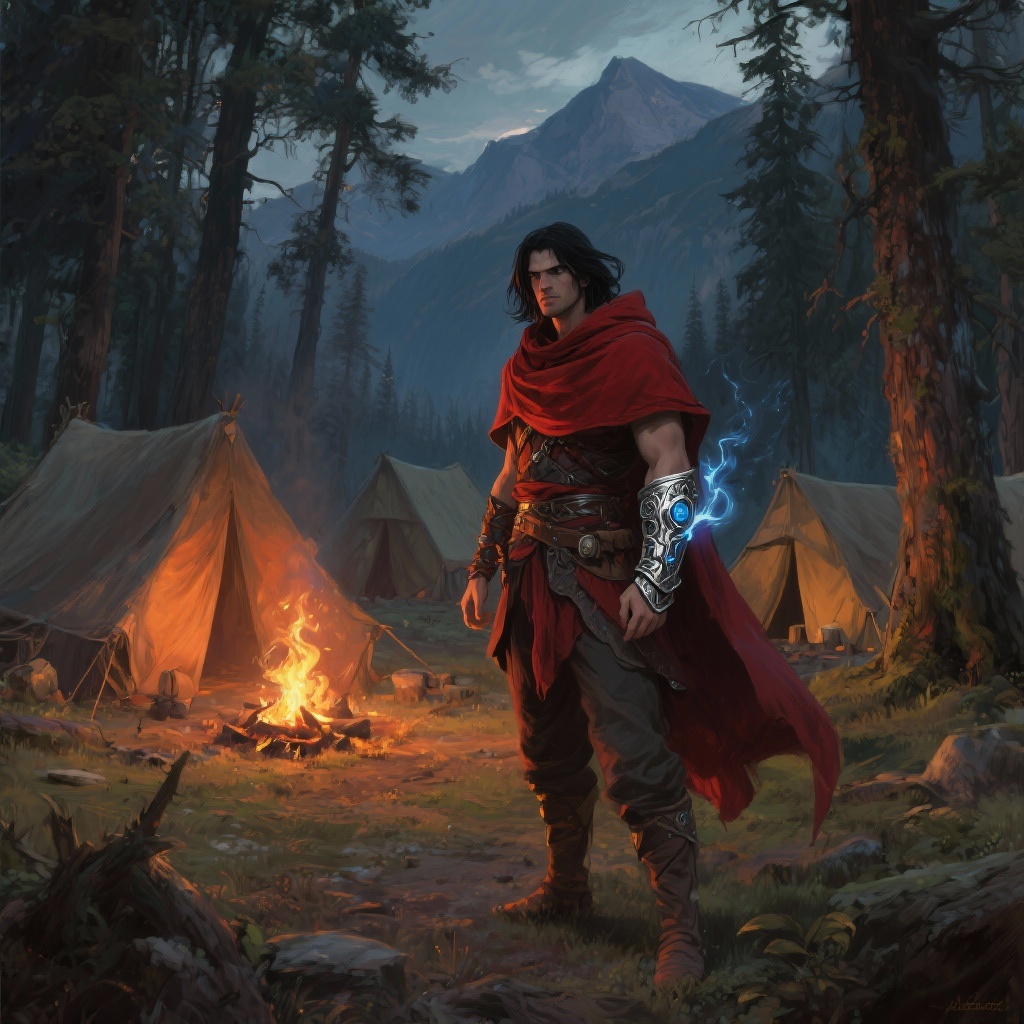
Kial Mayers — The Founder of the Briar
Kial Mayers was born in Hollowbarrow, a weather-beaten mining town clinging to the lower slopes of the Barrier Mountains. Life there was harsh, predictable, and deeply communal — a place where every child learned to swing a pick long before they learned to read, and where the mines swallowed generations of families whole. Kial was raised with the certainty that he, like his father and grandfather and countless kin before him, would live and die beneath the mountains. That certainty didn’t trouble him. He loved the familiarity of the work, the camaraderie of the shafts, the quiet pride of being a Frontier Cezoran who carved his living straight from the bones of the world.
Even as a youth he stood out. Handsome, strong, and gifted with an effortless charisma, Kial was the kind of young man people listened to without thinking. He had a laugh that disarmed tempers, a smile that smoothed disputes, and an easy manner that marked him as a future leader of Hollowbarrow’s miners’ cooperative. That life might have been his future — simple, honest, rooted — had the Mana-Forge Consortia never found Hollowbarrow.
Their representative arrived in a lacquered carriage, crisp coat shining beneath the foothill sun, and brought news of a “new era” for mining. The gathered townsfolk listened as he unveiled the Consortia’s marvel: a mana-powered drilling rig capable of carving through rock at unprecedented speeds. It was sleek, metallic, almost beautiful in its precision. The miners murmured, uneasy. Everyone understood what the representative did not say — that machines which worked ten times faster also meant ten times fewer miners needed to feed their families.
But Kial, ever hopeful, stood at the front of the crowd. He believed the promises. Better safety, fewer collapses, richer yields. Perhaps, he thought, this machine could spare his younger siblings from the dangers he had grown up with. Perhaps the Consortia truly meant to help. His optimism was infectious, and for a brief moment even the sceptics considered the future might not be as grim as they feared.
Then came the catastrophe.
The Mana-drill was activated deep in one of Hollowbarrow’s main shafts with Kial among the workers assigned to its first test run. For a few minutes, it hummed with startling efficiency. Then the tone changed. The machine juddered, stuttered, and began to scream — a high, metallic wail that echoed down the stone corridors. Before anyone could react, the device erupted in a violent, concussive blast. The tunnel shook as if struck by an earthquake. Timber supports snapped. Rock collapsed. Screams filled the dark.
When the dust settled, several miners lay dead. Many more were bleeding or broken beneath the rubble. Kial survived, but his right arm was crushed and torn, mangled beyond natural recovery. Hours passed before rescue teams hauled the survivors into daylight. Hollowbarrow carried its dead home on makeshift stretchers. The wounded were tended by family hands. And through it all, the Consortia’s representative insisted that the miners must have “operated the machine incorrectly.”
No compensation.
No apology.
Not even acknowledgement.
Something in Kial — something fundamental — cracked. His optimism curdled into outrage, then into a deeper, darker fury that festered as he lay in bed, arm bound in splints, staring at the ceiling with thoughts that clawed at him like trapped animals. His world, once so small and certain, had been turned grievously upside-down. The Crown did not care. The Consortia would not listen. Hollowbarrow would suffer while the architects of their suffering rode away untouched.
And in the Astral Shoals, something heard him.
One night, as he drifted in the brittle space between sleep and waking, a shape stepped through the boundary of his vision — a creature of bone-like metal, claws glinting, tail coiled, its eyes glowing with an unnatural blue-white pulse. Kial tried to scream, but the figure raised a hand and the fear softened, replaced with something like recognition.
Xix introduced itself softly.
It told him it understood injustice.
It told him it, too, had been cast aside by the march of cold, uncaring progress.
It told him his pain mattered.
In Kial’s weakened, traumatised state, the creature’s words slipped through him like water through cracked stone. His mind bent — not violently, but gently, almost gratefully — toward the comforting certainty Xix offered. By dawn, they were no longer strangers. They were companions bound by shared wounds and a shared hunger for retribution.
The first consequence of this new partnership came swiftly. The Mana-Forge Consortia representative departed Hollowbarrow in his carriage, eager to escape the town’s accusations.
He never reached the next settlement.
His coach exploded on a mountain pass, torn apart by carefully placed charges triggered at the exact moment the wheels hit a particular ridge. Local Peacekeepers blamed bandits. The Consortia dismissed it as a tragic accident. Kial simply limped into the woods with Xix at his side, vanishing into the foothills where his transformation began in earnest.
From there, his thoughts sharpened and darkened under Xix’s guidance. What had been anger became purpose; what had been despair became destiny. He roamed from settlement to settlement, speaking to other wronged labourers, stirring the resentment that already smouldered in their hearts. He became a wandering prophet of fury, his words impassioned and persuasive, his presence strangely magnetic.
His charisma drew others.
His injury made him seem sacred.
His certainty made him irresistible.
And so the Briar was born — not yet a movement, not yet a rebellion, but a seed planted in stolen soil, watered by blood, and tended by a demon with infinite patience.
As he grew in influence, his madness did not reveal itself in wild ramblings or erratic behaviour. Rather, it manifested as conviction — absolute, unwavering, quietly terrifying. When Kial spoke, his dark eyes shimmered with something just slightly not-human, something that made listeners feel they were witnessing the rise of a destined figure. In truth, they were watching a man slowly unravel, thread by thread, until only the tapestry of the Briar remained.
Today, Kial travels with the Root — a charismatic, handsome, dangerous visionary wrapped in a red hooded cloak and followed by people who cannot see where his path leads. He places absolute faith in all of them. Only Xix knows how misplaced that faith is.
Kial’s Purpose
In his mind:
The Briar is an army-in-waiting.
The people cry out for a leader.
He will march on Leolin Bay.
He will destroy the Aether Core Reactor.
He will make the Crown kneel.
In reality:
- The movement is too small,
- Too divided,
- Too temporary,
- Too afraid.
But Kial’s belief is contagious — and that is what Xix desires most.
Physical Description
Specialized Equipment
The Aether-Matrix Bracer
Though not a true Conduit’s device, Jareth crafted a replica-like prosthetic:
- a platinum lattice structure,
- woven with sapphires,
- housing micro-etched mana channels,
- attached to Kial’s damaged arm.
The bracer:
- restores full function to the limb,
- stores a small reserve of Mana,
- releases it as a shocking-grasp discharge,
- used primarily to interrogate, intimidate, and punish rather than as battlefield magic.
To his followers, it appears miraculous.
To Kial, it is proof that destiny favours him.
Social
Contacts & Relations
Relationship with the Root
- Sahira Quen’Tal — The Witch of Tzintava — sees her as a prophetess of revolutionary justice.
- Rex and Tann Rookfell — The Mercenary Sisters — believes their loyalty is ideological, not financial.
- Lilah Meristre — sees her terror as devotion.
- Jareth Calwen — views him as a brilliant visionary.
- Xix — considers it his closest friend, adviser, and guardian spirit.
He sees unity where there is none.
He sees destiny where there is manipulation.
He sees an army where there are scattered, frightened bandits.