The Cocan Peninsula
Fed by the Alfari River, this region of Susma stands alone, the Alfari the only river not running completely dry over the Dry, though sections of it and some of its tributaries, that is rivers feeding it, will. This river is a massive resource to the region, and has allowed the riverlands and more nutrient rich and less sand dense soil to see a forest of sorts come into being. Predominantly coconut and banana trees, the region is also the only part of Susma that continues to get some small amount of rain even over the dry, most of it likely caused by the currents near the coast, rain coming in off the sea. It is notably far less than during the rainy season, likely only raining once or twice a month, but the fact that it does rain during that eight or nine months at all is hugely relevant in dictating the environment present in this region.
Emberstone Badlands
Separating Valewyr and Susma, this band of burned and cracked volcanic wasteland covered in jutting mesas and towering plumes from long dormant volcanoes is actually corrupted land, a vicious wound upon the world. No matter the month, no matter the season, it does not rain here. Even the rainy season in the desert, fed by the air currents from the Valewyr Shelf, seem to simply skip over this region, like a stone skipping across a pond. The air burns to breath here. It is a dangerous and evil place, rich with Void Taint and not much else. Wandering the Emberstone Badlands is not advisable nor is it for the faint of heart. Some stories and rumors exist, as always do about such regions, of it being a
Scar upon Reality/World-Wound, though no evidence could i find to confirm those rumors. This region is solely the realm of wild stories, legends, and stories of beast, corruption and lost treasures that would be and continue on some level to be the bait of Exemplari and want-to-be Exemplari.
Kairkor Reefs
These reefs, dominating the bays and coasts of the land and islands along the eastern coasts of Susma, specifically encompassing the land of the Alkora and Doren Caliphates as well, this massive stretch of warm, shallow coastal and island waters are thick with kelp forests and diverse, rich and robust coral reefs. The seas here are fished and 'farmed' in many ways, as there are various edible and useful coral species, as well as seaweeds and kelps. The sheer volume of aquatic species that can be found here is notable, as the unique mixture of bands of kelp forests between reef shelves provides a fantastic close proximity mixed biome that a wide range of specific populations of fish, mollusks, cephlapods, birds, mammals and many other varieties of animal have made their home.
The Symphonious Mountains
This marvelous mountain range of ancient stone, worn but still towering, a mountain range with scars of erosion yet an overall smoothness, a roundness to their edge and peaks that tells of a range that has seen the rise and fall of ages. These mountains, some of their melted and sheened, are so old they saw the Sundering, and amongst some of the glass like cliffs and shale passages and cliffs they earn their name, the wind often singing a beautiful symphony of sorts, soft though it may be in most cases, though during a proper Harimeas Howler, a unique type of windstorm, it can truly become as a symphony, eerie yet beautiful in its all encompassing volume. These storms do pose dangers of course, the winds get strong enough to rip clear and fling thin shards of shale, which can act more or less like flying blades at those speeds, but unpredictable. When it tears pieces loose they are thin, but normally large in diameter making them exceedingly dangerous even if the do not directly strike a person, as if they strike the ground or something more solid like a boulder or cliff face, they can shatter, sending sharpened shards like shrapnel into and at anything nearby. However in spite of this there are known routes for trade through the range, though no major trade roads travel directly through it. Most trade or travelers, barring the bold or foolhardy ones, would rather spring the expenses to go around the range by rail, or by sea.
This is in large part also due to a second more ever present danger the mountains present. This range also gets its name for a particular phylum of bestial, being home to various types of the Harpyeryes family, many of which have unique cries or 'songs', a strange mutative capability, part of their cursed Void taint, that can influence and manipulate creatures whom are so unlucky as to hear it. There are four subtypes, subspecies if you will, each whom affect those unlucky enough to hear their calls differently.
The Scorch-Scar Corridor
This gash across the
Great Bala is basically singlehandedly responsible for the reputation of the desert itself. Ove five hundred kilometers across at its widest points and extending over eight hundred kilometers from north to south this central section of the desert can only be crossed safely at one point, a thin juncture a straight shot between the capital of Tiate and the city of Ildar-Karak and even that is only due to the only three small oases anywhere within this stretch being all along that route. Besides this it is a seemingly naught but sand, burnt rock, ash and sun scorched stone. It is a place not of the Void's pure taint or evil, but something just as sinister, for it is a dead land in every sense of the world. Nothing is believed to be capable of living in such extremes, for even the rains seem, as if with purposeful hateful intent, skirt around this entire region. Yet despite that, things do live, or more appropriately,
wander that scorched expanse. Tales of haunting, of scorched corpses and harrowing entities, of strange burrowing creatures, and hidden cave networks hiding mutated peoples of a monstrous and scorpion like nature abound. The corridor where the Karaite Highway and rail lines cross, known as the Iliate Pass, it is no different visually, save the three oases and the small towns you will find within them, military fortresses being a more apt description for them.
Besides those oases the lands are still as scorched, still as seemingly bereft of life, however there is no ever present hate in the hot, dead, unmoving air. Despite the scorching heat, there is no
malice detectable, unlike, to hear those few foolhardy souls who've wandered the Scorch-Scar and returned to tell their tale, out in the desert proper. Out there the heat, the dry, the ever still, hot, oppressive air, so hot it hurts to breath, it feels hateful. It feels malicious. Something about it feels deadly, viscous, hateful. However this is untrue within that corridor. Furthermore strange pillars of pure white marble extend, ancient markers cracked and eroded, yet glowing the faintest golden white at night, humming with ancient magic. Every five miles, exactly, precisely, on both sides of the passage, known as the Iliate Pass, they stand.
It is believed they are of an ancient magick, from the Faei or even from the Tanes themselves. Whatever their origin, the denizens , beasts and spirits that hunt and haunt the Scorch-Scar above and below the sands avoid them, as if afraid of or repelled by them in some way.
The Saltspires
At the most southeastern point of Susma lies a harrowingly beautiful, if deadly sight. Massive jutting mesas of white gold, sandstone of the purest tone, as if etched and bleached, kissed by the sun itself, with basalt columns and protruding rock faces amidst a sea of white crust and dust, thick as if sand, but the purity of it as if a snow or white crystal. Salt. Pure salt, this region is known as the Saltspires and though beautiful from a distance, it is a natural hazard and resource all in one, a promise of wealth, but a threat of death. Amongst the Saltspires, the deserts become even less hospitable, yet it is a place that the edges of are a valuable natural resource, and thus people live around and at the edges of this region, making a way of life and livelihood harvesting these valuable mineral salts. This salt flat with its towering basalt and sandstone mesas, is dry, arid, and prone to life sucking dust storms of pure mineral salts that can leave one dehydrated in minutes if you are not prepared, and cannot seek shelter. Even the dust kicked up from traveling should you wander to deep within its clutches could see you viciously dehydrated from breathing it in.
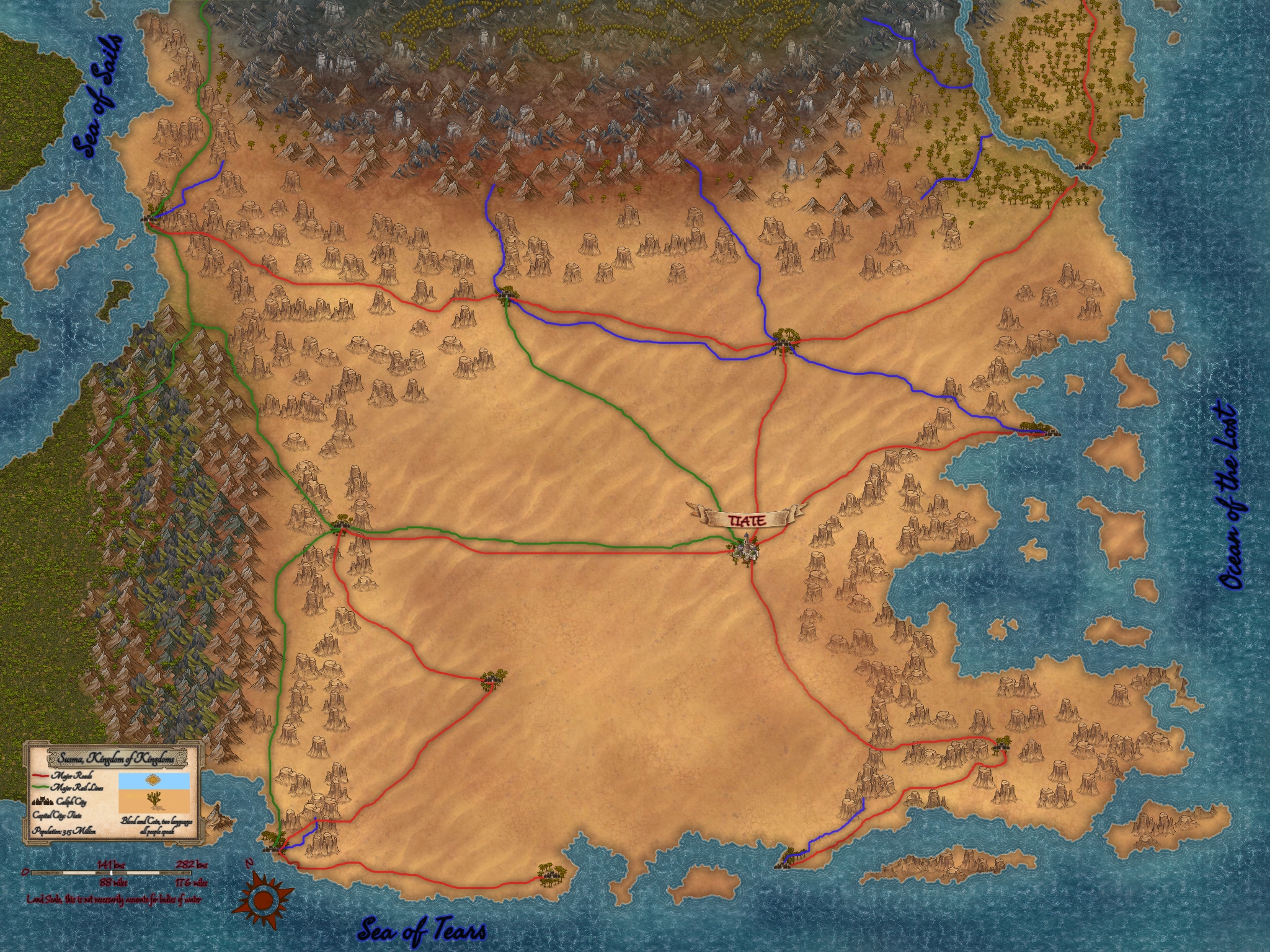


Sooo, I love maps. And therefore, would you mind adding some names of the different zones to yours?
Oh they are there. You need to make them visible. Top left corner you'll see a little icon like stacks of paper. Hover over it (don't know what it looks like on mobile or if you click it? Unsure) and you'll see three options. Caliphate cities. Caliphates, and like 'Geographical Regions/landmarks'. You'd want that third one, that'll make them visible. I have them in marker groups :)
Ohhh, I seeeeeeee! Thanks!
No problem :) Yeah I do that with all my maps fyi, it just keeps them cleaner on opening cause some of them get really busy. This one isn't crazy busy yet but next campaign I'm running is in this nation (at least to start) so it could very well become busy, so its a way to keep it neater and let people view just the markers they are looking for.