
Rohara, the Wild Plains
The nation of Rohara, like all those on Gavis-Lune, is quite unique amongst the nations of Valerick in its own way. Dominated by the Grazea, it should not be surprising to find out this nation is something of an agricultural superpower. Often referred to as the breadbasket of the world, and for good reason, Rohara supplies nearly one quarter of the world's grains, maize, and root vegetables. However unlike many nations of the time and era, and unlike what one may expect from such a widespread and rural nation, with only a few dense urban centers, Rohara has no traces of the old feudalism like structures remaining. They are no kingdom, have no nobility or holders of land or titles. They are an honest and full democracy, representative, voted on by every person of the appropriate ages of majority regardless of being a property holder or tax payer, so long as they are a citizen of the nation. Operating with a parlimentary government structure, using those elected representatives to form a governing body, with elections being held once every 8 years. However this will be much more skillfully explained by my colleague Rafiq Khal'naziri in their own works.
Rohara also has embraced the coming industrialization whole heartedly, not merely using locomotives and sky-ships, but having an entire magnegraph system operating via communication stations and conduit poles along those very railways, allowing written messages to be sent between her major cities in but mere minutes. Every passing year she expands and works to expand this infrastructure, in harmony with her agricultural position of course. Traveling Rohara one cannot help but marvel at the vastness of her great plains, the Grazea seeming endless often on the horizon, a vast sea of grasses and plant life, wild and hearty. A unique nation and region, the blending of innovation and agricultural traditions quite an interesting one to see and experience.
Mar'elin Du'ristic
Structure
Rohara is governed quite literally by its people, in a sense. With a parliment currently sitting at two hundred and seventy seats, every town, city and even village, so long as the population in its urban core is over five hundred people, has a seat. Those whom live in communities smaller than this, or on rural farms and plantations and the like are not left out however. They still vote, their votes being cast within the political race for the community seat geographically closest to them.
This parliament, known as the Council of Voices is elected every 8 years. No one can serve more than once, ever. Switching seats does not work. You get one term. The political landscape of Rohara has seen groups known as enclaves form, eleven of them. These groups, these enclaves, have candidates running for the seats in as many races as they can every eight years. The enclave with the most seats is the one whom gets to form the government, however unless they have 136 seats by themselves, which has only occurred once in Rohara's near four hundred year history of running this system, they have to form a coalition of some sort to actually form a government.
The enclave with the next most seats, second place, forms the leadership core of the 'opposition'. This is where the Council of Voices name comes from. These two enclaves will select one seat from among their representatives, normally and historically the seat of the individual whom won their race by the largest margin, to be the 'voices' of the government and the opposition respectively. Parliment is in session every weekday for six to eight hours and all manner of things will be discussed, debated and deliberated, all manner of bills presented to perhaps form legislation.
Under this system of course, by its nature, the first and second place enclaves cannot work together to form a 'government' if a coalition is required. This is enshrined in the very foundation of Rohara's laws, as the second place enclave is legally bound to take up the roll of the opposition. The concept here is that a government should always be debating and deliberating with itself, and should not make decisions to swiftly or too easily expect in times of dire need.
The other concept at play, one the Roharan people value, is tied up in understanding them as a culture. Ride wild, Die free. Those words are tied to this indirectly. Rohara would never and has never been a nation of landlords, lordships, counts or titles. Nobility as most other cultures in Valerick understand it does not fly here. There is of course economic hierarchy and those with wealth and standing, however in the eyes of the societal norms and culture writ large, they do not garner or get any special privilege's or legalities.
The unique aspects of this culture and political system can even be seen in her legislation and legal code. Whilst there are notable similarities to most any other nation on Valerick, what is most interesting is how her tax code and system is utilized when calculating legal punitive damages and fines for breaching laws, contracts or for damages in law suits. Such things are never doled out as an amount of coin, but as a percentage of income after taxes, utilizing the previous year's tax records. This system is a near unique one, shared only with Susma, their southern mercantile neighbors, and one that people from most any other part of Valerick find confusing, and some mistakenly believe is 'unfair' or 'unjust'.
This system has been the subject of two referendums in Rohara's history and both times the vote was overwhelmingly, to the tune of seventy percent or more, in favor of keeping it. Thus it remains in place to this day.
This parliament, known as the Council of Voices is elected every 8 years. No one can serve more than once, ever. Switching seats does not work. You get one term. The political landscape of Rohara has seen groups known as enclaves form, eleven of them. These groups, these enclaves, have candidates running for the seats in as many races as they can every eight years. The enclave with the most seats is the one whom gets to form the government, however unless they have 136 seats by themselves, which has only occurred once in Rohara's near four hundred year history of running this system, they have to form a coalition of some sort to actually form a government.
The enclave with the next most seats, second place, forms the leadership core of the 'opposition'. This is where the Council of Voices name comes from. These two enclaves will select one seat from among their representatives, normally and historically the seat of the individual whom won their race by the largest margin, to be the 'voices' of the government and the opposition respectively. Parliment is in session every weekday for six to eight hours and all manner of things will be discussed, debated and deliberated, all manner of bills presented to perhaps form legislation.
Under this system of course, by its nature, the first and second place enclaves cannot work together to form a 'government' if a coalition is required. This is enshrined in the very foundation of Rohara's laws, as the second place enclave is legally bound to take up the roll of the opposition. The concept here is that a government should always be debating and deliberating with itself, and should not make decisions to swiftly or too easily expect in times of dire need.
The other concept at play, one the Roharan people value, is tied up in understanding them as a culture. Ride wild, Die free. Those words are tied to this indirectly. Rohara would never and has never been a nation of landlords, lordships, counts or titles. Nobility as most other cultures in Valerick understand it does not fly here. There is of course economic hierarchy and those with wealth and standing, however in the eyes of the societal norms and culture writ large, they do not garner or get any special privilege's or legalities.
The unique aspects of this culture and political system can even be seen in her legislation and legal code. Whilst there are notable similarities to most any other nation on Valerick, what is most interesting is how her tax code and system is utilized when calculating legal punitive damages and fines for breaching laws, contracts or for damages in law suits. Such things are never doled out as an amount of coin, but as a percentage of income after taxes, utilizing the previous year's tax records. This system is a near unique one, shared only with Susma, their southern mercantile neighbors, and one that people from most any other part of Valerick find confusing, and some mistakenly believe is 'unfair' or 'unjust'.
This system has been the subject of two referendums in Rohara's history and both times the vote was overwhelmingly, to the tune of seventy percent or more, in favor of keeping it. Thus it remains in place to this day.
Culture
Rohara is an interesting blend of culture, as their words, Ride wild, Die free, would perhaps suggest a culture in opposition to large social programs, or structures, and certainly law enforcement/governmental oversight. However, that is not quite accurate. Due to the unique rules of their government and its structure, term limits, and the massive voting pool, most Roharans do not see that body as a violation of those words, but rather a tool to insure those words can be honored and achievable.
This is because these words more refer to resistance, resistance of outside forces, in particular the empire of Valewyr, and their handful of attempts to subjugate, absorb, or otherwise take control of Rohara in some way. The militant nation that is Rohara's eastern neighbor, though currently at peace, a peace that has lasted nearly six decades, it is well remembered that the Valewyrin Empire had its imperialistic designs set on Rohara, and has more than once in her history.
Furthermore they are a culture whom cares for their own and this shows even at a national level. Though rudimentary in structure, and at current limited mostly to the larger cities and towns, Rohara has, through her tax system, something resembling a taxpayer funded healthcare system. Hospitals, hospices, doctors, apothecaries, pharmacists and herbalists all tied into this system, their costs handled via taxpayer coin, instead of ever being the problem of the patient. The rural regions have less ease of access thus far, though they are not entirely without. Part of this system and its budgeting does include traveling doctors and pharmacists whom's sole job is to travel between rural communities, and making themselves available for what help they can. At the very least this provides folks with medicinal advice, knowledge and perhaps guidance to go and seek treatment in a larger community should it be required, somewhere with proper facilities, oft even coming with a written and documented referral.
This is because these words more refer to resistance, resistance of outside forces, in particular the empire of Valewyr, and their handful of attempts to subjugate, absorb, or otherwise take control of Rohara in some way. The militant nation that is Rohara's eastern neighbor, though currently at peace, a peace that has lasted nearly six decades, it is well remembered that the Valewyrin Empire had its imperialistic designs set on Rohara, and has more than once in her history.
Furthermore they are a culture whom cares for their own and this shows even at a national level. Though rudimentary in structure, and at current limited mostly to the larger cities and towns, Rohara has, through her tax system, something resembling a taxpayer funded healthcare system. Hospitals, hospices, doctors, apothecaries, pharmacists and herbalists all tied into this system, their costs handled via taxpayer coin, instead of ever being the problem of the patient. The rural regions have less ease of access thus far, though they are not entirely without. Part of this system and its budgeting does include traveling doctors and pharmacists whom's sole job is to travel between rural communities, and making themselves available for what help they can. At the very least this provides folks with medicinal advice, knowledge and perhaps guidance to go and seek treatment in a larger community should it be required, somewhere with proper facilities, oft even coming with a written and documented referral.
Military
Show spoiler
Rohara, due in large part to the issue with Valewyr as a neighbor, does not have....conventional military in the same way many nation states that have formed on Valerick do since the Sundering. Instead Rohara has an expectation and legislated service of all those of age of majority (adjusted as appropriate for their ancestry/race) for a period of four years. This full time service will be localized, training at a garrison near you or in an appropriate academy and you will be placed based on your own life skills, the first year being basic testing and training. In some ways, this particular aspect of Roharan culture and behavior has seen the improvement in attitude towards Skye Elves and those of Valewyrian descent whom live in the country over time.
The full time nature of it is a misnomer, only requiring three days a week, allowing you to continue working the family farmstead or otherwise, at least for the first year. The second to fourth years however are full time, living on base, learning to fight, learning military basics for whichever branch you are in, going on patrols and other such exercises, and even engaging in small scale conflicts with bestials and other such localized menaces as required. Once your four years are up, however you are not freed of your obligation. Instead you are simply 'reservist' expected to be part of your local township or regions militia, drill and keep your basic skills sharp at least twice a month, and should it be required of you, be brought back into service in a more full time role. However Rohara does have a small core of professional armed forces, the sort of backbone of this structure, the foundation from which this can operate. Amongst these usual divisions such as a few warmages, medicinal sorts, basic infantry, scouts and cavalry and their ilk, there is of course an intelligence apparatus, and some elite units. The Crows: This shady body is made up of an unknown number of individuals, and run via the Church of the Traveler, through the Council of Voices as well. They are the Roharan intelligence apparatus, and are impressively good at their job. It is estimated that no less than two hundred agents and operatives are active in various political and highborn circles in Valewyr alone at any given time, a perhaps unsurprising fact given the history between the two neighbors.
Order of the Stars: These individuals are tied more to the Church of the Traveler, however do have some deference to the authority of the nation and its government as well. Like all Templar orders they are competent warriors and dedicated to fighting back some of the darker forces that can manifest or be at play in Valerick, however unlike most other orders they are not a heavy force, operating instead in a more scouting, skirmishing and supportive role on a battlefield. They also, through their faith, seem to possess some small divination like powers.
Roharan Raiders: The elite troops of the Roharan army, this cavalry force numbering some eight thousand or so, are master horsemen, world class duelists with epee, sabre and rapier. However most importantly, they are dragoons, masters of skirmish tactics from horseback with bow and bullet. Most of them keep at least a pair of pistols, oft one of them a revolver, as well as a recurve bow and a quiver of finely crafted arrows. They do not travel heavy on armor, preferring to act as a highly mobile quick strike force over a heavily armored shock troop. Breastplates, and some thick padded gambeson, no platemail or chain present.
Their Roharan Rastovs, the special breed of horse the Raiders breed and raise themselves, is well known and prized by the unit and those select few lucky enough to ever come into possession of one, even one who fails the unit's rigorous training standards. They need less food or water than regular horses, are faster and with much higher stamina. It is said they can cover easily a hundred and fifty to two hundred kilometers in a day over the plains without tiring, and can maintain a strong gallop for an hour or more without ever needing to breath heavy or struggling. They are also surefooted animals and seemingly a little smarter than the average horse.
The full time nature of it is a misnomer, only requiring three days a week, allowing you to continue working the family farmstead or otherwise, at least for the first year. The second to fourth years however are full time, living on base, learning to fight, learning military basics for whichever branch you are in, going on patrols and other such exercises, and even engaging in small scale conflicts with bestials and other such localized menaces as required. Once your four years are up, however you are not freed of your obligation. Instead you are simply 'reservist' expected to be part of your local township or regions militia, drill and keep your basic skills sharp at least twice a month, and should it be required of you, be brought back into service in a more full time role. However Rohara does have a small core of professional armed forces, the sort of backbone of this structure, the foundation from which this can operate. Amongst these usual divisions such as a few warmages, medicinal sorts, basic infantry, scouts and cavalry and their ilk, there is of course an intelligence apparatus, and some elite units. The Crows: This shady body is made up of an unknown number of individuals, and run via the Church of the Traveler, through the Council of Voices as well. They are the Roharan intelligence apparatus, and are impressively good at their job. It is estimated that no less than two hundred agents and operatives are active in various political and highborn circles in Valewyr alone at any given time, a perhaps unsurprising fact given the history between the two neighbors.
Order of the Stars: These individuals are tied more to the Church of the Traveler, however do have some deference to the authority of the nation and its government as well. Like all Templar orders they are competent warriors and dedicated to fighting back some of the darker forces that can manifest or be at play in Valerick, however unlike most other orders they are not a heavy force, operating instead in a more scouting, skirmishing and supportive role on a battlefield. They also, through their faith, seem to possess some small divination like powers.
Roharan Raiders: The elite troops of the Roharan army, this cavalry force numbering some eight thousand or so, are master horsemen, world class duelists with epee, sabre and rapier. However most importantly, they are dragoons, masters of skirmish tactics from horseback with bow and bullet. Most of them keep at least a pair of pistols, oft one of them a revolver, as well as a recurve bow and a quiver of finely crafted arrows. They do not travel heavy on armor, preferring to act as a highly mobile quick strike force over a heavily armored shock troop. Breastplates, and some thick padded gambeson, no platemail or chain present.
Their Roharan Rastovs, the special breed of horse the Raiders breed and raise themselves, is well known and prized by the unit and those select few lucky enough to ever come into possession of one, even one who fails the unit's rigorous training standards. They need less food or water than regular horses, are faster and with much higher stamina. It is said they can cover easily a hundred and fifty to two hundred kilometers in a day over the plains without tiring, and can maintain a strong gallop for an hour or more without ever needing to breath heavy or struggling. They are also surefooted animals and seemingly a little smarter than the average horse.
Technological Level
Squarely early industrialization.
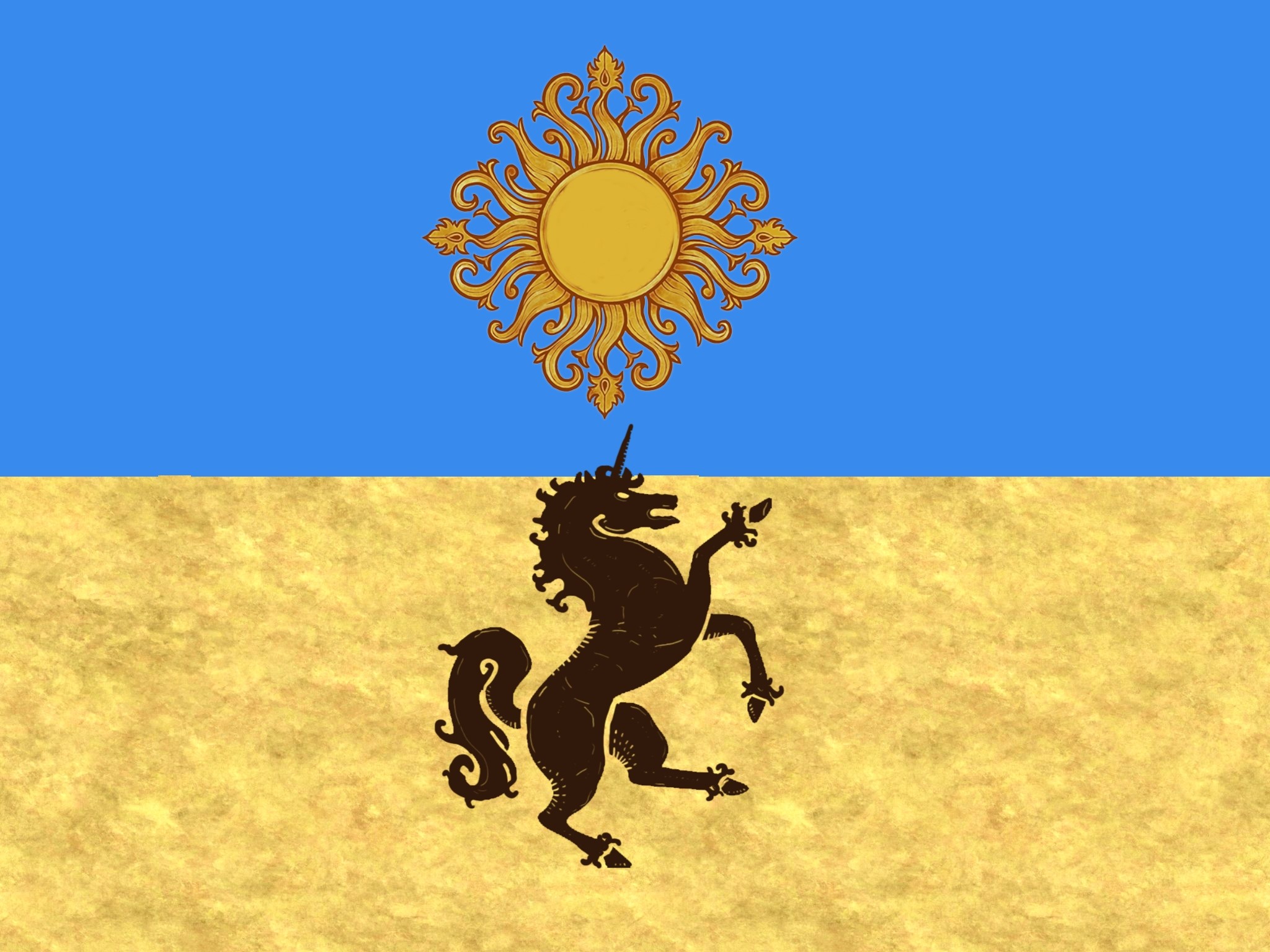
Ride Wild, Die Free
Maps
-
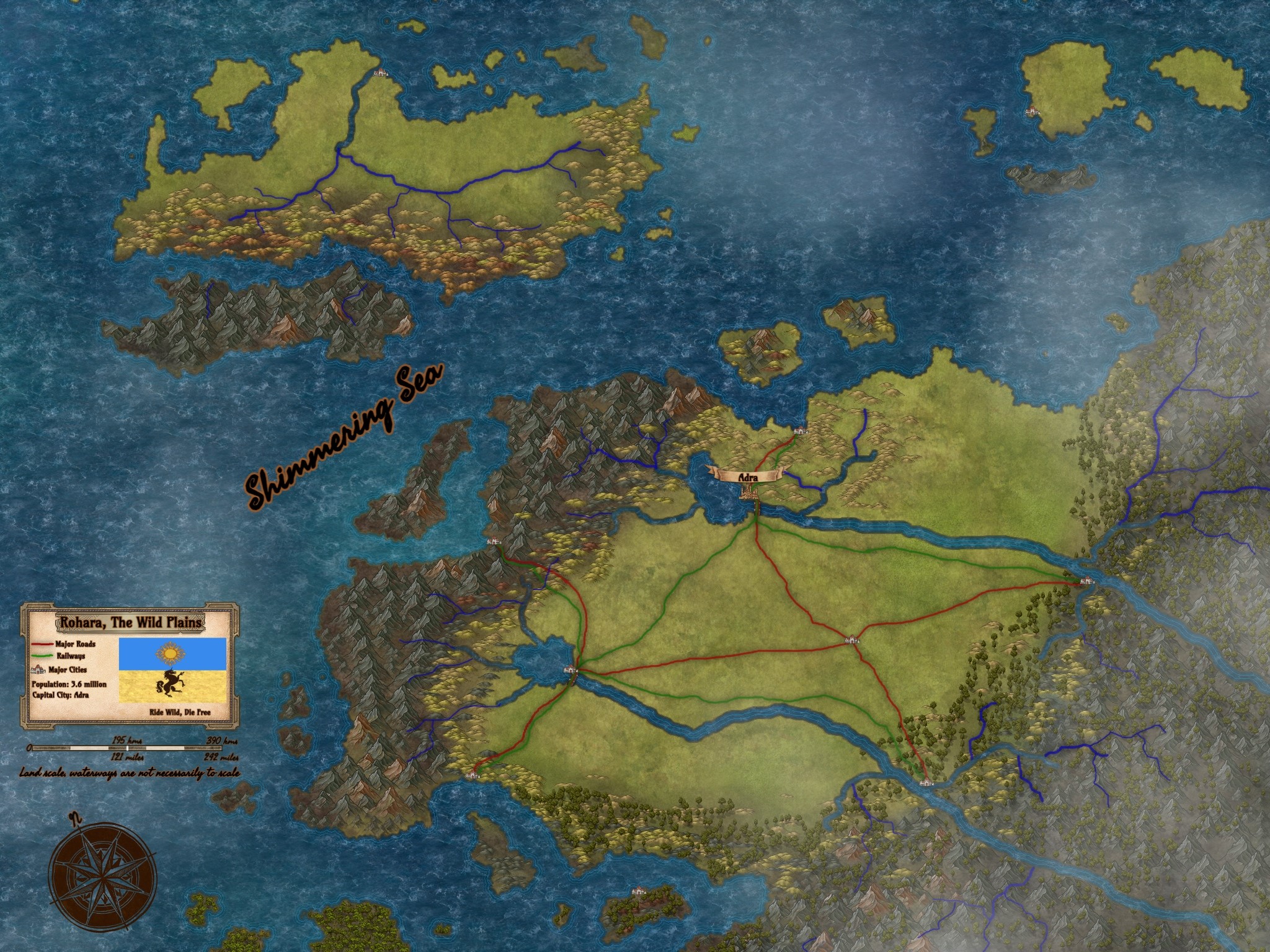
Rohara, the Wild Plains
Type
Geopolitical, Country
Capital
Demonym
Roharan
Ruling Organization
Government System
Democracy, Parliamentary
Economic System
Market economy
Currency
The Roharan Flaxxen, trading at a value of 1.41 to 1 with the Wastonian Shailling. Despite this Rohara is actually quite a wealthy nation, for strength of its coin outside its borders is not its primary method of exerting power and therefore influence and generating wealth on the world stage. That would be its agricultural might. Its notes are called Flaxxen, its larger coins (silvers) are called stems and its smaller coins (coppers) are called roots, all nods to Rohara's heritage and power base as the world's breadbasket. They divide their notes and coins similarly to every other nation, that seems to be something that has traveled, a formula that has been rather agreed upon as a good one to use. Its odd denomination coins are known as taproots (for 2.5 coppers) and gnarlroots (for 7.5 coppers) whilst the 5 root coin has no unique moniker and is simply known as a fi'root shortening the word five. Similarly amongst the stems you have a trimming (2.5 silvers) and a clipping (7.5 silvers) and the 5 stem coin is simply known as a stive, once again just taking out letters and fusing the words to create a new term.
Major Exports
Massively in the lead is grain, and other such food stuffs, as well as various animals (again food). They have a smattering of other goods and resources some of which inevitably moves via export, but by percentage agricultural goods easily make up 60-75% of their exports.
Major Imports
Mostly they import lumber (though they have some domestic production), metal ores and other such resources, as well as finished goods.
Legislative Body
All these systems are best left to the more skilled and thorough discussion in the works of my dear friend Rafiq Khal'naziri, and so I would direct you thusly.
Location
Controlled Territories
Neighboring Nations

Comments