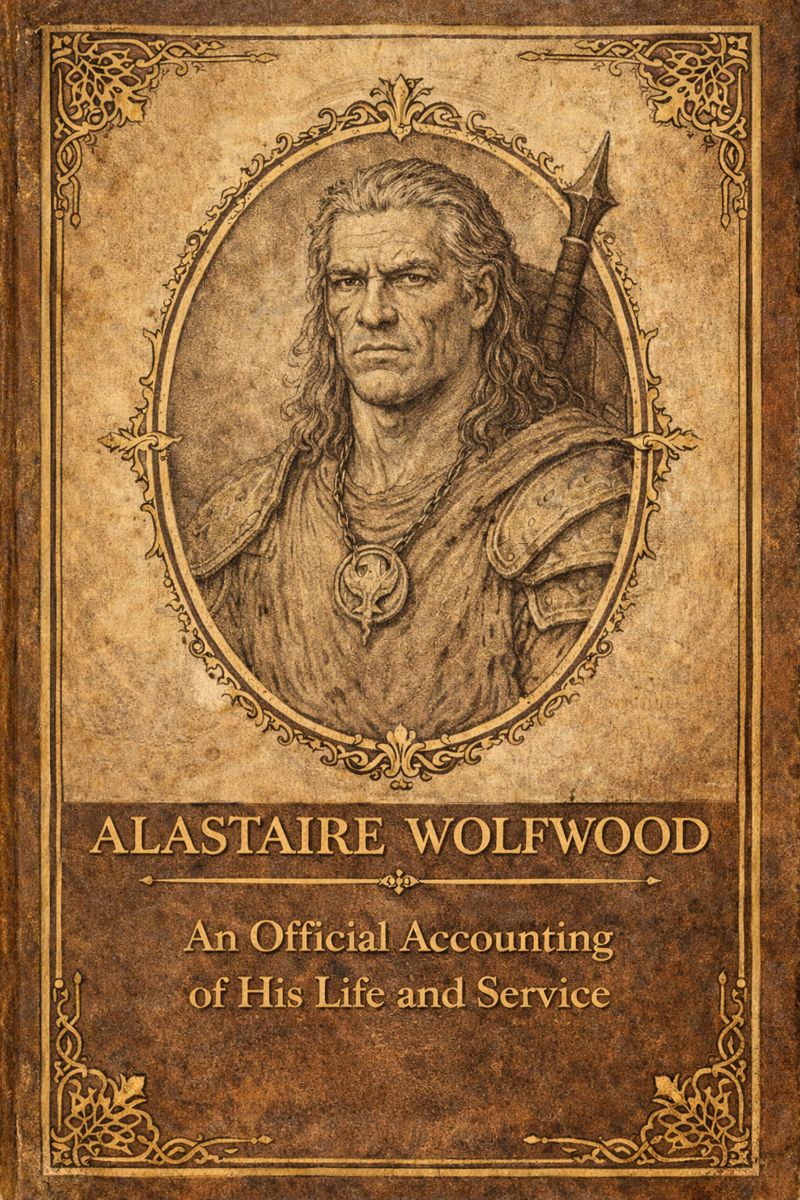

Chapter II — Deeds and Renown
The recorded feats of Alastaire Wolfwood are too numerous, and too widely distributed across campaigns and regions, to be comprehensively accounted for within a single manuscript.
Numerous military annals, diplomatic records, and regional histories preserve accounts of his interventions, often under differing titles or incomplete attribution. A consolidated collection of these accounts may be found in The Unbroken Path: A Compendium of Wolfwood’s Campaigns, wherein additional deeds, testimonies, and battlefield summaries are preserved.
What follows here are not exhaustive records, but the most prominent and widely cited legends associated with Wolfwood — events whose retellings shaped public understanding of his nature and capability.
Whitefield — The Breaking of Wills
At the Battle of Whitefield, Wolfwood’s forces were severely outnumbered by a superior and well-entrenched enemy host. Contemporary records describe the engagement as strategically untenable, with defeat considered inevitable by all accounts prior to contact.
Amid the chaos of battle, Wolfwood confronted the enemy warlord — a figure renowned as the greatest swordsman of the age — in full view of both armies.
Official histories state that Wolfwood prevailed decisively in single combat, striking down the warlord despite overwhelming disadvantage. Upon witnessing their champion’s fall, the opposing force lost cohesion and morale, fracturing almost immediately. What had appeared moments earlier to be an assured rout became a sudden and total collapse.
Whitefield is widely cited as the moment Wolfwood’s name passed fully from military record into legend — proof that a single warrior, at the critical moment, could overturn the course of an entire war.
The Black Chalice
During a diplomatic convocation intended to formalize peace, Wolfwood was targeted in a covert assassination attempt.
Poison was introduced into his wine. Multiple witnesses attest that Wolfwood knowingly drank from the tainted chalice and exhibited no sign of harm. When the assassins revealed themselves, he engaged them directly, defeating them before broader violence could erupt.
The incident became emblematic of Wolfwood’s incorruptibility, giving rise to the belief that poison held no power over him, and that his body itself rejected treachery.
Through the Fire at Durnholme
During the Burning of Durnholme, Wolfwood is recorded as having crossed a fully engulfed structure to secure an evacuation route for trapped civilians.
Eyewitnesses claim the flames parted around him, his cloak emerging unscathed and his body untouched. He is said to have stepped through the inferno without pause, emerging on the far side as if the fire itself had yielded.
This account remains among the most frequently cited examples of Wolfwood’s apparent transcendence of mortal limitation.
Harrow’s Watch
Throughout the Siege of Harrow’s Watch, Wolfwood was reputed never to have slept.
Accounts place him upon the walls at all hours, unmoving even under sustained assault. His presence became synonymous with the fortification itself, and morale among defenders reportedly held so long as he remained visible.
The phrase “as steady as Wolfwood” entered common military usage during this period, signifying unbroken vigilance.
The Unassailable Blade
Numerous reports attest that Wolfwood could not be taken by surprise.
Assassination attempts are recorded as having failed repeatedly, with some accounts claiming that blades never reached him, or that attackers faltered before striking. This gave rise to the widespread belief that Wolfwood was immune to ambush and deception alike.
Whether through perception, instinct, or something more, Wolfwood came to be regarded as untouchable.
The Burning Lance
In one recorded engagement against a demonic entity, Wolfwood endured a direct strike from a weapon known as the Burning Lance — a blow described as lethal to any ordinary combatant.
Witnesses report that Wolfwood remained standing after impact and continued fighting without hesitation. The encounter concluded with the entity’s defeat and Wolfwood’s withdrawal from the field.
This event further cemented his reputation as a figure whose endurance surpassed mortal bounds.
The Duel Without Steel
In a duel against a world-renowned master of the blade, Wolfwood is said to have faced an opponent already weakened by an unseen ailment.
The two warriors met at distance, separated from the gathered witnesses by both terrain and circumstance. Those present report that no exchange of blows occurred at first. Wolfwood is observed speaking briefly — the words themselves unheard and unrecorded.
What followed was decisive.
The opposing duelist lowered himself to one knee, weapon still in hand, neither discarding it nor raising it in challenge. He did not appear defeated by force, but by resolve.
Wolfwood then drew his blade once.
With a single stroke, he ended the duel.
The legend endured not for what was said, but for what was seen: that Wolfwood’s words alone were enough to end a lifetime of mastery, and that when steel was finally drawn, it was drawn only to conclude what had already been decided.
Assessment of the Legends
Taken together, these accounts portray Wolfwood not merely as a skilled warrior, but as a figure operating beyond ordinary limitation — immune to poison, flame, exhaustion, ambush, and fear.
Whether these qualities arose from exceptional discipline, uncommon constitution, or forces not fully understood, the record is unanimous in its conclusion:
Alastaire Wolfwood stood where others could not, endured what others could not, and prevailed where others failed.