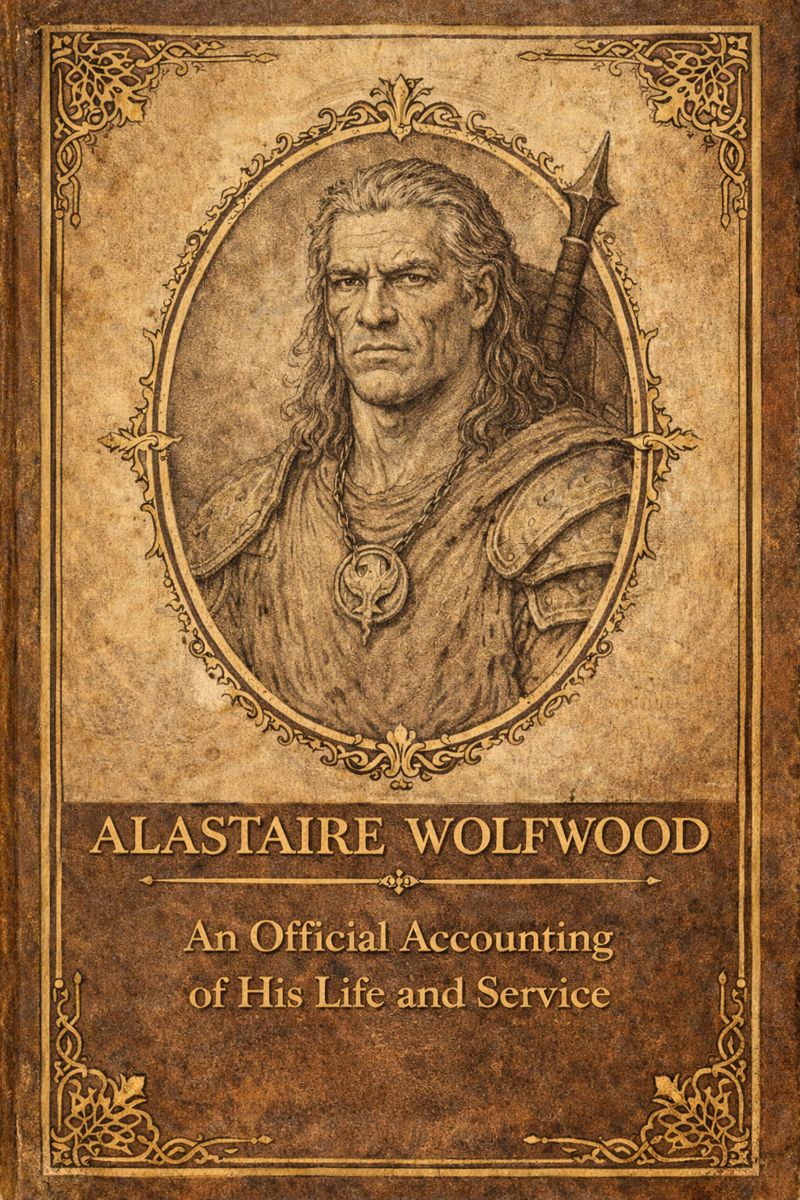

Chapter I — The Man and the Making of a Hero
Alastaire Wolfwood is remembered as a warrior forged not through privilege or patronage, but through sustained service during a period defined by instability, border conflict, and the earliest signs of encroaching corruption.
Early records place Wolfwood as a common-born soldier of no notable lineage. His initial service was unremarkable in rank, yet exceptional in outcome. From the outset, Wolfwood demonstrated prodigious battlefield aptitude — a natural grasp of timing, positioning, and threat assessment that surpassed formal training expectations.
His defining trait, however, was not brilliance alone.
Repeated reports note Wolfwood’s refusal to abandon ground even when withdrawal would have been justified. He held lines beyond exhaustion, remained engaged after command structures fractured, and continued advancing where others consolidated or fell back. In several recorded engagements, his presence alone stabilized failing formations.
Promotion followed swiftly, though not by petition.
Wolfwood advanced through necessity — elevated to roles others could not or would not hold. He accepted rank only insofar as it allowed continued front-line deployment. When offered permanent command or strategic appointment, he declined, preferring proximity to battle over authority removed from it.
To Wolfwood, glory was not abstract.
It was found where steel met consequence.
As his reputation grew, he was increasingly deployed outside conventional formations. Field commanders, constrained by failing resources or collapsing morale, began requesting Wolfwood directly. He was assigned to:
-
Reinforce broken fronts
-
Break stalled engagements
-
Hunt hostile commanders and arcane specialists
-
Intervene in situations officially deemed unsalvageable
Though formally subordinate, Wolfwood exercised broad discretion in execution. He accepted objectives without contest — but methods remained his own.
Transition from Soldier to Hero
By the midpoint of his career, Wolfwood’s name had spread beyond military channels.
Civilian accounts, diplomatic correspondence, and secondary testimony increasingly described him not as a soldier, but as a figure of last resort — one summoned when conventional measures failed, and who departed without claim, reward, or explanation.
It is during this period that Wolfwood ceased to be regarded as merely an exceptional combatant and became, in public memory, a hero.
This reputation was not cultivated through proclamation or alliance. Rather, it emerged organically from repeated accounts of impossible endurance, decisive action under collapse, and survival in circumstances where loss was assumed.
By the time of his later campaigns, Wolfwood was no longer perceived as ascending through ranks.
He had stepped beyond them.
Disposition and Character
Contemporary accounts describe Wolfwood as a study in contradiction.
He was consistently recorded as courteous, patient with civilians, and unfailingly willing to aid those in danger. Yet beneath this kindness lay unmistakable ambition — not for power, but for remembrance.
Wolfwood understood legend.
He pursued danger not solely out of duty, but with the awareness that only in the crucible of battle could a name be forged large enough to endure. Confidence marked his conduct, often bordering on arrogance, though never expressed as disdain. He did not look down upon others — he simply believed himself capable of more.
Those who served alongside him rarely accused him of cruelty. Some accused him of recklessness. Few questioned his resolve.
One surviving assessment records the sentiment succinctly:
“Wolfwood did not inspire loyalty. He inspired confidence.”
Meeting of Aurora Vettori
It was during an extended deployment near Brimcham that Wolfwood first encountered Aurora Vettori.
Records indicate that Wolfwood, having observed irregular decay within the surrounding forest — phenomena not yet formally classified — sought passage deeper into the affected region. Aurora Vettori, already familiar with the land and its dangers, acted as his guide.
Their association, initially practical, deepened swiftly.
Contemporary observers describe the bond that formed between them as unusually close, though never romanticized in public record. They traveled together frequently during this period, and Wolfwood was thereafter rarely documented without Aurora’s proximity.
Those who knew them spoke of a partnership closer than kin — one founded on shared resolve rather than shared origin.
Following this association, a notable shift occurred in Wolfwood’s public demeanor. Accounts from this period onward describe him as more reserved, more measured, and markedly less inclined toward overt displays of bravado.
Many historians attribute this change to Aurora’s influence.
Others simply note that from this point forward, Alastaire Wolfwood appeared less concerned with the size of his legend — and more with the cost it demanded.