
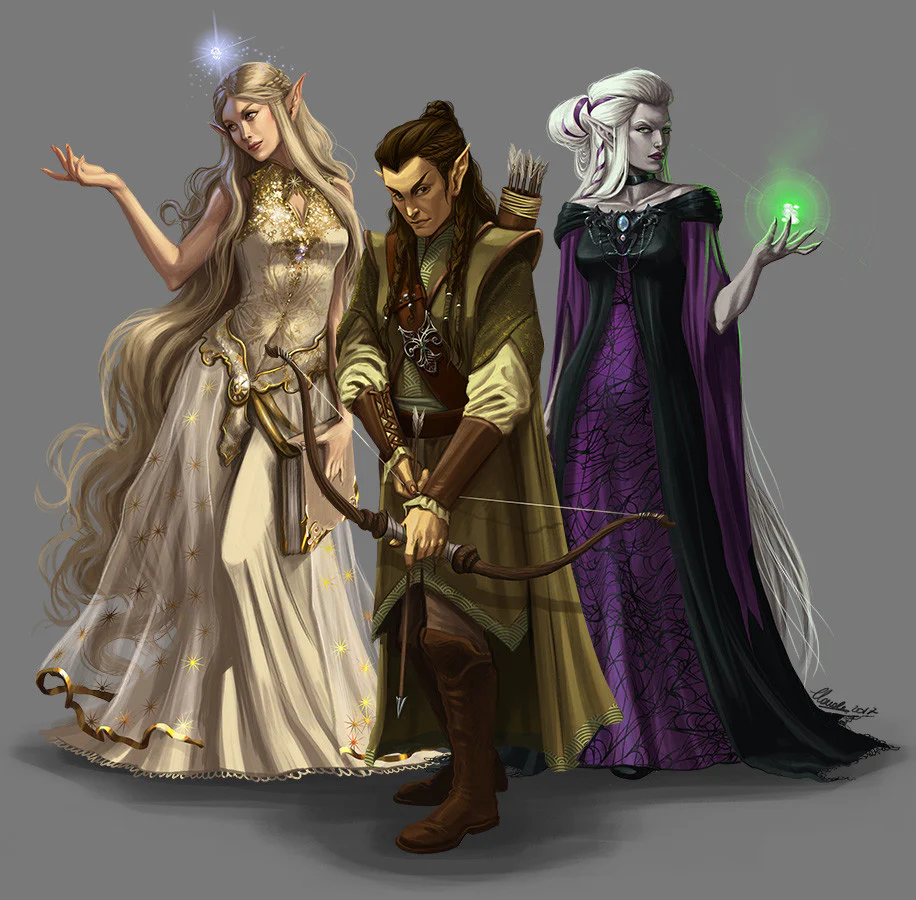
Elves
High Elves
Known as the Eldar or first elves, the high elf race is the most populous of the elves that remain in Yyrda in the New Era. They are credited with the formation of the first of the Golden Empires of antiquity, the elven domain of Faedrun, the majority of which existed within the great forest of the same name, which once stretched from the Falinor Heartlands to the Dragonsbane Mountains and as far north as the Wildwood; some elvish historians even claim that the forest empire passed into the Reach and was contiguous with the areas now known as the Darkwood, the Forest of Pericarp, and the Forest of Wyrms. The Empire of Faedrun stood for thousands of years of relative peace, tolerating and occasionally allying with the Dwarven Citadels in their mountain kingdoms and unperturbed by the upstart human nations when they began to swiftly spread across the continent. It was only the advent of the great Dragon War that threatened the stability of their empire, which saw a quick decline in the centuries of strife that followed and eventual subjugation to the human Kingdom of Falinor in the early days of the Unification Wars.
A proud and noble people, the high elves are often considered to be exemplars of their species and are occasionally referred to as “true” elves, although this labeling cannot be separated completely from a Faedruin isolationism that can at times compete with Falinorian ethnocentrism in its rigid dedication to cultural purity. While not typically as xenophobic, high elves (and Faedrun elves in particular) often regard other members of their species such as Wood Elves and Drow as astray or even barbaric; Faedrun high elves also generally view high elves who have chosen to integrate into human society rather than remain among the Eldar as having forgotten the true way of their people. That being said, half-elves are generally not looked down on, as a strong cultural tradition of interspecies romance exists among the high elf bards and historians–although half-elves are often vaguely help up as ethnic ambassadors, responsible for bringing the enlightenment of elvish wisdom to the less fortunate peoples of the continent.
Of all the elvish races, the high elves have perhaps the closest innate connection to magic. They were the first to commune with the Great Dragons and were guided by them in their early years, and they walked with the last of the Elder Blood beneath the stars before the founding of the elven empire, learning much of what once was and what should not be allowed to come to pass. For all their arrogance and aloofness as a people, some measure of that ancient wisdom remains even diminished as they are in the New Era, and among all the people of Yyrda they remember the most of what occurred in the world from prehistory to the present.
Astral Elves. A rare subset of high elves, making their home in Faedrun when they are not journeying on the Astral sea. Astral Elves hold a place of esteem among the elves of Fedrun for the path they have chosen among the stars, although little is known about them even among high elf society.
Wood Elves
Not all the Eldar desired to build; those who chose not to join their brethren in establishing the Great Empire of Faedrun and held to the nomadic ways of their early years in Yyrda became known as Wood Elves. Little inherently distinguishes a High Elf from a Wood Elf in appearance, although the latter have a greater likelihood of having skin of a more coppery or greenish hue than their paler cousins; however, the primary difference between the two is in their relationship to the magic of the earth–while the High Elves retained a closeness to the magical tapestry of the world known as the Weave, the Wood Elves stayed true to magic’s origins in the earth itself, finding themselves drawn to the less articulable teachings of nature and the forests they steward. As a result, Wood Elves often appear more at home in the wilds than their more civilized brethren–and some might venture perhaps more deserving of the title “true” elves for their adherence to a way of life closer to the origins of their people before their traffic with Dragons, Ala’ain, and other peoples.
Most known Wood Elves in the New Era can be found in nomadic clans in the Wildwood on the northern border of Okyra; along with some little-known tribes in the Morgani Lowlands, they are one of the few peoples of The Westerlands to successfully resist subjugation by the Kingdom of Falinor. As such, while they are considered barbarians among most high elves of Faedrun and rebels by those allied to the crown of Falinor, dissenting factions among Falinor’s tributaries, including with Faedrun itself, often look to the Wood Elf clans as a source of inspiration.
Drow (Dark Elves)
Little is known about the Underdark Elves, also known as the Drow or Dark Elves. Some legends have it that an Eldar clan at the dawn of history lost its way when traveling in the mountains and ended up trapped beneath the earth, leading to the establishment of the Drow civilization over the course of the millennia that followed. Only in the past few centuries have certain members of Drow society found their way back to the surface; those who are willing to share about their past tell tales of strife and horror and dark spider gods in the dim places beneath the earth.
[Note: The Drow of Yyrda are modelled after the lore of The Forgotten Realms’s Underdark, including elements from the novels by R. A. Salvatore; however, some drow individuals and groups have settled onto the surface world over the past few centuries and likely have histories and cultures of their own! Also see “Night Elves” for a “reskinned” Drow species with an alternate history.]
Night Elves [mechanically a reskin of the Drow species]
Night Elves are descended from either the Eldar who were split from the rest of the Empire of Faerun during the Dragon War on the eastern side of the Dragonsbane Mountains or from nomadic clans of Wood Elves who traveled to woodlands of the Reach Unsung. Regardless of their origin, they were able to establish a small but thriving civilization in the Shadesea Ilses that relied on a new form of magic based on the erection of arcane obelisks and architectural complexes–some believe that it was inspired from technology recovered from ancient Architect ruins on the bottom of the Mare Tenebreux. However, the Night Elf civilization was short-lived, as they were quickly subjugated by the Dark Lord during his dominion over the Reach, their history and magic arts abandoned or turned to the service of their new master. It is uncertain whether it was their strange connection to the magic of the obelisks or their corruption in service to the Dark Lord that turned their skin a deep shade of indigo, although their sensitivity to sunlight is generally ascribed to their centuries-long acceptance of the Dark One’s Curse.
The Night Elves were one of the Dark Lord’s main shock troops during the Great War of the Reach with Falinor, although they eventually managed to throw off his yoke in a daring attempt to switch sides in the final years of the war. Unfortunately, while winning key victories for the humans of the Westerlands, the Night Elves were ultimately betrayed by their new allies and allowed to be crushed by the Dark Lord’s forces in their ancestral homeland. Now, little is left of the Night Elves aside from an occasional purple-skinned mercenary among Haddal’s Deserters and a scattering of ruins and broken monoliths half-claimed by the tide.
Known as the Eldar or first elves, the high elf race is the most populous of the elves that remain in Yyrda in the New Era. They are credited with the formation of the first of the Golden Empires of antiquity, the elven domain of Faedrun, the majority of which existed within the great forest of the same name, which once stretched from the Falinor Heartlands to the Dragonsbane Mountains and as far north as the Wildwood; some elvish historians even claim that the forest empire passed into the Reach and was contiguous with the areas now known as the Darkwood, the Forest of Pericarp, and the Forest of Wyrms. The Empire of Faedrun stood for thousands of years of relative peace, tolerating and occasionally allying with the Dwarven Citadels in their mountain kingdoms and unperturbed by the upstart human nations when they began to swiftly spread across the continent. It was only the advent of the great Dragon War that threatened the stability of their empire, which saw a quick decline in the centuries of strife that followed and eventual subjugation to the human Kingdom of Falinor in the early days of the Unification Wars.
A proud and noble people, the high elves are often considered to be exemplars of their species and are occasionally referred to as “true” elves, although this labeling cannot be separated completely from a Faedruin isolationism that can at times compete with Falinorian ethnocentrism in its rigid dedication to cultural purity. While not typically as xenophobic, high elves (and Faedrun elves in particular) often regard other members of their species such as Wood Elves and Drow as astray or even barbaric; Faedrun high elves also generally view high elves who have chosen to integrate into human society rather than remain among the Eldar as having forgotten the true way of their people. That being said, half-elves are generally not looked down on, as a strong cultural tradition of interspecies romance exists among the high elf bards and historians–although half-elves are often vaguely help up as ethnic ambassadors, responsible for bringing the enlightenment of elvish wisdom to the less fortunate peoples of the continent.
Of all the elvish races, the high elves have perhaps the closest innate connection to magic. They were the first to commune with the Great Dragons and were guided by them in their early years, and they walked with the last of the Elder Blood beneath the stars before the founding of the elven empire, learning much of what once was and what should not be allowed to come to pass. For all their arrogance and aloofness as a people, some measure of that ancient wisdom remains even diminished as they are in the New Era, and among all the people of Yyrda they remember the most of what occurred in the world from prehistory to the present.
Astral Elves. A rare subset of high elves, making their home in Faedrun when they are not journeying on the Astral sea. Astral Elves hold a place of esteem among the elves of Fedrun for the path they have chosen among the stars, although little is known about them even among high elf society.
Wood Elves
Not all the Eldar desired to build; those who chose not to join their brethren in establishing the Great Empire of Faedrun and held to the nomadic ways of their early years in Yyrda became known as Wood Elves. Little inherently distinguishes a High Elf from a Wood Elf in appearance, although the latter have a greater likelihood of having skin of a more coppery or greenish hue than their paler cousins; however, the primary difference between the two is in their relationship to the magic of the earth–while the High Elves retained a closeness to the magical tapestry of the world known as the Weave, the Wood Elves stayed true to magic’s origins in the earth itself, finding themselves drawn to the less articulable teachings of nature and the forests they steward. As a result, Wood Elves often appear more at home in the wilds than their more civilized brethren–and some might venture perhaps more deserving of the title “true” elves for their adherence to a way of life closer to the origins of their people before their traffic with Dragons, Ala’ain, and other peoples.
Most known Wood Elves in the New Era can be found in nomadic clans in the Wildwood on the northern border of Okyra; along with some little-known tribes in the Morgani Lowlands, they are one of the few peoples of The Westerlands to successfully resist subjugation by the Kingdom of Falinor. As such, while they are considered barbarians among most high elves of Faedrun and rebels by those allied to the crown of Falinor, dissenting factions among Falinor’s tributaries, including with Faedrun itself, often look to the Wood Elf clans as a source of inspiration.
Drow (Dark Elves)
Little is known about the Underdark Elves, also known as the Drow or Dark Elves. Some legends have it that an Eldar clan at the dawn of history lost its way when traveling in the mountains and ended up trapped beneath the earth, leading to the establishment of the Drow civilization over the course of the millennia that followed. Only in the past few centuries have certain members of Drow society found their way back to the surface; those who are willing to share about their past tell tales of strife and horror and dark spider gods in the dim places beneath the earth.
[Note: The Drow of Yyrda are modelled after the lore of The Forgotten Realms’s Underdark, including elements from the novels by R. A. Salvatore; however, some drow individuals and groups have settled onto the surface world over the past few centuries and likely have histories and cultures of their own! Also see “Night Elves” for a “reskinned” Drow species with an alternate history.]
Night Elves [mechanically a reskin of the Drow species]
Night Elves are descended from either the Eldar who were split from the rest of the Empire of Faerun during the Dragon War on the eastern side of the Dragonsbane Mountains or from nomadic clans of Wood Elves who traveled to woodlands of the Reach Unsung. Regardless of their origin, they were able to establish a small but thriving civilization in the Shadesea Ilses that relied on a new form of magic based on the erection of arcane obelisks and architectural complexes–some believe that it was inspired from technology recovered from ancient Architect ruins on the bottom of the Mare Tenebreux. However, the Night Elf civilization was short-lived, as they were quickly subjugated by the Dark Lord during his dominion over the Reach, their history and magic arts abandoned or turned to the service of their new master. It is uncertain whether it was their strange connection to the magic of the obelisks or their corruption in service to the Dark Lord that turned their skin a deep shade of indigo, although their sensitivity to sunlight is generally ascribed to their centuries-long acceptance of the Dark One’s Curse.
The Night Elves were one of the Dark Lord’s main shock troops during the Great War of the Reach with Falinor, although they eventually managed to throw off his yoke in a daring attempt to switch sides in the final years of the war. Unfortunately, while winning key victories for the humans of the Westerlands, the Night Elves were ultimately betrayed by their new allies and allowed to be crushed by the Dark Lord’s forces in their ancestral homeland. Now, little is left of the Night Elves aside from an occasional purple-skinned mercenary among Haddal’s Deserters and a scattering of ruins and broken monoliths half-claimed by the tide.
