
Dwarves
The Dwarves are as proud and as ancient a race as the Elves and have a reasonable claim to have established the first settled civilization after the Cataclysm in their great Citadels beneath the mountains.
While the Dwarven Fatherlands are held to lie beneath the now-shattered range known as the Mountains of Sky, Dwarven histories hold that their citadels and subterranean networks stretched beneath not only the Dragonsbane Mountains in the east but the long-lost peaks known to legend as Bara’s Spine. However, since the Dragon War and the event known to the Dwarves as the Breaking, the vast majority of these once-great underground cities have been lost, with the majority of the known remaining dwarven population living on the surface in the diaspora, most to some degree disillusioned with the ways of their forefathers due to events few will speak of to outsiders, but many whisper has to do with a cataclysmic betrayal by either their gods or their ancestors, or perhaps both.
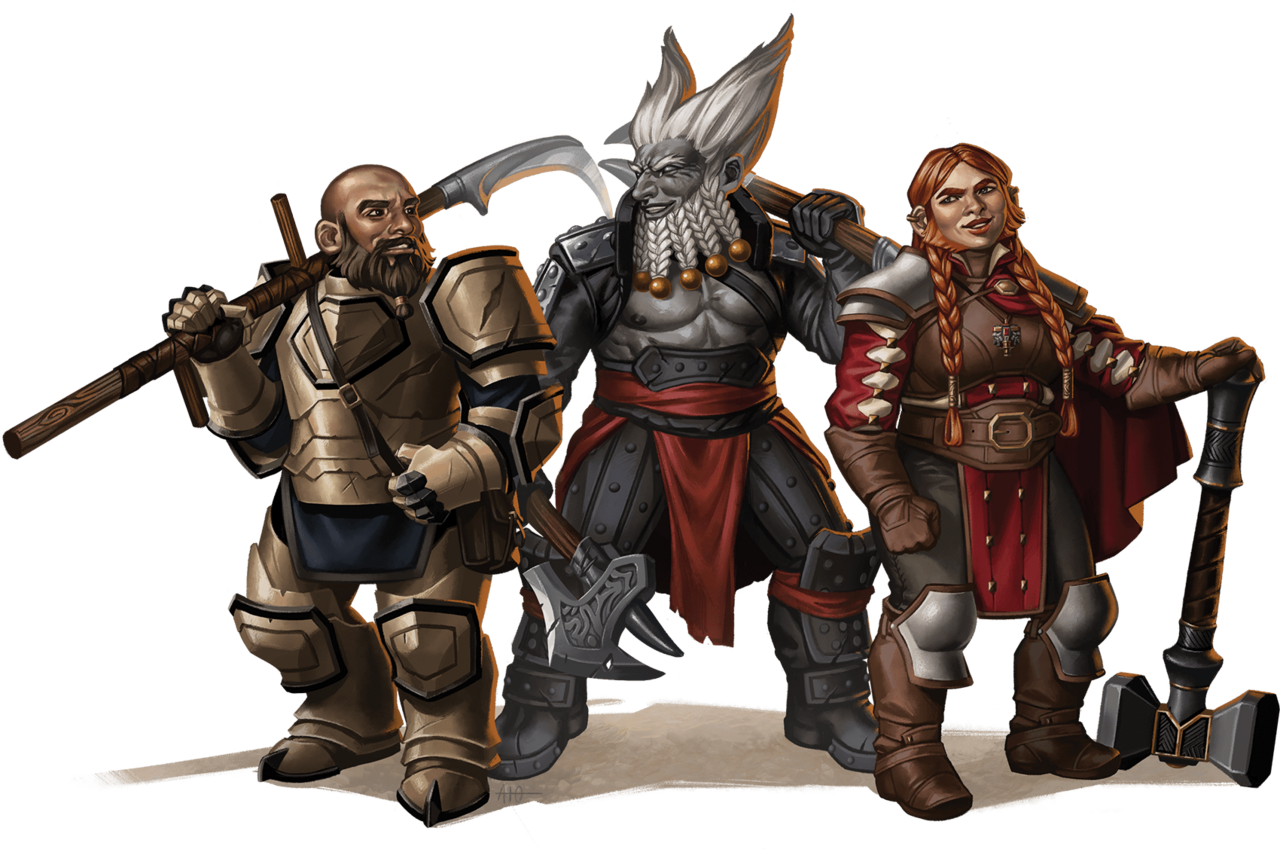
These members of the Dwarvish race, referred to as Hill Dwarves for their choice to roam freely upon the surface of Yyrda rather than return to what remains of their ancestral undercities, are typically far more open-minded and amicable with non-dwarven races. Their time on the surface has also subtly changed their features, with eyes and skin accustomed to the sun and fresh air; while not adverse to spending long stretches beneath the ground, many Hill Dwarves eventually yearn for the open spaces they have grown fond of during their long exile upon what they refer to as the Crust of the Earth.
Some Dwarves, however, stubbornly adhere to the Old Ways, maintaining the last remaining holdings beneath the Mountains of Sky; the last of the Great Dwarfholds, Stonebeard Citadel, still stands nearly as resplendent as it did in the Golden Age of the first Empires (before even the elves knew the front end of a hammer, many Dwarves would say). These remnants are known as Mountain Dwarves for the heritage they claim from their forefathers–and for their far greater likelihood to be found under stone than aboveground. Mountain Dwarves, unlike the more amicable cousins, are more likely to be rigid, humorless, and suspicious of outsiders, although their pride and strength in their Dwarven identity rivals that of the most illustrious of the Eldar High Elves. Politically, the Mountain Dwarves maintain a strong presence in the Westerlands, their armies rivaling if not exceeding those of Faedrun and other Falinorian Tributaries; although they were ultimately defeated in the Falinorian conquest and owe them their begrudging allegiance and tribute, their remoteness has allowed them a greater degree of autonomy than many other subject states, and the vast riches from their hidden mines beneath the earth has given them a distinct advantage in the mercantile economy of the Westerland guilds–when they deign to participate in dealings with non-dwarves.
[Note--Some Hill Dwarves, after generations on the surface, did eventually return to their mountain halls and reintegrate with their Mountain Dwarf brethren; and some Mountain Dwarves have made the decision to question the ways of the past and join their tanned surface brothers on the sunlit Crust.]
Little is known about the third type of Dwarf in Yyrda, the Grey Dwarves who, seeing the fall of their once-proud Citadels, sought to escape the pain of their loss by digging deep enough to the earth that they might at last lose themselves, or reunite with the depths that once gave them birth. A handful of Drow who have made it back to the surface in recent years speak of encounters with this mysterious group, but not much is known about the extent of their presence in the earth far beneath their ancestral halls.
While the Dwarven Fatherlands are held to lie beneath the now-shattered range known as the Mountains of Sky, Dwarven histories hold that their citadels and subterranean networks stretched beneath not only the Dragonsbane Mountains in the east but the long-lost peaks known to legend as Bara’s Spine. However, since the Dragon War and the event known to the Dwarves as the Breaking, the vast majority of these once-great underground cities have been lost, with the majority of the known remaining dwarven population living on the surface in the diaspora, most to some degree disillusioned with the ways of their forefathers due to events few will speak of to outsiders, but many whisper has to do with a cataclysmic betrayal by either their gods or their ancestors, or perhaps both.
These members of the Dwarvish race, referred to as Hill Dwarves for their choice to roam freely upon the surface of Yyrda rather than return to what remains of their ancestral undercities, are typically far more open-minded and amicable with non-dwarven races. Their time on the surface has also subtly changed their features, with eyes and skin accustomed to the sun and fresh air; while not adverse to spending long stretches beneath the ground, many Hill Dwarves eventually yearn for the open spaces they have grown fond of during their long exile upon what they refer to as the Crust of the Earth.
Some Dwarves, however, stubbornly adhere to the Old Ways, maintaining the last remaining holdings beneath the Mountains of Sky; the last of the Great Dwarfholds, Stonebeard Citadel, still stands nearly as resplendent as it did in the Golden Age of the first Empires (before even the elves knew the front end of a hammer, many Dwarves would say). These remnants are known as Mountain Dwarves for the heritage they claim from their forefathers–and for their far greater likelihood to be found under stone than aboveground. Mountain Dwarves, unlike the more amicable cousins, are more likely to be rigid, humorless, and suspicious of outsiders, although their pride and strength in their Dwarven identity rivals that of the most illustrious of the Eldar High Elves. Politically, the Mountain Dwarves maintain a strong presence in the Westerlands, their armies rivaling if not exceeding those of Faedrun and other Falinorian Tributaries; although they were ultimately defeated in the Falinorian conquest and owe them their begrudging allegiance and tribute, their remoteness has allowed them a greater degree of autonomy than many other subject states, and the vast riches from their hidden mines beneath the earth has given them a distinct advantage in the mercantile economy of the Westerland guilds–when they deign to participate in dealings with non-dwarves.
[Note--Some Hill Dwarves, after generations on the surface, did eventually return to their mountain halls and reintegrate with their Mountain Dwarf brethren; and some Mountain Dwarves have made the decision to question the ways of the past and join their tanned surface brothers on the sunlit Crust.]
Little is known about the third type of Dwarf in Yyrda, the Grey Dwarves who, seeing the fall of their once-proud Citadels, sought to escape the pain of their loss by digging deep enough to the earth that they might at last lose themselves, or reunite with the depths that once gave them birth. A handful of Drow who have made it back to the surface in recent years speak of encounters with this mysterious group, but not much is known about the extent of their presence in the earth far beneath their ancestral halls.
