
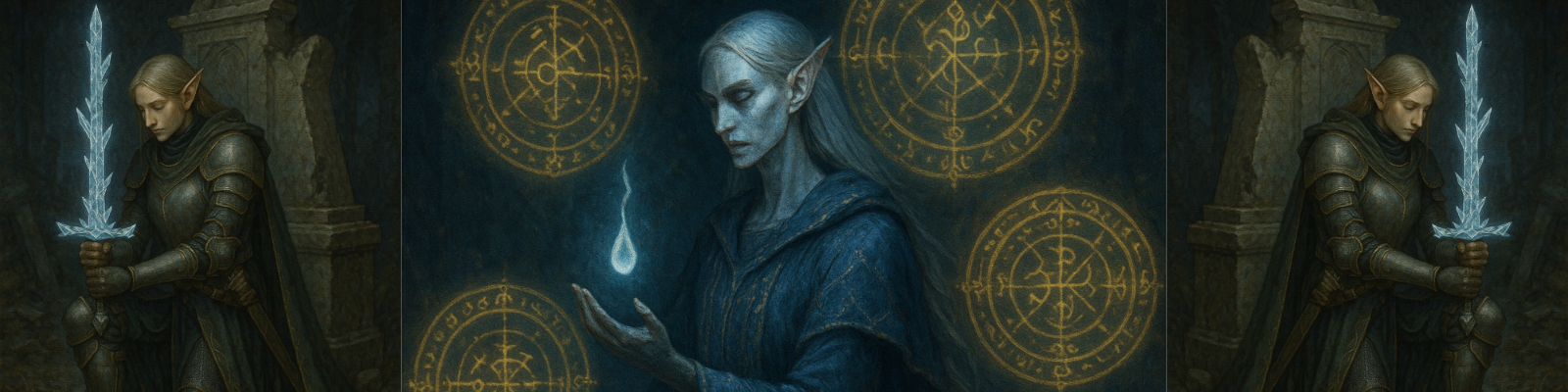
Duskwyrm Elves
“We do not live. We remember. We do not age. We unravel.”
– Shaelir Veyn’sorrow, the Weeping Archivist
The Duskwyrm Elves, called the Veyndralir in their own glimmering, whisper-soft tongue, are a dying lineage of highborn fae-beings; memory-bound, soul-worn, and too ancient to be young again. Their culture is rooted not in the present but in the weight of the past, a past that seeps into everything they do, feel, speak, or conjure. They are not mortals who remember, but memories that have forgotten how to die. These elves are the descendants of a splintered celestial race, once stewards of stellar magics and dreams, who were cast down during the fall of the Starvault Concord. Where others moved on, the Veyndralir bound themselves to remembrance and sorrow, becoming living reliquaries of forgotten epochs. Their identity is shaped by their origin as keepers of starlit history, mourners of lost civilizations, and archivists of divine betrayal.
Twilight Existence
Duskwyrm Elves are most active beneath moonlight or starlight, and their cities are built deep in hollowed earth, subterranean sanctuaries called Hollowholds, where enchanted mirrors on the ceilings reflect the sky above. These great cities, such as Nythrelmere and Veymr’s Lament, serve not as homes but as tombs that remember. To walk among the Veyndralir is to step into a world where the air itself carries whispers of ancestral grief. They do not believe in “time” as a linear force. Instead, their lives are woven into a lattice of shared memory called the Glyphtide, a soul-binding network that allows ancient experiences to pass between generations. An old elf may dream the birth of a child not yet conceived, or a young apprentice may suddenly know the sword-forms of a long-dead knight. To them, knowledge is not taught, it is relived.Tears That Spell Reality
The Duskwyrm Elves’ signature magic, lacrimancy, is an arcane practice that uses tears (infused with memory, emotion, and resonance) to alter reality. Their spells are cast not with incantations, but with weeping, humming, or silent gestures that manipulate the ambient Anamnesis Field, an unseen tide of psychic memory energy. Their tears are alchemically potent: sorrow grants shielding, joy sparks flame, regret fuels divination. A single vial of an elf’s tears can hold a century of trauma or love and be weaponized or treasured in kind. This rare magic is both feared and revered, and many believe it is the last echo of a dead god’s heart.Knights of Sorrow, Blades of Echo
Among the most feared and venerated of the Duskwyrm, the Veilwardens are an elite order of warrior-philosophers bound by sacred oaths of remembrance. Their blades, crafted of shardglass, a shimmering crystal harvested from fallen memory-stars, cut not flesh but legacy. A single strike can cause an enemy to forget their name or relive the pain of every battle they've lost. Veilwardens kneel not before gods, but before monuments to the fallen. Their code forbids personal glory. They fight so that the stories of others are not forgotten. They carry no banners, only silent sorrow. Their armor is engraved with tear-glyphs of the comrades they’ve buried. Each plate added is not a mark of promotion, but a wound remembered.Faith Without Gods
The Duskwyrm Elves once served the Celestarchs, divine entities who danced among stars and dreamt of worlds. When the Celestarchs abandoned them (or died, as some say) the Veyndralir refused to forget. They became grief incarnate, worshiping memory itself as a sacred force. Their temples are silent chambers called Echo Sanctums, built not to commune with gods but to listen to ancestral sorrows. Priestesses known as Teardamsyls serve as spiritual guides. They do not preach; they sing memories in ritual canticles, called Sorrow Hymns, during rites of birth, bonding, and death. Most do so with veils over their eyes, for vision is considered a distraction from truth.Architecture of Grief
Their structures blend seamlessly with their philosophy: elongated spires of mirrorstone, underground vaults lit by artificial constellations, spiral sanctums where time and direction dissolve. Homes are often circular or open-ended, symbolizing the eternal nature of memory and the rejection of finality. Decor is minimal, but every surface means something; walls carved with glyphs only visible during eclipses, floor tiles aligned with historical events, ceiling stars mirroring the exact sky on the night a loved one died. No building is ever torn down. If abandoned, it is wrapped in mourning silks and sealed with a glyph of forgetting. The act of demolition is a cultural horror.Slow Decline, Quiet Extinction
The Veyndralir are dwindling. Each generation is smaller than the last, and their fertility has waned almost entirely. Many believe this is due to their unbreakable bond to the past: there is no room for new souls while the old remain. Births are sacred and rare. Each new child is named not for hope, but for the one whose death made space for them. Some among them seek to sever the Glyphtide, to forget the past and reclaim a future. These rebels, often exiled, are called The Dyrneless, and their existence is a painful topic for most communities.Philosophy of Remembrance
“To forget is to betray. To betray is to unmake.” This mantra summarizes the Veyndralir's entire outlook. They do not believe in moving on. Suffering must be honored. Joy must be preserved. Silence is not emptiness; it is memory echoing in dignity. While outsiders may see them as tragic or overly solemn, the Duskwyrm Elves find immense beauty in what others fear. To weep is not weakness, it is worship. To mourn is not despair, it is resistance. And to remember is the highest form of love.Naming Traditions
Feminine names
Shaelyra, Naevessa, Elunwe, Merineth, A’lorien, Veynthara, Lysielle, Tírwen.
Masculine names
Thalior, Veyndar, Corviel, Relynth, Zaremmor, Daurion, Elphirith, Malrikhael.
Unisex names
Sylthiel, Auranir, Qorellan, Eryndros, Ylaeth, Sorien, Velisthar.
Family names
Veymrill, Ithweir, Sorrowhymn, Elthynra, Duskmourn, Qavelys, Starhollow, Rilthwen.
Other names
- Tearmaiden — Priestess of ancestral sorrow
- Dyrnebinder — Wielder of memory-forged weapons
- Echoforged — A soul reborn with residual memories
- Hollowblade — Knight who lost their name in battle
- Glypheir — Seer of forgotten truths
Culture
Major language groups and dialects
- Veynthiri: Root tongue of the Veyndralir
- Elun’seir: Ritual dialect used for spellweaving
- Glasscript: A silent language written in tear-glyphs, visible only under moonlight
Culture and cultural heritage
- Memory operas sung without words using glyphs and gestures
- Ancestral pain preserved in starcrystals
- Festivals held on eclipses, where “time folds”
Shared customary codes and values
- “To forget is to betray the past.”
- All actions must honor memory, legacy, or the pain that shaped it.
- Silence is sacred in ancestral grounds.
- Wounds are never hidden; they are shown as proof of devotion.
Average technological level
While the Veyndralir eschew industrial or mechanical innovation, their civilization operates at an extraordinarily high level of arcane-magical advancement; especially in disciplines involving memory, light, sound, and soul-binding. Their technology does not resemble mortal constructs of stone or steel but rather ethereal, semi-sentient structures and tools derived from emotion-infused materials.
Common Etiquette rules
- Never speak someone’s name aloud without permission
- Offer memory-silence (a bowed head) to those grieving
- Formal greetings involve touching crystal tokens
Common Dress code
- Long trailing robes, veil hoods, crystal-stitched fabrics
- Armor is worn only ceremonially unless one is a Veilwarden
- Sashes denote memory-rank (white = youth, indigo = elder)
Art & Architecture
- Cavern cities lit by mirrored constellations
- Artifacts woven from memory-strands or whisperglass
- Mosaics shaped like tears, floors carved in spirals of grief
Foods & Cuisine
- Glowing root vegetables, misty mushrooms, and tearfruit
- Elixirs brewed from dew and lunar sap
- Meals served cold, symbolic of mourning and memory
Common Customs, traditions and rituals
- Memory Silence: A common sign of respect, where one lowers their head, closes their eyes, and ceases all breath or motion for exactly three heartbeats. Practiced during greetings, departures, or after witnessing acts of sacrifice.
- Crystal Token Exchange: When meeting for the first time or parting for the last, Veyndralir exchange tiny slivers of soulglass etched with personal glyphs—memories captured in solid form. These are carried on the person like a talisman.
- Moonlight Offerings: On cloudless nights, food, art, or tears are left under moonlight for lost ancestors. It is believed that ancestors "read" these offerings as language.
- Shared Dreaming: Families and bonded groups frequently participate in ritual trance-states guided by a Tearmaiden. These shared dreams allow for deep empathic connection and spiritual recalibration.
- The Long Weep: Once per decade, entire Hollowholds enter a day of mourning where no one speaks. Art is created, wounds are honored, and old grudges may be ritually released via lacrimage; tears spilled with intent.
- Gesture-Only Hours: On days marking personal loss, many Veyndralir observe “The Quiet Span,” communicating entirely through gesture, glyph, and motion to let the silence of remembrance speak louder than words.
Birth & Baptismal Rites
- Infants are bathed in moonwater while names are sung in reverse
- Each child receives a “first tear;" a single, enchanted drop from a parent
Coming of Age Rites
- Called Glyphember, when the child casts their first memory glyph
- Typically occurs after their first dream of a life they have not lived
Funerary and Memorial customs
- Bodies are dissolved in Rootglass Pools
- Ash is mixed into memory-ink and stored in spellbooks
- Mourners gift a final memory to the dead via “griefscript”
Common Taboos
- Forgetting a loved one’s face (punishable by exile)
- Desecrating a soul-crystal
- Speaking during a lunar rite
- Laughing near ancestral monuments
Common Myths and Legends
- The First Tear: A star goddess wept the world into being
- The Dyrnefall: The Veilwardens once turned a meteor into the first sword
- The Echo Song: A cursed melody that summons every ancestor's final thoughts
Historical figures
- Veymelle the Silent — First martyr of the Veilwardens
- Thaurion the Hollow Voice — Invented griefscript
- El’saria Starblight — Betrayer who tried to burn the memory vaults
- Shaelir Veyn’sorrow — Committed mass dream-suicide to prevent memory collapse
Ideals
Beauty Ideals
- Ethereal stillness
- Veiled eyes or bioluminescent tears
- Graceful decay (wilted florals, faded silks, tear-stains)
- Body markings of starlight scars or glowing veins
Gender Ideals
- Gender is seen as a spiritual resonance, not a binary
- Teardamsyls are traditionally femme but not always female
- Masculine-presenting elves often serve as guardians or lament-blades
- No social division in duty or power
Courtship Ideals
- Expressed through “shared remembering” (reliving core memories together)
- Lovers gift each other preserved tears in crystal vials
- Courtship may take centuries; urgency is considered dishonorable
Relationship Ideals
- Polyamory is common among soul-bonded groups
- Marriages are often bound by shared oaths to specific memories or ideals
- Jealousy is considered a sign of soul-fracture
Major organizations
- The Veilwardens (memory-bound knights)
- The Teardamsyls (theocratic spell-singers)
- The Chorus of Sorrow (wandering philosophers)
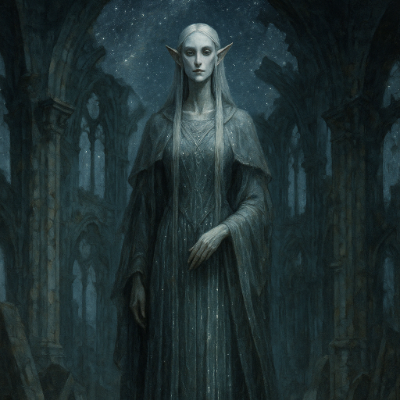
Duskwyrm Elf by SheWolfSymphony


Comments