
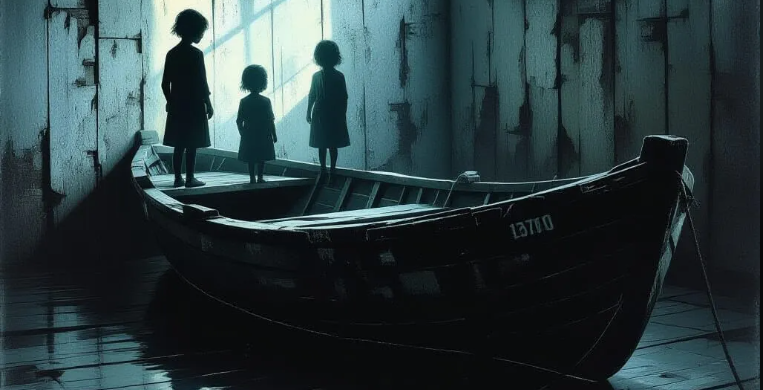
L.T. File: 098: Hùrtajznǔ - Shadow Children
While on the open sea, Aulvi and other sailors have reported seeing the shadows of children on the decks, against the walls of the ships, and deep in the below decks. They never make sounds, but occasionally something like words appear to those who follow the shadows. Sometimes letters in an ancient text appear in the rice stores or seemingly written in the flour as it pours from the sack.
Research suggests that the language is also occasionally found on ancient Ngākauwhenuen artifacts found in the deep dives. Translations are still being worked on, but the characters drawn by sailors match exactly the characters from the ancient items, though the civilization those items came from has been long lost.
The shadows are never adult, and consistently avoid the direct gaze of sailors. Some sailors who have been on the seas over the Rift for too long report dreams of explosions and fallen civilizations. They remember the same cities and the same situations as other sailors. It is uncanny across species and culture. Anadi, Aulvi, Hugh, Zevemlyan, Pirate, slave... all have dreams with similar, almost exact details that two people should not share, that are occasionally confirmed by artifcts found later. Sometimes child-sized handprints appear on ships with no children.
The Shadow children seem to increase activity the closer to the Rift, and are unheard of outside of Hechesoia with the exception of ships carrying cargo, and museums, and storage spaces for collectors of the ancient items. Collectors, and therefore the Twilight Shadows, have great interest in obtaining these items. Collectors for the dreams, Twilight shadows for the information that the dreams might contain when researched with proper safety protocols. The only thing all people who have these dreams have in common is the name of the people they thought they were in their dream- Dabèjyá.
Summary
I. The Log of Hānere “Bone-Eater” Takawhenua
(Recovered from the wreck of the Maunga o te Kōura, found drifting three leagues east of the Green Shoals.)
Ain’t slept right in six nights.
Storms don’t bother me. I’ve had worse than these waves. But what’s walking our decks now— that’s no storm.
We took that idol three days out from the Rift. Silver thing, smooth like a child’s skull, faces carved all ‘round it. Looked like they were laughing.The boys joked it was lucky.
It ain’t.
First night, I saw shadows move when no light was there.Small ones, like kids running. Thought it was rum or bad lanterns. But they kept to the walls, kept to the corners. When I looked right at ‘em, they were gone. When I turned away, they were closer.
Second night, I heard them. Not loud—just playing. Soft feet. Laughter under the waves, like the sea had children of its own. I spat overboard and told it to keep ‘em. Sea didn’t listen. Idol started leaking salt like it was crying.
By the fourth night, even the hard ones were whispering prayers. We wrapped the idol and tossed it. Should’ve sunk fast, but it floated, shining in the moonlight, like it was watching us go. Didn’t matter. Shadows stayed.
Now they walk beside us. One sits by my bunk when I wake. Looks like my girl back home, hair over her face, knees hugged tight. She don’t move. She just is. And when I try to touch her, my hand passes through the dark. Men talk about going overboard. Some already have. Say the water’s whispering their names. I told ‘em it’s in their heads. But tonight, I saw something I can’t shake. My own shadow weren’t where it should be. It was kneeling beside the small one, like it was trying to hold her.
I don’t write good, but I know this much— whatever’s out there remembers us better than we remember ourselves.
And I think the sea remembers what we did to it. If anyone finds this, don’t sail near the Rift. Don’t take what ain’t yours.
And if you see the shadows of children—
don’t look ‘em in the eyes.
They remember you too.
Note from Director Sashine- Onyx Wind: Due to lack of dates and reliable sources it is difficult to determine if this is, in fact Hùrtajznǔ, or some related phenomena. Shadows are consistent, but remain when perceived. Could have something to do with this floating idol that cries salt. Superstition among pirates may account for additional paranoid hallucinations, but in this line of work, we must assume that this idol is dangerous, and has properties not endemic to Hùrtajznǔ. Should the idol arise, treat it as a fourth sphere danger until otherwise quantified.
-Addendum Director Sashine- Onyx Wind : relay fourth sphere danger, increase to fifth for containment.
II. Curator’s Report – Library of the Son, Lèùl Shlùr̈ùl
Filed under Restricted Collection: “Anomalous Acquisitions — D’ɞ Fragment”
Curator: Ṣhèen Vahlirë- Watershed, Linguistics Division
Entry 1:
The manuscript arrived in perfect condition, though the courier swore it was found “in the shallows near the Rift.”
Bound in pale barkcloth, ink still wet-smelling. The language is not of any recorded aulven root. It appears to be a children’s book — illustrations of joyful scenes: a market, a garden, children with small glowing spheres hovering over their palms.
No text has yet been deciphered.
Entry 2:
I have noticed… movement. When I glance away, pages turn of their own accord, never violently, just as if being read.
Several times I have returned to find the book open to a page I did not mark — always the same one: children beneath a black sun, their faces lit by something unseen.
Their shadows are too sharp.
Entry 3:
The evening staff have begun avoiding my alcove. They say they hear small feet in the corridor after midnight.
Today, while preparing to copy the images, I caught the smallest tilt of a head on the page. I swear the ink had shifted. The child looked toward me. When I blinked, the image was still again — but the shadow beneath her hand now touched the edge of the frame, as if reaching out of it.
Entry 4:
I covered the manuscript and went to the reflection pool to compose myself. When I returned, my lamp had gone out. The room was very still. Yet from under the cloth came a soft rustling, the sound of turning pages, faster now, urgent. I dared not look. I only whispered to the darkness that I meant no harm. The sound stopped. Then, just once, a child’s voice — not cruel, not kind, perhaps mournful — whispered:
"ḍẓɞýæmóǵ’u ngå"
Entry 5:
I am relocating the manuscript to the Tranquil Shadows. For now, I will not enter the reading room at night. The silhouettes under the lamplight are too many for one man to cast, but they lessen each day the book is in the care of the Shadows.
III. Transcript Fragment – Dreamwalk Observation (Tranquil Shadows Archive)
Dreamwalker: Elir Maulien, 2nd Circle Dreamwalker
Site: Sanctum Tranquillus, Chamber of Quiet Waters.
Objective: To observe residual dream-culture of D’ɞ through artifact connection
Preparation:
Circle sealed. Mirrors warded. The Codex of Substrata set open to anchor the descent. Focus sigil: “To see what the world remembers.” three higher circle members present to oversee: Ocean Mist, 3rd circle dreamwalker , Black Ivy, 4th Circle Dreamwalker , and Director Sashine.
Phase 1 – Entry:
I step into stillness.
The dream comes not as a place, but a texture—soft as woven grass, humming faintly, like voices behind a curtain.
I sense laughter, bright and clean, but it fractures on approach. As if this shadow world is made of rice paper, and the strength of my psychic aura is too much, even with so little training. Each echo belongs to someone who no longer exists.
Phase 2 – Contact:
Shapes form — children, I think. Their faces are not complete faces, but impressions of joy. They play in circles of light, tossing orbs of memory between them. Each orb glows with something that wants to be language. I reach toward one, and it bursts like pollen. A voice follows:
“Dabèjyá.”
The sound strikes deep — not in my ears, but in my bones. I try to repeat it, but the meaning slips away, as if the word itself refuses to survive its translation. I sense a warning, a grief, a forgiveness. Perhaps all three.
Phase 3 – Observation:
The world-memory is kind. It does not lash out. It wants only to be witnessed. But when I press for more — to understand what Dabèjyá means — the children turn to me in unison. Their shadows stretch behind them, and I see what cast them: no light at all, only the outline of the past burning itself into the present. The realization breaks the dream.
I surface gasping, hands trembling.
Notes (upon waking):
We were wrong to call them “ghosts.” They are remembrance made sentient through sorrow. If Dabèjyá is their word for anything, it may mean “that which must not be repeated.” The world itself dreams of its mistakes.
Note from Director Sashine- Onyx Wind: Translation was based on impression, not knowledge. Preserved for accuracy of note, not accuracy of phenomenal linguistics. Will provide additional note-training for Elir as his human mind has not completely shattered the dream when attempting to access it. Continued attempts and training for dream conversion are intended at this time for operative Maulien.

Comments