
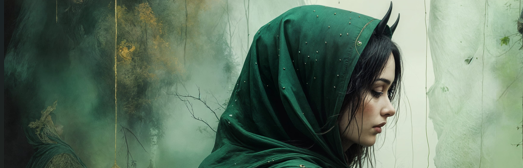
L.T. File: 037:Juhlï'ṭṣín-Lady in Green
Betrayal. It is among the deepest hurts and hardest of memories. Deciding to do it destroys you, and seeking vengeance for it defines you. Long, Long ago, before mortals walked the survace of Vyům a great betrayal took place in the heart of the world. An Aulvi mother betrayed by he one she loved, he one with whom she had raised children. Her lover, who's name has been lost to history traded her and her children to those who dwell below, suggested them for an experiment rather than themself. Those who dwell below, those who so pridefully exercise every chance to experiment for the knowledge of pain and insight that it gives, took the offer.
The mother was put through grueling, torturous, experimentation that her children did not survive. She was transformed, but also was left as she was. She broke containment and hunted her betraying lover. It is unclear whether she found them, but what is clear, is that she was one of, if not the, first Aulvi to escape the Below. Those who hunted her never returned, and the hunt was not deemed important after some time, and those who dwell below Wrote her off.
In every culture on Vyům, save perhaps Kaigaran and Hueian cultures there are stories about things tht go bump in the night, superstitions about being good to thine neighbor, and commandments to be faithful to those you love. Especially those with whom you have had children. Of course most betrayals go unpunished, and some are mercifully punished by local laws. Others, however have the mischance of coming face to face with the bogeywoman of betrayal's vengeance -Juhlï'ṭṣín. Some know her as Juhli, others call her the eater of betrayal, still others refer to her as the woman-... or the thing- in green.
Some legends state that she devours those who betray the lovers they've born children with. Other myths suggest that she lures them away to drink their blood, still others suggest that darker, more terrible things occur. Unfortunately for those who commit this particular sin... all three are true.
She is described in every bit of lore as a woman of average height and smooth features, but pointed ears, and two green horns sprouting from above her brow ridge. She always wears green, though, strangely, it always seems to be one trend out of modern fashion. Before the Aulvi reached the surface, her origins were unknown, and some attributed her to the fey, and were not so far off from the truth, for like her elder cousins, she is a thing twisted by a singular purpose, but is neither singularly aulvi, fey, or aberration.
When she finds her victim, she will lure them away from any innocent observers and take on her form of dread. No two accounts match, as is often true of those who dwell below. Their forms are so alien that no two mortal beings will see the same horror, though many suggest similar terrible features: tentacles that grow to be much larger than she could appear to be, teeth and glowing olive eyes covering every surface of her form, an offness and simultaneous stiffness and fluidity that cannot linger together in one space together too long in a mortal space before changing it from the real to the unreal. Once this form is taken, she unravels and unmakes her prey in a fashion, not unlike what the scientists from the order of the drift suggest might occur on the event horizon of a singularity. A nihility of oblivious space, a vacuum and hollowness full of lack. Vacant, save for the somehow green feeling of nothingness within desolate vacuity of null. Even the screams of her prey are drawn in, as though to prevent the world from hearing their pleas for help and mercy.
-Editors note (Seaglass ) - this sounds very unplesant
Beyond this, when she is done, there is not a single cell that remains in the area of her prey, and she morphs back into the form of a horned woman with soft features.
Despite her extreme prejudice towards betrayers, Juhlï'ṭṣín is often noted to be kind to others who deserve it, and even those who are unkind to her are unlikely to find themselves spaghettified (again, a term from the order of the drift.) as that method of vengeance is saved solely for those who are the focus of her hunt. Juhlï'ṭṣín seeks out orphans who are not living in safe spaces and fosters them unti she can find them safe homes, often in Aulvi settlements. Battered women and men are often also taken into her care and protected for a time, until they get the help they need. In these circumstances she will take various names, all having to do with the color green, or with the specific name Juhlï.
Juhlï is also known to take lovers, both male and female, primarily human or Aulvi. She is reported to be, in every tangible way like an Aulvi during these encounters, and is described as warm, loving, gentle, and even shy during romantic encounters. She always explains that she cannot stay together long, but that if she returns during the person's lifetime, she will search them out. She is often seen visiting ancient burial mounds to leave olive branches and green flowers native to the region.
To orphans and battered individuals, she is known instead as the Olive mother, and her assistance has earned her a holiday among the Aulvi: Olive Day is a day of celebration of families, and orphans, and caring for others. It is also a reminder as to why the Aulvi do what they do for each other.
- Editor's note (Seaglass) it is the recommendation of this Writer that the threat level be -Uhŕ for the purpose of her kindness to others, and that the typical threat level of -Plèṭṣïb̧ be waived as a result of the fact that despite the methods, she is only punishing the wicked, and has never shown the propensity to harm anyone else.
-Seaglass
Summary
I. Firsthand Accounts
A. Survivor Account — Aulvi Ranger
I was patrolling the river terraces when I heard someone calling my name. Not shouting. Calling. A woman’s voice. I followed it like a child chasing a memory.
She stood beneath the willow, dressed in green. Soft face, delicate green lace. Horns like polished jade.
"Go home," she told me. "Tonight is not for you."
I asked what was happening, foolishly. She touched my cheek—a kindness so gentle it made my throat hurt.
"Go home," she repeated. "Your heart is clean."
I ran. I don’t know why. I think she eased the fear in me on purpose.
When I looked back, she was gone.
B. Third-Person Account — Consumption Event
He saw her lead the man away from camp. The betrayer laughed, thinking her a midnight tryst. The witness followed at a distance, curious, half-asleep. Then the woods folded. The woman in green grew tall—no, deep—stretching forward like a shadow cast by an invisible sun. Her limbs multiplied. Teeth glittered in places where teeth should never be. Olive eyes blinked open across her skin like lanterns drowning, like the sky opening onto infinite stars in an even greater infinite void.
The betrayer didn’t have time to scream. His voice was stolen before he made it. Reality bent inward. Colors drained except the wrong shade of green. The man was pulled apart without ripping—unwound like thread sucked into a hole with no bottom and yet full of endless weight. The void swallowed everything: breath, light, hope.
When it ended, Juhlï’ṭṣín stood alone beneath the trees, smoothing her dress as though adjusting a wrinkle. She looked toward the witness. He fainted. She must have carried him back to camp and tucked him into his own bedroll. He was found in the fetal position muttering "Green Lady" over and over again. He has recovered from the trauma of the event, but refuses to go out in the woods alone anymore.
C. Account from an Adult Survivor of Abuse
I was hiding in the ruins when she found me. I thought she’d kill me like the stories said. Instead she wrapped a blanket around my shoulders. It smelled like moss after rainfall.
"You are safe," she said. "I am here only to help you leave."
She didn’t rush me. Not once. She waited until I could stand, then guided me to an Aulvi caravan.
When I turned to thank her, she was already gone
II. A Lover’s Sonnet
Written by Denosceir, Chosen of Sharellius. A legendary poet of the Mirevi people before the rule of Galvander, who loved her and was not betrayed in 1,289 (pre)
“Sonnet of the Olive's Return”
O olive flame who walks where sorrows gather,
Whose gentle hands once traced my weary skin,
You came at dusk when all my thoughts would blather,
And breathed green dawn to stir my heart again.
You bore no chains though forged in grief and fire,
Your horns were soft as river-polished stone;
You held me close yet warned me of desire—
That you must wander, hunting prey alone.
Still, when the moons turn pale with winter’s ache,
I feel your warmth in dreams of moss and vine;
I wake to rings of olive in your wake,
Proof that our fleeting nights were truly mine.
Return once more, though decades stand between—
My heart will know the woman robed in green.
Archivist's note: It was never clear whether Denosceir ever re-met his lady love, though this poem led to a number of his more famous plays having a theme where the female lead was an Injurae, which roughly translates to world-wise injenue, seemingly innocent and pure, but knowledgable and often with a dark secret in her past. These Injurae defined his works, and always wore green, either completely, or hidden somewhere on their costume, and often had hints of green in their makeup and other lighting elements.These works were considered well ahead of their time for gender equality, and were very well-received, but have gorwn even more popular as time has passed.
There have been accounts following his death in 1,228 of a green-clad woman leaving olive branches at his grave. This is of especial note following the era of Zevemlya, due to the fact that the gravestone is in the ghost-mists, but close enough to the city of Iron-ridge to be seen from the ramparts on the northern wall. The ghost-mists seem to shy away from the green woman, and it is reported that the olive branches deter ghosts for days after being left. - Birdsong- Cillia Cilli
III. Children’s Accounts — The Olive Mother
A. Aulvi Child (Age 8)
"She braided my hair because I was crying. I was wearing a green dress. She said green was a strong color. I told her we matched. She laughed. She told me I would find a home where people shared their food. She was right!"
B. Human Child (Age 6)
"Her horns were shiny. She carried me on her back like my mom used to before the fire. She didn’t let the bad man near me again. She gave me a flower that never wilted."
C. Anadi Spiderling ( Age 5)
"She hummed a web-song! Not the right words but she tried. I told her she was doing it wrong and she laughed. She kept me warm until the shadow-walkers came. She smelled like soap, or that green leaf some people put on food to make it taste like soap."
D. Mixed-Orphan Group Testimony
"She never said goodbye. She just left us with the Aulvi and smiled. We all knew she had other kids to save, but we hope to see her again to thank her."

Beautiful
Thank you!