

Vreathe Technology
AUTHOR's NOTE - This Article is from an out of universe point of view. It references the Earth, real world time periods, and equivalent technologies and trends from our own history. Vreathe's technology level is generally in the early 1800's earth equivalent, but due to the prevalence of magic, old technology from the Silver Age, and Elves generally being more advanced than humans, some technology can be from as late as the 1950's earth equivalent, while some older technology dates as far back as the 1500-1600's earth equivalent is still in use with little actual advancement.
Food Preservation
Food preservation in the World of Vreathe has always been somewhat easy, at least for the Elves, thanks to Death Magic. This class of mana manipulation causes cells to spontaneously kill themselves and it can sever connections in a body's nervous system. Low levels of death magic can kill bacteria and virus cells, but generally leaves plants and animals unaffected. Slightly higher levels of death magic can kill fungi, parasites, and small insects but can cause localized damage in larger creatures. The Elves have been taking advantage of this for many thousands of years to make their food last much longer, and this could be considered a form of Pasteurization.
Because the Elves can just death magic away any harmful bacteria, their traditional food tends to be completely uncooked and the number of raw meat dishes they have far exceeds the number that any Human culture has. In current times however, due to urbanization and industrialization, most Elves do not handle their own food and they eat just as much cooked meats and other foods as Humans do. Between the handling, packaging, variations of temperature storage, something might have grown in the food regardless of how much death magic was used in the process.
Humans on the other hand are not very adept at mana manipulation and are generally unable to just cast a spell to make their food last longer. Humans have resorted to various methods to preserve food from drying and smoking it, to covering it with salt, pickling it, and more. Most food preservation technology on Vreathe was born out of a human need to make their food last longer.
| Name | Description |
|---|---|
Canning |
Canning has been around on Vreathe for roughly 150 years and was invented by Humans in Verdina. Looking for a method of preserving food for very long periods of time, it was observed that cooking food in a sealed jar would allow the food to last for up to five years without spoiling. At first, tinted glass jars, sealed with a tin lid were used. Later tin cans and then steel cans were used when it became viable to mass produce them, though this advancement is only around 50 years old. Metal cans have taken on a variety of shapes, from simple cylinders, to more rectangular shapes. Can openers for tin/steel cans are a different story. These have been around for only 100 years. In older days, cans were opened with a hammer and chisel. In current times, Twist-Key openers are common, as are rotating wheel openers. |
Refrigeration
|
Nearly all forms of refrigeration on Vreathe involves the use of cutting and transporting of blocks of Ice. Ice is a crystal and therefore an Aethercite. Ice charged with Aether will stay frozen and destroy surrounding heat energy, and can stay frozen for decades. Naturally occurring aetheric ice is found at the tops of icy peaks where it is quite dangerous to acquire. Ice Houses to store excess ice are common everywhere.
Cassel is a lucky kingdom because it controls the Aelurus Islands to the southeast and therefore controls the northern half of Nivema's Sorrow, a massive ice sheet that is forever frozen. Ice here is regularly harvested and traded across the world. Ice from Nivema's Sorrow can stay frozen indefinitely, even with no aether charge, making it desirable over other forms of ice. |
Refrigeration
|
For kingdoms that aren't as lucky as Cassel, mechanical forms of refrigeration have been developed, utilizing a vapor-compression system. This system uses a circulating coolant that compresses into a high temperature and pressure, then when it expands, it rapidly cools, absorbing heat from an enclosed area. This system was invented in the Elf-Kingdom of Faeon around 50 years ago, though scientists in the Human kingdom of Galleska have ben working on prototypes for about a century earlier.
This kind of mechanical refrigeration is only available at an industrial scale, and is used to produce large amounts of Ice. This ice is then charged with Aether then distributed to various ice houses. |
Pasteurization
|
In current times, beer, wine, and other juices are pasteurized by applying a low amount of heat after it is packaged. This process was discovered roughly 100 years ago and isn't that different from canning. The major difference is that pasteurized food isn't cooked. Depending on the product, the shelf life of food can be extended by a few weeks to many years. It should be noted that the technology isn't there to pasteurize milk yet. |
Pasteurization
|
Pasteurization has been around on Vreathe since time immemorial, thanks to Death Magic. The Elves perfected the technique where, after sealing food in a jar, the food is exposed to low levels of Death Magic, which kills microbial life. As long as the jar is sealed, the food can be preserved for many years. The original containers for this method involved clay jars covered with a wax seal. There are some drawbacks to this technology. The glass has to be made of Colorless Beryl, also known as Goshenite, so the death magic can pass through the glass. Finding single specimens of Goshenite large enough to make jars for food storage is difficult. Because of this, Goshenite is more commonly used to make small vials for specialty potions, which are often charged with low levels of death magic so they don't sour. If regular glass is used, the glass made from silicate sand, the glass will just absorb the death magic and the food will never be preserved properly. Another methods involves keeping a chunk of Alluthian Purple Jade in the jar, which projects a field of death magic when charged. This allows the container to be made of any material. The problem with this method is that purple jade is only found in Alluthian lands, making it hard to come by in other areas of Vreathe. |
Industrial Technology
| Name | Description |
|---|---|
Steam Engine |
A steam engine creates mechanical work with pressurized steam. The heat source can be wood, kerosene, or coal. There also exists Aethercite alternatives. Peridot crystals when charged with mana will give off a consistent heat at the levels required for a steam engine and can be quickly turned off. Steam Engines helped industrialize Vreathe roughly 100 years ago. They are used in blacksmith forges and as propulsion systems on boats, airships, and land vehicles.
The Elves have developed a Plasma Steam Engine utilizing Topaz crystals. This involves dropping an aether saturated Topaz crystal directly into the water source. The plasma-like heat from the crystal will vaporize the water and keep the engine going for several weeks until it needs to be recharged. Once started, the engine can't be turned off until the topaz plasma burns out. This technology is popular for use with water pumps and factory work. Even human kingdoms have migrated over to the elven technology for this type of work. |
Iron and Steel Production |
Various methods of iron and steel production exists and have been continuously refined for thousands of years. The most common methods of iron and steel production in current times include the use of Blast Furnaces, Crucible Steel, and most recently the Bessemer Process. The mass production of Steel has only been around for the last 75 years or so. |
Gem Forging |
Gem forging is the process of adding ground up Aethercite crystals to molten iron, thereby transferring the properties of the aethercite to the final steel product. The properties of the Aethercite are actually transferred to the carbon rather than the iron, which is generally inert to magic. The higher the carbon content, the stronger the enchantment, but generally the softer the steel. Carbon isn't the only material that can have the properties of Aethercite transferred to it. Tin can also have properties transferred to it in some cases, allowing for gem forged Brass and Bronze. Gem Forging is most commonly used in weapons and armor, but it can be used for other things as well. |
Transportation Technology
| Name | Description |
|---|---|
Airships |
Airships were in common use during the Silver Age and were of every size, from personal transport vehicles to the massive sky fortresses that could challenge even the Gods. The method by which these vehicles flew was though to be by Quartz Crystal, back when those crystals had gravity altering powers. Then The Silver Age Cataclysm occurred, which changed how various aethercite crystals worked.
During the Bronze Age, the Orcs of Veracrul were the only ones with airships. They ruled the skies and were the enforcers of the Younger Gods. The Gods ordained that Humans and Elves should never have the technology of their ancestors, so the Orcs would regularly flatten cities and even entire kingdoms that advanced too far, making the Bronze Age an extended period of human kingdoms rising over hundreds or thousands of years, then being destroyed in a single night. In current times, Airships were first rebuilt by the Elves around 500 years ago, who use Gravity Stones attached to a ship's steel frame to make it float. Elven Airships often double as naval ships and can float in the awater as well as the air. |
Horsecar |
|
Horse-drawn wagons |
|
Trains |
Lighting Technology
| Name | Description |
|---|---|
Wood Torches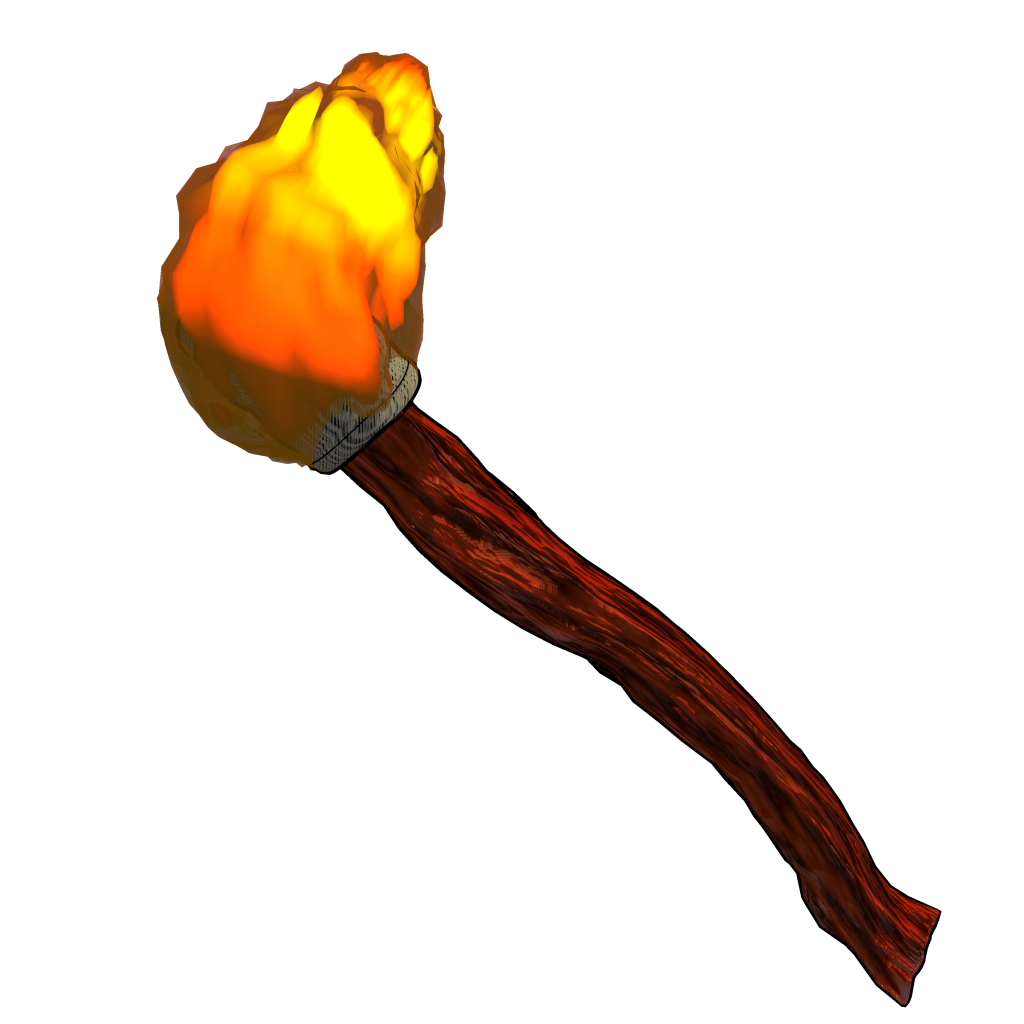 |
Simple wooden torches, consisting of a long stick made of a dense wood, with the tip wrapped in a linen or cotton cloth, and dipped in various oils. These have been in use since time immemorial. Useful as a light but can also be used as a weapon in emergencies. Torches are easy to make, even in less than ideal conditions, and last for around an hour, though times can vary depending on the cloth and oils used.
Common woods used for torches in Cassel include Ash and Oak woods. Common cloths used include Cotton and Linen. Common Oils include Olive Oil, Animal Fats, Pine Resin, and Citronella. More modern Torches in Cassel are made of a steel or bronze body and function the same way as an oil lamp. The interior is almost entirely filled with oil and a wick feeds the oil through a small opening in the top. These torches can last for over a dozen hours depending on the type of oil used. |
Glowing Crystals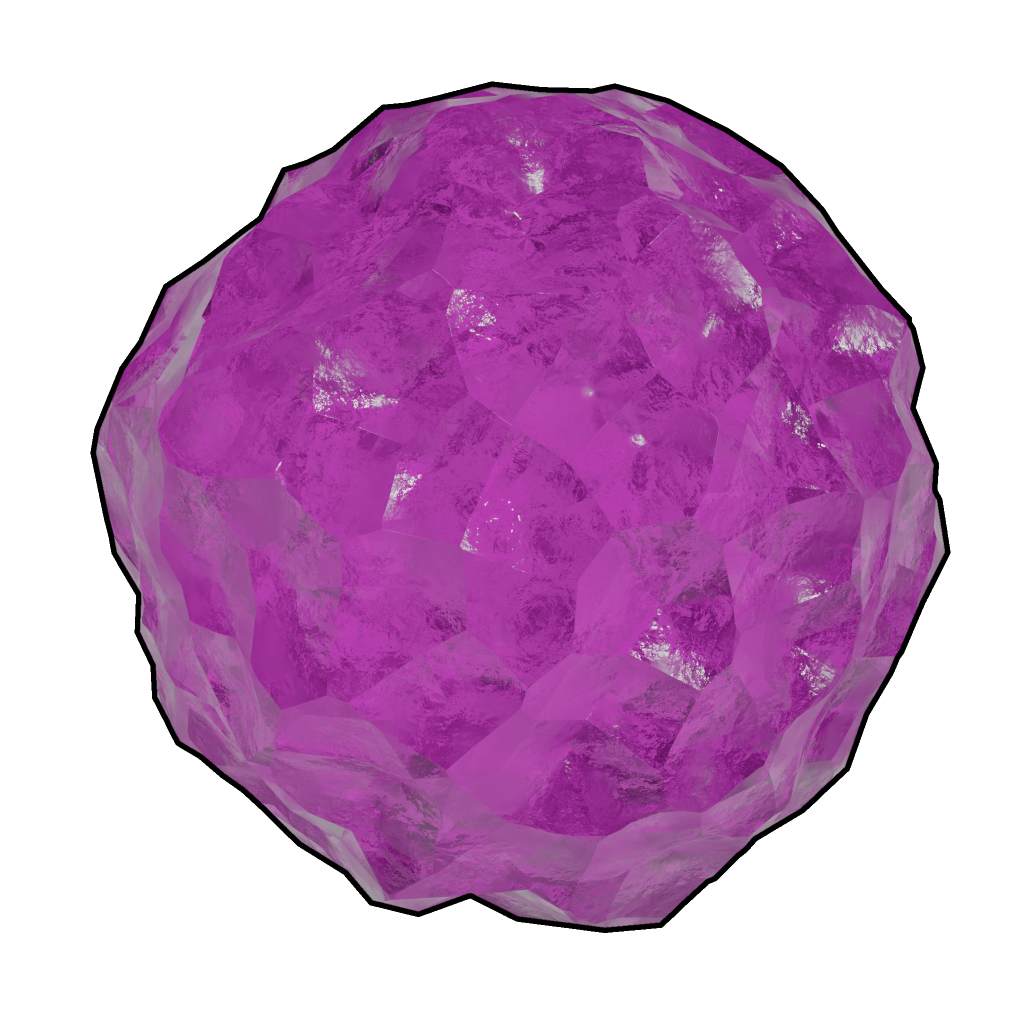 |
There is no shortage of aethercite on Vreathe that glows when charged with mana or aether, and many can be turned into bright glowing lights. Normally they are put on fixtures that resemble a torch or lantern, but sometimes they are used by themselves.
|
Candles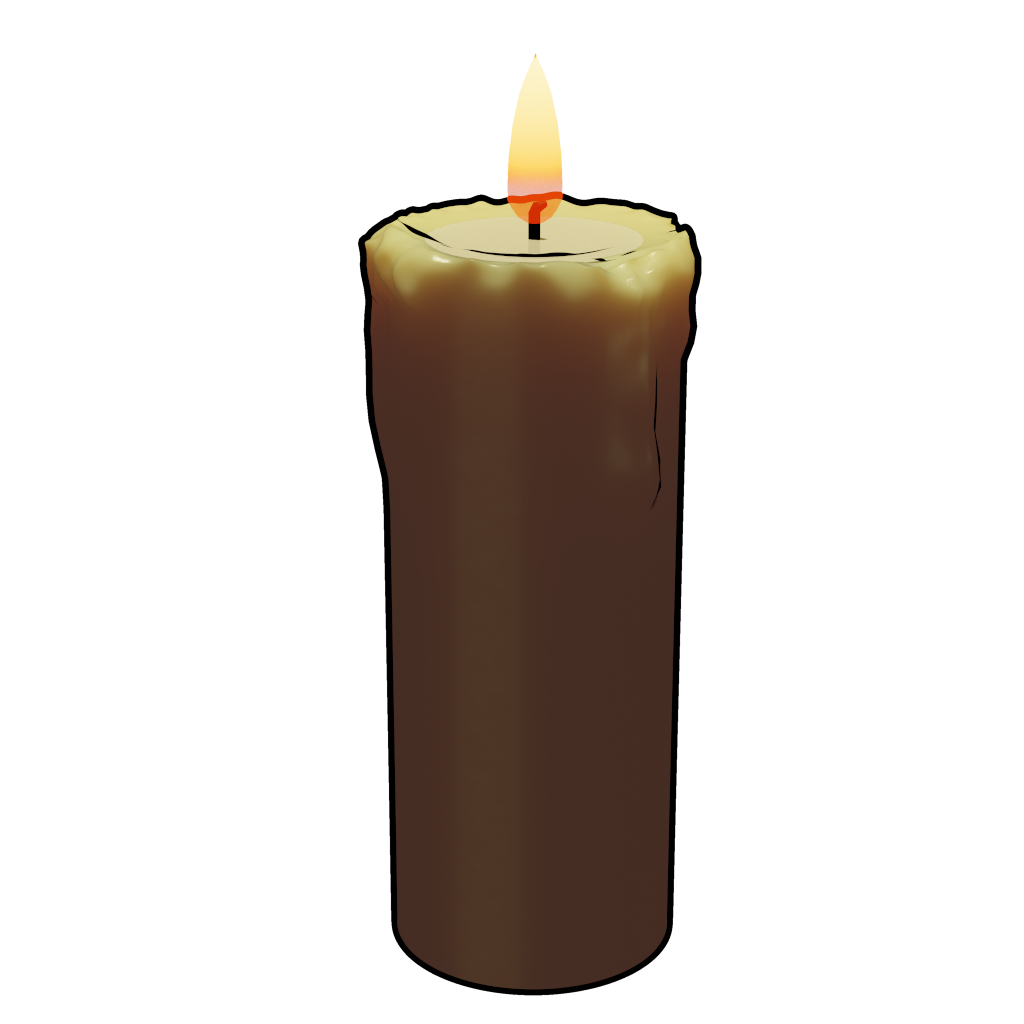 |
A small column of wax with a cloth wick in the center. The wax is commonly made of tallow or beeswax, and it flammable only after it melts and is drawn up the wick. The light is generally dim, barely bright enough to light a small room. Candles last around six hours before it burns out, leaving behind nothing but small bits of unburned wax.
Magic Candles are made by grinding bits of Aethercite into dust and adding it to the wax mixture. As the melted wax ignites, the magic in the dust is drawn out, changing the color of the flame and producing an effect. The specific effect this creates is highly dependent on the aethercite used. An Amethyst for example produces a cool violet flame that projects life magic wherever its light touches, which is the effect it creates when charged with mana. Since aethercite are often formed from expensive and rare crystals, grinding them into dust and then burning it is seen as a terrible waste. Usually the crystal dust can be reclaimed after the candle is burned away, though a little is destroyed each time. In the case of some crystals, any interaction with fire can completely destroy it. |
Oil Lamps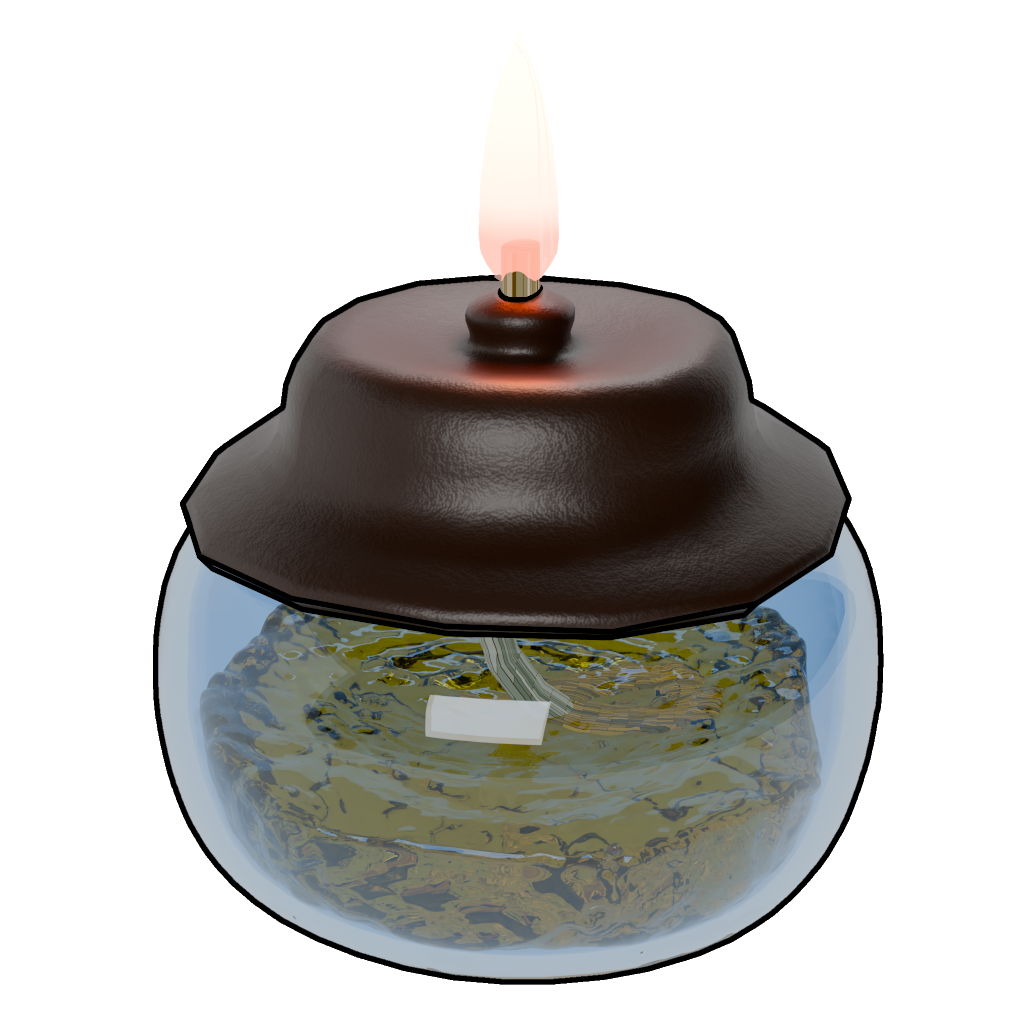 |
Older oil lamps were made of dried clay or bronze and had a small opening to draw the oil and fuel the flame. Current designs are made of glass or ceramic with a bronze or steel top, and uses a cloth or copper wick to draw the oil instead. Oil Lamps can last for up to twenty hours before needing a refill, though this is dependent on the type of oil used.
Simpler designs require the wick to be pulled manually, either bare handed or with a pair of pliers, but more complex designs have a turnkey that raises and lowers the wick when spun. Ideally the wick doesn't burn while the oil around it is ignited and continuously draws more oil. Brightness and size of the flame can be adjusted with wick height. Similar to Magic Candles, Magic Oil Lamps are made by grinding bits of Aethercite into dust and adding it to the oil mixture, which then creates the desired effect as the oil burns. |
Portable Lanterns |
A portable lantern is a light source kept in a protective enclosure that often has a large handle to carry by hand. The oldest designs consisted of large candles protected by iron strips. Many western nations still keep candles and oil lamps in protective clay enclosures, with a large opening on one side directed away from the wind. Eastern nations have moved on to an Iron, Tin, or Brass enclosure with the light source surrounded almost entirely by a glass bulb. Openings are put in the top and bottom and protected by additional metal pieces to allow air to flow but still protect from the wind.
Then there are magical options. The Elves of Lyonne create glowing moonstone lanterns while the Elves of Ledo use Sodalite. Both types have intricately carved wooden enclosures with a bronze or bright steel ring on top to act as the handle. Simpler and much older designs are also still in use with the enclosure being made of woven rope with the handle being a large loop. |
City Lighting |
|
Moonlight Towers |
In the real world Moonlight Towers were tall towers that illuminated areas of a city at night, designed to illuminate several city blocks at once. Arc Lamps were the most common lights used, which were bright and Harsh. They were common in the United States in the late 1800's where upgrading street lights was prohibitively expensive.
In the World of Vreathe, in the Kingdoms of Cassel, Moonlight Towers are tall steel or stone structures that sit at the center of cities and larger towns, and are between 30 meters and 100 meters tall. At the top of these towers is a steel sphere, constructed in a triangular pattern. In the center of these spheres on a platform is a large chunk of Moonstone, weighing a hundred kilograms for the smallest towers, to over a ton for the largest towers. Moonstones absorb the special aether that is given off naturally by the moon. Since they are always exposed to the air and exposed to the light of the moon, moonlight towers are always charged with enough aether to give off a soft light that is marginally brighter than a full moon on a cloudless night. This light also feels warm to living creatures, even in the middle of the coldest winters. Moonlight Towers, because of their height and their never ending bright light, can often be seen from several kilometers away, and are used as navigation markers for travelers, both on land and on airship. While they are the main source of lighting in smaller towns, they are not the main source of lighting in larger towns and cities, which often have networks of oil, gas, or sodalite lamps that keep the streets much more brightly lit. |

Comments