
Albion Hall
⚠️ Content Warning
This article may contain mature themes, including homoerotic content, complex power dynamics, sexual encounters with vampires and anthropomorphic beings, as well as other adult material.
Reader discretion is advised.
TABLE OF CONTENTS is in the World Navigation
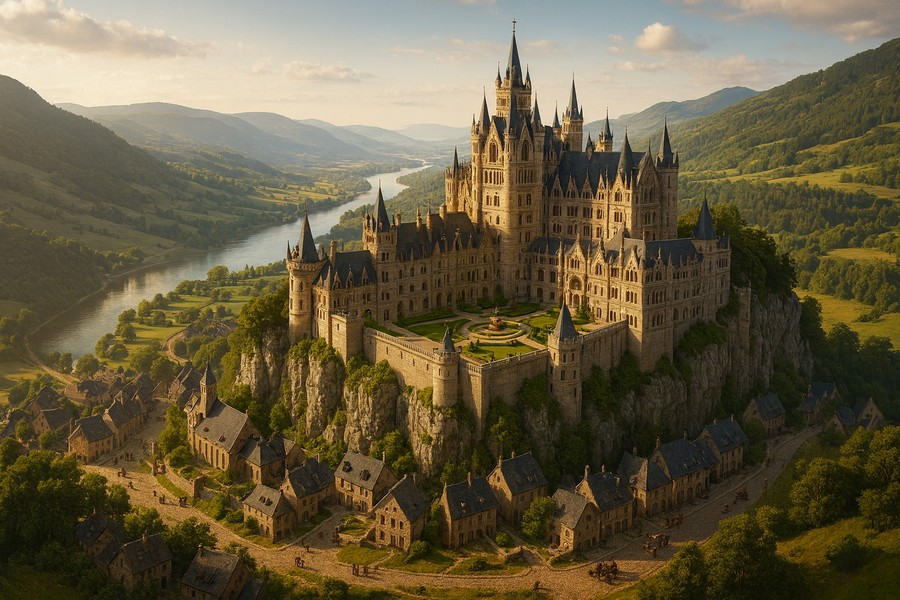
Perched atop of Mount Albion, Albion Hall rises like a legend carved in stone above the green forrests and the shimmering blue Surluse river valley of Avalon. Built in the late 14th century, the Hall’s foundations reach far deeper into history—and perhaps into other realms.
Constructed on the ruins of an ancient Fae structure, many of the original, eerily symmetrical stones were reused in the building’s walls and arches. These stones lend the manor an otherworldly, dreamlike atmosphere: walls that seem to glow in twilight, corridors that seem longer than they are, and mirrors that sometimes reflect more than one’s own image.
Visitors often describe Albion Hall as “strangely beautiful”—as though glamour itself still lingers in the woodwork.
Albion Hall is no ordinary place. And those who sleep within its walls rarely dream alone.
Alterations
Over the centuries Albion Hall has been reworked rather than replaced, each generation of Lancelots leaving its handprint on the stone.
In the late-14th-century the first Duke of Avalon raised a compact fortified hall with curtain wall, gatehouse and chapel, threading the eerily true Fae ashlars into arches, thresholds and lintels for “strength” as much as for superstition.
In the mid-Tudor years the place shed its harsher edges: the moat was partly infilled to make garden terraces, the great hall was opened with generous mullioned-and-transomed windows and a handsome timber roof, and a long gallery was run along the sun-facing range for show and promenade.
Early in the Stuart period the principal court was regularised and prettied—strapwork gables, clustered brick chimney-stacks and a broad oak stair announced the house as a seat rather than a redoubt, while the old gatehouse was softened into a ceremonial entrance with an oriel and heraldic panels.
The early Georgians “tidied” discreetly where they dared, inserting a few sash windows, bolection-moulded panelling and improved circulation, but the stubborn medieval fabric—especially where it keyed into the older foundations—resisted wholesale rationalisation.
Mid-Victorian romanticism then restored the skyline we know: crenellations were reinstated, chapel windows were given lancet tracery, a minor octagonal stair-turret was raised, and select areas of the uncanny Fae stone were deliberately re-exposed in jambs and door reveals. Beneath it all, subsurface consolidation stitched the ancient sub-structure back to the living house.
Architecture
Albion Hall reads as a layered fortified manor: a late-medieval core adapted into an early-modern residence and, in the nineteenth century, redressed in Gothic Revival sentiment. Its irregular courtyard plan steps over a rocky knoll on Mount Albion — great hall range to the north, service wing to the west, the Tudor long gallery closing the south to make a sheltered court — while a modest solar tower still plays the part of a keep.
The walling is pale Avalon limestone rubble with dressed quoins; here and there bands of reused Fae ashlar run arrow-true through the masonry, unnervingly smooth to the touch.
Roofs are oak-framed under lead and slate. Openings mix Perpendicular two- and three-light mullions with later oriels and (where the Victorians archtecture did not evict them) a handful of Georgian sashes; the skyline is busy with clustered chimneys and revived battlements.
Interiors carry oak panelling and carved spandrels from the Tudor–Jacobean refit, with Victorian encaustic tiles in porch and chapel. Local custom still garlands the doorway corbels at midsummer—an old practice the family neither endorses nor forbids.
History
The first hall rose in the late fourteenth century, its builder, the first Duke of Avalon, cannily keying new footings into the long, level platform left by a Fae-structure.
Work advanced in phases over roughly two decades, from rock-cut foundations and curtain wall to the great hall with dais, solar lodging, chapel and service ranges.
In the later sixteenth century the house was turned from defence to display: glazing increased, the hall was enlarged, and a south-facing long gallery took command of the views over the Surluse valley.
Around the 1610s–20s the Jacobean campaign regularised the main court, introduced the great stair and a modern chimney system, and recast the gatehouse as a showpiece.
A measured Georgian modernisation followed in the 1730s–40s—select sashes, new panelling, repairs to plaster—but the ground under the oldest courses behaved oddly enough to discourage zeal.
Between 1848 and 1862 a historically minded owner and architect “restored” the romance: battlements and lancets returned, a stair-turret rose, unstable corners were pinned, and stretches of the unnaturally true Fae ashlar were brought back to sight. What presents itself today is that Victorian silhouette, behind which the Tudor–Jacobean heart and the medieval bones remain very much alive.

Comments