
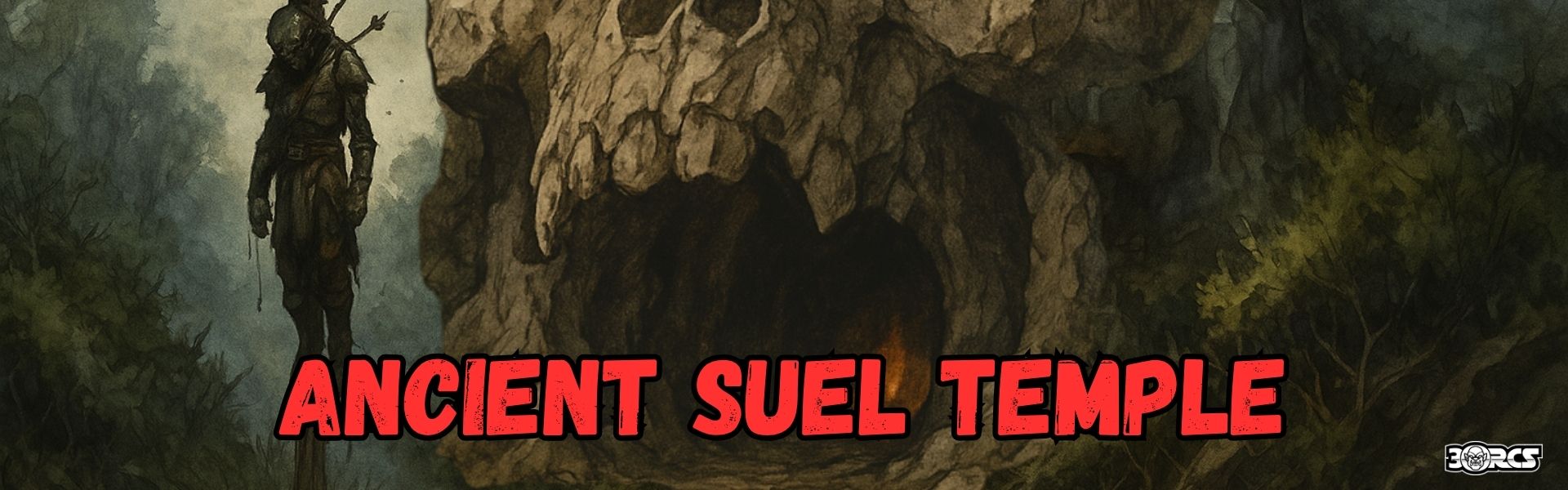
The Ruby Law: A History of the Ancient Suel Temple-Complex
What it is (for your table)
A funerary-temple founded by Suel jurist-priests of Wee Jas with Lendor (measure), Jascar (stone/guard), and Fortubo (craft) as the working triad—built just off the Velverdyva River trade road near Verbobonc. It served as a lawful necropolis and rites-house for Suel families active along the river corridor. Over the centuries, Velunese/Ferrondine administration and shifting piety reduced it to caretaker use; border wars and trade shocks finally saw it sealed, sacked, and forgotten—until your campaign reawakens it.
Founding window (best fit: c. 10 CY)
- Context on the Selintan & Greyhawk’s rise: The Selintan basin coalesces under the Landgraf of Selintan (the “Landgraviate”), with the river realm expanding its sway across the basin; this is the polity Suel enclaves would have felt pressing in culturally and administratively.
- Ferrond on the horizon: Within the early 1st century CY, Aerdy’s western viceroyalty (Ferrond) is already forming into the Great Kingdom’s premier frontier administration, ruled from Dyvers—the very corridor our site sits off of. This places any independent Suel cult-builds on borrowed time.
- Local build surge: At “the dawn of the first century CY,” Verbobonc, City walls itself and undergoes a major construction push—exactly when a Suel funerary/rite complex could plausibly arise nearby before full incorporation.
Placement: Founding around c. 10 CY cleanly matches your late preference and the LGG’s note that Ferrond (from Dyvers) is already ascendant, while Verbobonc’s build-boom provides labor, materials, and motive for a prestigious Suel Pantheon shrine on the Velverdyva frontier.
Frontier, but connected: why here
- The Selintan–Velverdyva artery made this ridge a perfect place for a diaspora cult-center: reachable by road and river, yet far enough from urban oversight to preserve Suel funerary law. The basin around Greyhawk coalesced under the Landgraf of Selintan (“Landgraviate”), a title denoting a lord who answered directly to the sovereign—early proof that this corridor centralized fast and would pressure independent enclaves.
- Dyvers/Ferrond on the horizon. The western viceroyalty (Ferrond) was administered from Dyvers, Free Lands of —Aerdy’s proud frontier jewel—so any unregistered cult-property west of Greyhawk sat on borrowed time as the viceroy’s writ spread.
History & Placement — Ruby Law Temple
Founders. Suel jurist-priests of Wee Jas (with Lendor’s measure, Jascar’s stone, Fortubo’s craft) established a funerary temple-crypt serving Suel houses along the Velverdyva.
Route. Suel families withdrew from the Selintan basin (disliking Aerdian cultural pressure) and moved upriver by way of Dyvers/Velverdyva into the Verbobonc march.
Why here. Frontier-adjacent yet connected: a defensible ridge off the trade artery, basalt/ruby resources for Ruby-Law aesthetics, and local gnome/elven craft to realize Suel stone-logic.
Founding (best fit). c. 10 CY. Aligns with Verbobonc’s early-century fortification/build surge and precedes formal Veluna/Ferrond incorporation—prime window for an independent Suel cult-estate.
Pressure & decline. 1st–2nd century CY: Ferrond administration from Dyvers regularizes the marchlands (registries, levies, inspections) and erodes Suel autonomy; local piety trends Velunese, later civic Cuthbertine.
Closure. 350–355 CY: regional wars and Kron-side disruptions sever routes; clergy seal the Sixfold approaches under Wee Jas protocols.
Use this date at table: 355 CY — Sealed & Abandoned.
Aftershocks. Late 550s CY turmoil (Temple of Elemental Evil era) weakens old seals; scavengers and orcs probe the service runs.
Present (579 CY). Orc desecration triggers the Ruby Witness ward; Valdris Jasildane, the Ruby Mortarch, reawakens to reconsecrate the complex and conscript the dead.
Landgraf note. Early Greyhawk’s Landgraf of the Selintan held directly of the sovereign—no intermediary—explaining why Suel houses built outside Landgraviate oversight while the window lasted.
Dating guidance (props & inscriptions). Corner-stones and ledgers cite 10 CY for consecration; registry entries cease by 355 CY.
Founding & first patronage (best fit: c. 10 CY)
- Around the dawn of the 1st century CY, Verbobonc’s elves and gnomes walled the town and launched a building boom (“Earth and Stone, Man and Gnome”), the perfect moment for Suel families to endow a prestigious crypt-temple nearby before formal incorporation into Veluna/Ferrond.
- We place the temple’s consecration about 10 CY, squarely inside your preferred window (−100 to 50 CY) and aligned to the local civic surge and growing Ferrondine governance from Dyvers.
Founders’ intent. The complex blended processional chapels (Wee Jas witness), stone-logic halls (Jascar/Fortubo), and mortuary service (washing, naming, binding), all ordered by Lendor’s six-count. The temple kept registries for Suel houses trading and settling along the Velverdyva.
Growth, pressure, and the slow squeeze (1st–2nd century CY)
- As the March turned from frontier to administered corridor under Ferrond (Dyvers), independent cult estates began facing registries, levies, and inspections. The viceroyalty era is explicitly tied to Dyvers as seat and capital, underscoring that this was where order and taxes came from.
- 119 CY: The Verbobonc, Viscounty is formally incorporated into Veluna and the Viceroyalty of Ferrond, tightening civic-clerical control and marginalizing autonomous Suel rites.
Waning & caretaker phase (3rd–4th century CY)
- Across the 300s, Verbobonc’s civic life grows more Velunese; St. Cuthbert later displaces Rao in key roles—an arc that naturally sidelines Suel funerary authority from public life.
- By mid-century the region is wracked by Furyondy–Veluna vs. Keoland tensions: tariffs, “wandering” bandit bands, and then outright Keoish incursions across the Lorridges and Kron Hills, severing routes and stressing rural sites like this one.
Sacked, sealed, and abandoned (the hard break)
- 350–355 CY: Keoland’s Second Expeditionary Force pushes over the Kron Hills, seizes Devarnish, and chokes west-road trade. In this same campaign window, local crypt-complexes on the south-Velverdyva shoulder are looted, pressed into billet, or ritually decommissioned and sealed by their clergy to prevent profanation. Your temple is among them.
- The date to cite at table: 355 CY — “Sealed and Abandoned.” By this year, the complex’s registries end, the inner doors are barred under Wee Jas protocols, and stewards disperse. (The later Short War expulsions in 436–438 CY ensure any lingering Suel caretakers do not return.)
Echoes into the late centuries (why it became a dungeon)
- The Velverdyva corridor stays a high-value trade track—Dyvers and Greyhawk contend, tariffs rise and fall, and rural sites get periodically scavenged.
- Late 550s CY: The Temple of Elemental Evil turns the Kron Hills hot; whatever seals remained are stressed by refugee bands, humanoid raids, and opportunists.
- 579 CY (campaign present): Orc trespass and Pyremian desecration on the main level stir old bindings; Valdris Jasildane, the Ruby Mortarch—once arch-verger of these halls—reasserts Ruby Law over the crypts, seeking to reconsecrate the complex on Suel terms while conscripting the dead to do it.
.
Landgrave note (for your sidebar): The LGG uses Landgraf of Selintan for Greyhawk’s early ruler—a title denoting a magnate who held territory directly of the sovereign (no intermediate liege), which helps explain why Suel houses along this corridor felt compelled to build outside direct Landgraviate control while the window remained.
Quick timeline
- c. 10 CY (Founding): Suel diaspora clerics establish the Ruby Law temple-crypts off the Velverdyva, leveraging Verbobonc’s early-century building boom.
- 1st–2nd century CY: Ferrond administration from Dyvers regularizes the frontier; the complex loses civil autonomy.
- 119 CY: Verbobonc is formally incorporated into Veluna/Ferrond, accelerating the eclipse of Suel ritual authority.
- 3rd–4th century CY: Local religious center-of-gravity shifts (Rao /Veluna; later St. Cuthbert in civic roles). The Ruby Law falls out of sanctioned use.
- Late 550s CY: The Temple of Elemental Evil draws turmoil to the region; any remaining Suel caretakers are gone, leaving the site sealed, scavenged, or forgotten.
- 579 CY (your campaign present): Howling Moon orcs violate the lower vaults; the Ruby Mortarch reawakens and begins consolidating undead control (your module arc).
Notes on inference vs. canon
- The exact founding date of a Suel temple in the Verbobonc marchlands is not specified in LGG. The placement at c. 10 CY is a best-fit inference that harmonizes: (a) Greyhawk/Selintan polity formation, (b) Dyvers-led Ferrond frontier governance in the early 1st century, and (c) Verbobonc’s dawn-of-century construction push.


Comments