
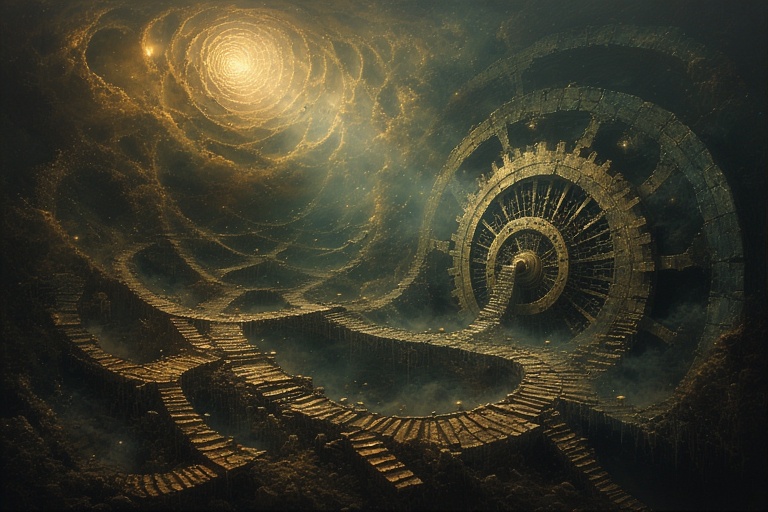
Va'lore existence is not a matter of chance, but a meticulously constructed edifice, built upon the unyielding principals of cosmic equilibrium. The very moment life ignites, the slow, inevitable process of decay begins, a constant force that must be accounted for in any lasting structure. This inherent balance is the bedrock upon which Va'lore stands, a foundation that demands constant vigilance. The laws governing this structure etched into the very fabric of existence are the unyielding truths of its construction, no mater how harsh they may seem to those within its walls.
The Five Foundational Laws
The gods themselves decreed five immutable laws, binding even their own divine will, serving as the essential blueprints for reality and the foundational framework for Va'lore.
The first law, a safeguard for the fragile mortal spirit, grants autonomy. Though souls are bound to Va'lore's grand cycle of birth and demise, their choices remain sovereign. Gods may whisper temptations or offer guidance, but the ultimate path is chosen by the individual. Should a god presume to seize a mortal's agency, their divine essence will unravel, casting them from their celestial station to walk the earth as a mortal, stripped of their power and immortality.
The second decree, however, acts as a cosmic governor. It dictates that no single force, be it the vibrant bloom of life or the chilling grip of oblivion, creation's surge or destruction's finality, shall ever dominate the eternal dance—overwhelm the other. Va'lore itself shall bear the scars, its very fabric rent by the imbalance.
Third, the eternal cycle of birth and death, the very rhythm of Va'lore, shall remain uncorrupted. No mortal shall be unnaturally tethered to life beyond their allotted span, nor shall a soul be forcibly returned to the mortal coil before its time, lest the flow of existence itself be dammed.
Fourth, the underworld is a crucible, not a destination. Souls arriving there shall find their eternal path dictated by the sum of their earthly deeds, a balance that grants either ascent or a deeper descent.
Fifth, every significant deed, every act of profound creation or destruction, shall leave an echo upon the tapestry of Va'lore. These reverberations shall shape the currents of fate and the very essence of the realms, ensuring that the weight of existence is felt across all epochs.
The Nine Pillars
Beyond this foundation lies a series of nine pillars, warnings whispered by the gods to their mortal charges, not as absolute commands, but as vital guidelines for self-preservation and the continued harmony of Va'lore. To heed them is to walk a path of safety; to ignore them is to invite personal ruin and, collectively, to risk the very integrity of the cosmic edifice.
The First Pillar: The Sanctity of the Spark.
To extinguish a mortal life without just cause, without the balance of consequence, is to invite the unraveling of your own existence. Life's flame, once kindled, is a fragile thing, and its abrupt cessation by another's hand creates a void that draws only darkness. Should this law be broken, the perpetrator will experience a slow withering, their own vitality draining away to compensate for the void they have created—a chilling echo of the life they extinguished.
The Second Pillar: Tread Lightly With the Unseen.
To seek forbidden knowledge, to tamper with forces beyond mortal comprehension, or to wield power without understanding its true cost is to invite madness and ruin. The unseen realms hold dangers that can unravel the sanity of the boldest mind and the very fabric of existence for the unwary. Those who delve too deep into forbidden lore may find their minds fractured, becoming conduits for chaotic energies that warp their perception and actions, or they might be consumed entirely by the entities they sought to control, their essence becoming a mere echo within the vast, unknowable void.
The Third Pillar: Do Not Covet the Divine Spark.
To aspire to the power or station of the gods, to attempt to usurp their dominion or to hoard divine essence is to invite a fall from grace more profound than any mortal can endure. Such hubris invites a reckoning that strips away all that is held dear, leaving only a hollow echo of ambition. Hubris aimed at the divine can result in a permanent spiritual hollowness. The offender might be stripped of all their worldly possessions, relationships, and even their sense of self, left as an empty vessel forever yearning for what they can never reclaim, a mere shadow of their former ambition.
The Fourth Pillar: Seek Not the Stolen Dawn.
To unnaturally prolong life beyond its appointed span, or to bind a soul to a decaying form through forbidden arts, is to corrupt the natural course of existence. This perversion of life's cycle ensnares the spirit in a torment of unending decay, a fate far worse than the peace of oblivion. Individuals attempting to cheat death or unnaturally extend their lives may find themselves trapped in a state of perpetual, agonizing decay, their consciousness aware but their body failing, or worse, become incorporeal specters bound to their dying flesh, forever reliving their final moments of torment.
The Fifth Pillar: Honor the Scales of Fate.
To defy the judgments of the underworld, to attempt to cheat the balance of deeds, or to interfere with the destined path of souls is to invite cosmic retribution. The scales of fate are immutable and their imbalance will be corrected, often with devastating consequences. Those who tamper with the underworld's judgments may find their own soul irrevocably unbalanced. They could be condemned to an eternal cycle of karmic debt, forever replaying their transgressions or suffering the exact injustices they sought to prevent for others, their own destiny becoming a twisted reflection of their interference.
The Sixth Pillar: Let the Cycle Turn Unhindered.
To interfere with the natural passage of birth and death, to obstruct the flow of souls through the grand cycle, is to dam the very river of existence. Such corruption breeds stagnation and despair, and those who block the flow will find themselves trapped in the mire of unlife. Individuals who disrupt the soul cycle might find themselves eternally frozen in a state of 'unlife,' neither truly living nor dead, their existence a stagnant mire where time has no meaning and their consciousness slowly erodes into a formless despair, unable to move forward or find peace.
The Seventh Pillar: Forge Not the Unmaking.
To wield the power of destruction with reckless abandon, without cosmic cause or divine sanction, to seek the obliteration of life or realms for personal gain, is to court oblivion itself. The forces of unmaking are primal power, and those who haphazardly command them risk becoming their first, and final victims. Reckless use of destructive power can result in the wielder's own essence being unmade, their very being atomized or dispersed into the chaotic energies they unleashed, leaving no trace of their existence, becoming the first casualty of their own unmaking.
The Eight Pillar: Guard The Threads of Kin. To betray those bound to you by blood or oath, to sow discord and malice within your own community is to sever the very bonds that sustain life. Such treachery creates spiritual blight that attracts misfortune and leaves the perpetrator isolated and vulnerable, their own existence unraveling from within. Betrayal of kin or oath can lead to a profoun
d spiritual isolation, where all connections to others wither and die, leaving the perpetrator a pariah, haunted by the fractured bonds they themselves severed, their own inner being slowly decaying from the lack of connection and trust.
The Nine Pillar: Disturb Not the Slumbering Wards.
To breach places or artifacts deliberately sealed against intrusion, to awaken that which has been bound for the safety of Va'lore is to invite catastrophe. These wards protect against primordial chaos and existential threats; their violation unleashes forces that can shatter reality and consume all who dwell within it. The violation of ancient wards can unleash primordial chaos, causing the offender's physical form to contort and twist into monstrous shapes, driven mad by the unleashed entities, or they may be annihilated outright, their essence consumed by the very forces they foolishly disturbed, leaving behind only ruin.
Cracks in the Edifice
The flesh, the vessel for the soul, is born of natural processes—the breeding of mortal creatures. The soul itself, however, is a divine gift, meticulously crafted by the gods. Each new soul is assembled from three key parts: Akil'il (intellect), Msis'im (emotion), and Kimo'ta (the spark that becomes memory), all carefully stitched together by the thread of destiny with the aim of minimal disruption. Yet, it is through the crucible of mortal experience that the true "cracks" in this divine edifice begin to form—not as visible fissures, but as profound, invisible echoes of impact.
Akil'il, the soul's intellect, is a malleable energy. While all beings possess the potential for intelligence, some begin with a greater inherent measure of this energy than others. Regardless of the starting point, Akil'il can stretch and grow through exposure, or shrink and wither when neglected. However, the process of this stretching, particularly when driven by trauma or overwhelming experience, can be perilous. For some, excessive or poorly managed expansion can lead to fragility, making their Akil'il brittle and prone to shattering under pressure—manifesting as mental breaks or panic attacks. These are the hairline fractures left by profound loss or unbearable stress, sometimes causing a person to misinterpret social cues or struggle with clear reasoning. For others, through deliberate reinforcement, Akil'il can become as resilient as hardened steel. This strengthens their will and bolsters their defenses, but at a cost. If one chooses to fortify their intellect completely, they may find their Msis'im (emotion) growing distant, leading to a clinical detachment or a perceived coldness in their demeanor. This hardening, while a defense, can also be seen as a sealed-over crack, preventing genuine connection.
Kimo'ta, the initial spark, is a viscous energy that glimmers with a brilliance akin to sunlight dancing across a riverbed. This energy flows continuously, bringing forth purpose and experience into the soul. As this spark interacts with Akil'il and Msis'im, it solidifies into memory, shaping the very essence of the soul and its understanding of existence. When profound loss occurs, and the soul cannot let go, the Kimo'ta can become stagnant, its vibrant waters clouding with the weight of unresolved grief. This stagnation is a deep fissure, anchoring the soul to past pain and dimming its capacity for future light, sometimes manifesting as a persistent feeling of déjà vu or a profound sense of being lost.
Msis'im, the soul's breath of emotions, encompasses the spectrum from exhilarating joy to profound despair. It is the tempest that drives connection and passion, a vital force that imbues existence with color and meaning. However, this potent energy carries its own dangers. If allowed to completely overwhelm reasoned thought, Msis'im can lead to a perilous disregard for self-preservation, as the intensity of feeling may overshadow the logic needed for survival. Unchecked emotional tides, born from deep wounds or betrayals, can carve out chasms within the Msis'im, leaving the soul vulnerable to being pulled into the abyss by the very forces it struggles to contain.
The Thread of Destiny is the divine weave that holds these three core components—Akil'il, Msis'im, and Kimo'ta—in proper alignment, forming the cohesive soul. Guided by the gentle hands of Somnara, the goddess of sleep and fate, and her celestial servants, this thread ensures that the soul's journey through Va'lore is imprinted with purpose and consequence, shaping its path across epochs. When mortal experiences inflict deep wounds, these threads can fray or knot, creating points of weakness that are the true "cracks." There is no single "chosen" soul; all souls hold a place within the grand destiny of Va'lore, and it is up to each individual to be brave enough to discover their unique role, and perhaps, to mend the cracks within themselves.
The Imprints of Resonance
The very fabric of Va'lore is not merely a passive stage but a canvas upon which every significant deed, every profound emotion, and every divine decree leaves an indelible mark. These are the Echoes, residual energies that permeate the world, much like the subtle vibrations that linger in a grand cathedral long after the choir has fallen silent or the resonance within a perfectly constructed vault. These Echoes are born from moments of intense existential impact: the creation or destruction of a soul, a god's overriding of mortal free will, a betrayal that splinters destiny, or a sacrifice that reshapes fate. They are not mere memories, but active energetic imprints, potent remnants of power and consequence. The stronger the original event or emotion, the more profound and lasting the Echo. A god's decree might resonate for millennia, while a mortal's act of pure, selfless love could leave a localized warmth in a sacred grove. The Echoes interact with the world in subtle yet significant ways. They can influence the ambient mood of a place, drawing those sensitive to such energies closer. In regions where divine intervention has been frequent, the air might crackle with latent power. Where great suffering has occurred, a palpable sorrow might cling to the very stones. Some Echoes are so potent they can even affect the physical realm, subtly altering natural phenomena or attracting creatures drawn to specific energetic signatures. Understanding these Echoes is key to navigating Va'lore, as they are the whispers of history and the undercurrents of divinity, shaping the present by the weight of the past.




Comments