
Narcosis Scarabs
Basic Information
Anatomy
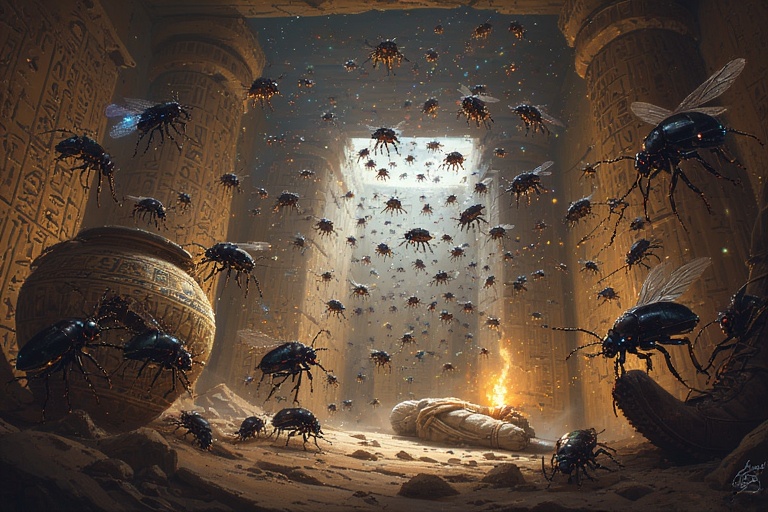
Within the suffocating embrace of Va'lore's crypts, where the air hangs thick with the spectral scent of decay, dwell the Narcosis Scarabs. These are not creatures of sunlit fields, but denizens of perpetual twilight, their existence intertwined with the hushed finality of the grave. Their abodes are ossuaries of forgotten life, littered with the bleached remnants of bone and the still-soft, yielding textures of decomposing flesh. It is in this morbid tapestry that their true, unsettling beauty is revealed. Faintly, almost imperceptibly, a luminescence blooms in the oppressive gloom. This is not the harsh glare of day, but the ethereal glow of spores, drifting like spectral dust motes, lending an almost sacred, yet deeply disturbing, aura to the scene. Against this backdrop, the scarabs themselves are jewels of the underworld.
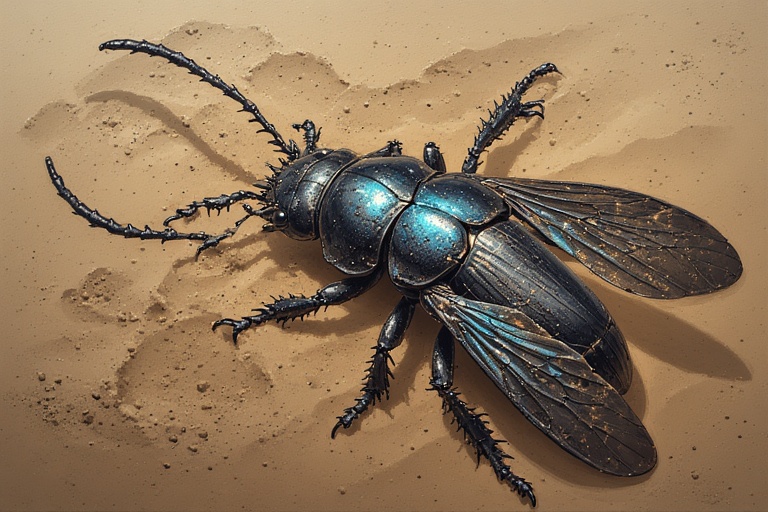
Their carapaces are a deep, iridescent black, catching the scarce light and refracting it into subtle undertones of bruised violet and midnight blue. But it is their elytra, the wing covers, that truly command attention. Here, intricate patterns, born of a subtle bioluminescence, pulse with a faint, internal light. These are not mere markings, but a silent language, a network of communication woven into the fabric of their being, glowing with a purpose lost to the casual observer. Fine lines, resembling the delicate tracery of veins, crisscross these luminous maps. And at the very heart of this obsidian form, near the thorax, a fleeting, scarlet shimmer hints at a vital, hidden warmth within the cold, dead spaces they call home. Their brief lives, a mere nine to twelve months, are spent in this spectral dance of light and shadow.
These creatures possess an uncanny ability to traverse any surface, defying gravity with an effortless grace, clinging to ceilings and sheer walls as if they were as mundane as dry earth. Their chitinous feet, equipped with microscopic hooks, find purchase on the most unforgiving of substrates, allowing them to navigate their subterranean domain with an agility that belies their seemingly cumbersome form. This remarkable adhesion is not a learned behavior, but an intrinsic part of their physiology, a testament to their adaptation to the vertical, often unstable, environments of the crypts. It is a silent, instinctual mastery of their surroundings, a constant, unacknowledged marvel in the perpetual gloom. Within the crypts, the scarabs are attuned to the subtle shift in temperature that accompanies active decomposition, a warmth that guides them through the otherwise uniform chill of the stone. They also react to the faint vibrations carried through the ossified remains and packed earth, distinguishing the slow settling of the crypt from the approach of larger, potentially threatening entities.
Chief among these perceived threats is the Crypt Stinger Wasp, a creature of relentless aggression. These wasps are the primary natural predator of the Narcosis Scarabs, their venom a potent paralytic agent that incapacitates the scarabs, allowing the wasps to then inject their own eggs into the paralyzed host. The scarab's scarlet shimmer, a subtle warmth near its thorax, is thought to be a lure for these predators, a fatal beacon in the dark. But the true horror of the Crypt Stinger lies in its indiscriminate nature; if a suitable host is not found, or if threatened, these wasps are known to lay their eggs in any available flesh, including the open wounds of living creatures, turning even a minor injury into a potential incubator for gruesome infestation
Genetics and Reproduction
The Narcosis Scarab’s brief existence, a mere flicker in the eternal gloom of Va'lore’s crypts, is a testament to the relentless cycle of decay and renewal. Their lives, a swift nine to twelve months from the nascent spark of an egg to the final, ephemeral bloom of adulthood, are intimately tethered to the very essence of dissolution. It is within the nutrient-rich embrace of decomposing matter that their genesis unfolds. Fertilized eggs, laid in delicate clutches, find sanctuary within the yielding flesh, the inherent warmth and moisture acting as a cradle, coaxing life forth within the span of a single week.
From these fragile beginnings emerge the grubs, the ravenous architects of decomposition. This larval stage is a period of unbridled consumption, where their voracious appetites relentlessly break down organic tissues. They undergo multiple molts, shedding their exoskeletons like discarded shrouds as their forms swell with the sustenance they devour. This prolonged phase, often spanning many months, sees their mass increase exponentially, preparing them for the profound metamorphosis that awaits.
Once their larval hunger is sated and their growth reaches its apex, they enter the pupal stage, a period of quiescent transformation. Seeking a more stable substrate – the drier earth or compacted detritus of the crypt – they burrow and await the miraculous reshaping of their being. This interlude is fleeting, usually concluding within a few weeks, as the grub surrenders its form to become the adult scarab.
The adult, with its iridescent carapace and the faint, internal luminescence of its elytra, emerges with a singular purpose: reproduction. Their focus shifts from unending consumption to the propagation of their kind. They navigate the spectral landscape, seeking both suitable mates and new feeding grounds, ensuring the continuation of the Narcosis Scarab lineage. This adult phase, the shortest of their cycle, is a fervent dedication to ensuring that the morbid dance of life and death within Va'lore’s crypts
Behaviour
The Narcosis Scarab, a creature of the perpetual crypt, navigates its brief existence with an instinctual solitude. Driven by the primal urges of sustenance and the propagation of its lineage, these obsidian jewels typically tread their decaying paths alone. Yet, in the rare instances where the bounty of death proves exceptionally generous, aggregations form. These are not true communities, but ephemeral gatherings, loose confederations drawn together by an abundance of food. Within these temporary assemblies, competition, sharp and immediate, becomes the dominant currency of interaction, a silent, scuttling testament to the relentless pursuit of survival.
Their role in the subterranean ecosystem is one of elegant paradox. They are decomposers, yes, but not in the manner of a rapacious parasite that actively hastens the demise of a living host. Instead, the Narcosis Scarab practices a form of *commensalism* with the departed. They offer a service to the stillness, benefiting from the slow, inevitable return of flesh to earth without hastening the inevitable. It is a delicate balance, a quiet partnership with the grave.
A more tentative, yet fascinating, aspect of their existence is the potential symbiotic dance with certain phosphorescent fungi that cling to the damp stone of Va'lore's crypts. These ethereal growths, themselves drawn to the rich nutrients of decay, seem to be drawn to the scarabs' subtle luminescence. In turn, the faint, ghostly glow of the fungi may serve to illuminate previously unseen feeding grounds for the scarabs, a spectral beacon in the oppressive dark. This interaction remains a subject of fervent study, a whispered debate among crypt scholars: is it mere coincidence, or a nascent, mutually beneficial exchange?
Furthermore, communication, particularly among adults, is thought to be conducted through the subtle modulation of their bioluminescent elytra. These fleeting displays of light are believed to convey rudimentary information—territorial claims, readiness for mating, or the distant whisper of danger—a silent, instinctual language painted in ephemeral light.
Additional Information
Uses, Products & Exploitation
The unique sensory capabilities of the Narcosis Scarabs have led to their integration into specific cultural practices and nascent medical applications within Zahirara. Among the followers of Malina, Obsequy, and at times even the Raven Queen , the scarabs are integral to funeral rites that emphasize the natural cycle of return. A core tenet of their belief is that flesh, if left to linger and decay unattended, can become a vessel for lingering malice and negative energies, potentially trapping the soul and hindering its passage.
The scarabs, through their natural processes, are seen as agents of purification, hastening the flesh's return to the earth. Certain rituals involve the careful introduction of scarab larvae to the deceased, encouraging a controlled decomposition that liberates the spirit. Following this natural process, the bones are then meticulously cleansed and purified, often through ceremonial bathing and incantations, before being ground into a fine dust.
This dust, imbued with the essence of the departed, is then scattered at a place of sentimental or profound importance to the deceased, completing their reintegration into the world and the ongoing cycle.
In more holistic medical facilities, the scarabs' acute sensitivity to biochemical markers is being explored. While direct application is rare and highly controlled, their ability to differentiate between healthy and necrotic tissue has led to rudimentary diagnostic methods. Some practitioners attempt to observe scarab behavior around a patient's samples, interpreting their attraction or aversion as indicators of underlying conditions. The iridescent dust shed from their carapaces is also rumored to possess mild antiseptic properties, though this is largely anecdotal and unverified by conventional Va'lorian medicine.
Perception and Sensory Capabilities
Narcosis Scarabs possess a highly specialized olfactory system, allowing them to detect the subtle chemical signatures of decomposition at remarkable distances. They are particularly attuned to the volatile organic compounds released by decaying flesh, guiding them unerringly to their sustenance. Furthermore, their senses are finely tuned to identify the distinct biochemical markers of necrotic or infected tissues, enabling them to distinguish between wholesome decay and biological threats to their own kind or their chosen habitats.
Comments