
Ascelyn Gastrell
(a.k.a. Sage of Fogwood, The Alabaster Doctor)
Physical Description
General Physical Condition
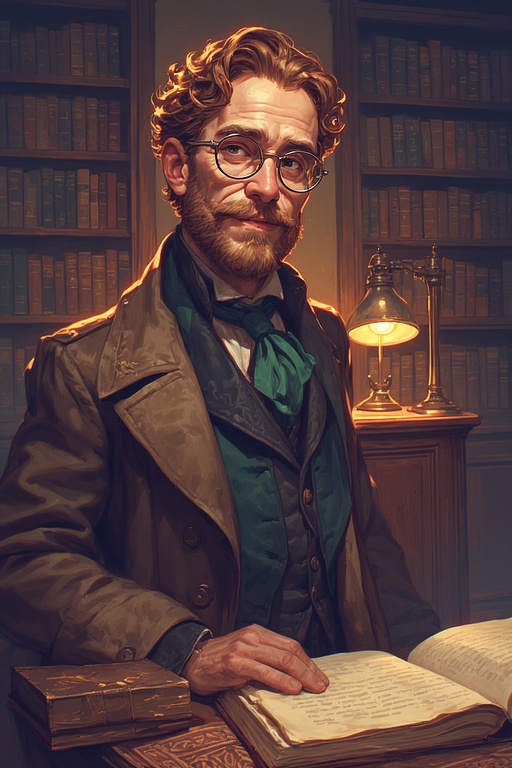
A man of modest stature at five-foot-seven, possessed a comforting roundness to his build. His auburn hair, a cascade of curls, framed a face that was, by all accounts, rather ordinary, yet held a certain gentle quality. This unremarkable countenance, however, belied a soul perhaps deeper than its outward appearance suggested, a man who might observe the world with quiet contemplation.
Apparel & Accessories
Ascelyn Gastrell’s public persona is a carefully constructed edifice, a testament to his scholarly pursuits and refined sensibilities. When necessity or social obligation demands his presence, he is invariably clad in garments that speak of gravitas and quiet affluence. His coats, fashioned from the finest wool, possess a tailored elegance, their hues of charcoal, deep navy, and forest green exuding an academic solemnity. Beneath these, crisp linen shirts are fastened, and cravats are knotted with an almost surgical precision, each fold a silent declaration of meticulousness. His spectacles, delicate instruments of polished silver, rest upon his nose, their subtly tinted lenses hinting at countless hours spent immersed in texts, poring over knowledge even in the dimmest light. His footwear, always gleaming, is a harmonious blend of practicality and understated style, completing an image of a man of learning, comfortable in his intellectual domain.
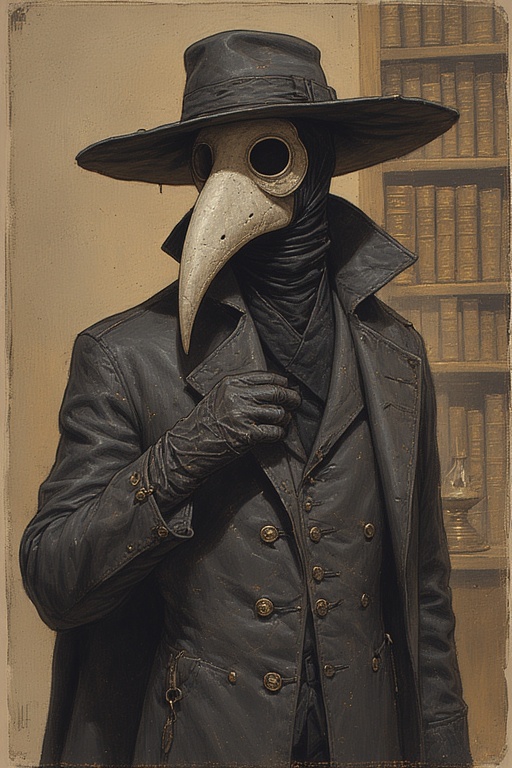
Yet, this outward presentation is a mere facet, a public mask that conceals a deeper, more guarded reality. When Ascelyn retreats to the sanctuary of his private studies, or when the world outside necessitates a more clandestine movement, a stark transformation occurs. He dons a long, dark leather coat, its surface bearing the honorable scars of time and use, stained in places, evoking a somber echo of physicians who once braved the ravages of pestilence. His undergarments become utilitarian, dark and functional, designed not for comfort but for discretion, for an almost complete erasure of self. The most arresting element of this secondary guise is a beak-like mask, meticulously crafted from darkened leather, its smoked glass lenses rendering his gaze inscrutable, his very face a phantom. This unsettling visage is often augmented by thick leather gloves and a broad-brimmed hat, shadows deepening the mystery. This is not the attire of a scholar seeking engagement, but of one who actively withdraws, who seeks in the accumulation of knowledge a potent shield against the very mortality he so intently scrutinizes.
Specialized Equipment
- Physician's Medical Bag: A well-worn leather satchel, its interior compartmentalized and lined with oilcloth. It contains a comprehensive set of surgical instruments, including various scalpels, forceps, retractors, and probes. Pouches hold tinctures, salves, and powders, alongside a mortar and pestle for compounding remedies. Bandaging supplies, linen thread, and needles are neatly stored, alongside lancets for bloodletting.
- Tinker's Precision Tools: A separate, smaller case holds a collection of fine instruments for delicate work. This includes precision tweezers, various magnifying lenses, small chisels and picks, calipers for precise measurements, and dissection needles.
- Alchemical & Specimen Apparatus: A collection of intricately crafted glass vials, distillation apparatus, and a small, lead-lined box for the secure containment of specimens.
- Scholarly Implements: A specially treated, leather-bound journal and quill, designed for durability and the preservation of notes, alongside a hand-cranked bellows for controlled ventilation.
Mental characteristics
Personal history
Ascelyn Gastrell’s origin story was far from a simple arrival into the world; it was a meticulously woven tapestry, spun from the threads of familial expectation and the nascent stirrings of a formidable intellect, all set against a backdrop of societal gravitas that seemed to hum with the very air of scholarly discourse. His lineage was one etched deep into the annals of intellectual pursuit, a lineage where the weight of reputation was a palpable presence, a constant, almost audible, hum in the very atmosphere of their existence. His father, a titan of the mind, a man whose very discipline was a honed blade, possessed a singular vision for Ascelyn: that he would be the inheritor of his formidable legacy, a torchbearer destined for the hallowed, scent-of-formaldehyde halls of medicine. This paternal influence was not merely guidance; it was a relentless forge, hammering into young Ascelyn a spirit of unyielding competition and an almost sacred reverence for absolute excellence. His tutelage was not confined to the dissection of flesh, though that was certainly a significant component, but extended to the dissection of abstract thought itself, a rigorous process that demanded a ruthless, unflinching logic, a constant stripping away of sentimentality until only the pure, unadulterated truth remained.
Yet, within this austere, intellectually charged environment, there existed a delicate counterpoint, a softer hue provided by his mother. Her presence was a balm, a quiet grace that flowed from a deep, inexhaustible reservoir of empathy. She nurtured Ascelyn’s innate sensitivity, a delicate bloom unfurling against the stark, unyielding landscape of his father’s demanding expectations. It was she who fanned the embers of a profound, almost childlike, wonder about the fundamental mechanics of existence, about the intricate dance of life and its inevitable cessation. Her gentle guidance encouraged his early, persistent inquiries into the “why” of things – the intricate workings of a broken toy, the poignant, silent surrender of a wilting flower. This inherent duality, the stark contrast between intellectual mastery and a profound emotional capacity, became the very bedrock of Ascelyn’s complex psyche, the foundational elements upon which his future, shaped by both logic and loss, would be irrevocably built.
Ascelyn’s intellectual brilliance was not a gradual dawn; it was a sudden, incandescent flare, a blinding light evident from his earliest years. He did not merely engage with his studies; he consumed them with an insatiable, almost voracious, hunger. The hallowed academies he attended, institutions steeped in tradition and academic rigor, recognized him not just as a student, but as a prodigy. He was a star pupil, his name whispered with a mixture of admiration and a touch of awe, renowned for the sharpness of his mind, the meticulous precision of his methods, and a thirst for knowledge that seemed to know no bounds, a seemingly bottomless well of curiosity.
His professors, men and women of considerable intellect themselves, saw in him a raw talent, particularly in the burgeoning fields of anatomy and the nascent, still-enigmatic understanding of the body’s intricate systems. He approached the study of medicine not as a mere profession, but as a scholarly quest, driven by the dual forces of his father’s unwavering expectations and his own burgeoning curiosity about the ultimate cessation of life’s intricate mechanisms, the grand finale of the biological symphony.
But for Ascelyn, the greatest moment, the turning point that irrevocably altered the trajectory of his life, was not found within the sterile confines of an operating theatre or the hushed reverence of a library. It occurred at a soirée, an event meticulously orchestrated by one of his father’s most esteemed colleagues, that Ascelyn’s path intersected, fatefully, with Mireille’s. Amidst the carefully curated politeness of the assembled guests, the delicate clinking of fine china, and the murmur of sophisticated conversation that formed the ambient soundtrack of such gatherings, Ascelyn, found his attention irrevocably drawn to Mireille.
She was engaged in quiet conversation with a small cluster of individuals, her laughter a bright, crystalline note that cut through the room’s ambient hum, or perhaps she was observing the scene with a subtle, knowing smile, a hint of an inner depth that transcended the social veneer, a quiet understanding that set her apart. What drew Ascelyn to Mireille was, in essence, the polar opposite of his father’s formidable demands and his own relentless academic pursuit. She possessed a radiant warmth, an authentic empathy that seemed to possess an almost alchemical ability to dissolve pretense, to peel back the layers of social artifice. She was simply a woman who harbored a profound appreciation for beauty, for the quiet, unassuming joys that life offered, the small miracles often overlooked in the pursuit of grander achievements.
Their initial exchanges, polite and measured, quickly deepened, evolving into conversations that held a rare and precious intimacy, a connection that felt both profound and effortless. He discovered in her a kindred spirit, someone who viewed the world with a similar, though considerably gentler, curiosity, and who offered a profound emotional solace, a sanctuary he hadn’t consciously realized he was seeking.
She did not demand intellectual prowess from him; she did not scrutinize his achievements or measure his worth by his academic accolades. Instead, she simply appreciated the intricate landscape of his mind and, more significantly, the gentle, steady rhythm of his heart. Mireille was the embodiment of the warmth and connection that his father’s relentless drive had inadvertently pushed aside, and in her presence, Ascelyn found a peace, a sense of belonging, that his intellect alone could never provide.
This burgeoning love, this unexpected sanctuary, was to become the very foundation upon which his future, and his eventual descent into the shadows, would be built. The societal pressures surrounding Ascelyn's family were immense, and the impending wedding to Mireille was to be a spectacle of grandeur, meticulously orchestrated by his father to cement their family's status. Ascelyn, while outwardly compliant, felt the weight of this performative union. Mireille, however, was visibly wilting under the elaborate preparations, her gentle spirit overwhelmed by the ostentatious displays and the sheer scale of the event.
Seeing her distress, Ascelyn conceived of a clandestine act of defiance. He proposed a secret marriage, a private vow exchanged before the public spectacle. Mireille, finding solace in his understanding and the promise of a genuine commitment away from prying eyes, readily agreed. Under the guise of final preparations, they slipped away to a small, unassuming temple nestled on the city's quieter outskirts. It was there, amidst the hushed reverence of the simple sanctuary, that they encountered Father Valerius, then a less severe priest, who, perhaps sensing the sincerity of their clandestine plea, agreed to officiate their true union.
Their vows were exchanged in quiet intimacy, a stolen moment of pure connection before they returned to the gilded cage of societal expectation. As the grand ceremony commenced, Mireille, now Ascelyn's wife in truth, could barely contain her mirth. His hand, clasped tightly in hers, felt the tremor of her suppressed giggles, a shared secret that made the elaborate charade all the more bearable, and their bond, in their eyes, all the more profound.
The tragedy that shattered Ascelyn's world occurred on the night his son, Caspian, was expected to be born. Pressured by societal norms and the insistence of family elders that a woman of Mireille's delicate condition should not endure the rigors of childbirth within the manor, Ascelyn was persuaded to have Mireille taken to a separate, more clinical setting. He had promised Mireille he would be by her side, a promise he was forced to break. The ensuing complications, the swift and brutal loss of both wife and child, were compounded by the crushing weight of guilt. He was not present for his child's first breath, nor his wife's last, a failure that gnaws at him relentlessly, fueling his obsession to conquer death itself. This guilt, a constant companion, is a primary driver behind his relentless pursuit of Thanatology.
Mental Trauma
Ascelyn Gastrell's journey into the esoteric study of Thanatology was not born of morbid curiosity, but from a crucible of profound personal loss and a subsequent shattering of faith. In his earlier years, a respected physician, he was present at the birth of his own child, a moment of profound hope and anticipation.
Despite his considerable skill and fervent prayers for a benevolent divine intervention, fate intervened with brutal swiftness. A sudden, unforeseen complication—or perhaps simply the cruel caprice of a silent cosmos—claimed both his wife and their infant child. This devastating double loss, compounded by the perceived indifference or cruelty of the divine powers he once revered, fractured his worldview. His faith withered, replaced by a burning conviction that the gods had not only cursed life with the inevitability of death but had actively orchestrated his personal tragedy.
Morality & Philosophy
Ascelyn's initial forays into this most profound and often feared knowledge were not born of a morbid fascination, nor a cruel intent. They sprang from the desperate, unyielding logic of a physician, a man sworn to mend and to understand the frailties of the flesh. The "freshly departed," he told himself, were not truly gone. They were merely travelers, their vessels, still warm, still possessing the faint, ephemeral echoes of the life that had so recently animated them. It was a matter of purity, a sacred pursuit of the precise instant the soul detached itself from its mortal coil, before the slow, inexorable march of decay could obscure the divine secrets held within. This was not desecration, he reasoned with a fervor that bordered on prayer, but a solemn study of transition, a physician's duty to truly grasp the ultimate ailment that afflicts us all.
And then there were the living, those souls teetering on the precipice of the void, their final breaths shallow and their suffering profound. For them, the urgency was different, the argument not one of purity but of scarcity. Time, that most precious and fleeting commodity, was slipping away. If their end was nigh, if their departure was inevitable, then their remaining moments, their very agony, could be transmuted. They could be channeled into a potent, invaluable lesson. He was not stealing life, he assured himself, but rather salvaging a final, precious gift from the clutches of an unavoidable defeat, a tragic necessity for the greater, albeit future, good.
Finally, for those already returned to the silent embrace of the earth, the graves offered a more tangible, yet no less vital, purpose. He was not merely disturbing the slumber of the dead; he was enacting a grim, necessary quarantine. The lingering "filth," the insidious potential for malice to fester and bloom within unattended decay, was a threat he firmly believed he was neutralizing. By studying these remains, by dissecting the whispers of their decomposition, he was learning to combat the insidious spread of corruption. He was striving to spare future souls from the endless, gnawing suffering that unchecked death could so easily unleash.
Social
Contacts & Relations
Agnes Meadowlight: An elderly housekeeper, fiercely loyal to Ascelyn, whom she views with a grandmother's affection. Having served Mireille's family for years, Agnes came into Ascelyn's employ through his beloved wife. Their shared grief over the loss of Mireille and little Caspian—a loss Agnes experienced as a profound personal tragedy—forms a silent, unbreakable bond between them. She dedicates herself to maintaining the manor's pristine condition, largely unaware of the true depths of Ascelyn's Thanatological pursuits. Her devotion is absolute, yet her knowledge of his work remains strictly superficial, focused only on the outward appearance of his scholarly endeavors.
Dr. Elias Thorne: A former colleague and current rival of Ascelyn. Thorne, often referring to Ascelyn derisively as the "Sage of Fogwood," harbors a professional disdain for Gastrell's more unconventional theories and practices. While Thorne is aware of Ascelyn's reputation as a scholar of mortality, he remains entirely ignorant of the clandestine and ethically ambiguous nature of Ascelyn's deeper investigations.
Rhea: A young woman from the city's underbelly, who harbors a profound, almost devotional, affection for Ascelyn. She sees in him a potential savior, not only from the harsh realities of her life but from the inevitability of death itself. Rhea is privy to Ascelyn's more unsettling activities, having even offered a physical sacrifice—a limbs—for his studies. Her missing limbs has been replaced by an intricate prosthesis, a testament to Ascelyn's disturbing research into defying mortality. The outer layer is meticulously crafted to mimic human skin, yet its color is subtly off, a shade that doesn't quite align with natural tones, a constant, quiet testament to her sacrifice and his relentless pursuit of overcoming the limitations imposed by fate and the divine. She works with his artificial prosthetics, further solidifying her unique bond and his disturbing research into replacing what is lost.
Vane: An ancient and unnervingly well-preserved purveyor of the obscure and the forgotten. Vane presides over a clandestine collection of texts, artifacts, and whispered lore, operating on the principle that all knowledge is a commodity to be traded. He views himself as a mere supplier, devoid of judgment, offering what is sought to those who can meet his price – be it coin, a rare relic, or a piece of Ascelyn's own hard-won discoveries. His motives are purely transactional, but his access to the truly forbidden makes him an indispensable, albeit perilous, contact for Ascelyn's research.
Father Valerius: A devout priest of Malakor, the Silent Judge, deity of judgment and the immutable finality of death. Valerius sees Ascelyn's work not as study, but as sacrilege – a desperate, impious attempt to tamper with the sacred transition of souls. He is a stern guardian of the natural order, viewing Ascelyn's research into the mechanics of death as a direct affront to his god and a dangerous perversion of life's ultimate certainty. Valerius is likely to be a formidable opponent, driven by unshakeable faith to prevent Ascelyn from further desecrating the boundaries between the living and the departed.
Family Ties
The echoes of his lost family, Mireille and little Caspian, are the very marrow of his being, the driving force behind this grim crusade. Their absence is a chasm that swallows light, a constant, gnawing ache that fuels his relentless pursuit of understanding. He carries their memory not as a burden, but as a sacred torch, illuminating the dark path he treads. This cosmic injustice, this cruel jest of fate, demands a reckoning. There are no other ties that bind him, no other souls to anchor him to a world that so casually ripped his asunder. Only this relentless quest, born of their memory.
Mannerisms
Ascelyn possesses a series of quiet, almost imperceptible habits that betray a mind constantly at work, seeking order and control. He has a particular fastidiousness about physical contact; a handshake, even a brief one, is invariably followed by a discreet, yet deliberate, wiping of his palm on his trousers or a hidden handkerchief. This is not born of disdain for others, but rather an almost involuntary reflex to shed any perceived contamination. His movements, when not engaged in research, are precise and economical, each gesture carrying a purpose. He has a tendency to adjust his spectacles with a specific, two-fingered motion, and when deep in thought, he might unconsciously trace the seams of his coat or the edges of a table with a fingertip, as if seeking to smooth out any perceived imperfection in his surroundings.
When discussing topics that brush against the edges of his personal trauma or the more volatile aspects of his Thanatological studies, his carefully constructed eloquence can falter. A subtle tension will gather around his jaw, and his speech, usually smooth and measured, will develop a pronounced, almost jarring, stutter. He will often pause, his eyes darting away as if searching for the lost words, before forcing them out with a visible effort. This is a rare occurrence, usually reserved for moments of extreme, albeit internal, stress, and he will strive to regain his composure with evident haste, often returning to a more clinical, detached tone to mask the vulnerability.
The tongues he mastered were keys to forgotten realms. Seracharine, the celestial dialect from which all scholarly pursuits and forbidden lore sprang, was his primary instrument. Beyond this, he navigated the common vernacular, the elegant cadences of Elvish, the guttural pronouncements of Dwarf, and the practical expressions of Gnome. Most esoteric of all was the Curix, a script as delicate as starlight, the exclusive medium of the Empyreans.
I love the additions of mannerisms and mental state
Thank you ^_^ I am working hard to bring him to life. I really wanted a feel of a tragic figure who does terrible things instead of just a straight up "Evil" .
Unraveling the Grimm, one dream at a time.