
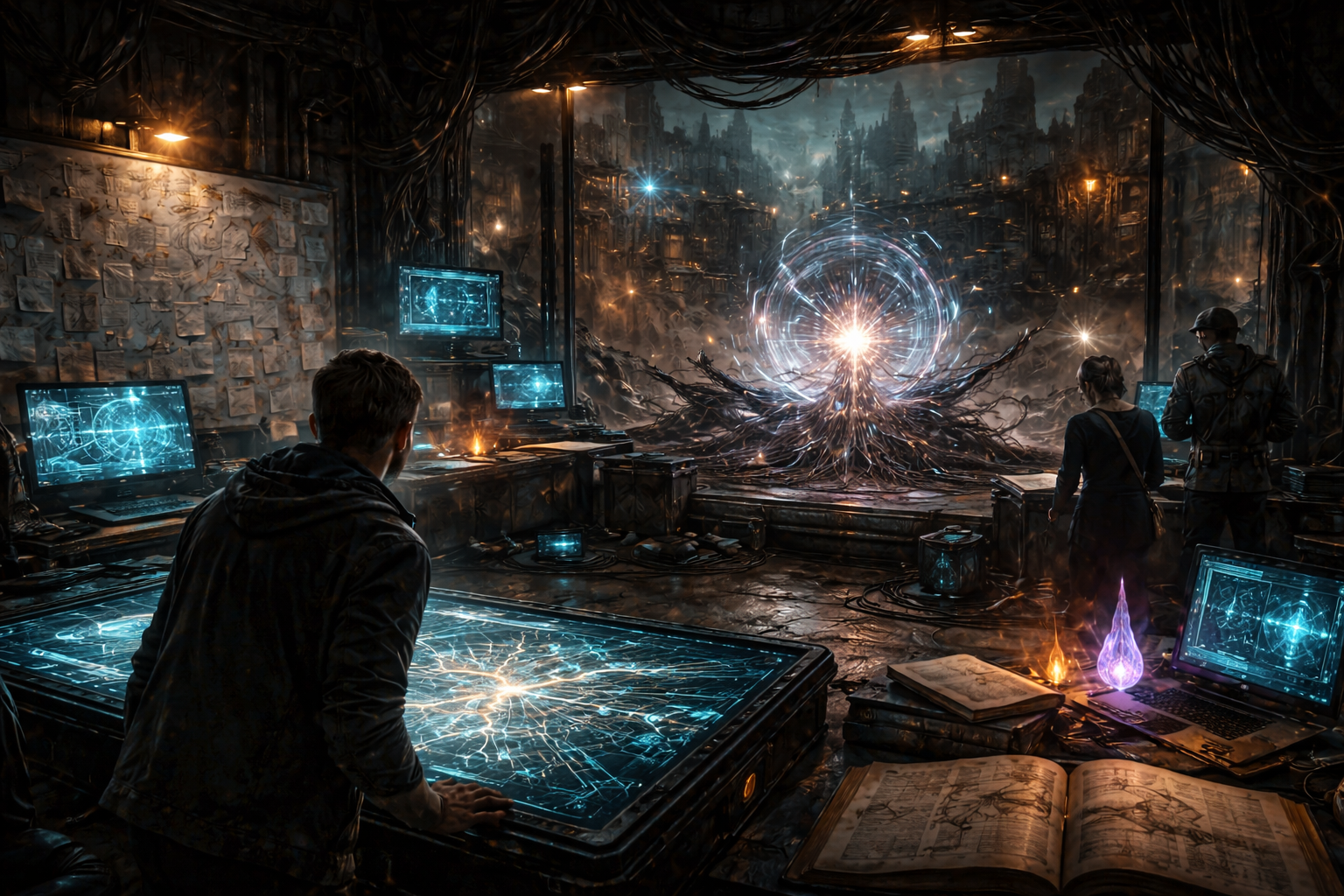
Urban Arcana
Urban Arcana is the academic field that investigates how arcane, supernatural, and metaphysical forces intersect with, alter, and are shaped by the Mundane world, particularly within contemporary urban environments. Rather than focusing on isolated magical traditions or otherworldly realms, Urban Arcana explores the persistence of arcane phenomena within cities, infrastructure, and social systems that were not designed to recognize their existence. The modern world is conceptualized not as an obstacle to magic, but as a complex medium through which arcane forces diffuse, adapt, and occasionally thrive. Urban features such as streets, transit systems, abandoned buildings, data networks, and population density are considered variables influencing how magic manifests, mutates, or destabilizes reality.
A central premise of Urban Arcana is that the Mundane world unintentionally replicates conditions previously limited to mythic or concealed spaces. Factors such as dense populations, layered construction, artificial darkness, unresolved trauma, and constant motion generate environments where supernatural phenomena can anchor and propagate without deliberate ritual or intent. Arcane effects are frequently misinterpreted within mundane frameworks, often classified as accidents, mental health crises, infrastructure failures, or criminal activity. This misattribution enables such phenomena to persist beneath the appearance of normalcy. Urban Arcana interprets these misclassifications as evidence of magical interaction, emphasizing that disbelief does not negate influence but merely obscures causality.
Urban Arcana is inherently interdisciplinary, integrating concepts from occult theory, anthropology, urban planning, psychology, disaster studies, and metaphysics. Practitioners examine how ley lines may reroute through power grids, how abandoned transit corridors function as liminal thresholds, and how repeated human suffering can imprint locations with persistent supernatural resonance. The field also investigates adaptive entities, including humans, creatures, and phenomena that evolve in response to urban environments, becoming specifically suited to contemporary conditions rather than ancient contexts. These adaptations frequently render traditional containment or magical frameworks inadequate, necessitating new models of response grounded in the realities of modern life.
Ultimately, Urban Arcana reconceptualizes the city as an active participant in supernatural processes rather than a passive setting. The field contends that magic has not vanished in the modern era; instead, it has been absorbed, refracted, and concealed within systems of concrete, steel, bureaucracy, and routine. By examining how arcane forces persist and transform within the Mundane, Urban Arcana aims not only to understand these phenomena, but also to predict, mitigate, or harness their effects before they escalate into crises that defy conventional explanation.



Comments