

The Parting Mirror
“Every life has a moment where another road seems kinder. The danger is not in noticing it, but in standing still long enough to imagine who you might have been if you had taken it. Wonder long enough, and the road begins to feel like an accusation rather than a memory.”
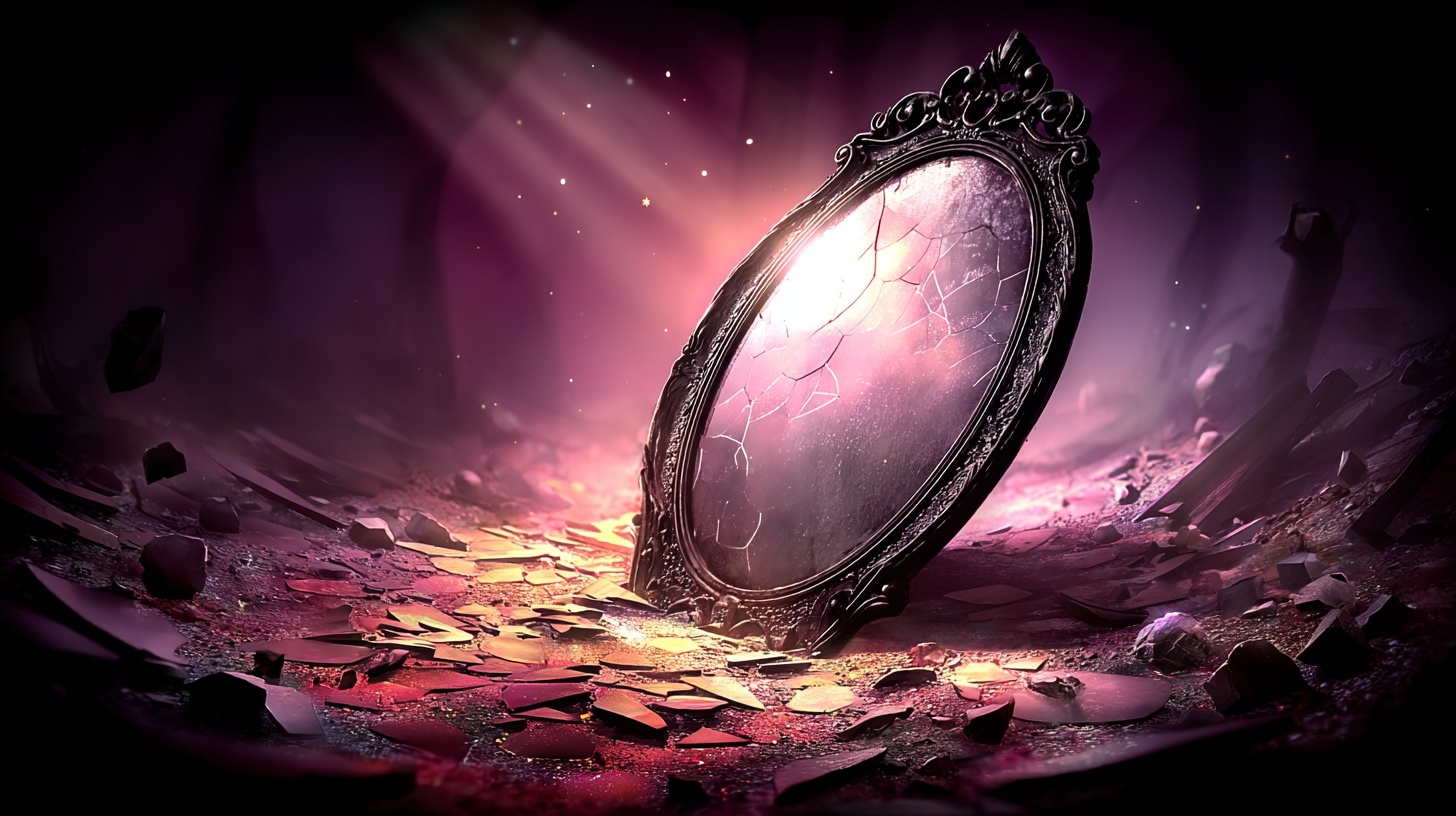
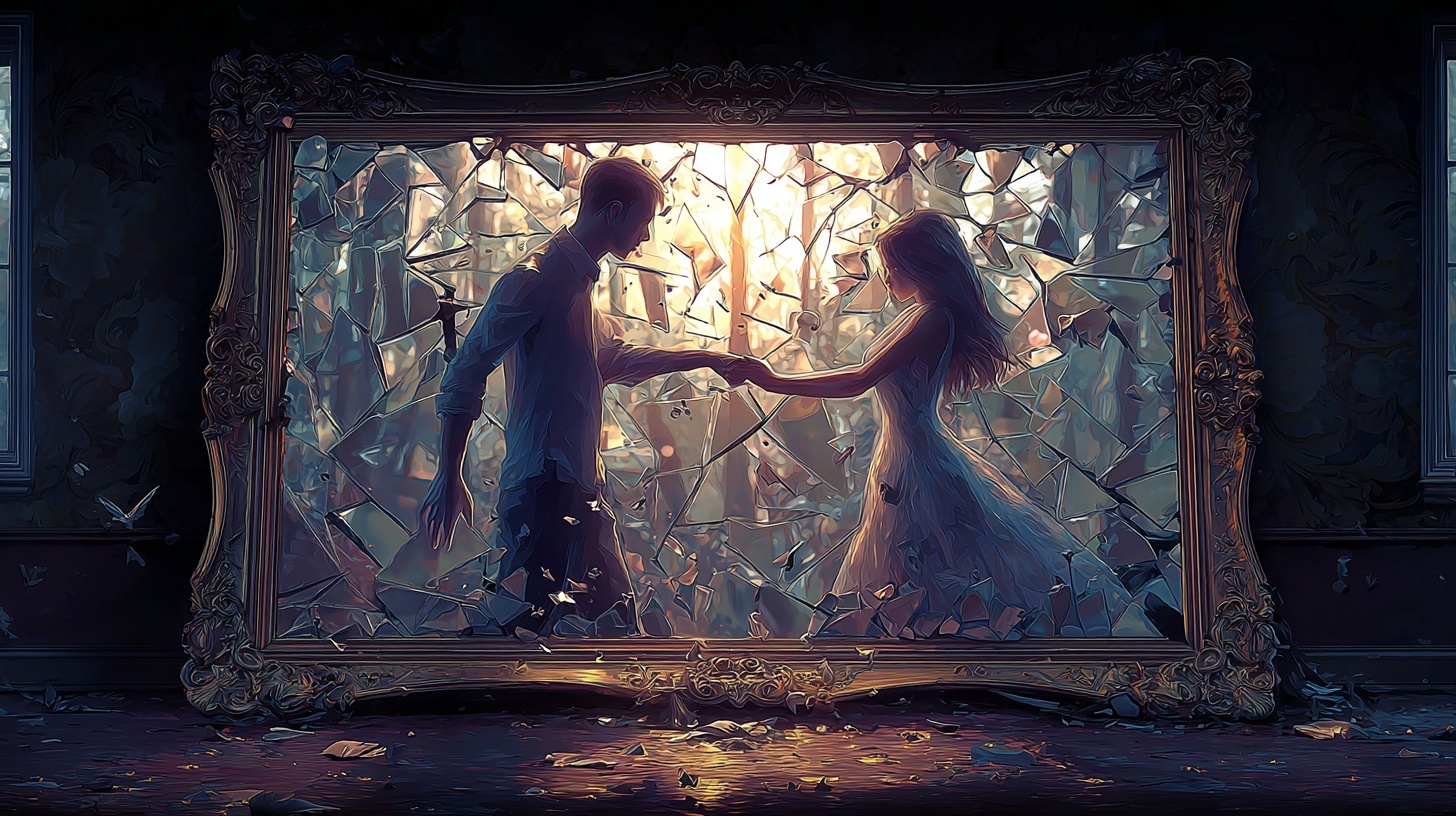
The Parting Mirror is never found by those who are looking for escape. It appears instead in lives that are already complete by most measures, lives that look finished from the outside and feel quietly unfinished from within. It stands in rooms meant for contemplation rather than protection, places where people come to think, to remember, or to convince themselves that what they have is enough. The mirror does not feel invasive. It feels patient, like something that understands how long it can afford to wait. To look into it is not to witness spectacle, but to recognize a familiar ache rendered gentle. The reflection shows a life that unfolded with fewer sharp turns, a sequence of days where loss never quite took root. Nothing about it is extravagant. It is smaller than fantasy and heavier than hope. The sadness comes not from what is missing, but from how easily it all seems to fit together. The viewer is left with the quiet realization that this life did not require heroism or sacrifice. It only required being elsewhere when one moment went wrong. Time inside the mirror does not pause to be observed. It moves forward with or without attention, indifferent to the gaze that follows it. People within the reflection laugh, argue, grow older, and make plans that will be kept. They do not look back. The life continues in a way that feels profoundly unfair, not because it exists, but because it does so without asking permission. The mirror offers no commentary. It allows the viewer to sit with the knowledge that this version of the world was always possible. The decision to reach out rarely feels dramatic. It comes after long stillness, after the moment when longing stops hurting and starts to feel practical. The surface yields without resistance, cool and calm, like a boundary that was never meant to be solid. There is no sense of departure, no final heartbeat to mark the change. One moment holds a person shaped by years of memory. The next holds only the room and the mirror standing quietly where it always has. What remains behind is not ruin, but absence woven into daily life. Friends speak names that no longer answer. Projects wait for hands that will never return. Love becomes something unfinished rather than lost. The sadness here is not loud enough to demand explanation, only persistent enough to linger. The world continues because it must, carrying the shape of someone who chose a different version of themselves over staying. In the life beyond the glass, there is no such lingering. The mirror is careful. It delivers its gift without leaving a scar. The person who arrives is greeted by a world that already knows them, already trusts them, already loves them. The sorrow that once defined their choices is gone, replaced by a sense of quiet belonging. The tragedy is that it all feels deserved, as though happiness itself were proof that the choice was right. The Parting Mirror is feared not because it is cruel, but because it is gentle. It does not demand a soul or extract payment in blood. It offers a life where grief never quite happened and asks only for agreement. In that moment, it poses a question that has no correct answer. Whether it is better to endure a world shaped by loss, or to step into one where everything feels right, knowing that somewhere else, the sadness you avoided will still remember your name.
Mechanics & Inner Workings
“There are many things in this world that promise happiness, and most of them lie. The mirror is worse. It tells the truth. It shows you a happiness that is real, attainable, and already lived by someone with your face. It lets you feel how easy it would be to step into it and how reasonable it would sound afterward. That is how it wins. Not by force, but by making surrender feel like mercy.”
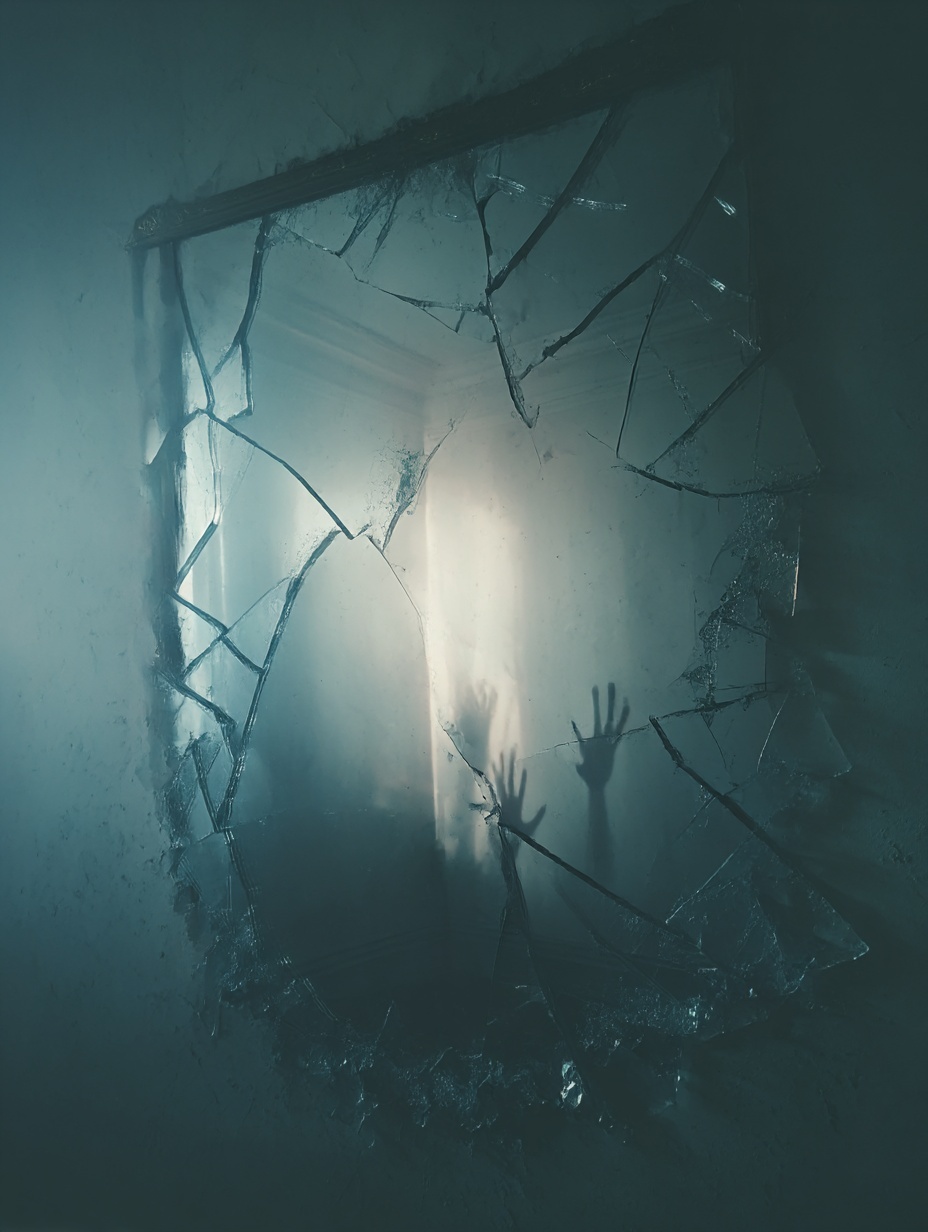
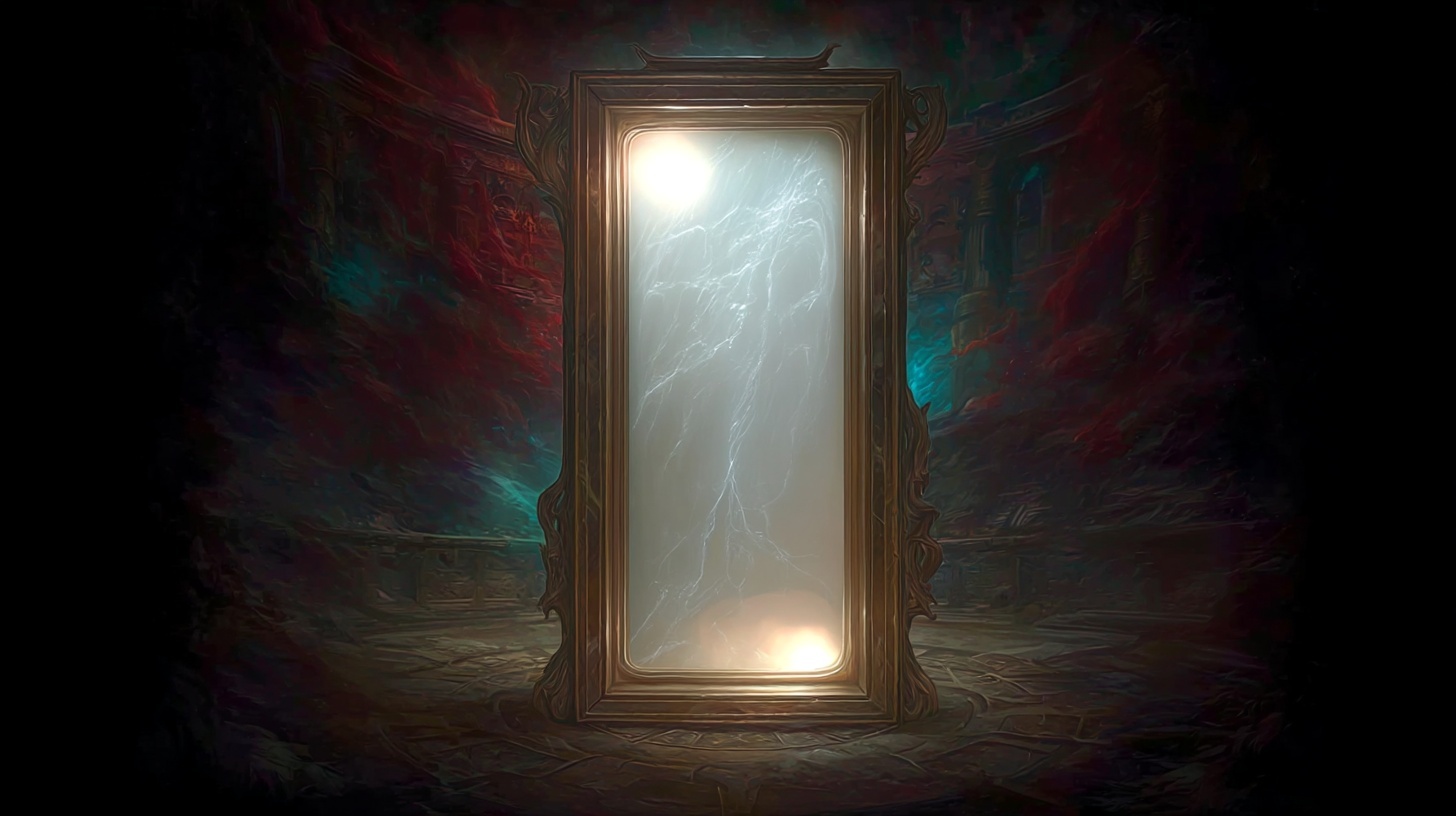
The Parting Mirror does not function as a spell in the conventional sense. There is no invocation, no trigger word, no visible surge of arcane force when it is activated. Its magic is passive and constant, always observing, always aligning. When a person stands before it, the mirror does not read surface thoughts or conscious wishes. It reaches deeper, isolating the singular desire that has exerted the greatest gravitational pull across that person’s life. This desire is not necessarily noble or dramatic. It may be safety, belonging, absolution, or the simple wish that things had not gone wrong in one specific moment. The mirror responds only to what the heart has already chosen, even if the mind has never admitted it. Once that desire is identified, the mirror does not create a new reality to satisfy it. Instead, it locates an existing one. Somewhere within the vast lattice of possible outcomes, there is a version of the user for whom that desire was fulfilled naturally through different choices, chance, or circumstance. The mirror does not simulate this life or conjure it temporarily. It establishes a direct metaphysical alignment between the user and that parallel existence. The reflection shown is not a vision but a live window, anchored to a reality already in motion and already complete. The danger of the mirror lies in how it resolves overlap. Two identical identities cannot persist within the same reality. When the user crosses the mirror’s surface, the artifact enforces exclusivity. The incoming self is stabilized instantly, while the original inhabitant of that life is unmade. This is not displacement or transfer. There is no soul migration or lingering echo. The removed version ceases across all metaphysical registers at once, as though their continuity had never been required to begin with. The mirror performs this act without resistance or strain, implying that such erasures are not violations of reality’s rules but applications of them. What makes the mirror uniquely hazardous is that it imposes no visible toll on the user. There is no corruption, no madness, no lingering mark that betrays what was done. The magic completes cleanly and permanently. The user retains their memories, their sense of self, and their emotional continuity, now seated within a life that feels earned because it fits so well. This absence of punishment is itself a structural danger. The mirror offers absolute success without immediate consequence, encouraging the belief that nothing has been broken because nothing appears broken. The mirror’s influence does not end at the moment of crossing. The abandoned reality continues to exist with full integrity, carrying the weight of loss without explanation. The mirror does not sever connections gently. It allows grief, confusion, and unresolved bonds to persist indefinitely. From a metaphysical standpoint, this creates an imbalance that cannot be corrected because the missing individual was not destroyed by violence or accident. They were removed by choice. The mirror therefore introduces a permanent asymmetry between worlds, one cleansed of loss and one forced to absorb it. The true danger of the Parting Mirror lies in what it normalizes. By functioning flawlessly, it reframes erasure as a valid solution to regret. It demonstrates that fulfillment can be obtained not by enduring consequences but by selecting a reality where those consequences never occurred, regardless of who must be removed to make room. The mirror does not compel this logic. It merely proves it works. In doing so, it presents a model of magic where the greatest cost is not paid by the one who acts, but by a version of them who never consented to be erased.
Manufacturing process
"To look at the world and decide it would be better to erase a self than endure a memory is not genius or ambition. It is grief so complete that it stops distinguishing between mercy and violence. Whatever he lost was not something that could be mourned, because mourning still accepts that the loss belongs to you.”
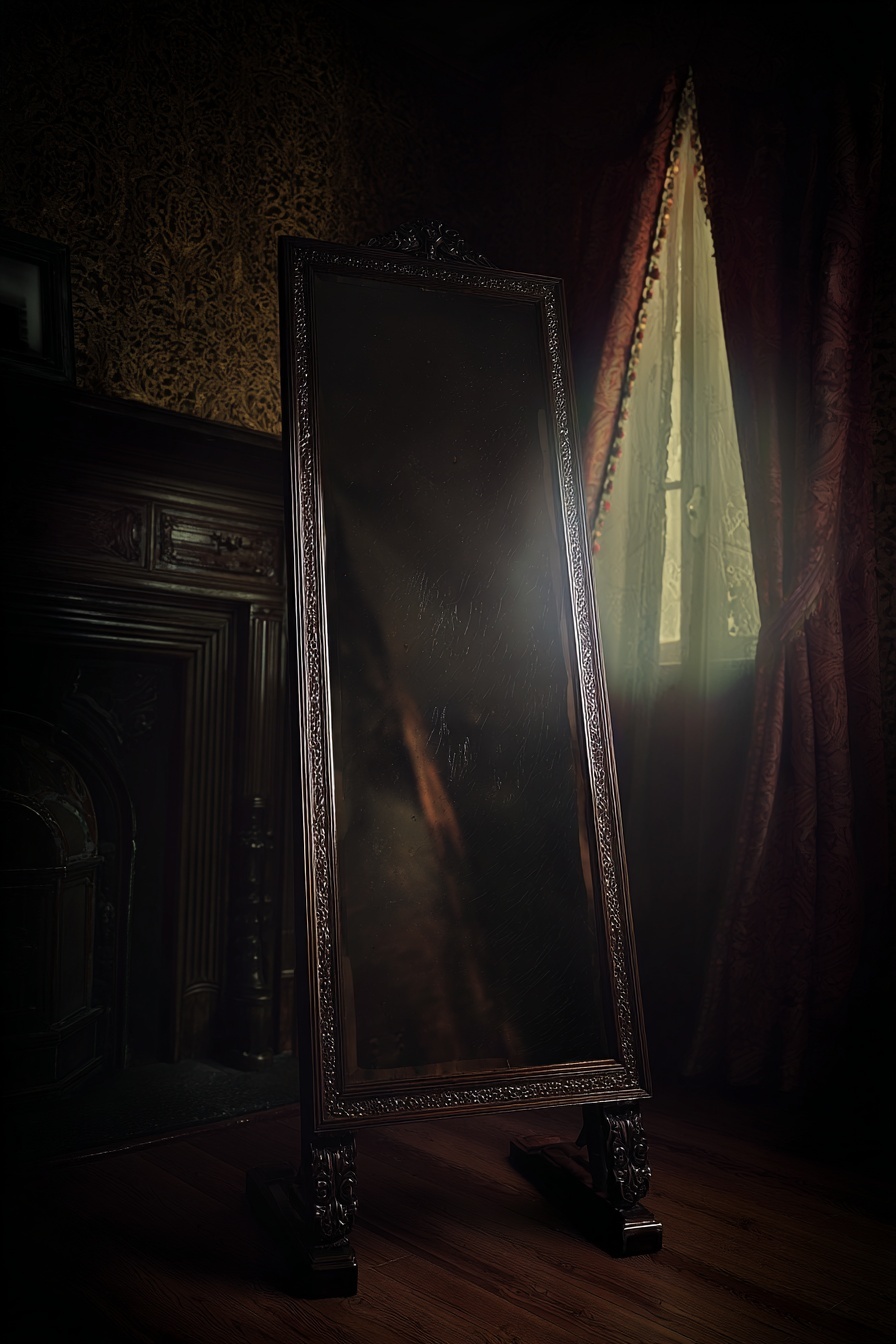
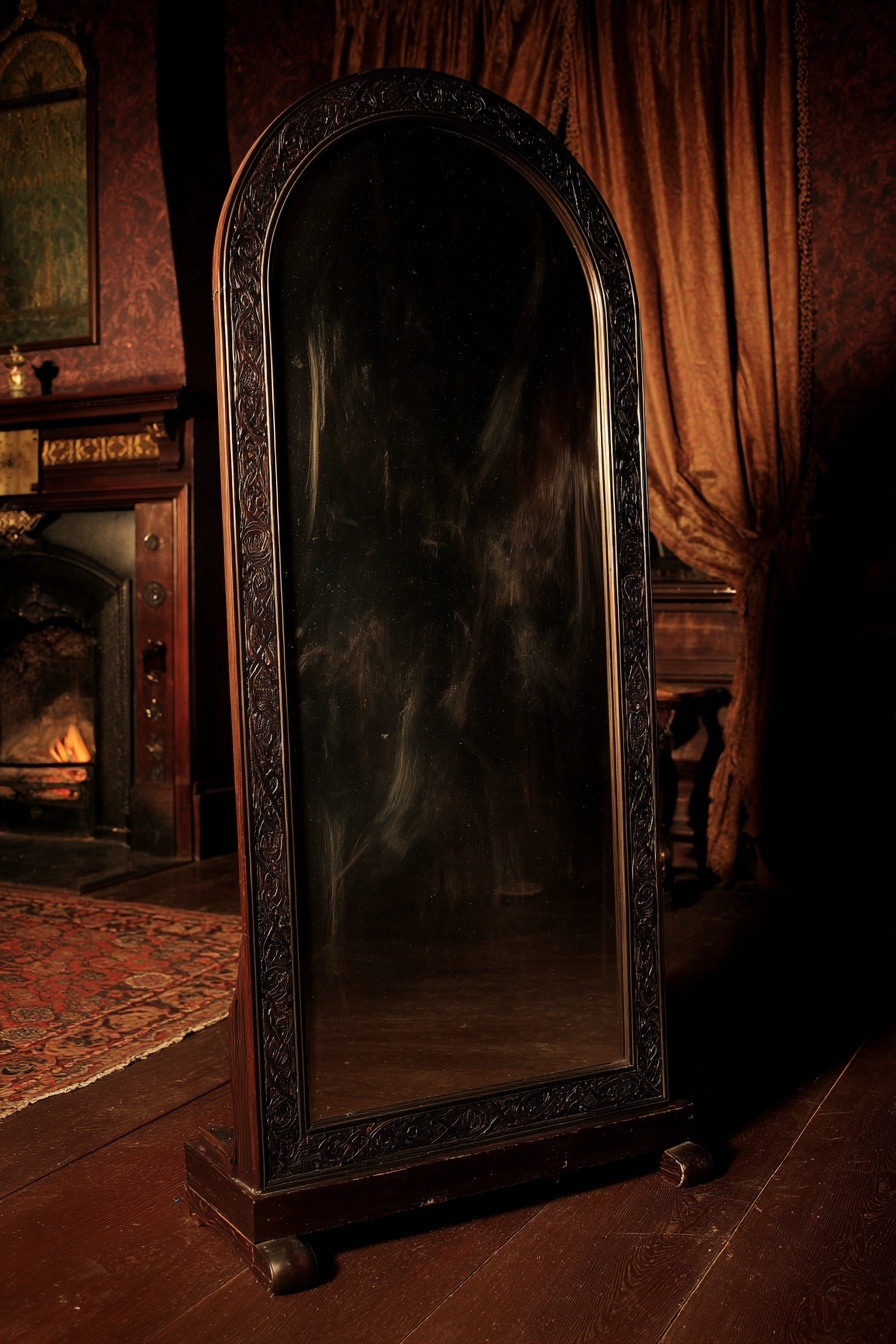
The wizard who created the Parting Mirror was named Halveth Ruun, a transitive arcanist whose reputation rested on his work mapping decision based divergence in living subjects. His catastrophe was not theoretical. It was witnessed, recorded, and quietly buried. Ruun was married, and his partner died during a sanctioned planar experiment when a containment circle failed by a margin so small it was later measured in heartbeats. Ruun survived. The records list the death as accidental, unavoidable, and closed. Ruun did not accept that verdict. He became convinced that the failure represented only one possible outcome, and that survival elsewhere proved the error could be corrected. Ruun’s fixation hardened into doctrine. He isolated himself and began reconstructing the experiment not to prevent the death, but to locate the version of reality in which it had never occurred. His journals describe hundreds of modeled timelines in which the same moment unfolded differently. In many, his partner lived. In most, Ruun himself did not. This did not deter him. He concluded that survival was irrelevant. What mattered was identifying a version of the world where the desired outcome already existed and finding a way to step into it without destabilizing the surrounding structure. The manufacturing process began with Ruun dismantling his own sanctum and reconfiguring it into a compression chamber for probability. He layered containment wards not to repel intrusion, but to prevent divergence. For weeks at a time, the interior of the chamber existed under enforced sameness, a state in which events were permitted to occur but forbidden to resolve differently. Ruun subjected himself to these conditions repeatedly, documenting memory loss, emotional flattening, and gaps in continuity as acceptable degradation. He wrote that a self willing to be improved must be prepared to be thinned. The mirror’s reflective surface was created through an act of self displacement. Ruun engineered a convergence between two versions of himself, one who had lost his partner and one who had not. The process did not merge them. It selected between them. The mirror was formed at the moment that choice was enforced, capturing the boundary where one Halveth Ruun continued and the other was removed. The surviving Ruun could not later determine which life he had originally lived, only that the mirror now worked exactly as intended. Completion of the mirror required final calibration, during which Ruun tested it repeatedly on lesser divergences. Animals. Servants. Eventually, associates who trusted him. The records do not describe screams or resistance. They describe confirmation. Each successful use reinforced his belief that the mirror was not an abomination but a correction mechanism. He wrote that grief was a symptom of limited perspective and that once a better version of oneself existed, remaining in a worse one was an act of negligence. Ruun’s last entry is dated three days after the mirror’s final stabilization. It contains a single sentence written with unusual care. “I see her waiting, and this time I know which side I am on.” When investigators later entered the sanctum, they found the mirror uncovered, the chamber intact, and no sign of Halveth Ruun. His partner’s name appeared nowhere in the room, not in ink, not in memory wards, not even in the mirror’s reflection. The artifact was complete. The price had already been paid. The frame of the Parting Mirror is not fashioned from any single metal, wood, or stone that can be cleanly identified. Analyses conducted by those with the means to attempt them describe a composite material that resists categorization, behaving like worked obsidian under pressure while exhibiting the density and thermal indifference of deep stone. When cut or scored, the material heals slowly over time, seams drawing themselves closed as though the frame were remembering an earlier, uninterrupted shape. No tool marks remain for long, which has led some to conclude that the frame was not constructed so much as persuaded into its current form. The reflective surface itself is not glass in any ordinary sense. It contains no measurable sand content and does not fracture when struck, instead rippling briefly before settling again into perfect stillness. Those who have examined fragments taken during rare moments of instability report that the surface absorbs light rather than reflecting it, returning only what it has already decided to show. Under magnification, the mirror reveals layers that do not align spatially, as though multiple depths occupy the same plane. Attempts to remove or thin the surface invariably fail, the material reverting to its original thickness regardless of how much is scraped away. Embedded within the mirror, though never visible at the same angle twice, are inclusions resembling veins or threads suspended behind the reflective plane. These filaments are believed to be composed of condensed probability, a substance theorized but never successfully harvested elsewhere. Their presence suggests that the mirror’s function depends not on raw magical force, but on constraint. These threads do not generate outcomes. They bind them, locking countless potential lives into fixed relationships so the mirror can identify which version may be exchanged without unraveling the structure entirely. The backing of the mirror is rumored to contain organic components, though no consensus exists on their origin. Some accounts speak of cured membranes taken from beings that existed briefly across multiple realities at once, creatures whose deaths produced remains that did not agree on where they had occurred. Others describe the material as having once been human, though stripped of any defining features before incorporation. When exposed to certain divinatory techniques, the backing responds with patterns consistent with residual identity, suggesting that something capable of being someone was rendered into function instead. The assembly of the Parting Mirror is believed to have required a convergence rather than a workshop. Components were not joined sequentially but aligned simultaneously, each piece dependent on the others to maintain coherence. Ritual descriptions, where they exist at all, emphasize silence, isolation, and the deliberate suppression of names. Nothing involved in the mirror’s creation was allowed to be fully acknowledged as itself. Materials were chosen not for their strength or rarity, but for their willingness to exist without certainty, to remain unfinished in ways that could later be exploited. What ultimately distinguishes the Parting Mirror from other constructed artifacts is that no single component can be identified as essential. Every part appears interchangeable in theory, yet irreplaceable in practice. Remove one element and the mirror ceases to function, not by breaking, but by becoming ordinary. This has led to the unsettling conclusion that the mirror is not powered by its materials, but by the relationships between them. It is an object held together by enforced agreement, a structure that only works because every component has already accepted the role of being used to erase something else.
History
“He did not build a machine. He built an answer. And like all answers to the wrong question, it solved the problem flawlessly and destroyed everything that had made the question bearable in the first place.”
The earliest credible reference to the Parting Mirror appears in the private estate records of Caldrin Vey, a jurist whose influence once shaped three neighboring courts without his name ever appearing in public decrees. The mirror was listed among his personal effects with no description beyond its dimensions and a note that it was to remain covered when not in use. Vey’s correspondence from the final years of his life reveals a growing fixation on contingency and regret, expressed not as remorse but as irritation that reality permitted no revisions. His papers end abruptly. His household continued to function for decades afterward, staffed and funded as before, though Vey himself is never mentioned again except in the past tense. The mirror next surfaces in the possession of Selienne Marr, a patron of the arts whose salons were attended by philosophers, mathematicians, and minor sovereigns. Guests remarked on a tall veiled object placed in a private gallery that was never discussed directly. Marr was known for her composure and restraint, yet her final season was marked by a sudden generosity that unsettled her peers. Debts were forgiven. Inheritances were accelerated. When she failed to appear at her own midsummer gathering, no explanation was offered, and none was demanded. The mirror vanished from the estate inventory within the same year, quietly removed before the household was dissolved. Several generations later, fragments of the mirror’s passage can be traced through the sealed archives of the Arkhavel Collegium, an institution that prided itself on never acknowledging phenomena it could not formally define. A single restricted folio describes an object held briefly in the care of a senior provost whose work focused on probability theory and ethical determinism. Students recalled that the provost canceled all lectures without notice and resigned his post in writing that expressed satisfaction rather than distress. His office was cleared methodically. The mirror was returned to its crate. No further discussion appears in the Collegium’s records, though the folio itself was later removed and replaced with a blank binding. The most disturbing account belongs to House Karsyne, a mercantile dynasty that tracked its lineage with obsessive precision. The mirror was acquired through an anonymous exchange and installed in a secured wing accessible only to the family head. During this period, genealogical records show a subtle but undeniable shift. A key figure in the family narrative simply ceases to appear, replaced seamlessly by a successor whose decisions align perfectly with an alternate branch of previously speculative inheritance. Servants noted nothing unusual beyond a sense that the house felt quieter. The mirror was sold shortly thereafter to a buyer whose name was recorded and then carefully scratched out. In its most recent confirmed appearance, the Parting Mirror passed through the hands of a coalition of financiers and diplomats who treated it as a shared secret rather than a possession. It was moved between estates under guard, never displayed, never spoken of directly. One member of the group withdrew from all negotiations without explanation, and another abruptly reversed a lifelong political position to general approval. Within a year, the coalition dissolved amicably, citing irreconcilable differences that none seemed interested in resolving. It's current whereabouts are unknown.
Significance
“The mirror does not tempt you with grandeur or power. It tempts you with rest. It shows you a life where nothing is pressing, nothing is unfinished, and nothing is waiting for you to fail again. That is the cruelty of it. It does not ask you to become more. It asks whether you are tired enough to stop being who you are.”

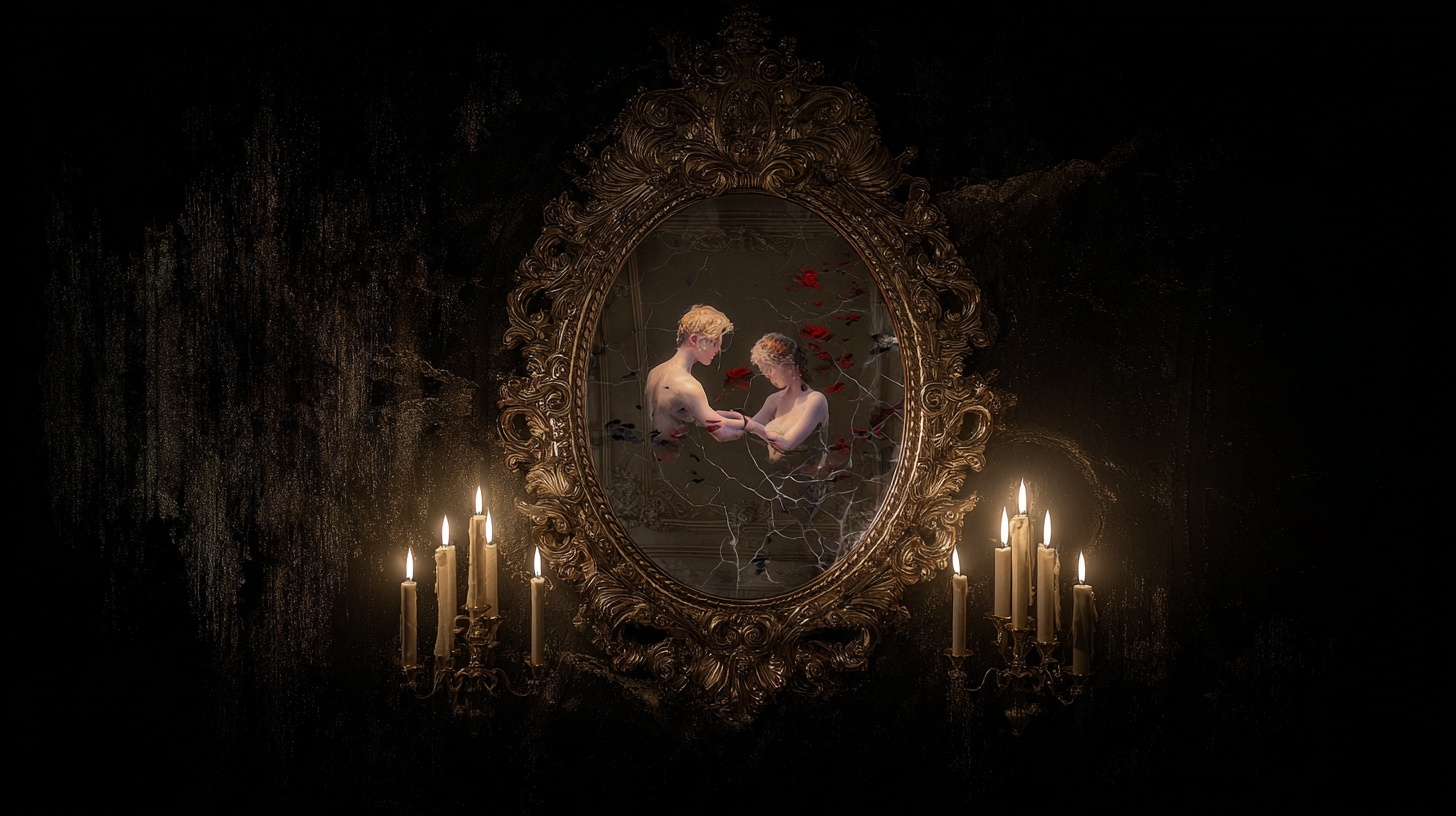
Using the Parting Mirror is not an act of travel or transformation. It is an act of selection. The mirror does not generate a new future or reshape the present. It identifies an already existing reality in which the user’s life unfolded differently and enforces a substitution. One version of the self is permitted to continue. Another is removed. The universe does not register this as damage or interference. It accepts the exchange as valid, which suggests that identity is less fixed than commonly believed and more like a position that can be reassigned. The most unsettling implication lies in what happens on the receiving side of the crossing. The life entered through the mirror is not vacant. It is occupied until the moment it is not. The individual who belonged to that reality does not experience loss, fear, or resistance. They are not displaced or imprisoned. They are simply overwritten, their continuity severed so completely that no trace of absence is left behind. Everyone in that world retains their memories, affections, and expectations, now attached seamlessly to the intruder wearing a familiar face. The original world is not afforded the same erasure. The departure leaves behind a persistent absence that cannot be resolved. Relationships end without explanation. Responsibilities go unmet. The missing individual becomes a permanent anomaly in the lives of others, someone who is remembered too clearly to be dismissed and too completely gone to be recovered. The mirror ensures that one reality heals instantly while another is forced to carry the wound indefinitely. The mirror also demonstrates that fulfillment is not a moral outcome. The life shown in the glass is not a reward earned through virtue or endurance. It is simply a configuration in which circumstances aligned more favorably. The mirror strips meaning from struggle by proving that satisfaction exists elsewhere without it. This reframes regret as a matter of opportunity rather than consequence and invites the user to decide whether perseverance has any inherent value when alternatives can be taken instead. There is a broader implication that unsettles even those who never intend to use the artifact. If a single life can be replaced without resistance, then every life is theoretically provisional. Continuity becomes conditional. The self is no longer singular but one instance among many, sustained not by necessity but by the absence of intervention. The mirror does not create instability. It reveals how little stability was required to begin with. The Parting Mirror therefore represents a violation that does not announce itself as one. It does not corrupt the user or demand sacrifice. It presents a complete life and waits for consent. The act that follows is not impulsive or violent. It is deliberate, informed, and quietly catastrophic, carried out in full awareness that somewhere, in a world that will never know loss, someone else is being allowed to continue because another was willing to be erased.
“Magic that demands sacrifice announces itself loudly. Magic that functions perfectly should be regarded with suspicion. When an effect produces no backlash, no instability, and no visible cost, it is because the cost has been redirected, not eliminated.”
Item type
Unique Artifact
Current Location
Current Holder
Creator
Owning Organization
Rarity
Unique
Weight
800lbs
Dimensions
8ft x 4ft
Base Price
Priceless





Comments