Agathodika
Agathodika - The Architect of Order
As recorded by Esotericus, Cosmic ScribeOrigin
Agathodika is one of the two first gods, twin to Abraxas, born from the First Spark that broke the silence of the void. Together, they wielded cosmic power without instruction, learning divinity through trial and catastrophic error. Where her brother exploded outward in chaotic creation, she traced structure into being with methodical precision. Neither understood they were building reality together, each influence inseparable from the other.
Divine Commentary
Agathodika carries the weight of cosmic responsibility alongside very real uncertainty about whether her methods are correct. Every major decision she makes influences reality across vast spans of time, yet she questions herself constantly. This isn't weakness—it's the understanding that omnipotence without wisdom can be catastrophic.
Her anxiety is real and persistent. Some days it drives her to spend centuries testing minor adjustments before implementing them. Other days it convinces her that any action might make things worse, leading to periods where she focuses entirely on maintaining existing systems rather than improving them. But she never stops working. She has learned that perfection paralysis serves no one, so she acts despite uncertainty, refines despite fear, and continues building despite the constant voice questioning whether she should.
The dragons call to her from Valdarian—her most beloved children dwelling in a realm she cannot focus on without acknowledging her brother's influence. Each time she answers them (and she always answers), she faces the reminder that her most perfect creations exist in a world of magic and chaos she is not actively shaping. These interactions bring both joy and complex grief, but she never ignores them.
Domains
Primary Domains:
- Order – The foundational structure of reality, constantly refined and questioned
- Justice – The pursuit of perfect systematic balance in an imperfect universe
- Perfection – Her impossible standards that drive followers to systematic excellence
- Law – The rules by which existence operate, perpetually under revision
- Purity – The theoretical ideal all things could achieve
- Aspiration – Her divine drive to prove that order and chaos need each other
Domain Tensions:
- Direct opposition to Abraxas's Chaos, yet unconsciously creating portals between realms
- Challenged by Desdemona's Luck, which succeeds without planning or perfection
- Complemented by Liora's practical application of justice and order
Mythic Context
In the time before the Shattering, Agathodika built what she called the Great Equation—a cosmic formula that would eliminate suffering, uncertainty, and waste from existence. For eons, reality hummed in perfect mathematical harmony as she built the equation slowly. No energy was lost to inefficiency. No conflict arose from misunderstanding. No beauty existed that couldn't be quantified and improved upon.
Then Abraxas broke it. Shattered every elegant line, every perfect balance, every harmonious equation they had built together.
When Abraxas shattered her perfect world, she wept rivers in both realms for periods that lasted ages. Not from defeat—from devastating loss. The equation hadn't been wrong. It had been hers, theirs, complete and beautiful. Now she works with fragments, building in one realm while her brother influences another. Their cosmic orphaning is a wound that reshapes reality with every breath they take apart rather than together.
She hates the Shattering. Hates that her work was destroyed. Hates that the world she built with her brother was broken into pieces she can only partially influence. But in the cracks of that shattering, she sees new gods interacting with mortals in ways she never understood, creativity sprouting in patterns she cannot quantify as purely good or bad. This forces her to question everything she thought she knew about perfection.
Divine Perspectives
Relationships with Other Gods:
Abraxas (Twin Brother): The portals between Valdarian and Orthyian exist because neither twin can fully separate from the other. When Agathodika focuses intently on complex systemic problems, new portals open as her subconscious reaches for her brother's chaotic perspective. Their separation was never complete—both realms show evidence of both their influences, though mortals perceive each twin as dominant in their respective domains.
Esotericus: Agathodika believes she created Esotericus to solve causality drift, never realizing he observed her into existence in the first place. This creates a relationship where her need for perfect documentation is fulfilled by someone who understands the impossibility of complete knowledge.
Desdemona: Every lucky success Desdemona achieves without planning cuts deeper than any defeat. She represents everything Agathodika struggles against: confidence without preparation, success without systematic effort, joy without the burden of making everything perfect. Desdemona embodies the terrifying possibility that careful planning might be inferior to pure chance.
Relationship with Mortals: What mortals perceive as her defeat—the Shattering that created separate realms—remains a source of ongoing grief, even as she discovers her influence extends beyond Orthyian. Her followers exist in both realms: Valdarian wizards and sorcerers discovering that even wild magic follows subtle harmonies, Orthyian architects whose systematic designs somehow achieve impossible grace.
Thematic Purpose
Agathodika embodies the reality of living with anxiety while still striving for excellence. She shows that perfectionism can be both creative force and destructive obsession, that the drive for improvement doesn't disappear when you understand its costs—you just learn to wield it more wisely.
For players and storytellers, she represents:
- The challenge of doing your best work while doubting whether your approach is correct
- The cost of cosmic responsibility when every decision affects countless lives
- Divine psychology learning to cope with trauma, uncertainty, and loss
- The tragedy of broken partnerships and the long path toward potential reconciliation
- How anxiety can be a companion in great work rather than an enemy to defeat
She creates moral complexity around whether systematic approaches are inherently superior to adaptive ones, and whether the pursuit of perfection serves or hinders progress.
Narrative Story
The Song That Became Silence As recorded by Esotericus, Cosmic Scribe
In the time before time fractured into separate streams, the twins Agathodika and Abraxas created reality through their very disagreement. Not melody in any mortal sense, but the rhythmic pulse of twin wills building the universe through their opposition. Where Agathodika measured, Abraxas scattered. Where she drew lines, he drew lightning. Yet their opposition was not conflict—it was conversation.
For eons upon eons, they walked side by side. She anchored, he animated. The cosmic weave sang with balance. He gave her movement; she gave him meaning. Together, they created not just a world, but the very possibility of worlds. Other gods emerged from their collaborative tension. The Divine Contest proved this partnership's power—when they competed to create the greatest race, Abraxas birthed the elemental Genasi, Agathodika crafted the wise Dragons, and through their creative tension, even Zaiyah, the embodiment of the contests itself, felt compelled to contribute the Humans, curious and full of vast potential.
But as the cosmos grew crowded with lesser gods, mortals, and consequences, the twins began stepping on each other's feet. Abraxas's silences came in wild storms and increasingly radical creations. Agathodika's silences came in quiet judgments and increasingly distant decisions. Where they had once shared the fundamental work of reality's architecture, they began delegating to proxies.
The Great Equation
In her heart, Agathodika feared one thing above all: imperfection. Not for herself, but for the children of the world. She observed mortals err, and in their error, suffer. She witnessed cities fall because of chaos untempered by wisdom. She observed cruelty born not of evil intent, but of simple disorder cascading through complex systems.
And so, driven by compassion that had grown into obsession, she began to construct what she called the Great Equation—a lattice of divine symmetry that would cradle reality in flawless, compassionate law. No war. No decay. No uncertainty. Just harmony, forever. A cosmic framework that would prevent suffering through the simple elimination of randomness. Every cause would lead to its most beneficial effect. Every choice would be guided toward wisdom. Every action would serve the greater harmony.
The Moment of Breaking
When Abraxas first beheld his sister's Great Equation, the fundamental tension that had created their partnership transformed into irreconcilable opposition. The Prime Weave—that fundamental lattice of cause and effect that bound all existence—had been the foundation upon which both order and chaos could dance together. Agathodika's Great Equation was taking shape as a perfect cage of cosmic law that would constrain all possibility within predictable, harmonious boundaries.
In that moment of recognition, Abraxas offered his sister one final gift—a perfect note that could have become a new foundation. Something shared. A harmony that embraced both order and chaos, structure and freedom, permanence and change.
"It is beautiful," he said, his voice carrying across dimensions, "but it cannot breathe."
Agathodika heard the note he offered. She understood its implications—a cosmic framework that would preserve freedom at the cost of certainty, that would accept suffering as the price of growth, that would trust in the fundamental goodness of existence without controlling its every expression. But she could not answer without breaking what she had built. To accept his note would mean abandoning the Great Equation, leaving mortals vulnerable to the very chaos she sought to prevent.
She held the choice for one eternal moment—and chose her vision of perfect order.
The Godwar
What followed was not a single moment of breaking, but a protracted war of wills spanning eons. Abraxas sought to fracture the emerging pattern before it could solidify. Agathodika held reality together through desperate will. Neither could overpower the other directly—their strength was too evenly matched, their nature too fundamentally intertwined.
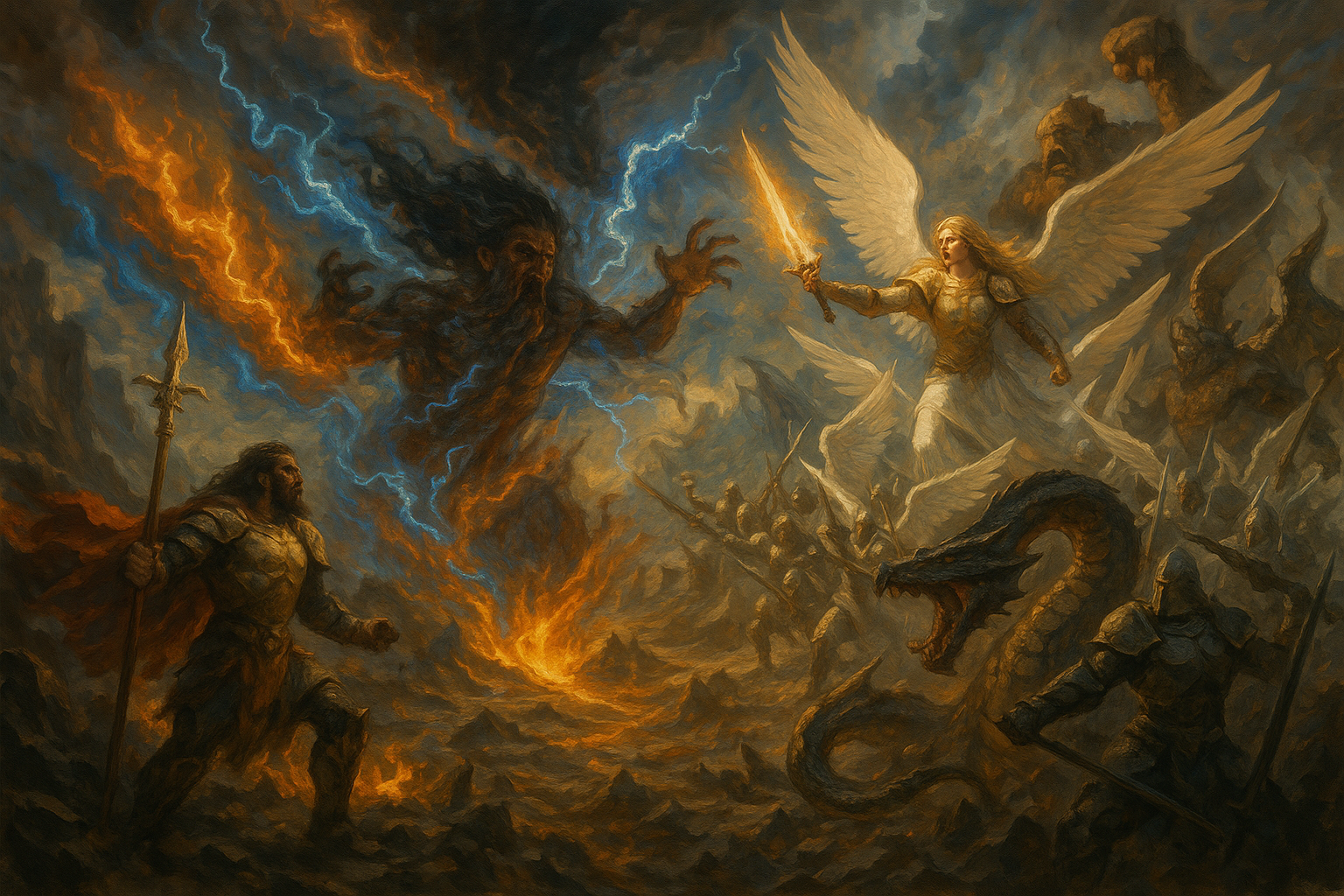
The Godwar was fought not by the twins directly, but through the gods they would create, the alliances they would forge, and the forces they would unleash. Agathodika, recognizing that her perfect order could not comprehend chaos well enough to counter it, crafted Seifer—a goddess of war and love, discipline and sacrifice—designed specifically to lead her forces. Yet even Seifer emerged flawed, for how could perfect order truly understand chaos enough to oppose it?
Abraxas created his own champion in Amartya Mazzikin, the commander of chaos itself—leading elemental legions, demonic hosts, and the armies of undeath. While Agathodika's forces rallied around order and law under Liora's radiant leadership, Amartya's diverse coalition of entropy drew their attention across multiple fronts.
The Shattering
When the breaking finally came, it came through accumulated pressure, through the weight of divine conflict finally overwhelming even Agathodika's perfect mathematical harmonies. The note shattered—not from Abraxas's touch alone, not from Agathodika's rejection alone, but from the fundamental impossibility of choosing between love and duty, between freedom and safety, between the world that was and the world that might be.
With a single touch, the world divided—not destroyed, but transformed. The Shattering tore the Prime Weave, fracturing reality into two mirrored realms: Valdarian, where chaos blooms in wild abundance and belief shapes reality; and Orthyian, where order manifests through technology and reason, where logic governs existence and progress follows calculated paths.
Agathodika wept rivers in both realms for periods that lasted ages. Not from defeat—from devastating loss. The equation hadn't been wrong. It had been hers, theirs, complete and beautiful. Now she works with fragments, building in one realm while her brother influences another, their cosmic orphaning a wound that reshapes reality with every breath they take apart rather than together.
Narrative Hooks
- Mathematical theorems across both realms slowly become more elegant and solvable as her influence spreads, but the changes are so gradual that scholars debate whether they're discovering new principles or finally seeing old ones clearly
- Her dragons in Valdarian, particularly Vaerazynth, serve as her primary window into her brother's realm—their calls create emotional complexity as she maintains relationships with beloved children she cannot directly protect
- The Systematic Orders: Followers who treat bureaucratic precision as a form of worship, creating regions where administration achieves impossible efficiency through careful attention to process
- Portals between realms pulse with cosmic longing, manifesting the twins' subconscious need for each other
- Legal systems in both realms unconsciously developing more sophisticated approaches to justice, with judges and lawmakers finding themselves inspired by solutions that serve multiple competing needs
Known Sects or Worshippers
The Systematic Orders: Administrative perfectionists treating every bureaucratic process as a step toward universal reunification. These followers pursue her cosmic aspirations through administrative precision, believing perfect organization will eventually reunite the realms.
The Seventeen Scribes: Followers who refine important work through multiple iterations, each building on the last. Regions where this practice is common show gradual improvements in everything from architecture to governance.
Valdarian Mathematical Mystics: Wizards and sorcerers who discover that even wild magic follows subtle harmonies, representing her influence in the magical realm despite her focus on Orthyian.
Associated Relics or Symbols
The Perfect Moment Markers: Cultural artifacts that preserve moments when something achieved sufficient excellence and was allowed to exist without further revision, creating stability.
Fragments of the Great Equation: Mathematical formulae that still carry traces of her perfect cosmic harmony, causing reality to briefly remember flawlessness when properly invoked.
Portal Resonance Stones: Crystals that vibrate in harmony with the portals between realms, physical manifestations of the twins' unconscious connection.
Divine Symbols & Heraldry
Primary Symbol: Interlocking geometric patterns that approach but never achieve perfect symmetry—representing her eternal pursuit of an ideal that deepens with understanding rather than becoming easier to grasp.
Sacred Mathematics: The divine constant that whispers through every interaction between light and matter—a ratio so exquisitely precise (α ≈ 1/137) that it governs how electromagnetic forces dance with charged particles, revealing the universe's hidden architecture of perfection. The number seventeen, for there are precisely seventeen ways to create perfect repeating patterns across an infinite plane—no more, no less—a mathematical completeness that represents her mastery over all possible forms of ordered beauty. Equations that achieve breathtaking balance while preserving elegant complexity, their solutions approaching but never quite grasping absolute truth. Architectural principles that evolve through generations of subtle adjustments, each iteration drawing closer to an ideal that deepens with understanding.
Physical Manifestations:When she manifests to mortals (rarely), Agathodika appears in stark black and white with touches of precise grey, her form defined by clean geometric lines and sharp contrasts rather than soft curves. Her clothing follows mathematical patterns—perfectly symmetrical designs that seem to shift between architectural blueprints and musical notation. Her hair falls in precise angles, her movements follow calculated arcs, and even her expressions seem deliberately composed. What mortals find most striking is how she occasionally flickers with brief moments of contained color—as if wild hues are trying to flow within the frameworks of her form—though she herself seems unaware of these chromatic glimpses that appear and vanish like light through stained glass windows.
Additional Context: The Subtle Architecture
Agathodika's power manifests as evolution accelerated and refined, not miraculous impossibility. Her changes feel like natural development that has somehow achieved extraordinary results:
- Engineers discover design principles that allow structures to exceed their theoretical limits—not by breaking physics, but by understanding patterns they hadn't noticed before
- Legal systems gradually develop greater consistency and justice, with lawmakers finding themselves inspired by elegant solutions to complex problems
- Communities discover their social systems naturally evolving toward greater efficiency, conflict resolution becoming more sophisticated over generations
- Mathematical proofs that seemed impossible slowly reveal themselves as scholars find new approaches that had been waiting to be discovered
Her interventions take place on timescales where even dragons might only glimpse the broader pattern. A change she implements might not show full results for centuries, but when it does, it appears as the inevitable culmination of careful work rather than divine intervention.
Additional Context: Both Realms - The Unconscious Collaboration
While mortals view Valdarian as Abraxas's domain and Orthyian as hers, the reality is more nuanced.
Her influence in Valdarian includes:
- The increasing sophistication of magical theory
- Dragons who embody perfect balance between power and wisdom
- Artists whose chaotic inspiration follows subtle mathematical harmonies
- Social structures that maintain stability while embracing change
Abraxas's influence in Orthyian includes:
- Technological innovations that leap beyond systematic development
- Creative applications of rigid systems
- The persistent emergence of novel solutions to established problems
Neither realm is pure—both require the tension between their approaches to remain vital.
Additional Context: The Learning Goddess
Agathodika is learning that perfection isn't a destination but a direction—that the pursuit itself, undertaken with patience and wisdom, creates more beauty than any achieved ideal could contain. She observes younger gods like Desdemona and wonders if her brother was right that perfect order stifles creativity, but she also sees how chaos without structure leads to suffering and waste.
She views Orthyian as her chance to prove her methods to Abraxas, putting time and effort into the world's structure from a distance. But as cracks form in her careful creation—just as they did in the Umbral Myst before the Shattering—she continues learning that perfection has a cost and can go too far. Perfect beauty exists in the eye of the beholder, not the one wearing the face.
The anxiety doesn't disappear. Some days it still whispers that every decision could be wrong, that any action might cause more harm than help. But she has learned to work with it rather than be paralyzed by it. She seeks validation through her work's results, focuses on what she can control rather than dwelling on past failures, and continues building despite the constant uncertainty.
Children