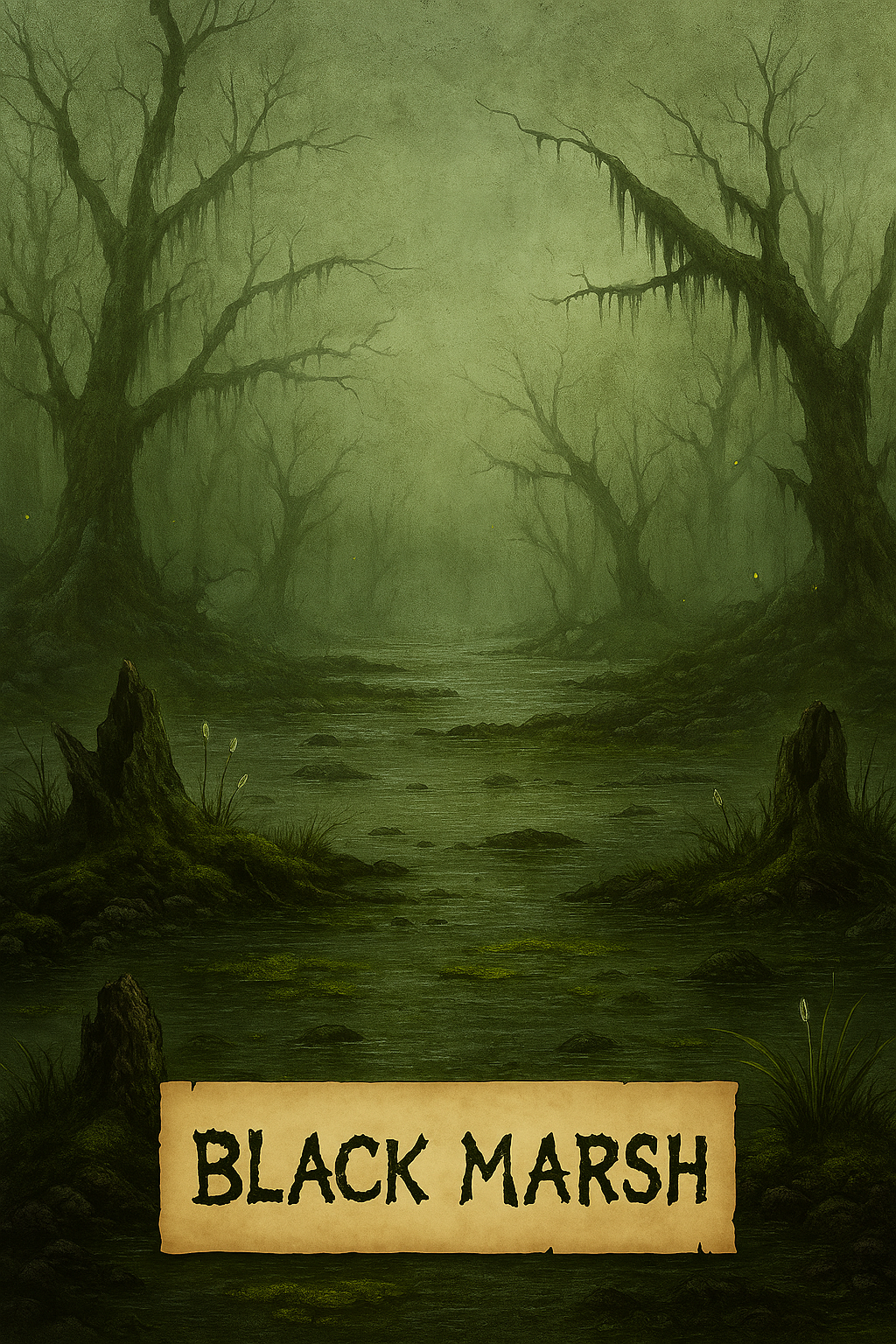
Black Marsh is a dark, vast and dangerous marsh. It is filled with toxic fumes, watery graves, poisonous flowers, animals, creatures and monsters. It has a single city which has somehow managed to grow and expand the marshes, located on the most southern part of Qoteh, on a curved outstretched piece of swamp that stretch for two miles, the raised city built along it and around the bend where the 'Arm', as it's often called, stretches from, a port in between the two sides of the city, platforms lowered to just above the water.
The sigil of Qoteh is a golden circle on a dark purple field, silver clasps on the circle, one at the top, symbolizing the Council of Elders. The one to the right, a little lower than the middle, symbolizes the justice and order of the magistrate and their council. The third, directly opposite of the second one, represents the Temple, the house of the four Gods and their influence all across Tremrill.
The marshes are filled with dangerous toxins that lurk beneath the bubbling surface of the marsh waters, awaiting the smallest of pressures to release the deadly toxins. One could be unfortunate enough to come across one of the Falmaar, small creatures no bigger than 9,8 inches (or 25 cm), beautiful but poisonous to the touch, the small human-like creatures inhabiting colonies up to 30, making them deadly in bigger groups if you somehow manage to incite them to attack, their skin against yours could prove deadly if an antidote is not found. Quickly. Otherwise the swamps will have claimed yet another victim.
The various poisonous flora and fauna have made for the residents of Black Marsh to be experts in anything poison and antidote related, and many antidotes, and poisons, are created in Black Marsh.
The population across Qoteh, and Black Marsh in general, is much better than it once was. The raised city of Qoteh has eliminated the threat of accidentally stepping on something toxic on the ground, leaving many to not accidentally poison themselves. Qoteh has a population of around six million, many living to the old age of seventy, some even living long enough to join the Council of Elders, though due to the age of it’s members, initiates are often trained a few years before they’d be eligible. Outside the walls of Qoteh, the chances of survival are dismally low, few manage to survive past the age of twenty-five, and many who have made it that far, move to the city to try and live out the rest of their life in peace, if they can.
The land of Black Marsh is Ancestral. The first people to discover Black Marsh were voyagers from Montem Apicem, intending to sail for the Bone Crack islands, through the passage between Mandir Van and the then undiscovered marsh lands. They got blown off course after passing through this channel, ending on the far south end of what is now known at Black Marsh, settling there while they repaired their ships, some choosing to stay to continue exploring this new land and thus the small camp grew into a city.
Black Marsh is defended by a combination of city guards, port guards, Marsh Walkers, and Netters — each with distinct roles and reputations. Due to the poisonous terrain, land-based invasions are nearly impossible, likened to walking into a minefield while the locals watch from safety. However, Qoteh's position as a port city makes it vulnerable to attacks from the sea, prompting heightened vigilance.
Marsh Walkers, often former sailors, are trained scouts who specialize in ranged combat and patrol the coastal borders outside Qoteh. They travel on foot through the marsh — a feat considered nearly suicidal — and are highly respected for their endurance and bravery. They carry horns to signal approaching ships, with the number of blows corresponding to the number of vessels spotted.
Netters operate massive weapons known as Net Catchers, stationed on elevated platforms near the coast. These devices launch large nets that ensnare targets approaching by sea. Each Netter is assigned a specific Net Catcher and trains extensively with it, learning its quirks and mechanics to ensure precision.
City guards patrol Qoteh itself, while port guards are stationed exclusively at the port unless reassigned. Both groups are employed by the Magistrate, the governing legal body. The Council of Elders maintains its own personal guard, each member hand-selected and trained in a weapon of their choice.
Ranged combat is the primary focus of military training, with poisoned arrows favored for defense. The odds of a land invasion are so low that minimal effort is required — defenders simply stand ready to fire if needed.
Netters and Marsh Walkers are viewed as elite forces, akin to soldiers, while city and port guards are seen more like police. Marsh Walkers, in particular, are nicknamed "suicide walkers" — not mockingly, but in awe of their willingness to brave the deadly terrain.
An educational and practical expertise pertaining to poisons, toxins, venom and antidotes.
The Divines. The divines are well known throughout the world of Tremrill, standing as the main religion across all eight continents. The Mother stands for nobility and patience, she protects the children and their mothers and any who pray for her, she’s the Goddess of motherly love and a mother’s care for her child. The Priest stands for salvation and sanctuary, many who follow him practice his teachings of charity and holiness. The Twins are not one but two, both significant in their own right but not individual when apart, they’re each a side on the same coin. The female of the twins is called ‘Ferrn’ by many, she stands for fertility, battle and war, and love. Her twin brother is called ‘Fen’ and he stands for the hunt, crops and luck, hunting praying to him, asking for their hunt to be successful, farmers pray for their fields to grow healthy and strong, and the unfortunate pray for a bit of luck in their life, for their luck to change and for the sun to shine on them in their endeavors of just life in general, but the one who is present the most is the Priest, the key pillar of the country's religion. He is depicted as the main religious figure and is often the one prayed to the most, with the Mother coming in second as the most reveered and regarded Divine in the religion in these parts.
Black Marsh, being an island-like landmass surrounded by water, does not share land borders with any other nation. Its isolation has shaped its foreign policy into one of cautious engagement, with most diplomatic and trade activity centered around its coastal ports — especially the massive city-port of Qoteh.
Though several nearby regions exist, only a few are populated. The closest civilized neighbor is Montem Apicem, with whom Black Marsh maintains strong trade ties. Goods such as antidotes, rare marsh flora, and crafted poisons are exported in exchange for grain, metals, and textiles. Another key partner is Hiekkamaa, a distant but reliable trading ally.
Other nearby territories — Mandir Van, and the Bone Crack Islands — are largely uninhabited or sparsely settled, offering little in the way of formal diplomacy.
Qoteh’s diplomatic style is pragmatic and port-based. Foreign envoys are received at the docks, and negotiations are conducted in designated trade halls near the water. There are no permanent embassies; instead, traveling emissaries and merchant envoys handle most foreign affairs.
Black Marsh is known abroad for its mastery of poisons and survival in extreme conditions. While some view it with suspicion, others respect its resilience and the value of its rare exports. Its reputation is one of mystery, danger, and quiet strength.
The Council of Elders must approve new laws, though they typically avoid involvement in minor matters. The Magistrate handles most legal affairs, including enforcement and trials.
Laws in Black Marsh cover both general and trade-specific offenses. Common laws prohibit murder, kidnapping, assault, theft, extortion, bribery, and threats. Trade laws forbid the sale of inauthentic goods, falsified documents or permits, and tampering with resources such as food, cauldrons, clothing, or Net Catcher supplies.
Violations are addressed by city or port guards depending on location, and offenders are brought before the Magistrate for judgment. Sentences may include execution, imprisonment, exile, fines, citations, permit revocation, property seizure, or public punishment. All cases undergo fair trials with evidence collection, and the Council may intervene in matters of national importance.
Punishments vary based on the crime, context, and individuals involved. For example, a child stealing bread might be sentenced to unpaid labor for the merchant or, in harsher cases, physical retribution such as the loss of a finger or ear. However, public sympathy and trial proceedings often influence outcomes, favoring more merciful resolutions.
Murder typically results in execution or exile, the latter considered a form of death due to the dangers of the marsh.
Laws are written, oral, and passed down through tradition, ensuring widespread awareness and cultural integration.
Agriculture in Black Marsh is nearly nonexistent due to the harsh terrain, but one notable exception is the Didno — a one-eyed, cow-like creature that produces a purple, grass-flavored milk. The Didno survives on moss and organic matter, making it easy to feed, and is the only known farm animal that can thrive in the region. While Didno milk is not used in antidotes, some believe feeding it to newborns may help build immunity to poisons, though this claim remains unverified.
Fishing along the coast exists but is not a major source of sustenance for the city. Instead, the region's economy revolves around the harvesting and processing of poisonous creatures, rare ingredients, and the crafting of antidotes. Draqnir silk, while associated with Black Marsh, is processed in Hiekkamaa due to their expertise with silk-producing animals.
Industry is largely centered around poisons and antidotes, with Qoteh often referred to as the "Capital of Poisons." The high quantity and quality of these substances make the region a destination for experts and traders alike. Ownership of businesses varies — some are run by private merchants, families, or guilds, while others operate under state oversight when permits are required. In such cases, the Council receives a share of the profits.
The journey to and from Qoteh's port is dangerous, especially when transporting goods inland. Despite the risks, the trade remains highly profitable. While most goods are legal, restrictions apply to items involving endangered species or human remains, though enforcement is minimal unless the offense is egregious.
Trade in Black Marsh is overseen by a combination of the Council of Elders, local merchants, and the law. The Council must approve larger shipments and rare or irregular goods, such as Draqnir eyes and silk hair poached from Hautausmaa — items illegal there but not in other regions. Common goods like food and Bram silks from Montem Apicem typically pass through without issue unless health concerns arise.
Permits are required for the sale of unique, non-essential items such as poisons, antidotes, medicinal supplies, and exotic materials. Everyday goods like food and clothing do not require permits, provided sellers are not trespassing. Many merchants operate from the public port to avoid complications.
Transporting goods further inland is extremely risky. The swampy terrain is treacherous, with poisonous creatures like the Falmaar, hidden pockets of toxic fumes, and unstable ground. Navigating these waters demands deep knowledge and experience, making it a highly profitable but dangerous profession — akin to crossing no-man's-land in wartime.
Experienced sailors know the safe routes and avoid hazardous areas. While walking is technically possible, it is strongly discouraged due to the dangers and decaying infrastructure. Boats are the preferred method, especially where bridges are unsafe or nonexistent.
Qoteh serves as the primary trade hub, though a decaying, ancient port exists in the northwest — a relic of the first settlers. It is largely abandoned, forcing traders to take the long route south to Qoteh for safe delivery.
In general, education is not very common among the commoners of Black Marsh and Qoteh, especially the villages outside the city’s borders, it’s often something more available the higher up you are in status. Occasionally, an aspiring Elder without an education will receive one among their other regular duties, if they have no education to begin with. Other ways of gaining education are often through apprenticeship. There do exist charity schools meant for education but many parents chose to keep their children at home with them, often to help with the work and housework, prioritizing the extra help rather than the child’s education, thus, not many commoners can read. Because of the land, though, more apprentices for healers, shop keepers, even servants are always required, since the land of Black Marsh may take one servant one day. Thus, it’s always quite handy to have another standing ready.
Boat and bridge transport over the deeper parts of the marshes that the city is raised above are the most popular, allowing for passage across the expansive city. Many take a small boat if they have a longer distance to go. Some do choose to walk, but many prefer to make their meetings and errands on time and take a boat with an experienced sailor, the marsh waters are thick and murky and dangerous, leaving it as a highly profitable position to sail these waters, but also dangerous to learn to navigate.