
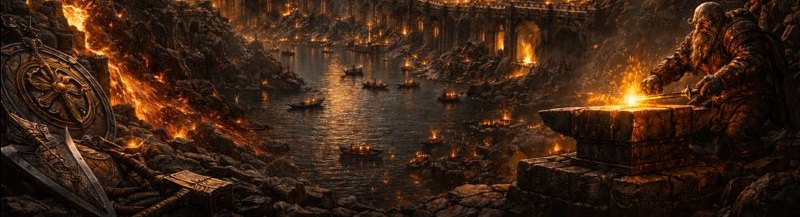
The Underroads
The Underroads are the true heart of dwarven civilization: an immense, ancient network of subterranean passages, halls, caverns, and cities that stretches beneath multiple continents and sovereign nations. To surface dwellers, they are half-myth and half-warning—a realm spoken of with admiration for its craft and unease for its depth and secrecy. To the dwarves themselves, the Underroads are not merely infrastructure or territory; they are the world as it was meant to be inhabited, shaped by stone, fire, and oath rather than sky and season.
Unlike surface empires, the Underroads are not a single unified state, nor are they a loose scattering of independent kingdoms. They form a confederated empire bound by tradition, shared culture, mutual defense, and an intricate system of inter-house rivalry. Power flows not from borders, but from gates, roads, and the great houses that command them.
Structure of the Underroads
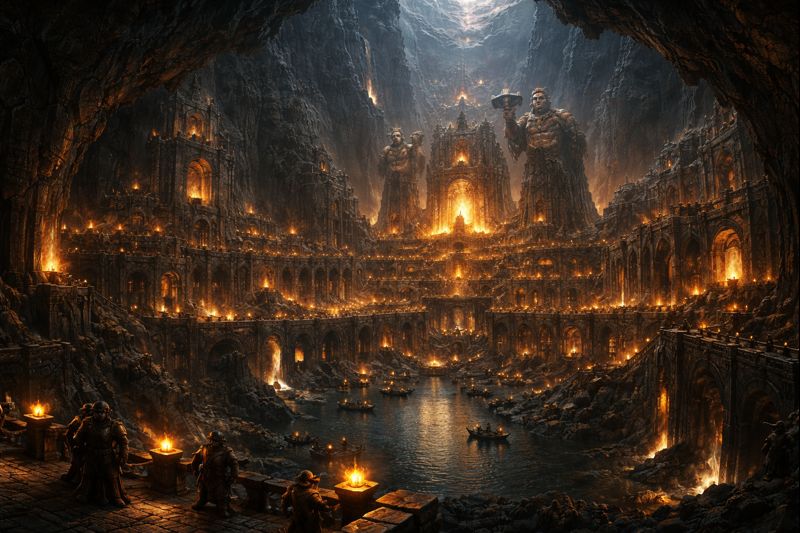
The Underroads are not uniform. They vary dramatically in scale, form, and purpose. Some stretches are monumental stone highways wide enough for caravans and marching hosts, maintained for millennia by guild-masons and house militias. Others are vast natural caverns containing underground seas, glowing fungal forests, or titanic vaults where entire cities cling to pillars of stone. Still others are narrow, ancient crevices—barely widened enough for dwarf-sized passage—left intentionally unexpanded, either out of reverence, caution, or defensive doctrine.
Navigation within the Underroads is deliberately non-intuitive. Distances rarely correspond to surface geography, routes spiral and intersect vertically as often as they do horizontally, and landmarks meaningful to dwarves—changes in stone grain, forge-heat vents, ancestral carvings—are nearly invisible to outsiders. Non-dwarves are not forbidden from traveling the Underroads, but without guides or sanctioned passage they are almost guaranteed to become lost, diverted, or quietly redirected.
Zaraks: Gates to the Deep
All surface holdings of the dwarves are known collectively as Zaraks. To surface cultures, a Zarak appears as a massive mountain fortress or walled citadel, often carved directly into the stone of a peak or ridge. These structures serve as trade hubs, diplomatic choke points, and defensive bastions. To the dwarves, however, a Zarak is not a city in its own right—it is a gatehouse. It is the threshold between the lesser world of sun and weather and the true world beneath.
Each major Zarak controls access to a corresponding region of the Underroads. The most powerful dwarven kings rule from Zaraks, not because they favor the surface, but because command of a gate confers immense economic, military, and political leverage. To hold a Zarak is to control who enters the deep, what goods flow between realms, and which houses gain access to the arteries of dwarven civilization.
Zaraks are monumental by design: layered walls, rune-locked gates, kill corridors, and ceremonial façades meant to impress and intimidate surface folk while reassuring dwarves of the strength behind the stone. Though some surface dwarves live permanently within these holdings, they are culturally regarded as custodians and emissaries rather than the core of dwarven society.
Political Organization and the House System
Dwarven society is organized entirely around houses. Every dwarf belongs to a house, without exception. Houses function simultaneously as extended families, political factions, economic entities, and military units. Allegiance to one’s house supersedes allegiance to any king, city, or gate, though tradition demands loyalty to the throne while a house holds it.
The Underroads operate under a confederated system in which numerous houses compete for prestige, influence, and control of resources. Nobility among the dwarves is not hereditary in the absolute sense familiar to humans. A “noble house” is simply a house that currently holds sufficient power, alliances, and reputation to command authority. Houses rise and fall over centuries, though those powerful enough to claim and hold thrones tend to remain dominant for generations rather than collapsing abruptly.
Politically, the system is turbulent and opaque. Alliances shift, feuds simmer, and honor-debts may outlast wars. To outsiders, dwarven politics appear convoluted and unstable. To the dwarves themselves, this is not dysfunction but balance. Cultural stability among the dwarves is absolute—nearly immutable—while political maneuvering is treated as a controlled pressure valve rather than a threat to society itself.
Kingship and Confederation
There are multiple dwarven kings, each ruling a major Zarak and its associated Underroad domains. These kings are sovereign within their spheres but bound to one another by ancient compacts governing mutual defense, trade rights, and the sanctity of the roads. No single king claims dominion over all dwarves, nor would such a claim be accepted.
When matters arise that threaten the Underroads as a whole—deep incursions, existential threats, or cataclysmic disruptions—the kings convene councils attended by their houses’ champions and forge-lords. These councils are rare, deliberate, and slow, but when consensus is reached, the response is overwhelming.
Religion and the Forgefather
Dwarven religious life is effectively monotheistic. While the dwarves acknowledge the existence of other gods, their worship is wholly centered on Aspira, Lord of the Forge, whom they regard as their creator and divine progenitor. Aspira is not merely a god they follow; he is the philosophical foundation of their worldview. Craft, duty, endurance, and oath are not moral abstractions to the dwarves—they are sacred acts reflecting the will of the Forgefather.
Temples to Aspira are indistinguishable from forges, courts, and armories. Religious authority is inseparable from craftsmanship and governance, and priesthood often overlaps with master-smiths, judges, and architects. Other deities are respected, sometimes even honored diplomatically, but never placed alongside Aspira within dwarven worship.
External Relations and Conflict
Most surface nations maintain pragmatic and positive relations with the dwarves. Zaraks take up little arable land, interfere minimally in surface politics, and provide trade goods of unmatched quality. Dwarven neutrality in surface wars is common, though not guaranteed.
The elves of Suin’ai maintain a strained but largely tolerant relationship with the dwarves. Their conflicts are ancient, rooted in competing claims over mountains, forests, and the philosophical divide between permanence and growth. Open war is rare, but memory is long.
Within the deep, conflict is constant. Dark Elves, aberrant creatures, and other denizens of the Underdark regularly contest dwarven territory. These threats are not existential, but perpetual—treated as storms to be endured rather than enemies to be eradicated. The Underroads are defended not by walls alone, but by vigilance ingrained into dwarven culture itself.
The Nature of the Underroads
To understand the Underroads is to understand dwarven identity. They are not merely roads, but lifelines; not merely tunnels, but history made stone. They bind kingdoms without erasing their independence, foster rivalry without collapse, and allow a civilization to span continents without ever needing to conquer the surface above them.
The Underroads endure because the dwarves endure—patient, disciplined, and unyielding. Stone remembers, and so do they.
Dwarves

Comments