

Dean Rouge Herring
Mental characteristics
Personal history
Rouge grew up in an era similar to the current. A time where magic was common place art of combining magic and machinery was a well established practice. (According to Rouge three such eras have accord that he can remember, maybe more in the 200,000 years when he sequestered himself. He has learned not to share this disturbing fact around polite company)
He grew up in the slum of a long forgotten kingdom where his parents made a merger living trading off what he called “feeble” inherited magic.
As he grew older Rouge took interest in learned magic and for some time worked as an apprentice of a mage wright.
By the age of 25 Rouge was the head mage of a royal court. Surpassing those who had studied the arcane science for hundreds of years.
Through all his accomplishments Rouge was still bothered by what he considered gaps in his knowledge. He did not nor could he perform all spells, and there were those he did know but had not dissected them to the point of understanding them in totality. He hated most to admit that any of his underlings knew something he did not(though he was the only one that had the expectation that he knows all).
One day he began to grow envious of his colleagues with longer life spans and set out to do something about .
The Road To Lichdom
Life as a lich
100 years after completing the ritual for his lichdom Rouge would arise newly born as mummified undead arch mage. The power he accumulated over what should have been three life times no longer restrained by mortality. He would find himself in world not ready for him. It seems that in his absence the world had known a long lived peace.
I awoke to find the world at peace in my absence. That alone was proof of failure—not mine, but theirs. Conflict sharpens the world; peace dulls it. While I slept, nothing advanced, nothing was tested, and nothing truly mattered. They could have their peace, so long as they stayed out of my way and gave me mine.
During this period, the Arch Dragons had entered into a rare and lasting peace among themselves. That accord sent ripples across the world. Enemies of the dragons and their subordinate factions followed suit, as did rival powers, nations, and even deities. War slowed. Borders stabilized. For a time, restraint became fashionable.
Rouge found the stillness intolerable.
In his early years of undeath, he built a modest force of servants and dispatched them across the world to recover magical artifacts, books, scrolls, and any other repositories of arcane knowledge. For a time, this effort proved fruitful. The low-hanging fruit was gathered quickly—forgotten vaults, neglected ruins, poorly guarded relics.
Resistance followed soon after.
Artifacts were withheld. Knowledge was denied. Custodians refused to share what they believed was not his to claim.
By then, Rouge’s thinking had grown cold and absolute. Decades spent in isolation, surrounded only by the creatures he summoned or created, had stripped him of patience. At the first sign of resistance, he chose violence.
It did not take long for his servants’ actions to draw attention. Governments took notice. Adventurers’ guilds issued bounties. Coalitions formed. Rouge answered them all.
For the next decade, he crushed every army and so-called hero sent to challenge him. Each attack only reinforced his certainty that opposition justified escalation. His servants became soldiers. His soldiers became legions. Then, armies in their own right.
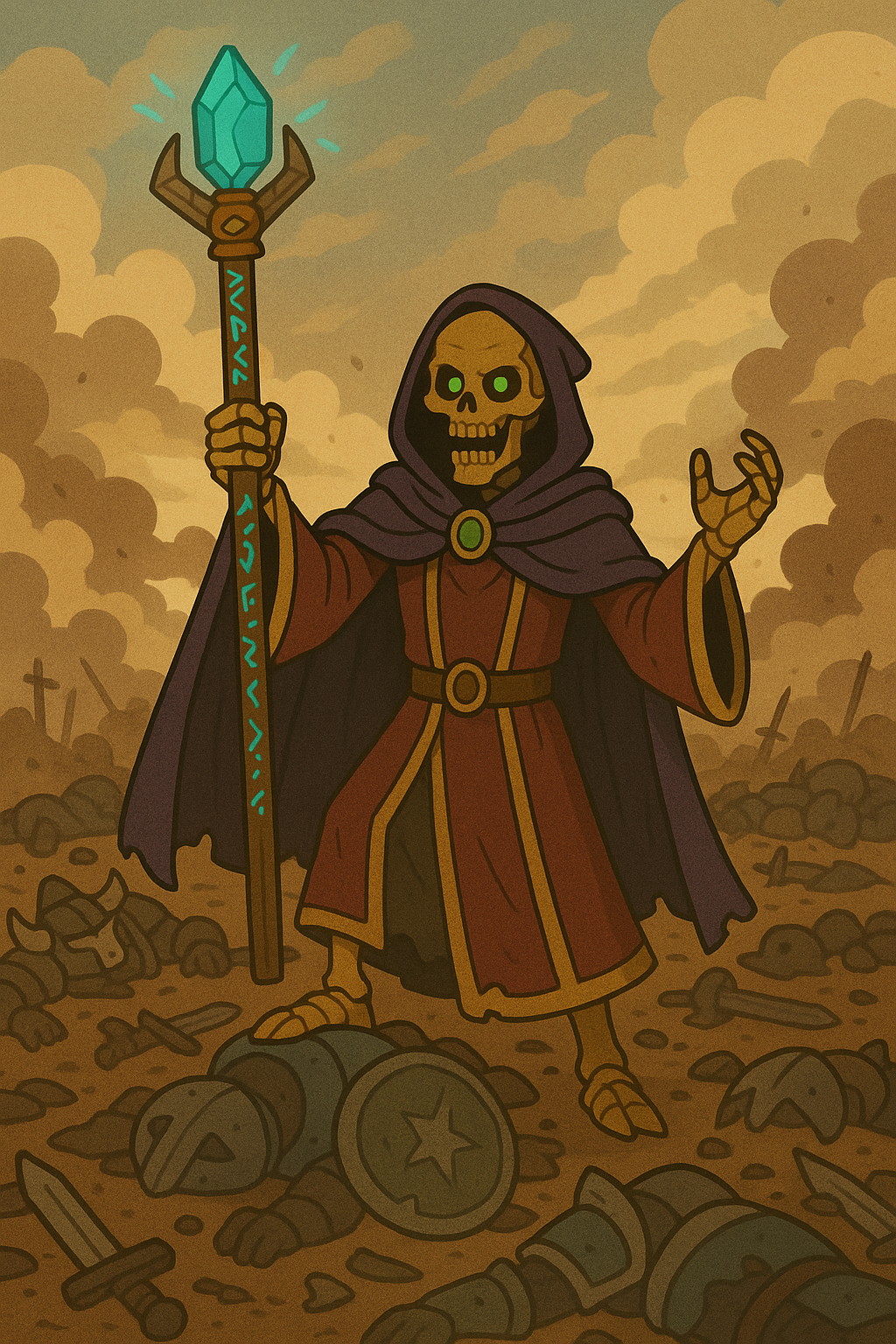
Over the following centuries, Rouge consumed magical knowledge on an unprecedented scale while conquering—or erasing—neighboring cities and nations. At the height of his power, his reach rivaled that of Pridera itself.
Rouge’s empire waxed and waned with his interest. It expanded when challenged, contracted when threats ceased to amuse him, only to surge again when attention returned. This cycle continued for generations—a kingdom that would fade into obscurity, only to erupt once more into a global power when the hornet’s nest was stirred.
All the while, continents shifted. Civilizations were born and died. Languages were buried, and new bloodlines rose to take their place.
Time did not stop for Rouge. As the ages marched on, the decay of his mummified body continued, until flesh gave way entirely and only bone remained. Centuries accumulated like a snowball rolling downhill, and even those bones began to grow brittle. Not from battle, nor from failed experiments—his magic could mend such damage with ease—but from the quiet, relentless truth of entropy. This was the fate of all things made of flesh and bone. They are consumed by time.
Gradually, Rouge replaced his failing remains with Eprualium, coated in bronze and etched with stabilizing runes. Piece by piece, the body that had once been a man was exchanged for something more enduring. In the end, almost nothing of the original form remained. Only the soul bound within the stone endured the final remnant of the man Rouge had once been.
During this vast span of undeath, Rouge clashed with—and occasionally allied himself to—beings of immense power: deities, archdragons, ancient fey, devils, demons, druids, and other entities whose influence placed them beyond mortal reckoning. To Rouge, they were not gods. They were peers.
A lost of words
It was unfortunate that those adventurers arrived too late to interrupt the ritual meant to recharge his phylactery. Under other circumstances, Rouge might have abandoned the attempt entirely—had the earlier failure not already hardened his resolve.
It was also unfortunate that this recharge was the largest he had ever attempted. More unfortunate still was that the adventurers had not stopped him at all. Had they arrived sooner, had they forced that revelation upon him earlier, the ritual might never have been completed. Instead, Rouge proceeded, blind to the implications of what he was about to do.
The tragedy lay in the miscalculation. Rouge had failed to account for several variables inherent to a spell of such unprecedented magnitude. His scaling was catastrophically flawed. What he believed would grant him another one hundred thousand years did not merely extend his existence—it distorted it. He had not added centuries. He had not added millennia. He may have added an eon. Even Rouge, with all his knowledge, could not accurately determine the number.
The Big Sit
Rouge sat motionless upon his throne.
Days turned to weeks. Weeks to months. Months to years.
As time passed, his servants began to fade. Some were slain by would-be heroes, others lost in skirmishes with neighboring powers. With Rouge unmoving upon his seat—and no hand to replace the fallen or renew the magic that bound his creations to this plane—his forces steadily dwindled.
Those who remained stayed loyal to the end.
They fought when they must, cleaned what they could, repaired what little still stood, and performed every duty they believed would preserve their master’s kingdom. But time is an enemy no army can defeat.
The palace was eventually buried—by neglect, by encroaching ruin, and by the slow weight of years. For a long while, the Lich King passed from living memory, remembered only in historical records. Even those were dismissed by many as cautionary tales: stories meant to warn ambitious mages against delusions of grandeur and dreams of immortality.
Rouge at Mage Academy
Rouge did not seek Mage Academy on his own.
He was found—years before his arrival there.
Near the end of his adventuring career, Drake, then still a field mage of considerable renown, followed fragmentary records and sealed references to a buried palace long dismissed as allegory. What he discovered was not a tyrant ruling an empire, but a lich seated upon a half-buried throne—motionless, lucid, and unmistakably aware.
Rouge did not rise to meet him.
He did not speak.
He simply stared at the ruby stone cradled in his hand—the heart that had once beat within his chest.
Drake spoke briefly. Asked questions. Received few answers. Rouge neither threatened nor reacted. After a time, Drake departed, convinced that whatever power sat before him had chosen isolation over dominion.
He did not yet understand why.
A Second Meeting, and a New Purpose
Years later, Drake returned—not as an adventurer, but as the newly appointed Headmaster of Mage Academy, charged with restoring an institution whose prestige had faded into caution and stagnation.
He sought Rouge deliberately.
This time, Drake did not come seeking answers. He came with an offer.
Mage Academy, he explained, was losing knowledge faster than it could replace it. Entire disciplines had vanished within a single generation. Students learned spells, but not foundations. Power endured; understanding did not.
Rouge listened.
For the first time in ages, he responded—not with words of ambition or conquest, but with quiet attention. Drake did not ask Rouge to rule, to fight, or to repent. He offered him something the Lich King had not realized he lacked:
A reason to matter again.
To teach what would otherwise be lost.
A Controversial Admission
A lich presenting himself as faculty—let alone at Mage Academy—was unprecedented. Ethics councils convened. Faculty objected. External arcane authorities threatened sanctions.
Drake stood firm.
He argued that Mage Academy had not fallen because it lacked power, but because it feared it. Rouge, he insisted, was not a conqueror seeking influence, but a repository of living history—one that could still speak.
Under Drake’s insistence, Rouge was admitted provisionally, bound by layered wards, constant oversight, and strict prohibitions on unsanctioned experimentation.
Rouge accepted every condition without negotiation.
That alone unsettled many more than refusal would have.
An Awkward Immortal
Millennia of isolation had left Rouge profoundly unused to mortal society.
He had spent ages interacting only with servants, constructs, and summoned entities—beings that obeyed without question and vanished when dismissed. Casual conversation, disagreement, and unstructured social interaction were skills he had to consciously relearn.
He spoke too formally.
He lingered too long on questions.
He sometimes forgot that people needed rest.
Students initially found him unsettling—not because of cruelty, but because of distance. He was attentive and precise, yet clearly unfamiliar with being among equals rather than tools or subordinates.
Drake often acted as intermediary, translating Rouge’s intent when tone failed him, quietly guiding him through the rhythms of academic life.
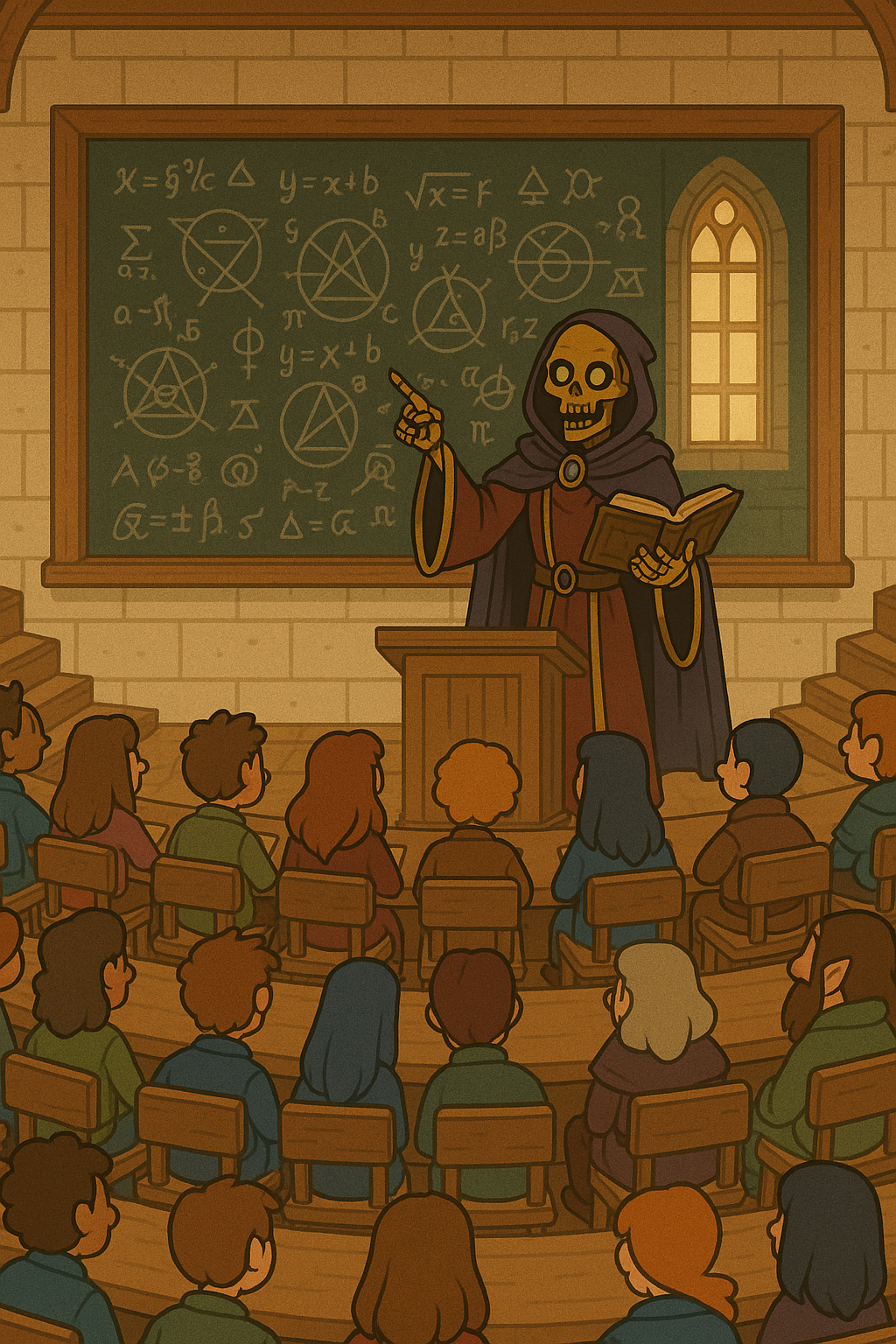
Students it is of no exaggeration to say that I have forgotten more magic than most of you will ever learn. But the whole of magic is not spells and incantations, it is in its practical use. Mastering one spell is better than simply learning a million.
Acceptance Through Teaching
Rouge did not win trust through assurances. He earned it through instruction.
He reconstructed lost disciplines with care and restraint. He taught forgotten languages so spells could be spoken safely again. He warned students away from dangerous shortcuts—not as a moralist, but as someone who had already walked those paths and survived them. He allowed his work to be challenged, scrutinized, and corrected. When proven wrong, he acknowledged it without retaliation.
Slowly, resistance softened. Faculty began consulting him privately. Students sought him out after lectures. Fear gave way to debate. Mage Academy’s reputation began to recover.
From Faculty to Dean of Students
Rouge’s elevation within the Academy was neither rapid nor inevitable. At first, he was limited to advanced seminars and archival work. But over time, it became clear that he possessed an unexpected strength: he was exceptionally suited to working with students.
Where others dismissed failure, Rouge recognized warning signs. Where ambition threatened to outrun judgment, he intervened early. He did not scold—he explained consequences, often through history no one else remembered. Students began coming to him not just for instruction, but for guidance.
When the position of Dean of Students became available, Drake put Rouge’s name forward. The opposition was fierce. Drake argued that no one understood the cost of unchecked ambition better than Rouge. Where others enforced rules, Rouge could explain why they existed. Where punishment discouraged, Rouge redirected.
After months of debate, the position was offered—with additional oversight. Rouge accepted reluctantly, later remarking that administration was far more exhausting than conquest.
Legacy at the Academy
As Dean, Rouge restructured mentorship programs, implemented early-intervention safeguards for experimental magic, and quietly dismantled practices that encouraged reckless competition. Discipline under Rouge was rare—but unforgettable.Students who crossed lines were not expelled lightly. They were made to study the histories of those who had done so before. Ignorance, Rouge believed, was the only inexcusable failure.
Under his tenure, catastrophic incidents declined. Graduation rates improved. Mage Academy regained its standing as a place of rigor, restraint, and discovery. History remembers Headmaster Drake as the man who restored Mage Academy.
Those who know the full story understand something deeper:
Drake did not tame the Lich King. He gave him a reason to teach. And in doing so, ensured that knowledge—once hoarded, once lost—would finally endure.
Species
Unknown (possibly extinct)
Ethnicity
Unknown. The civilization Dean Herring was born into has long since faded. With the march time and geographical change the land it once occupied is mostly gone or unrecognizable.

Comments