
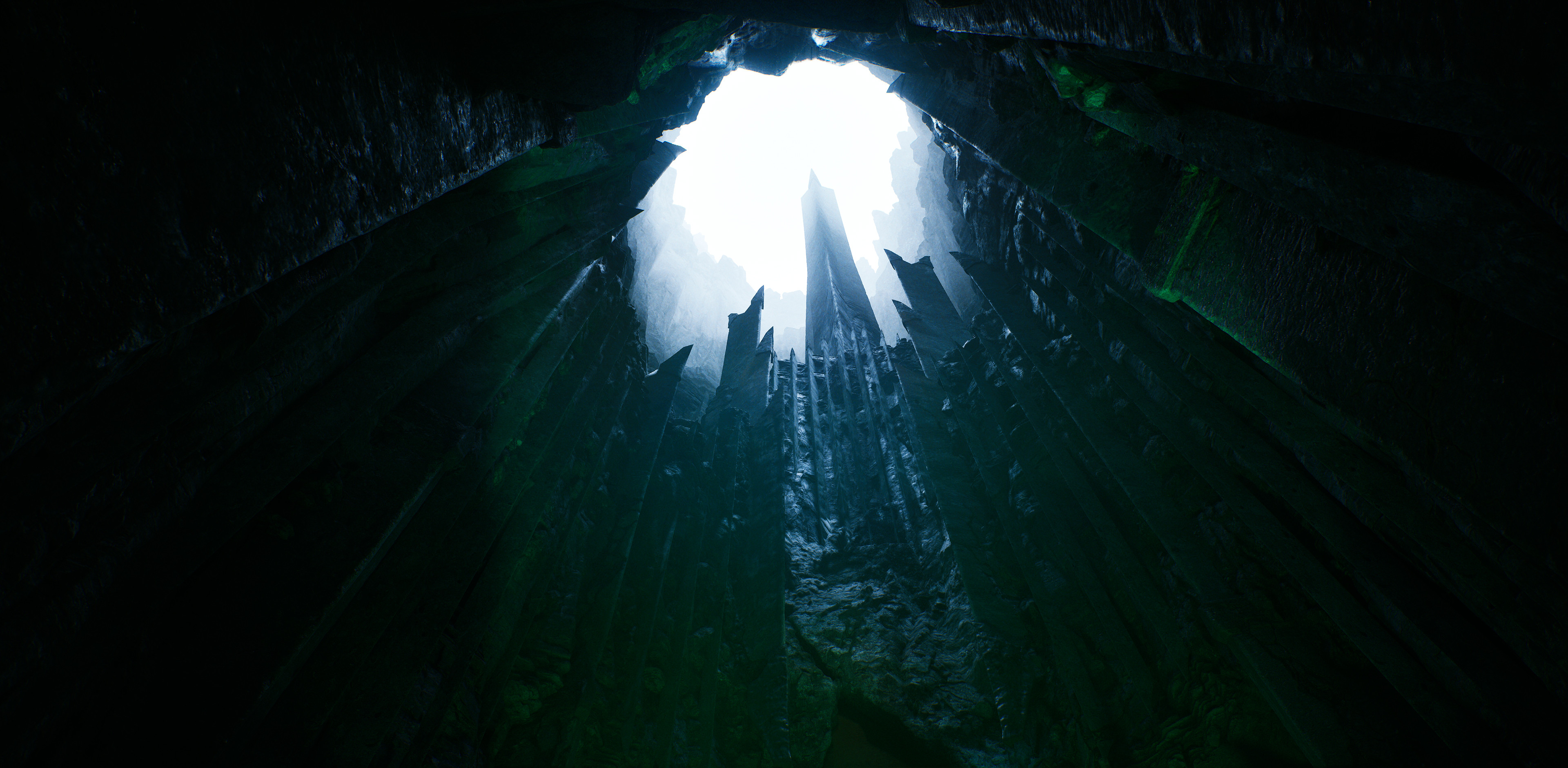
Zalindov, Aeonian Decree
Zalindov, commonly known as the Aeonian Decree, is a vast and ancient prison complex unlike any other in Aurora. It is a place where the laws of mortality falter, where death holds no sway, and even the frailest prisoner lingers eternally within its walls. To those who dwell beyond its reaches, Zalindov is both a myth and a warning, a fortress of endless torment where the condemned outlast the centuries. To those within, it is a world unto itself; an empire of wardens, inmates, and souls from countless ages, stitched together through conquest, faith, and decay.
No single architectural style defines Zalindov. Instead, its halls are a living archive of ages past: austere stone corridors built by forgotten wardens, spiraling meditation halls of the Silent Concord, mirrored runic chambers of the Veilward Circle, iron bastions of the Argent League, and bureaucratic order in the marble wings of the Dominion of Avar Krith. Over all of which now hangs the shadow of the Black Chimerarchy, the current rulers, whose dark iron and grotesque art twist the ruins of older ages into a monument of their dominance.
The Black Chimerarchy maintains a fortress-town above its uppermost gate, known simply as Outer Zalindov, a sprawl of tents, foundries, and blood arenas where prisoners are processed before being thrown into the depths. The surrounding wilderness is mostly abandonned, the few settlements that exist serving as suppliers, scavengers, or cult enclaves drawn by Zalindov’s grim allure.
The Black Chimerarchy themselves maintain control through a brutal hierarchy of warlords, slave overseers and beast-fused sorcerers who clawed their way into power through violence. Outside, merchants, mercenaries, and heretical pilgrims flock to profit from or worship the cursed site, though none who enter the prison’s gates willingly ever return the same.
Beneath them, the Dominion of Avar Krith’s surviving bureaucrats continue their ancient duties in the depths, keeping records of prisoners and cell designations long after their empire’s fall. Though no longer recognized by their conquerors, they persist as ghostly administrators, their tattered ledgers the only semblance of order within the prison’s infinite sprawl.
Many within the prison have lost all sense of time. They measure existence in “turns of silence,” “cycles of pain,” or the number of times they have tried to die. Still, strange communities persist — some faithful to old orders, others merely clinging to the hope that death might one day return to them.
No single architectural style defines Zalindov. Instead, its halls are a living archive of ages past: austere stone corridors built by forgotten wardens, spiraling meditation halls of the Silent Concord, mirrored runic chambers of the Veilward Circle, iron bastions of the Argent League, and bureaucratic order in the marble wings of the Dominion of Avar Krith. Over all of which now hangs the shadow of the Black Chimerarchy, the current rulers, whose dark iron and grotesque art twist the ruins of older ages into a monument of their dominance.
Geography
Zalindov lies deep within the southern reaches of western Läeril, nestled between the depths of the Tavepini Gardens and the storm-shrouded coast of the Bleeding Sound. Once in the middle of sprawling forest, the surrounding lands changed drastically during the Umbral Era, the surrounding lands became mostly barren, now sparsely adorned with strange flora that does not decay and fogs that never dissipate. The prison itself descends beneath the earth in layers — its oldest foundations carved into the living rock, while newer additions sprawl outward like a spreading infection of stone and iron.The Black Chimerarchy maintains a fortress-town above its uppermost gate, known simply as Outer Zalindov, a sprawl of tents, foundries, and blood arenas where prisoners are processed before being thrown into the depths. The surrounding wilderness is mostly abandonned, the few settlements that exist serving as suppliers, scavengers, or cult enclaves drawn by Zalindov’s grim allure.
Demographics
Within Zalindov’s bounds exist a grim populace. The majority are prisoners — immortals by circumstance, not nature — drawn from every age and empire that once laid claim to the prison. These include shattered remnants of the Dominion of Avar Krith, undying soldiers from the Argent League, monks of the Silent Concord, and countless nameless criminals and captives condemned by the Black Chimerarchy. Some have gone mad with endless existence, others have built fragile societies in the forgotten halls, trading, worshiping, or warring in cycles that never end.The Black Chimerarchy themselves maintain control through a brutal hierarchy of warlords, slave overseers and beast-fused sorcerers who clawed their way into power through violence. Outside, merchants, mercenaries, and heretical pilgrims flock to profit from or worship the cursed site, though none who enter the prison’s gates willingly ever return the same.
Government
Zalindov is ruled by the Black Chimerarchy, a loose confederation of warlords whose power is derived through might and fear rather than law. The ones in power oversee the prison’s different wings like feudal lords, each maintaining their own loyal guards and territories within the labyrinthine structure. The greatest among them, an undefeated warrior almost exclusively known as "The devourer" holds court in the topmost layer, where the air still tastes of wind and rain. Where the Dominion saw ledgers, the Chimerarchy sees a trophy: a monument to conquest. They rule Zalindov as both fortress and spectacle. For them, its undying prisoners are laborers, gladiators, and subjects for cruel grafting experiments.Beneath them, the Dominion of Avar Krith’s surviving bureaucrats continue their ancient duties in the depths, keeping records of prisoners and cell designations long after their empire’s fall. Though no longer recognized by their conquerors, they persist as ghostly administrators, their tattered ledgers the only semblance of order within the prison’s infinite sprawl.
History
The Chronicles of Zalindov, as Recorded by Imperial Archivist Theocles Var Krith, Year 913 of the Avar Reckoning Prologue: On the Nature of Eternity
Within the dominion of Avar Krith, all things are meant to be catalogued, ordered, and understood. Yet there are places where the quill falters and the ink of reason runs thin. Zalindov is such a place: a monument to endurance beyond comprehension, a wound upon mortality that refuses to heal. To record its history is not merely an act of bureaucracy, but of penitence, for those of us who have come to dwell within its immortal stone are both its keepers and its captives.
It has existed long before our ascendancy, before the rise of any known empire upon Läeril’s western face. Each age has carved its mark into the prison’s flesh, yet the foundation remains untouched — impervious, unaging, and inscrutable. Below is a partial record of its succession, drawn from fragmentary inscriptions, oral recitations, and the testimonies of the undying who still remember the turning of older suns.
I. The Pale Wardens
The first builders of Zalindov were not men, but something older, perhaps dragon-sworn, perhaps touched by the old god’s influence. They were known to us only as The Pale Wardens. Little remains of their tongue or faith, save their symbol: a hollow circle carved upon the gates of the Deepest Vault. Their architecture persists in the lowest foundations: smooth stone without seam or joint, corridors aglow with light that never wanes. The Pale Wardens spoke little, if at all, and bore masks of bleached metal that have been found still hanging in certain abandoned halls. Their silence was not ignorance but doctrine: the tongue awakens what they must keep asleep. Of their alleged disappearance we know nothing. No records. No corpses. Only their vigilance remains, etched into the very design of the prison.
II. The Silent Concord
Long centuries passed, and Zalindov slept until rediscovered by pilgrims: monks who stumbled upon Zalindov during their search for “ascendance”. Calling themselves the Silent Concord, they swore vows of muteness, believing that language itself could stir Zalindov’s deepest depths. For them, the prison was a monastery of paradox: a temple where immortality was curse rather than blessing. To them, tending the prison was a form of spiritual ascension; for who could claim greater detachment from the world than those who lived where no soul could escape?
They expanded the prison upward and outward, creating cloisters, meditation halls, and engraved walls filled with spirals of text meant only to be read, never spoken. Their architecture was quiet and inward, relying on curves, circles, and smooth gradients of space rather than hard angles. Ritual scars in the stone floors mark where they knelt in vast, unbroken silence. Their legacy persists in ghostly traditions: prisoners pacing in silence, guards refusing to answer screams. For generations they tended to Zalindov not as a prison, but as a monastery. Yet in time, silence consumed them. The final record of the Concord is carved upon the ceiling of the Chamber of Whispers: “To speak is to end. To endure is to fade.”
III. The Veilward Circle
Long after came The Veilward Circle, an arcane cabal of seers and scholars, who were perhaps the only faction who truly understood Zalindov’s purpose: it was a seal, not a prison. Unlike others, they did not expand its cells for prisoners, but its laboratories, vaults, and magical observation halls. To them, Zalindov was a planar anomaly, a scar in the weave of reality that had to be studied and maintained.
Their wings are the strangest in the prison. Corridors that loop on themselves, libraries where books rearrange at a glance, walls etched with glowing glyphs. They infused parts of Zalindov with dimensional wards, making certain cells unfindable without magical keys. They weren’t jailers—they were watchers, ensuring that what was bound beneath never stirred. They justified their expansions as safeguards, yet whispers claim they were also experimenting on prisoners, attempting to extract the secrets of Zalindov’s anomaly.
The Circle’s end came abruptly. Notes speak of “the reflection walking before the walker” and “the door that opened twice.” When they vanished, they left behind only quills still moving, and halls echoing with words written long after their authors had gone.
IV. The Argent League
Then came the Argent League, invaders from distant shores, soldiers without gods. To them, immortality was not curse but opportunity. Their prisoners were conscripts and enemies both, chained and sent into endless combat, stripped of rest or release, while the League tested tactics upon them. They turned Zalindov into a fortress, grafting battlements, barracks, and execution yards (useless, though the spectacle of death still cowed). Their expansions are brutalist, military, and foreign, banners and sigils still hang in tatters, silver aged black.
Yet the League underestimated Zalindov. Their commanders grew increasingly paranoid, unnerved that their soldiers could never escape by death, only by desertion. Rebellions followed, and soon both captors and captives were trapped in eternal attrition. When the League fractured and withdrew, they left hundreds behind. Some of those forsaken still stalk the lower tiers... undying soldiers who have known only endless war, their armor corroded but their fury fresh.
V. The Dominion of Avar Krith
When the Dominion’s reach expanded into the western marches, Zalindov was rediscovered by our surveyors and annexed by decree of the Emperor’s council. To our eyes, it was no holy site, no laboratory, but an institution in need of order.
Under our administration, Zalindov was systematized. Prisoners were numbered, cells recorded, ledgers carved in stone to endure where ink would fade. Each corridor bore classification marks: Judicial Wing, Archive Sector, Chirurgical study, Sentence Annex. For centuries, the prison served as the empire’s ultimate punishment, exile not from land, but from death itself.
We believed we had mastered it. We built marble offices, trained keepers, and established rotations for inspection. But in time, our dominion proved as mortal as any before it.
The Black Chimerarchy came from the south, warlords clad in iron and alchemy, beasts and men fused into one. They took Zalindov not for law, but for spectacle. They broke our guards, burned our ledgers, and herded our officials into the depths where we remain still.
Yet we persist. The old bureaucracy endures, though unrecognized. In secret, we maintain the records, inscribe the names, and mark the years no one else counts. We are archivists without empire, preserving a truth no conqueror cares to read.
VI. The Black Chimerarchy
Now Zalindov festers beneath the Chimerarchy’s rule. Its upper halls have been defiled by iron grafts and monstrous art. They use the undying as slaves and playthings, gladiators, test subjects, raw matter for their grafting rituals. They boast of dominion over the undying, yet none venture to the lowest levels where the Pale Wardens once stood vigil. Even beasts know fear.
Their banners proclaim victory, but victory here is meaningless. The walls of Zalindov outlast all banners. The Chimerarchs will fall as all others did, and the prison will devour their memory. Already the deeper halls whisper their names back to them, wrong, distorted, as if Zalindov itself is forgetting them on purpose.
Epilogue: On the Seal
There are records so old they predate language, symbols carved in circles of stone no tool can mark. Beneath all layers, beneath the halls of conquerors and scholars, monks and wardens, lies a chamber none enter twice.
Its doors are fused shut by will, not by lock. Its air hums with silence that devours sound. Those who have glimpsed it speak of something alive beyond comprehension, bound, unmoving, yet aware. The first decree of the Pale Wardens was never a punishment, but a sentence upon eternity itself. Zalindov was not made to hold men. It was made to hold that which could not die.
And so, we who remain, the archivists and keepers of record, continue our duty. For if memory fades, so too may the seal. And should the seal break, even eternity may end.
— Theocles Var Krith, Imperial Archivist, Deep Wing Seven, Zalindov.
Culture and Life Within
Despite its horror, Zalindov sustains a kind of grim civilization. The undying prisoners barter in relics and favors rather than goods. Makeshift shrines to forgotten gods and self-made saints crowd the corners of the old monastery halls. The Dominion remnants continue their endless record-keeping, and gladiatorial pits hosted by the Chimerarchy’s warlords serve as both punishment and entertainment.Many within the prison have lost all sense of time. They measure existence in “turns of silence,” “cycles of pain,” or the number of times they have tried to die. Still, strange communities persist — some faithful to old orders, others merely clinging to the hope that death might one day return to them.

Comments