
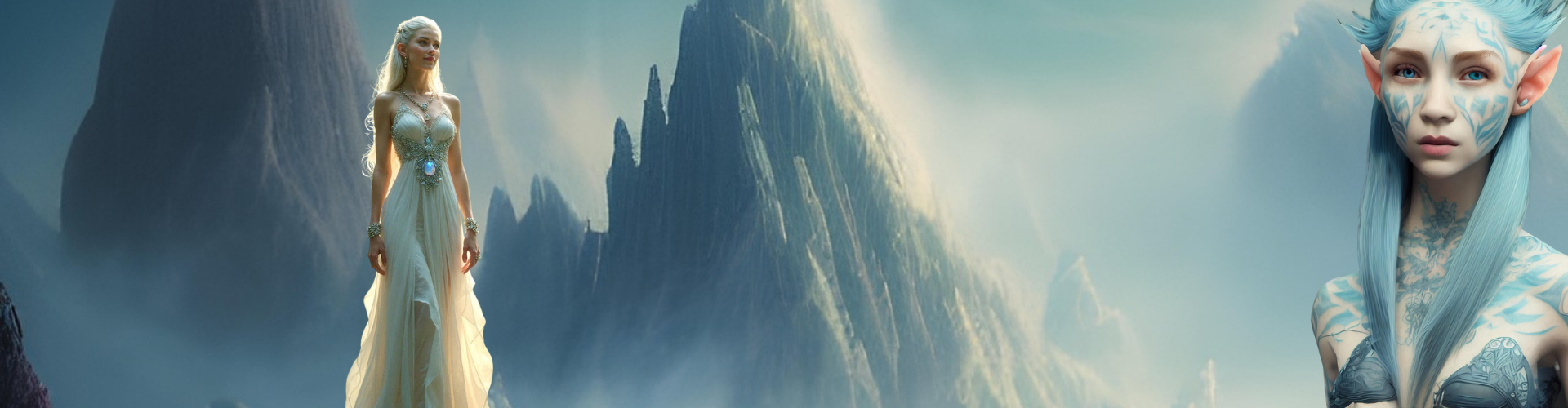
Elves of the Fractured Hour
Origins
The Elves of the Fractured Hour weren't born, but made. Once, the Timekeepers sought to craft guardians of history, beings who could slip through centuries and protect the threads of fate, but the experiment failed.
Instead of mastering time, the elves became broken by it. Their lives unspooled out of order. An infant might live fifty years before suddenly becoming a child again. A warrior could die in battle only to awaken decades later, unscarred but carrying the memory of death.
To outsiders, they appear cursed. To themselves, they are simply unmoored.
Physical Traits
Aging Out of Sequence
Their bodies refuse linear time. Some appear ancient but are “young,” while others look like children though they’ve lived centuries.
Temporal Flicker
In moments of stress, their forms shimmer — for a heartbeat they may become older, younger, or someone they haven’t been yet.
Eyes of Glass
Their eyes often show faint hourglass-shaped pupils, a reminder of the Timekeepers’ mark.
Naming Traditions
Names are fluid, shifting with their fractured lives.
Stage-Names
An elf takes a new name whenever their age shifts dramatically. A child who becomes an elder overnight will be renamed to reflect wisdom or gravitas. They’re lyrical, often short and sharp, sometimes strange—echoing the instability of their timelines.
- Examples:
- Feminine-leaning
- Elvara
- Nyssra
- Kaelith
- Veyra
- Lysenne
- Ardyne
- Zeyla
- Thariel
- Masculine-leaning
- Corven
- Thalen
- Eryndor
- Malrik
- Jorath
- Sylven
- Kaelor
- Dravyn
- Gender-neutral / Fluid
- Soryn
- Ilyra
- Faen
- Tyrel
- Oshen
- Vaeris
- Kethan
- Oryss
Thread Names
Families often maintain a “thread name,” a permanent identifier tying individuals back to their bloodline or memory-keepers.
- Examples:
- Hourveil
- Shardwell
- Chronet
- Veylin
- Tessera
- Mornvale
- Riftborn
- Glasstrine
- Seradyn
- Orrilith
Forgotten Names
Old names are never erased — they’re cataloged in family archives, recited during ceremonies to remind the elf of who they were.
- Examples:
- Eryndor of the Fifth Dawn
- Kaelith Thread-of-Silver
- Soryn the Twice-Unborn
- Ilyra Hourglass-Keeper
- Nyssra of the Shattered Moon
- Thalen the Returned
- Lysenne Starwoven
- Dravyn of the Silent Century
- Vaeris Who-Walks-Backwards
- Zeyla of the Endless Loom
Example of how one elf might accumulate names over time:
- Childhood: Faen Tessera
- After aging suddenly into adulthood: Faen the Unlooked-For
- After “dying” and returning decades later: Faen the Twice-Unborn
- Later recognized as an artist whose work spans centuries: Faen Thread-of-Silver
- Final ceremonial form: Faen Tessera the Twice-Unborn, Thread-of-Silver, of the Broken Dawn
Ideals
Continuity Through Community
Since individuals are unstable, they value collective memory. To them, family and fellowship are the true anchors of identity.
Art as Eternity
They see art as the only thing that survives time’s fracture. Every elf contributes to ongoing works, so their lives add layers to something lasting.
Fate is Fluid
They reject the concept of linear destiny. To them, inevitability is simply one of many loops, not an unbreakable line.
Traditions & Rituals
Memory Journals
Each elf keeps a detailed record of their life — often continued by family when they cannot. Journals are sacred objects, passed down like relics.
The Hourglass Vigil
Once each decade, the elves gather to mark the shifting of years. Some age forward; some backward. They light twin flames, one to honor what they have lived, one for what is yet to come. Elders often recite their own forgotten names aloud, reminding the community that even fractured lives have continuity.
The Rebinding
When an elf returns to a younger form, their family comes together to reintroduce themselves, read from old journals aloud and sharing fragments of memory to maintain continuity. Family members recite their ceremonial names to anchor them in memory.
The Fractured Song
A shared chant sung across centuries — fragments that only make sense when pieced together by many lives.
Funerals
Death is never final — funerals are held, but always with an empty seat left, in case the deceased “returns” in another cycle. Names are read aloud in full, with all descriptors and attachments, to honor every stage of a fractured life.
Major Organizations
The Circle of Stillness
A political faction that believes the Elves must stop wandering time and stabilize themselves through ritual, restraint, and enforced continuity. They see the Timeless Child as a threat because she embodies boundless movement.
The Weavers’ Covenant
A secretive guild of artisans who claim to have inherited techniques from the first Cloak-makers. They experiment with threads of lost hours, creating garments and artifacts that stabilize or destabilize an elf’s timeline. Some whisper they helped craft the Timeless Child’s cloak.
The Hourglass Throne
The closest thing to a ruling council, made up of the most “consistent” elves — those who have held one identity across centuries. They govern disputes, oversee rituals, and negotiate with outsiders. Their legitimacy is often challenged.
The Shadow of Reverse Dawn
An underground sect that believes the only way to achieve freedom is to embrace fracture fully — to abandon continuity, erase names, and let themselves become “pure chaos in flesh.” Considered dangerous extremists by most.
Connection to the Timeless Child
The Elves of the Fractured Hour see the Child as their perfection — one who walks time freely rather than being dragged by it.
The Circle of Stillness sees her as a destabilizing figure.
The Weavers’ Covenant sees her as living proof of their craft’s true power.
The Hourglass Throne fears her as a rival authority.
The Shadow of Reverse Dawn worship her as the embodiment of fracture made divine.
Outsider Views
Humans often fear them, calling them ghostwalkers or the broken-born. To some cultures, they are omens of catastrophe — proof that time itself can unravel.
Ghostwalker
The Broken-Born

They're timelords! =O
Too low they build who build beneath the stars - Edward Young
I couldn't help myself.