
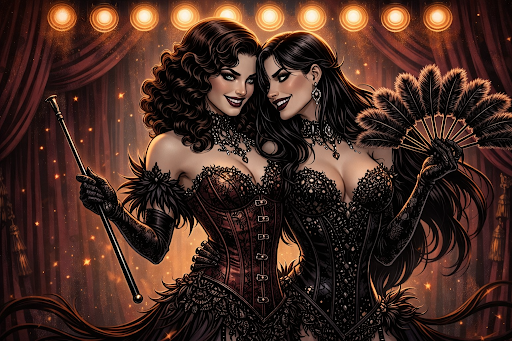
The Showgirls Gang - Les filles du spectacle
“People assume the Show Girls are about indulgence. Sequins. Champagne. Skin and scandal. That’s a child’s reading of the script.
What we actually are is discipline wrapped in velvet.
Every woman here knows why she’s on the stage and when to step off it. No one is owned. No one is disposable. We rehearse, we debate, we choose our targets carefully—and when the curtain rises, we move as one. I don’t rule them. I conduct them.
Men like to believe power is loud, crude, and obvious. They mistake that belief for safety. I let them keep it.
The Show Girls exist because the world devours talent and calls it love. We exist to remind it that consumption cuts both ways. If you’re going to stare, darling—make sure you understand what’s staring back.” -Cabaret
“Everyone thinks the Show Girls are Cabaret’s brain and my body. Cute idea. Wrong, but cute. This gang works because nobody here is pretending. You want a say? You earn it. You want the cut? You take the risk. You want protection? You give it back just as hard. Simple. Yeah, the girls get the spotlight. That’s on purpose. While you’re busy drooling or sneering, you don’t notice the bartender clocking your tells, the bouncer reading your exits, or the stagehand who already decided whether you’re walking out. I don’t care if you’re man, woman, neither, or both. I care if you pull your weight and don’t try to cage anyone. This isn’t a fantasy. It’s a family with knives in its teeth. Touch one of us wrong, and the whole damn show comes down on you. And trust me— you won’t enjoy the encore.” - Burlesque “Don’t let the music, the outfits, or the sex appeal fool you. The Show Girls are not a themed gang or a vanity project. They’re a disciplined criminal operation using nostalgia and desire as camouflage.” “Cabaret understands narrative the way most criminals understand guns. She doesn’t just commit crimes—she authors them. By the time the police arrive, the story has already been written, edited, and distributed. Evidence exists, but meaning has been redirected.” “Burlesque is the mistake people don’t survive making. They see heat, impulse, appetite. What they miss is control. She decides when things turn violent, and when they do, it’s fast, personal, and irreversible.” “The Velvet Kiss isn’t just a front. It’s a sensory weapon. Lighting, sound, crowd flow—everything is designed to keep people emotionally disarmed. Patrons think they’re choosing indulgence. They’re actually being curated.” “What makes the Show Girls difficult isn’t that they’re ruthless. It’s that they’re selective. They don’t burn neighborhoods or flood the streets. They target leverage points—predators, power brokers, people who rely on secrecy. That makes them harder to turn the public against.” “Internally, they’re smarter than most gangs. Equal cuts. Shared planning. No disposable bodies. That kind of structure doesn’t come from ideology—it comes from experience. From knowing exactly how exploitation feels.” “Make no mistake: they are criminals. Dangerous ones. People get hurt. People disappear. Lines are crossed.” “But if you go after them thinking they’re just performers playing dress-up, you’re already dead.” “They understand the same truth I do: justice and spectacle aren’t opposites. They’re tools. The difference is that I use mine to protect the vulnerable.” “They use theirs to remind the powerful that the spotlight can still burn.” - The Vermillion Vulpes
“Everyone thinks the Show Girls are Cabaret’s brain and my body. Cute idea. Wrong, but cute. This gang works because nobody here is pretending. You want a say? You earn it. You want the cut? You take the risk. You want protection? You give it back just as hard. Simple. Yeah, the girls get the spotlight. That’s on purpose. While you’re busy drooling or sneering, you don’t notice the bartender clocking your tells, the bouncer reading your exits, or the stagehand who already decided whether you’re walking out. I don’t care if you’re man, woman, neither, or both. I care if you pull your weight and don’t try to cage anyone. This isn’t a fantasy. It’s a family with knives in its teeth. Touch one of us wrong, and the whole damn show comes down on you. And trust me— you won’t enjoy the encore.” - Burlesque “Don’t let the music, the outfits, or the sex appeal fool you. The Show Girls are not a themed gang or a vanity project. They’re a disciplined criminal operation using nostalgia and desire as camouflage.” “Cabaret understands narrative the way most criminals understand guns. She doesn’t just commit crimes—she authors them. By the time the police arrive, the story has already been written, edited, and distributed. Evidence exists, but meaning has been redirected.” “Burlesque is the mistake people don’t survive making. They see heat, impulse, appetite. What they miss is control. She decides when things turn violent, and when they do, it’s fast, personal, and irreversible.” “The Velvet Kiss isn’t just a front. It’s a sensory weapon. Lighting, sound, crowd flow—everything is designed to keep people emotionally disarmed. Patrons think they’re choosing indulgence. They’re actually being curated.” “What makes the Show Girls difficult isn’t that they’re ruthless. It’s that they’re selective. They don’t burn neighborhoods or flood the streets. They target leverage points—predators, power brokers, people who rely on secrecy. That makes them harder to turn the public against.” “Internally, they’re smarter than most gangs. Equal cuts. Shared planning. No disposable bodies. That kind of structure doesn’t come from ideology—it comes from experience. From knowing exactly how exploitation feels.” “Make no mistake: they are criminals. Dangerous ones. People get hurt. People disappear. Lines are crossed.” “But if you go after them thinking they’re just performers playing dress-up, you’re already dead.” “They understand the same truth I do: justice and spectacle aren’t opposites. They’re tools. The difference is that I use mine to protect the vulnerable.” “They use theirs to remind the powerful that the spotlight can still burn.” - The Vermillion Vulpes
Structure
While Cabaret is officially recognized as the leader of the Show Girls, with Burlesque serving as her second-in-command, the gang’s internal structure is deliberately and unusually democratic for an illicit organization.
Operational decisions, target selection, and profit distribution are discussed collectively among core members. Every Show Girl has a voice. Every Show Girl receives an equal share of the earnings from successful operations, regardless of role or visibility. This structure fosters loyalty, discourages internal rivalry, and ensures that no member feels disposable.
This democracy, however, is not chaos.
Cabaret functions as the final arbiter of vision and tone. She shapes the long game—selecting themes, narratives, and symbolic targets—and steps in when consensus fractures or timing demands decisiveness. Burlesque enforces momentum and accountability, ensuring that debates do not turn into hesitation and that every member is capable of executing the plan they helped approve.
The illusion outsiders cling to is that equal say means equal power. In reality, the Show Girls’ structure works because Cabaret and Burlesque are trusted absolutely. Members speak freely because they believe they will be heard. They accept leadership because leadership has never betrayed that trust.
Planning sessions resemble rehearsals more than briefings. Ideas are tested, refined, and sometimes discarded through debate rather than command. Once a plan is set, dissent ends. Performance begins.
Equal pay removes the most common poison of criminal organizations: resentment. No one is working for crumbs while someone else builds an empire. There are no lieutenants hoarding wealth, no disposable foot soldiers. Anyone who risks their freedom risks it alongside everyone else.
This structure also acts as a filter. Those who crave dominance, recognition, or hierarchy burn out quickly. Those who stay are invested not just in profit, but in authorship. Each crime belongs to all of them.
To law enforcement and rival gangs, this makes the Show Girls difficult to fracture. There are no obvious weak links to flip, no disgruntled underlings waiting to be promoted, no clear chain of command to dismantle. Attempts to destabilize the group through bribery or intimidation tend to fail—or provoke collective retaliation.
The Show Girls are led, not ruled.
They do not follow orders—they follow the act.
Culture
The culture of the Show Girls is not accidental, nor is it decorative. It is a deliberate homage—a love letter written in velvet, brass, and blood—to the drama, showmanship, and criminal artistry of the 1920s, ’30s, and ’40s. Cabaret and Burlesque do not simply reference those eras; they inhabit them, extending a lineage where crime was theatrical, power was performative, and style was inseparable from survival.
At its core, the Show Girls’ culture treats crime as a staged event rather than a blunt act. Planning sessions are referred to as rehearsals. Operations are called acts. Success is judged not only by profit or escape, but by timing, elegance, and narrative impact. A job that makes money but leaves no impression is considered a wasted opportunity. The goal is not chaos—it is control through spectacle.
Aesthetic matters because it signals intent. Members are expected to cultivate presence: posture, voice, movement, and dress are all tools of the trade. Vintage silhouettes, jazz-era glamour, and burlesque-inspired flair are favored not as costume, but as armor. Looking intentional unsettles opponents and reassures allies. The Show Girls believe that if you are going to break the law, you should at least look like you meant to.
Performance is inseparable from discipline. Despite their sensuality and apparent indulgence, the gang values professionalism above all else. Rehearsal is rigorous. Sloppiness is unforgivable. Improvisation is celebrated only when it succeeds. This ethos is inherited from the criminal enterprises of Prohibition-era smugglers and con artists, where one bad night could end an entire operation.
Internally, the culture is communal rather than hierarchical. The democratic structure of the gang fosters shared ownership of both success and failure. There is no hazing, no ritual humiliation, no exploitation of newcomers. Members are expected to arrive as adults, capable of consent, agency, and accountability. Anyone who attempts to dominate, isolate, or control another member is removed without debate. This rule is absolute.
Sexuality within the Show Girls is treated as power, not obligation. Desire is personal, not transactional. While seduction is a tool of the trade, coercion is taboo. This distinction is rooted in both founders’ histories and is enforced with ferocity, particularly by Burlesque. The gang will tolerate many sins, but not that one.
Humor runs dark and sharp. Members bond through gallows wit, shared danger, and the quiet intimacy of preparing for acts that could end in prison or death. Nicknames, inside jokes, and coded language flourish backstage. Applause—real or metaphorical—is savored, but fleeting. Everyone understands that tomorrow always demands another performance.
Above all, the Show Girls value authorship. They refuse to be footnotes in someone else’s story. Whether stealing from elites, humiliating predators, or vanishing after a flawless job, they insist on choosing how they are seen—or not seen at all.
Their culture does not glorify chaos.
It glorifies intention.
In the world the Show Girls inhabit, power once wore silk and smoked in back rooms. Cabaret and Burlesque have simply taught it how to dance again.
Public Agenda
On the surface, the Show Girls have no agenda at all.
To the public, Clarisse and Vivienne are simply two women in a high-profile relationship who own and operate a successful retro nightclub in Toronto’s Distillery District. The Velvet Kiss is marketed as a passion project—an indulgent homage to vintage cabaret, burlesque, and live jazz performance. Its stated goals are cultural: entertainment, nostalgia, and the celebration of old-world glamour in a modern city.
In interviews, social media appearances, and press coverage, the pair present themselves as artists and entrepreneurs rather than activists or power brokers. They do not comment on politics. They do not court controversy. Any rumors of impropriety are dismissed as tabloid speculation fueled by the club’s exclusivity and clientele.
From the outside, there is nothing to oppose.
The Velvet Kiss pays its taxes, hosts charity events, supports local performers, and maintains a carefully curated image of tasteful decadence. Cabaret and Burlesque appear devoted to their craft, their venue, and each other—two women enjoying success on their own terms.
This lack of an obvious agenda is the point.
There is no manifesto to dissect.
No cause to denounce.
No movement to infiltrate.
To most observers, the Show Girls do not exist at all—only a club, a couple, and a good night out.
And that is exactly how they prefer it.
Assets
The Show Girls maintain a carefully balanced portfolio of legitimate and illicit income streams, allowing them to operate comfortably without attracting the attention that accompanies excessive wealth or rapid expansion.
At the surface level, the gang earns a respectable and sustainable living through The Velvet Kiss, which functions as a profitable nightclub and performance venue. Ticket sales, exclusive memberships, private events, and high-end bar service provide a steady, legal revenue stream. The business is well-managed, compliant with regulations, and financially transparent enough to withstand routine scrutiny.
Beneath that veneer, the Show Girls augment their income through a range of criminal activities selected for discretion rather than scale.
Blackmail is their most consistent illicit asset. Information gathered through social engineering, performance spaces, private rooms, and carefully cultivated relationships is monetized quietly. Targets are rarely bled dry; instead, they are kept useful, compliant, and silent.
Theft takes the form of precision jobs rather than smash-and-grab crime. Art, jewelry, financial instruments, data, and sensitive documents are preferred over cash. These thefts often intersect with other operations, serving as leverage as much as profit.
Prostitution, where it exists, is tightly controlled and framed internally as transactional autonomy rather than exploitation. The Show Girls do not traffic unwilling participants. Those involved are compensated fairly, protected aggressively, and permitted to walk away. This distinction is one Cabaret enforces strictly, both out of principle and optics.
Smuggling operations are selective and opportunistic, focusing on high-value, low-volume goods: rare art, illicit technology, restricted substances, and occasionally people who need to disappear rather than be moved in chains. Existing infrastructure within Toronto’s port and heritage districts is exploited discreetly.
Assassination is their most dangerous and least frequent asset. It is undertaken only when the payoff—financial, strategic, or symbolic—justifies the risk. These killings are theatrical, misdirected, or disguised as accidents, ensuring they generate confusion rather than clear investigative trails.
Together, these assets ensure that no single revenue stream defines the Show Girls or exposes them to collapse if disrupted. The organization does not chase excess. It values stability, leverage, and control over growth.
To outsiders, their lifestyle appears indulgent but plausible.
To rivals, their finances are frustratingly opaque.
To the Show Girls themselves, money is simply another prop—necessary, useful, and never allowed to steal the spotlight.
History
The Show Girls did not begin as an “organization” in the traditional sense. They began as an aftermath—two different women broken open by power, then deciding, separately and then together, that they would never be owned again.
Clarisse du Montagne was a prodigy shaped for the stage, raised on the promise that talent and beauty could conquer the world. Paris seemed to confirm it—until it didn’t. As a teenager she was drawn into the orbit of a respected politician who treated her like a secret luxury, grooming her with gifts and opportunities while keeping her invisible. When Clarisse finally understood she was one of many, she tried to fight back with exposure and blackmail, only to learn the real rule of the world: power does not argue, it crushes. Her career was ruined, her name smeared, her future erased with the effortless violence that money and influence can deliver.
She did not crawl away. She adapted.
Clarisse turned survival into craft—learning deceit, building networks, studying poisons, violence, and the mechanics of humiliation. She chose a new name, Cabaret, and made her revenge into performance. The politician’s death was not quiet. It was designed to be seen, to provoke a feeding frenzy of headlines and suspects, to force the elite to panic under the same spotlight they had once used to devour her. The city called it a supervillain killing. Cabaret, watching from the shadows, discovered she liked the word.
Paris became her first stage. Cabaret gathered women with their own reasons to hate the world that chewed them up—singers, dancers, escorts, grifters, girls who understood how men with power behave when they think they’re safe. Under Cabaret’s direction they ran cons, blackmail, and shadow work that fed on arrogance. Their success relied on a simple truth: criminals and authorities alike underestimated them. That underestimation became the gang’s greatest weapon.
Inevitably, the attention came. Cabaret crossed paths with Sébastien “BlueBeard” Mauvais, a vicious Parisian supervillain whose cruelty was too loud even for her taste. She survived the collision, but it left her marked. At the same time, a masked vigilante—Le Nocturne—began disrupting her operations with maddening precision. Worst of all, Interpol took the stage, and with them came Detective Jean Delacroix: disciplined, relentless, and infuriatingly immune to the easy manipulations that worked on everyone else. Cabaret found herself caught between three threats—one monstrous, one heroic, one lawful—and all of them capable of ending her if she stayed.
This is where the Show Girls’ defining trait was born: they do not die on stage. They exit.
Rather than let Paris become a noose, Cabaret dissolved her gang with intent and control. She paid her people fairly and disappeared before the hunt could close. That decision—severance, not abandonment—became the seed of the Show Girls’ later internal culture: equal cuts, shared say, and a refusal to treat their own as disposable props.
Vivienne Laroque’s path to the gang came from a different kind of fire. In New Orleans she lived for being watched—dance, burlesque, lust, attention as oxygen. She fell into a dangerous relationship with Dominique Baptiste, a gangster who adored her as a trophy until he tried to turn her into property. When he attempted to force control, Vivienne killed him in a fast, brutal act of self-defense and competence. She covered her tracks with the cold skill her father—an executed cleaner—had taught her in childhood.
The mob retaliated. Vivienne survived an abduction attempt, turned her captors into shields, and left bodies behind in the swamp. She understood then that New Orleans would never stop hunting her, and she fled on the first available flight out—Paris, by accident or fate.
Paris suited her. She found comfort, cash, and lovers quickly, and soon heard whispers of a woman called Cabaret—an elegant mastermind with theatrical taste and deep pockets. Vivienne arranged her approach like a performance: the right dress, the right drink, the right moment. Attraction came fast, but what truly fused them was recognition. Each saw in the other a version of herself that hadn’t broken—only sharpened.
Their relationship ignited with the same intensity as their ambition. Cabaret found in Vivienne a partner who would not cage her spotlight; Vivienne found in Clarisse a lover whose control did not feel like possession. When Cabaret decided to abandon Paris, Vivienne became the hinge the next act turned on. Together they closed accounts, settled debts, and left Europe behind.
Toronto became the rebirth.
In the Distillery District they opened The Velvet Kiss, a retro nightclub and stage styled as a love letter to the Roaring Twenties and the dirtier Thirties—brass, velvet, jazz smoke, and curated decadence. Publicly it was a legitimate business and a glamorous venue run by two women in a visible, enviable relationship. Privately it became the nerve center for a new gang: smaller, cleaner, more disciplined, and far harder to prosecute.
The Show Girls, as they are now known, grew from that foundation. Cabaret remained the official leader, Burlesque her second, but the organization took on an intentionally democratic structure. Members receive equal cuts and meaningful input, a deliberate rejection of the exploitative hierarchies both founders survived. Planning feels like rehearsal; consensus is argued openly; once the act is chosen, everyone commits.
Their income diversified—legitimate profit from The Velvet Kiss, augmented by blackmail, theft, selective smuggling, and occasional assassination when a target’s removal serves both practical and symbolic ends. They do not seek territory like traditional gangs. They seek leverage. They seek spectacle. They seek to remind the powerful that the spotlight cuts both ways.
And above all, they seek to ensure the same rule that birthed them remains true:
The show must go on.
Demography and Population
While the Show Girls are widely understood—both by the public and by their enemies—as an all-female gang, that perception is only partially true, and intentionally misleading.
The core identity of the Show Girls is female-led, female-centered, and culturally rooted in women’s control of spectacle, narrative, and space. Most visible operatives—the performers, infiltrators, grifters, and planners—are women, and this visibility is by design. It reinforces underestimation, feeds mythmaking, and keeps attention focused where Cabaret and Burlesque want it.
In reality, the organization’s population is broader.
Every member of The Velvet Kiss staff is part of the gang.
Bartenders, bouncers, waiters, stagehands, sound technicians, costume attendants, security personnel, and administrative staff are all vetted, initiated, and operationally trusted members of the Show Girls. Some are lifelong criminals. Others are former specialists—fighters, smugglers, fixers, hackers, runners—who understand discretion and loyalty better than applause. Their roles at the club provide legal cover, access, and situational control rather than limiting their criminal function.
The difference is not capability, but placement.
The women of the Show Girls are meant to be seen.
The rest are meant to be overlooked.
Bouncers are not merely muscle; they are counter-surveillance, extraction specialists, and last-line enforcers. Bartenders listen more than they pour. Waitstaff memorize faces, habits, and vulnerabilities. Stage crews control lighting, sound, sightlines, and timing—elements as lethal as any weapon in Cabaret’s hands. When violence occurs inside The Velvet Kiss, it is swift, coordinated, and almost never noticed by the patrons.
This structure reinforces the gang’s democratic ethos. All members—regardless of gender, visibility, or role—receive equal consideration in planning and equal shares in successful operations. No one is “just staff.” No one is ornamental. Everyone present is dangerous in at least one way.
Gender within the Show Girls is not about exclusion; it is about center of gravity. The organization is shaped by women, led by women, and aesthetically defined by female performance and agency. Those who join understand that framework and respect it. Anyone who resents it does not remain long.
To outsiders, this demographic reality is often discovered too late. Rivals who assume the men at the door are hired help, or the bartender is a neutral observer, or the quiet waiter is irrelevant, tend to learn otherwise in moments of sudden, irreversible clarity.
The Show Girls are not a gang with staff.
They are a gang disguised as a business—
and everyone inside the building is part of the act.


This is ***ing amazing