

The British Brawler
Background:
Born and raised in the tough streets of 1930s East End of London, Bert Baker grew up during the Great Depression, learning to fight in back alleys and make ends meet by any means necessary. Bert took up bare-knuckle boxing as a way to earn money, quickly gaining a reputation as the toughest and most resilient fighter in the East End. Known for his strength, endurance, and powerful punches, he fought countless bouts, often against men larger than himself, and rarely lost.
When the Second World War broke out, Bert enlisted in the British Army, determined to do his part for his country. He served with distinction, but it was his decision to volunteer for a mysterious experimental medical program that changed his life forever. The experimental compound known as Psi-Zero Nine enhanced his physical abilities to superhuman levels, turning Bert into an unstoppable force. Recognizing his newfound potential, Winston Churchill personally assigned Bert to the Night Shift, an elite unit tasked with fighting the monsters unleashed by the Nazi war machine during the Blitz.
In less than a week, Bert became a legend among the Night Shift, facing down abominations, supernatural creatures, and Nazi super-soldiers with nothing but his bare hands and his unbreakable spirit. The people of London began to call him "The British Brawler," a symbol of hope and defiance in the face of darkness.
Personality:
Bert Baker is a man defined by his resilience and unwavering determination. He has a heart of gold beneath his tough exterior, always willing to stand up for those who cannot defend themselves. His East End upbringing instilled in him a strong sense of loyalty and community, and he views his role as the British Brawler as both a duty and an honor.
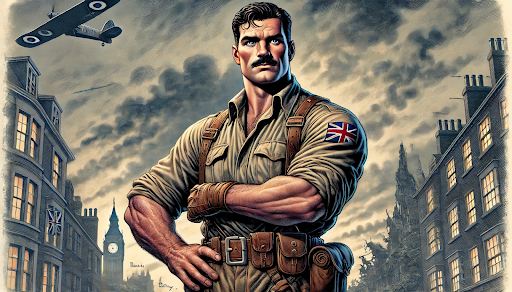
Though he is often seen as larger-than-life, Bert remains humble, never seeking glory or recognition for his deeds. He fights because it is the right thing to do, because his people need someone to protect them. He has a strong sense of humor, often using wit to lighten the mood in even the most desperate situations, and his signature mustache has become an iconic part of his image, adding to his roguish charm.
Bert takes pride in his working-class roots and is fiercely protective of his fellow Londoners. He despises bullies and tyrants, whether they are criminals in the streets or monsters created by Nazi scientists. Despite his superhuman abilities, Bert never sees himself as above anyone else—he is simply a man doing his part for King and Country, determined to protect the people he loves from whatever horrors the war may bring.
Born and raised in the tough streets of 1930s East End of London, Bert Baker grew up during the Great Depression, learning to fight in back alleys and make ends meet by any means necessary. Bert took up bare-knuckle boxing as a way to earn money, quickly gaining a reputation as the toughest and most resilient fighter in the East End. Known for his strength, endurance, and powerful punches, he fought countless bouts, often against men larger than himself, and rarely lost.
When the Second World War broke out, Bert enlisted in the British Army, determined to do his part for his country. He served with distinction, but it was his decision to volunteer for a mysterious experimental medical program that changed his life forever. The experimental compound known as Psi-Zero Nine enhanced his physical abilities to superhuman levels, turning Bert into an unstoppable force. Recognizing his newfound potential, Winston Churchill personally assigned Bert to the Night Shift, an elite unit tasked with fighting the monsters unleashed by the Nazi war machine during the Blitz.
In less than a week, Bert became a legend among the Night Shift, facing down abominations, supernatural creatures, and Nazi super-soldiers with nothing but his bare hands and his unbreakable spirit. The people of London began to call him "The British Brawler," a symbol of hope and defiance in the face of darkness.
Personality:
Bert Baker is a man defined by his resilience and unwavering determination. He has a heart of gold beneath his tough exterior, always willing to stand up for those who cannot defend themselves. His East End upbringing instilled in him a strong sense of loyalty and community, and he views his role as the British Brawler as both a duty and an honor.
Though he is often seen as larger-than-life, Bert remains humble, never seeking glory or recognition for his deeds. He fights because it is the right thing to do, because his people need someone to protect them. He has a strong sense of humor, often using wit to lighten the mood in even the most desperate situations, and his signature mustache has become an iconic part of his image, adding to his roguish charm.
Bert takes pride in his working-class roots and is fiercely protective of his fellow Londoners. He despises bullies and tyrants, whether they are criminals in the streets or monsters created by Nazi scientists. Despite his superhuman abilities, Bert never sees himself as above anyone else—he is simply a man doing his part for King and Country, determined to protect the people he loves from whatever horrors the war may bring.
Personality Characteristics
Representation & Legacy
Wartime Sex Symbol
If the Golden Age had a single poster boy for rugged, muscular, salt-of-the-earth masculinity, it was Albert “Bert” Baker—the British Brawler, the Psi-Zero Nine super-soldier, and one of the most lusted-after heroes of World War II. In an era dominated by polished gentlemen, caped patriots, and aristocratic crusaders, Bert was something entirely different: a bruiser carved from brick and East End grit, with a smile as dangerous as his right hook. He embodied a new kind of sex symbol—one rooted not in refinement or polished heroics, but in raw physicality, working-class swagger, and the unmistakable appeal of a man whose shirt never seemed to stay buttoned. Bert’s legend began long before the super-soldier serum. He was already an underground boxing sensation—broad-shouldered, cocky, all rough charm and rolled-up sleeves—when the Psi-Zero Nine project transformed him into a superhuman powerhouse. Once the war began, his image took on a mythic quality: newspapers printed photographs of him standing amidst rubble, sleeves rolled and muscles practically bursting from his uniform; propaganda posters used his physique as shorthand for British resilience; American newsreels lovingly captured the camera lingering on his forearms, chest, and cheeky grin; soldiers joked he could knock out a Panzer tank with one punch—and women believed he could. He wasn’t the Queen’s polished symbol of noble heroism; he was the people’s champion, a working-class titan who fought dirty, laughed loudly, flirted shamelessly, and hit like a sledgehammer. A Super-Soldier and a Global Heartthrob Bert never set out to be a sex icon—he simply existed, and the world swooned. Part of his appeal was visual: his “slightly out of uniform” uniform, that perfectly imperfect mustache, the teasing hint of chest hair peeking from an unbuttoned collar, the forearms that could make a dame forget her husband’s name. But it was more than looks. It was the grin he flashed after tossing a Nazi super-soldier through a wall. The way he spoke to women like they were equals but flirted like sin. The swagger that said: “I’m trouble, love, but the good kind.” And the fact that every punch he threw looked like a love letter to physicality itself. Pin-up artists adored him. Women's magazines worshipped him. Thousands of love letters poured in, many containing proposals, promises, or shockingly detailed fantasies. He wasn’t embarrassed—he found it hilarious. But the Ministry of War took full advantage. The infamous “For the Ladies” morale calendar—featuring Bert in a series of “accidentally provocative” poses—became one of the fastest-selling morale pieces of the entire war. The Cultural Impact: Strength, Desire, and the Working-Class Hero Bert Baker changed the visual language of heroism. Before him, sex appeal was associated with refinement, mystery, or aristocratic glamor. He introduced something earthier. A masculinity built not on nobility, but physical reality: sweat muscle grit rolled-up sleeves the kind of man who smelled like fighting and oak-aged whiskey Bert’s brand of sex appeal reshaped Allied propaganda, influenced superhero fashion, inspired countless imitators, and signaled a larger cultural shift toward the celebration of working-class bodies in media. He made strength erotic. He made toughness charming. He made the bruiser beautiful. And for millions, he became the first “superhero crush”—a man who could save the world in the afternoon and still have time to wink at the women gathered behind the barricades. Legacy Though his wartime exploits were legendary, it is his presence that endures. To this day: his propaganda posters are prized collectibles; his pin-ups are considered foundational Golden Age smut artifacts; and his image remains a touchstone in discussions of heroic masculinity. Bert Baker didn’t simply represent British strength. He represented a fantasy that felt real—sweaty, gorgeous, unstoppable, and deeply human. He wasn’t just a hero. He was a cultural earthquake wrapped in rolled sleeves and a grin. And when history remembers wartime sex symbols, it remembers him first.
If the Golden Age had a single poster boy for rugged, muscular, salt-of-the-earth masculinity, it was Albert “Bert” Baker—the British Brawler, the Psi-Zero Nine super-soldier, and one of the most lusted-after heroes of World War II. In an era dominated by polished gentlemen, caped patriots, and aristocratic crusaders, Bert was something entirely different: a bruiser carved from brick and East End grit, with a smile as dangerous as his right hook. He embodied a new kind of sex symbol—one rooted not in refinement or polished heroics, but in raw physicality, working-class swagger, and the unmistakable appeal of a man whose shirt never seemed to stay buttoned. Bert’s legend began long before the super-soldier serum. He was already an underground boxing sensation—broad-shouldered, cocky, all rough charm and rolled-up sleeves—when the Psi-Zero Nine project transformed him into a superhuman powerhouse. Once the war began, his image took on a mythic quality: newspapers printed photographs of him standing amidst rubble, sleeves rolled and muscles practically bursting from his uniform; propaganda posters used his physique as shorthand for British resilience; American newsreels lovingly captured the camera lingering on his forearms, chest, and cheeky grin; soldiers joked he could knock out a Panzer tank with one punch—and women believed he could. He wasn’t the Queen’s polished symbol of noble heroism; he was the people’s champion, a working-class titan who fought dirty, laughed loudly, flirted shamelessly, and hit like a sledgehammer. A Super-Soldier and a Global Heartthrob Bert never set out to be a sex icon—he simply existed, and the world swooned. Part of his appeal was visual: his “slightly out of uniform” uniform, that perfectly imperfect mustache, the teasing hint of chest hair peeking from an unbuttoned collar, the forearms that could make a dame forget her husband’s name. But it was more than looks. It was the grin he flashed after tossing a Nazi super-soldier through a wall. The way he spoke to women like they were equals but flirted like sin. The swagger that said: “I’m trouble, love, but the good kind.” And the fact that every punch he threw looked like a love letter to physicality itself. Pin-up artists adored him. Women's magazines worshipped him. Thousands of love letters poured in, many containing proposals, promises, or shockingly detailed fantasies. He wasn’t embarrassed—he found it hilarious. But the Ministry of War took full advantage. The infamous “For the Ladies” morale calendar—featuring Bert in a series of “accidentally provocative” poses—became one of the fastest-selling morale pieces of the entire war. The Cultural Impact: Strength, Desire, and the Working-Class Hero Bert Baker changed the visual language of heroism. Before him, sex appeal was associated with refinement, mystery, or aristocratic glamor. He introduced something earthier. A masculinity built not on nobility, but physical reality: sweat muscle grit rolled-up sleeves the kind of man who smelled like fighting and oak-aged whiskey Bert’s brand of sex appeal reshaped Allied propaganda, influenced superhero fashion, inspired countless imitators, and signaled a larger cultural shift toward the celebration of working-class bodies in media. He made strength erotic. He made toughness charming. He made the bruiser beautiful. And for millions, he became the first “superhero crush”—a man who could save the world in the afternoon and still have time to wink at the women gathered behind the barricades. Legacy Though his wartime exploits were legendary, it is his presence that endures. To this day: his propaganda posters are prized collectibles; his pin-ups are considered foundational Golden Age smut artifacts; and his image remains a touchstone in discussions of heroic masculinity. Bert Baker didn’t simply represent British strength. He represented a fantasy that felt real—sweaty, gorgeous, unstoppable, and deeply human. He wasn’t just a hero. He was a cultural earthquake wrapped in rolled sleeves and a grin. And when history remembers wartime sex symbols, it remembers him first.
Children


Comments