
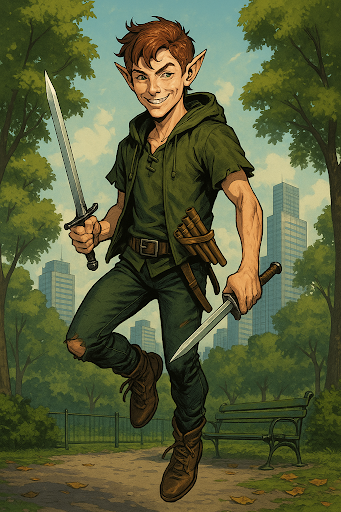
Peter of the Panpipes
Background
Peter Adam Newman was never meant to be Peter Adam Newman. He was a changeling—Aelfe of Albion left in a satin cradle so an otherworldly princeling could wear human manners for a while. The experiment failed spectacularly. Even for the fae he was prodigy: glimpsed hovering before his first birthday; trilling birdsong at three; dueling his tutors two-handed by ten, laughing as their blades rang. Music teachers called him unearthly. Society called him gifted. The Aelfe called him home.
He refused.
Adulthood, with its duties and dim rooms, sounded like a prison. When the Courts opened the way, he tore free mid-transit and fled to a far isle in Otherworld, a green tooth in a faerie sea he named Never-Never-Land—a place where time buckles and childhood won’t let go. There he crowned himself with bracken and crow feathers, charmed the local sprites, and began importing everything he found amusing: corsairs yanked from Caribbean decks, “natives” ripped from stories and campfire boasts, beasts and bogeys pulled through gaps between worlds. And children—always children—tempted with sugared promises, with “no one wants you” lies, with the simple thrill of a boy in the window who could fly.
To Peter, this was rescue. To the families he emptied, it was theft.
He played at war with stolen pirates until the game soured into blood. He “lost” boys to monsters and then replaced them with more, guilelessly tragic, as if toys had broken. He found a worthy enemy in Captain James Hook, a mortal who matched his blade. Peter took Hook’s hand in a fit of hilarity and fed it to a crocodile, laughing at the splash. Hook hammered cold iron into a curve of revenge and swore he would never leave Otherworld until that hook found Peter’s heart.
Decades turned. The world changed; Peter did not. Cowboys became detectives; detectives, masked heroes; his games adjusted costumes, not stakes. The Courts of Albion gossip about him still—a comet child whose radiance curdled into caprice. Darker fey nobles adore the spectacle; the Puck calls him a brat and keeps his distance. Peter Pan remains eternal, unteachable, and thrilled to prove it nightly.
Personality
Peter wears delight like warpaint. Everything is a game—stealing, dueling, daring, even dying—and if you flinch, you’ve already lost. He adores the squeal before the scream, the breathless edge where fun tips into fear, not because he hates mortals but because he cannot imagine they are real in the way he is. Adults are props; children are players; pirates are toys that fight back. He is generous with wonder and stingy with mercy, a boy who will give you flight and then dare you to survive the landing.
He craves admiration the way mortals crave warmth. Praise makes him brighter, wilder, more reckless. Reproof slides off—unless it comes from someone he nearly lets himself love, and then, for a blink, the mask cracks and a future rushes in: a man, a lord, a responsibility. He always slams the window shut in time. Better the laugh than the lesson.
Hook is the exception that proves him. Peter hates, fears, and needs him—the only adult who has ever stood across a blade and felt like a peer. Their feud keeps the sky sharp. Somewhere deep, where even his shadows don’t look, Peter suspects the game ends the day the hook goes quiet.
Until then, he is the boy in the night sky with a flute at his lips and starlight on his knife, inviting you to play a game you cannot possibly win.
Peter Adam Newman was never meant to be Peter Adam Newman. He was a changeling—Aelfe of Albion left in a satin cradle so an otherworldly princeling could wear human manners for a while. The experiment failed spectacularly. Even for the fae he was prodigy: glimpsed hovering before his first birthday; trilling birdsong at three; dueling his tutors two-handed by ten, laughing as their blades rang. Music teachers called him unearthly. Society called him gifted. The Aelfe called him home.
He refused.
Adulthood, with its duties and dim rooms, sounded like a prison. When the Courts opened the way, he tore free mid-transit and fled to a far isle in Otherworld, a green tooth in a faerie sea he named Never-Never-Land—a place where time buckles and childhood won’t let go. There he crowned himself with bracken and crow feathers, charmed the local sprites, and began importing everything he found amusing: corsairs yanked from Caribbean decks, “natives” ripped from stories and campfire boasts, beasts and bogeys pulled through gaps between worlds. And children—always children—tempted with sugared promises, with “no one wants you” lies, with the simple thrill of a boy in the window who could fly.
To Peter, this was rescue. To the families he emptied, it was theft.
He played at war with stolen pirates until the game soured into blood. He “lost” boys to monsters and then replaced them with more, guilelessly tragic, as if toys had broken. He found a worthy enemy in Captain James Hook, a mortal who matched his blade. Peter took Hook’s hand in a fit of hilarity and fed it to a crocodile, laughing at the splash. Hook hammered cold iron into a curve of revenge and swore he would never leave Otherworld until that hook found Peter’s heart.
Decades turned. The world changed; Peter did not. Cowboys became detectives; detectives, masked heroes; his games adjusted costumes, not stakes. The Courts of Albion gossip about him still—a comet child whose radiance curdled into caprice. Darker fey nobles adore the spectacle; the Puck calls him a brat and keeps his distance. Peter Pan remains eternal, unteachable, and thrilled to prove it nightly.
Personality
Peter wears delight like warpaint. Everything is a game—stealing, dueling, daring, even dying—and if you flinch, you’ve already lost. He adores the squeal before the scream, the breathless edge where fun tips into fear, not because he hates mortals but because he cannot imagine they are real in the way he is. Adults are props; children are players; pirates are toys that fight back. He is generous with wonder and stingy with mercy, a boy who will give you flight and then dare you to survive the landing.
He craves admiration the way mortals crave warmth. Praise makes him brighter, wilder, more reckless. Reproof slides off—unless it comes from someone he nearly lets himself love, and then, for a blink, the mask cracks and a future rushes in: a man, a lord, a responsibility. He always slams the window shut in time. Better the laugh than the lesson.
Hook is the exception that proves him. Peter hates, fears, and needs him—the only adult who has ever stood across a blade and felt like a peer. Their feud keeps the sky sharp. Somewhere deep, where even his shadows don’t look, Peter suspects the game ends the day the hook goes quiet.
Until then, he is the boy in the night sky with a flute at his lips and starlight on his knife, inviting you to play a game you cannot possibly win.
Children


Comments