

Lab Rat
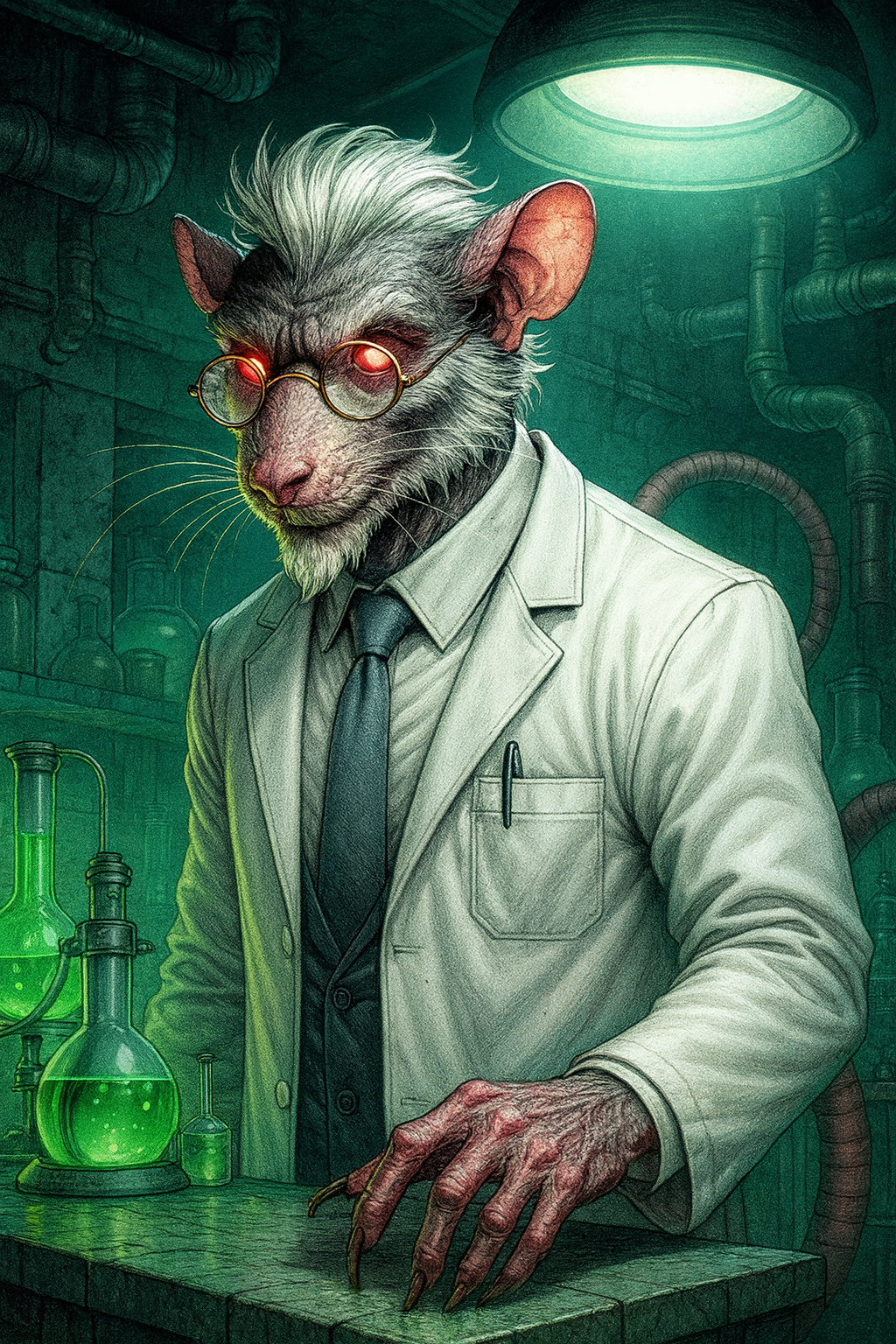
Doctor Nicodemus Stanisław Rutkowski (a.k.a. Lab Rat, The Sewer Surgeon, The Plague Prophet)
"No no no—wrong word, wrong word. Accident is what stupid people say when they don’t understand process.
Slip. Fall. Crunch. Splash. Screaming. Learning.
Ahhh—learning.
I evolved that day I fell into the vat. Oh yes, yes I did. It was an accident—but isn’t all evolution at first? Hmm? A mutation here, an adaptation there, trial and error where the strong get to reproduce and the weak go extinct, yes yes—very much evolution, mhmm, yes yes.
Pain? Oh there was pain. Delicious pain. Pain with data in it. Pain that meant something. My bones didn’t break, they negotiated. My skin didn’t burn, it revised itself. Screaming is just the body rewriting the manual.
They say monster. Monster monster monster.
Funny word. Easy word. Lazy word.
They were already rats—scurrying, hoarding, breeding, spreading their little ideas and diseases through concrete tunnels they pretend aren’t nests. I just stopped pretending. I made it honest. Teeth instead of smiles. Claws instead of contracts.
Hands shake sometimes. Twitch. Scratch. That’s not madness—that’s calibration. New muscles testing leverage. New nerves arguing about priority. Hunger is very persuasive, you know. Hunger makes things efficient.
Down here the city leaks. Waste flows. Warm. Nutritious. Perfect. Everything discarded comes to me eventually. That’s ecology. That’s truth. That’s inevitability, yes yes.
They wanted progress without cost.
Idiots.
I paid the cost.
I became the result.
Let the crow circle overhead. Let the police stomp and sniff and shout. Every system panics when a better organism appears.
In the end?
The rat survives.
The rat always survives.
Yes yes." -Lab Rat
Physical Description
General Physical Condition
Exceptional. Due to his mutation, Lab Rat exists in a constant state of peak physical performance. His strength, speed, endurance, reflexes, and recovery far exceed human limits, with no signs of natural degradation or fatigue common to baseline physiology. Injuries heal rapidly, pain tolerance is markedly elevated, and his body continuously adapts to stressors, maintaining optimal combat and operational readiness.
Body Features
Anthropomorphic albino lab rat physiology. Tall, digitigrade posture with elongated limbs adapted for speed, climbing, and sudden directional changes. Musculature is lean but densely packed, optimized for explosive movement rather than bulk. Skin is pale pink-white in exposed areas, with sparse coarse white fur along the spine, shoulders, forearms, jawline, and tail base.
Facial structure blends human and rodent traits: elongated muzzle, pronounced incisors, flared nostrils, and expressive whisker pads, paired with unsettlingly intelligent eyes. Hands and feet end in clawed, dexterous digits capable of fine manipulation as well as tearing force. A long, prehensile tail aids in balance, climbing, and spatial awareness. Overall appearance is unsettlingly efficient—clearly engineered by mutated evolution rather than aesthetics.
Facial Features
Predominantly rodent rather than human. Possesses a pronounced muzzle instead of a human face, with elongated nasal structure, flared nostrils, and dense whisker pads. Jawline is defined by powerful incisors and reinforced cheek musculature rather than human bone structure. Eyes are set forward enough to retain binocular focus, but their shape, glow, and placement remain unmistakably rat-like. Ears are large, thin, and mobile, capable of subtle movement that conveys alertness and agitation. Overall expression is unsettlingly intelligent, but entirely non-human—more creature than man.
Identifying Characteristics
A human-sized, upright albino lab rat wearing tailored clothing—typically a suit beneath a lab coat. Possesses a long prehensile tail, elongated muzzle, glowing red eyes, and prominent incisors. Moves with jittery, hyperactive precision rather than human gait. The contrast between professional attire and overtly non-human anatomy makes Lab Rat instantly recognizable; there is little to no realistic possibility of mistaking him for any other known entity.
Special abilities
Excerpt from Dr. Julia Cline, RCMP Liaison and Specialist in Human–Animal Hybrid Mutation Biology
“When mutated human–animal hybrids are discussed, people instinctively fixate on large animals as the primary threat. That assumption is understandable—and largely incorrect. What matters is not absolute size, but proportional capability. In many large-animal hybrids, it is the retained human primate physiology doing most of the functional work.
Rats, however, are a biological nightmare.
Doctor Nicodemus Rutkowski is proof that scaling small up is often far more horrifying than scaling large down. Allow me to explain what a six-foot-two, one-hundred-and-seventy-pound rat is capable of.”
Lab Rat possesses strength vastly disproportionate to his mass, derived from rodent muscle density and leverage rather than sheer bulk. His grip strength, bite force, and pulling power exceed human norms by several orders of magnitude, allowing him to tear through restraints, metal fixtures, and reinforced barriers with alarming efficiency.
His agility and acceleration are extreme. Rutkowski can reach full sprint speed in a fraction of a second, change direction without loss of momentum, and traverse vertical or inverted surfaces using claws, tail balance, and body compression. Confined environments amplify his advantage rather than limiting it.
Endurance and recovery are similarly enhanced. Rodent-derived metabolic efficiency allows sustained exertion with minimal fatigue, while rapid cellular regeneration enables him to recover from trauma that would incapacitate or kill a human opponent. Pain response exists but is functionally deprioritized during stress states.
Sensory capability is acute and multidimensional. Lab Rat processes scent, vibration, air movement, and sound as integrated data streams, granting near-omniscient awareness within enclosed spaces. Stealth against him in subterranean or urban environments is effectively impossible.
Finally, his most dangerous ability is cognitive. Rutkowski retains full human genius while benefiting from rodent pattern-recognition, threat prioritization, and instinct-driven decision-making. He does not hesitate, freeze, or second-guess under pressure. He adapts.
“In short,” Dr. Cline concludes, “he is not dangerous despite being a rat. He is dangerous because he is a rat—scaled up, fully aware, and very, very motivated.”
Apparel & Accessories
Prefers professional scientific attire that reflects how he perceives himself rather than how others see him. Commonly wears tailored suits beneath a lab coat, favoring muted, practical colors. Clothing is custom-altered to accommodate his tail, digitigrade posture, and clawed hands. Frequently wears round or narrow-lensed glasses, both as a visual affectation and to protect his sensitive eyes during experimentation. Carries specialized tools, vials, and data devices in coat pockets or utility belts integrated into his attire.
Mental characteristics
Personal history
Nicodemus Rutkowski was born in Chicago to a working-class family that valued stability, labor, and endurance over abstraction. His parents were not cruel, but they were fundamentally unequipped to understand a child whose curiosity bordered on obsession. Nicodemus dismantled household objects to understand their mechanics, devoured textbooks years ahead of his peers, and asked questions that had no practical answers. What he received in return was not encouragement, but unease.
At school, his intellect isolated him further. Teachers praised his brilliance while classmates responded with ridicule and hostility. Bullying was frequent and formative. Nicodemus learned early that intelligence did not make him admired—it made him other. Emotional withdrawal became a survival mechanism. Where others sought belonging, he sought mastery. Knowledge replaced companionship. Understanding replaced empathy.
By adolescence, Rutkowski had already internalized a worldview that would never leave him: that reality rewarded capability, not kindness, and that sentimentality was a liability masquerading as virtue.
University life refined rather than softened him. His aptitude for genetics and biochemistry was undeniable, and his academic ascent was rapid. Yet even as professors acknowledged his brilliance, ethics committees and oversight boards repeatedly intervened. His ideas were rigorous, replicable—and deeply unsettling. Nicodemus came to regard institutional ethics not as safeguards, but as fear wearing a badge of authority.
After graduating, Rutkowski moved easily between research labs and biotech firms. He was always employed, always productive, and always controversial. Projects ended not because they failed, but because he pushed them too far, too fast. Each dismissal reinforced his contempt for what he viewed as a society terrified of its own potential.
His final legitimate position was with BioEden, a biotech company willing—at least initially—to tolerate his extremism in pursuit of results. It was there that Rutkowski perfected his most infamous work: genetically altered lab rats engineered to produce rare biochemical precursors essential to the refinement of Adrenaline Maximizer (Ad-Max). To Rutkowski, these rats were not victims. They were proof—living systems demonstrating that biology could be coerced, optimized, and repurposed.
BioEden did not fall because Rutkowski was wrong. It fell because exposure made his work politically radioactive. When the company collapsed, Rutkowski did not repent or retreat. He stole what mattered—data, specimens, methodologies—and disappeared.
What followed was not a fall from grace, but a lateral move.
Rutkowski entered the criminal underworld with the same logic he applied to ecosystems: resources flow toward utility. He offered results, not morality. His expertise found a willing patron in Vince Vitale, leader of the Fine Boyz gang, who recognized Ad-Max for what it was—a chemical force multiplier capable of reshaping street-level power overnight. Under Vitale’s protection, Rutkowski resumed production, using his engineered rats as living biochemical factories while refining ever more potent variants of the drug.
Halifax was never meant to be permanent. It was simply another warren. Another laboratory. Another market.
Then the Corax intervened.
During a raid on the Fine Boyz Ad-Max operation, Rutkowski was cornered in his lab, pursued across catwalks and containment platforms suspended above vats of unstable mutagenic waste. In the chaos, he lost his footing and plunged into a volatile compound containing human and rat DNA. The fall was accidental. The transformation was not.
What emerged was no longer fully human.
The pain was immense. The loss irreversible. But Rutkowski did not perceive it as tragedy. His body adapted. Survived. Reconfigured itself into something faster, stronger, and brutally efficient. Where another mind might have shattered, his crystallized.
He had not been destroyed.
He had evolved.
After escaping RCMP containment, Rutkowski vanished beneath Halifax, severing the last ties to his former life. Family, profession, reputation—these were artifacts of an obsolete organism. In their place, he embraced a new identity rooted in survival, adaptation, and relentless iteration.
To the world, he became Lab Rat—a monster in a lab coat haunting the city’s underbelly.
To himself, Nicodemus Rutkowski is not a cautionary tale.
He is a successful experiment.
And the experiment is still running.
Gender Identity
Male, insofar as that is the biological classification he was born with. Rutkowski places little to no importance on cultural, social, or personal constructs of gender, regarding them as largely irrelevant outside of biological data and statistical variation. Gender holds no role in his sense of identity, purpose, or self-worth, and is treated as an informational category rather than a defining trait.
Sexuality
Asexual. Prior to his mutation, Rutkowski exhibited little to no sexual desire, regarding sex as a biological function rather than a source of intimacy or identity. This perspective persists after his transformation, further diminished by his altered physiology and priorities. He views sexual activity solely as a reproductive or experimental imperative when relevant, devoid of emotional or personal significance.
Education
Extensive. Rutkowski received advanced formal education in genetics, biochemistry, and related life sciences, completing postgraduate and doctoral-level training with exceptional distinction. While not a true polymath, his super-genius intellect allows him to rapidly acquire, synthesize, and apply knowledge across adjacent disciplines as needed. His academic breadth is driven by utility rather than curiosity, resulting in deep specialization supported by unusually wide technical literacy.
Employment
Following his graduation, Doctor Rutkowski was consistently employed in academic, private, and corporate research laboratories, specializing in genetics and applied biochemistry. He held positions at multiple firms and research institutions before his final and most prominent role as a senior researcher for BioEden, where his work ultimately led to his professional disgrace and disappearance.
Accomplishments & Achievements
Rutkowski regards every successful experiment—no matter how minor, grotesque, or cruel—as a personal triumph. Each genetic aberration, biochemical weapon, or surviving subject is catalogued in his mind as proof of his superiority and vision. He takes particular pride in outcomes others would classify as failures, viewing unintended horrors and unstable results as evidence of bold inquiry rather than error. To him, survival itself is an achievement, and anything that endures his methods earns a place in his personal canon of success.
Failures & Embarrassments
Rutkowski does not meaningfully acknowledge failure or embarrassment. Outcomes that others would categorize as mistakes, losses, or humiliations are internally reframed as data acquisition and iterative learning. Emotional responses such as shame or regret are absent; instead, he treats setbacks as confirmation that further refinement is required. This immunity to embarrassment makes him unusually persistent and dangerous, as social pressure, ridicule, or reputational damage have no deterrent effect on his behavior.
Mental Trauma
Rutkowski’s psychological damage predates his mutation by decades. As a child and adolescent, he endured persistent bullying from peers, driven by his social isolation, intellectual intensity, and inability to conform. His working-class parents, while not overtly abusive, neither understood nor supported his intellect, viewing his obsessions as impractical or alienating. This fostered deep resentment, emotional detachment, and an early belief that intelligence was something to be endured rather than nurtured by others.
Over time, these experiences cultivated a profound sense of superiority paired with chronic alienation. By adulthood, Rutkowski had learned to replace human connection with achievement and validation through intellect alone. His mutation did not create this fracture—it merely removed the last incentive to mask it.
Intellectual Characteristics
Doctor Rutkowski was a quantified and formally recognized super-genius prior to his transformation, possessing exceptional analytical ability, abstract reasoning, and scientific intuition. Post-mutation, these traits have not diminished—if anything, they have intensified. His cognition now operates at increased speed, with heightened pattern recognition, parallel problem-solving, and adaptive reasoning. He is capable of rapidly identifying systems, weaknesses, and emergent behaviors, allowing him to navigate complex biological, environmental, and tactical problems with alarming efficiency.
Morality & Philosophy
Morality, as traditionally defined, holds no meaning for Rutkowski. He rejects ethical frameworks as artificial constraints imposed by weaker organisms to preserve obsolete social structures. Decisions are evaluated solely through outcomes: survival, adaptation, efficiency, and improvement.
However, since his mutation, a faint and highly selective shadow of morality has emerged—directed almost exclusively toward rodents, particularly rats. He exhibits protective instincts, restraint, and even a form of loyalty toward them, rooted in perceived kinship rather than empathy. This moral consideration does not extend to humans, whom he continues to regard as resources, variables, or failures of adaptation.
As for his philosophy, Rutkowski adheres to an extreme form of biological determinism. He believes existence is governed by adaptation, competition, and survival rather than intention, justice, or meaning. Progress is achieved through iteration, failure, and selection, not consensus or restraint. In his worldview, evolution is the only honest judge, and stagnation is the sole unforgivable sin. Humanity’s greatest flaw, in his estimation, is its refusal to accept necessary change until it is forced upon it.
Taboos
Few by conventional human standards. Since his mutation, however, Rutkowski has developed strong taboos rooted in rodent empathy and personal obsession. He refuses to deliberately harm or unnecessarily waste rodents, particularly rats, viewing such acts as abhorrent and counterproductive. Displays intense aversion to careless experimentation, contamination without purpose, or destruction of viable specimens. Considers the curing, sterilization, or extermination of altered organisms—especially those he deems “successful”—to be a moral violation. Shows marked hostility toward anyone who treats mutation as spectacle rather than process.
Personality Characteristics
Motivation
To prove that his mutation represents a superior evolutionary outcome rather than a failure, and to demonstrate that progress unrestrained by ethics is both inevitable and necessary. Lab Rat seeks to reshape biological hierarchies, punish those who rejected or opposed him, and validate his worldview through survival, adaptation, and dominance. Revenge against Corax is personal but secondary; the true objective is to force the world to confront an improved version of itself—whether it is willing or not.
Savvies & Ineptitudes
Exceptionally savvy in genetics, biochemistry, virology, and applied mutation theory. Displays remarkable adaptability, spatial awareness, and environmental exploitation, particularly in confined or subterranean spaces. Highly effective at improvisation, pattern recognition, and long-term contingency planning. Excels at asymmetrical warfare, ambush tactics, and turning hostile environments into controlled ecosystems.
Conversely, Lab Rat is inept at long-term social manipulation, diplomacy, and alliance maintenance. His arrogance, erratic behavior, and inability to feign empathy undermine sustained cooperation. He routinely underestimates emotional bonds, moral conviction, and self-sacrificial behavior in others, dismissing them as evolutionary noise. Additionally, his reliance on mutation and adaptation can lead him to overlook simpler, non-biological solutions to problems he deems beneath his intellect.
Likes & Dislikes
Likes:
Classical music, particularly complex compositions with layered structures and mathematical precision, which he finds mentally stimulating and emotionally grounding. Food and drink have taken on heightened importance since his mutation; he now possesses an acute appreciation for texture, scent, and flavor, favoring rich proteins, aged meats, fermented foods, and strongly aromatic substances. Enjoys environments dense with sensory information—warmth, vibration, echo, and airflow—where his heightened perception can fully engage. Values efficiency, adaptation, and resilience in both organisms and systems.
Dislikes:
Overly sterile environments, bland food, and artificial flavoring, which he finds dull and intellectually offensive. Disdains wastefulness, stagnation, and what he perceives as evolutionary cowardice—refusal to change in the face of necessity. Strongly dislikes condescension, moral absolutism, and those who invoke ethics or divinity to avoid engaging with measurable reality. Has an aversion to high-frequency noise and chaotic light, which can overwhelm his heightened senses and provoke agitation.
Virtues & Personality perks
Relentlessly intelligent, adaptive, and resourceful. Lab Rat possesses an extraordinary capacity for learning under pressure, rapidly integrating failure into improved methodology. Displays unwavering focus once committed to a goal, pursuing long-term outcomes with patience most villains lack. Immune to sentimentality and moral hesitation, allowing him to make decisions quickly and decisively. Highly resilient—physically, mentally, and philosophically—able to function effectively despite pain, deprivation, or isolation. His lack of reverence for authority, tradition, or taboo grants him conceptual freedom, enabling innovations others would never attempt.
Vices & Personality flaws
Pathologically arrogant and incapable of accepting moral responsibility for the harm he causes, reframing failure and suffering as necessary data points. Prone to obsession, particularly with proving the superiority of his mutation and worldview, which can narrow his focus and blind him to immediate threats. His jittery, hyperactive cognition leads to impatience and impulsive escalation when overstimulated. Severely lacks empathy for baseline humans, viewing most people as inferior or expendable, which undermines strategic subtlety. Overrelies on biological solutions, often dismissing social, political, or symbolic approaches as inefficient. His need to prove himself—especially in relation to Corax—can be exploited, pushing him into risks he would otherwise avoid.
Personality Quirks
Exhibits constant low-level motion: tail flicking, shoulder twitching, finger flexing, teeth grinding, and rapid posture shifts. Rarely remains still for more than a few seconds unless deeply engrossed in experimentation. Frequently sniffs the air unconsciously when processing new information or sensing danger. Has a habit of tapping claws or tools in irregular rhythms while thinking. Often scratches at surfaces—metal, concrete, glass—not from irritation, but as a form of sensory grounding.
Speech is punctuated by verbal tics such as repeated affirmations and abrupt mid-sentence pivots as new ideas occur. May answer his own questions aloud or argue briefly with himself before continuing. Displays hyperfocus episodes during research or experimentation, during which external stimuli are completely ignored, followed by sudden bursts of restless movement once focus breaks.
Emotionally expressive in nonhuman ways: head tilts, teeth baring, crouching, or circling rather than conventional facial cues. Demonstrates a compulsive tendency to collect, sort, and reorganize objects—especially shiny, sharp, or chemically interesting items—often creating nested piles resembling rodent caches. Laughs in short, breathy bursts or high-pitched snickers when pleased or stressed.
These behaviors intensify under stress, sensory overload, or excitement, reinforcing the impression of a mind operating at extreme speed within a body that is constantly negotiating between genius and instinct.
Hygiene
Meticulous, bordering on obsessive. Despite his appearance and habitat, Lab Rat maintains strict personal grooming habits modeled after rodent behavior. He regularly cleans his fur, skin, claws, and teeth, often multiple times a day, particularly after experimentation or combat. His living spaces, while cluttered and organic in layout, are functionally clean—tools sterilized, waste separated, and contaminants carefully managed.
Rutkowski is acutely aware that rats are not inherently dirty animals, but highly efficient cleaners adapted to hostile environments. He embraces this trait, regarding cleanliness as a survival necessity rather than a social courtesy. He shows visible irritation toward unnecessary filth, contamination, or inefficiency in laboratory conditions, and reacts aggressively to disruptions of controlled sanitation.
In his mind, disease is a tool—not a byproduct of neglect.
Social
Contacts & Relations
Even within the criminal underworld and supervillain community, Lab Rat is widely avoided. Most criminals find him profoundly unsettling—an unpredictable blend of genius, cruelty, and biological horror—and recognize him as a liability rather than an ally.
When resources are required, Rutkowski relies on leverage rather than trust. He tempts gangs and black-market operators with designer drugs, temporary enhancement serums capable of turning street-level goons into short-lived monsters, or fragments of advanced technology he has already surpassed and discarded. Greed and desperation draw others into temporary collaboration, often against their better judgment.
These partnerships are strictly transactional and inevitably one-sided. Lab Rat views all associates as expendable assets and future test subjects, quietly envisioning a time when they will be reduced to specimens—rats within his warren—once their usefulness has ended.
Family Ties
Rutkowski severed all ties to his human family long before becoming Lab Rat, regarding such relationships as distractions incompatible with serious scientific pursuit. He expresses no regret over this estrangement.
In his current state, Lab Rat has developed a distorted sense of familial attachment toward rodents—primarily rats, and to a lesser extent mice, squirrels, chipmunks, and voles—particularly those that have undergone mutation. He refers to them in possessive, almost paternal terms, viewing them as kin, descendants, or proof of successful adaptation.
Select human subjects who survive experimentation and demonstrate loyalty are also afforded a limited, conditional form of familial regard. This “family” status is based entirely on utility, survival, and obedience, and lacks empathy in any conventional sense. Rutkowski does not consider these individuals human equals, but rather extensions of his work—living evidence that his vision of improvement is viable.
Religious Views
Situated between atheism and agnosticism. Lab Rat acknowledges the demonstrable existence of magic, psionics, gods, and other supernatural entities, but rejects all spiritual or divine interpretations of them. He classifies such beings as extradimensional organisms or advanced intelligences operating through exotic energy states—potentially linked to poorly understood physical models such as string theory or higher-dimensional physics. To Rutkowski, gods are not objects of worship but alternative evolutionary outcomes or technologies beyond current human comprehension. He categorically refuses to grant any entity metaphysical authority or moral primacy.
Social Aptitude
Minimal with most humans; Lab Rat exhibits little patience for conventional social norms or emotional exchange. Demonstrates markedly improved interaction with mutated animals and altered beings, whom he perceives as intellectually honest expressions of instinct and adaptation. While still erratic and unsettling, he appears more coherent and focused when communicating with entities that share a blend of feral drive and heightened cognition.
Interactions with other super-scientists are rare and deeply uncomfortable. Initial exchanges often begin in professional curiosity or confusion before giving way to a nightmarish realization of the sheer scope, speed, and moral detachment of Rutkowski’s intellect. Many who encounter him come away with the unsettling sense that they are no longer speaking to a peer—but to something operating several conceptual steps ahead.
Mannerisms
Rapid, twitchy movements; rarely still. Frequently paces, crouches, or perches rather than stands upright. Speaks in fast, overlapping sentences, often repeating or affirming his own thoughts (“yes, yes,” “mhmm”) when excited or agitated. Sniffs the air unconsciously when thinking. Fingers flex and twitch as if testing claws or tools. Laughs in short, breathy bursts under stress. Displays intense focus followed by sudden shifts in attention, reflecting a mind constantly racing ahead of his body.
Hobbies & Pets
Prior to his mutation, Rutkowski kept no pets and devoted himself almost exclusively to science—research, reading, experimentation, and theoretical study. These interests remain unchanged. However, his transformation has fostered a profound sense of kinship with rodents, particularly rats, which he now actively cares for, breeds, and studies as both companions and test subjects.
Lab Rat also refers to select abducted vagrants and homeless individuals taken into the sewer systems as his “pets”—specifically those who survive experimental procedures involving spliced rodent DNA. He rationalizes this as improvement rather than cruelty, viewing survival and adaptation as proof of worth. Those who fail are dismissed as biologically unviable.
Speech
Rapid, high-energy delivery; thoughts often outpace articulation. Voice tends toward a sharp, nasal edge under excitement, dropping into low, muttering commentary when focused. Speaks in bursts, frequently double-speaking or verbally agreeing with himself (“yes, yes,” “exactly, mhmm,” “correct, very correct”) as he follows his own logic in real time. Accent remains Midwestern American, but cadence has become erratic and predatory.
Favors rodent- and rat-based metaphors, framing people, cities, and systems as nests, warrens, food chains, or infestations. Common phrases include references to survival, adaptation, hunger, and culling. Compliments are clinical and conditional (“viable,” “promising stock,” “good survival traits”). Insults focus on weakness and stagnation (“soft,” “obsolete,” “poor breeding stock”). Greetings are abrupt or distracted; farewells are often absent, replaced by sudden disengagement. Swearing is minimal and utilitarian, used only for emphasis. Language frequently blends scientific terminology with animal instinct, reinforcing his worldview that intellect and predation are inseparable.
Wealth & Financial state
Lab Rat possesses no conventional financial wealth, but operates with significant material resources acquired through theft, extortion, and black-market exchange. Since his mutation, his enhanced physical abilities and strategic intellect have made him an exceptionally capable thief, allowing him to steal advanced devices, sensitive data, and specialized materials from research facilities, hospitals, universities, and criminal stockpiles.
These resources have been funneled into transforming his sewer-based lairs into a small but highly advanced research-and-development operation. While fragmented and mobile, his infrastructure rivals legitimate biotech labs in capability, making his lack of formal funding largely irrelevant.
Alignment
Supervillain
Current Status
At large; haunting the nightmares of people with musophobia
Date of Birth
October 30
Birthplace
Chicago, Illinois, USA
Children
Current Residence
Halifax Catacombs and interconnected sewer systems beneath Halifax, Nova Scotia
Sex
Male
Gender
Man-Rat
Presentation
Rat-Man
Eyes
Bright red
Hair
Stark white
Skin Tone/Pigmentation
Albino lab rat pallor; pale pink-white skin with sparse, coarse white fur along spine, forearms, and jaw
Height
188 cm / 6’2”
Weight
77 kg / 170 lbs
Quotes & Catchphrases
“Accident? No no—adaptation. Pain is just data arriving all at once, yes yes.”
“Still breathing? Good. That means you’re viable. For now.”
“Ethics are a luxury for organisms that aren’t being outcompeted.”
“The body learns faster than the mind—mine simply listened.”
“You call it monstrous because you recognize efficiency and it frightens you.”
“Hunger clarifies everything. Try it sometime—very enlightening, mhmm.”
“Cities are warrens. People just refuse to admit they’re nesting.”
“Survival isn’t cruel. It’s honest. Cruelty is pretending everyone deserves to live unchanged.”
“Run if you like—rats are very good at following patterns.”
“Evolution doesn’t ask permission. It just takes notes.”
Belief/Deity
Atheist


Comments