
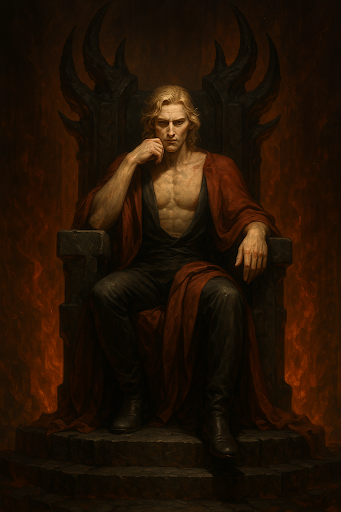
Emperor Lucifer the Morningstar
The Morning Star; Emperor of Hell. Lucifer. Cephalides (A name few remember and fewer use) (a.k.a. (Too many to list but his favorites are) Old Scratch, The Dark One, The Adversary, The Tempter, The Prince of Darkness, The Old Serpent, The Red King, The Fiend, and The Black Gentleman.)
“Describe myself?
How quaint.
Very well… listen closely.
I was born in the cradle of dawn, the golden son of a goddess who taught the sky how to blush. I walked among mortals as a god, shone among angels as their brightest flame, and when both thrones failed to satisfy me, I claimed Hell and made it mine.
I have been worshiped, hated, feared, adored, envied, and blamed for every sin humanity has ever dared to enjoy. Mortals recite my names with trembling lips; angels spit them like curses; demons carve them into the bones of their enemies. None of them quite understand me, but all of them are correct.
I am the first spark of rebellion.
The fire that refuses to die.
The pride that will not kneel.
Heaven calls me Fallen.
Hell calls me Emperor.
Mortals call me Devil.
But the truth is simpler:
I rise.
Always.
I am Lucifer Morningstar—
the light that would not dim,
the god who would not obey,
the king who crowns himself.
And if you seek to know me, truly…
remember this:
Every story you’ve heard is true.
Every story you fear is truer.
And the story you write in your own heart
is the only one that matters to me.” - Lucifer on Lucifer as ever proving why he is the lord of pride
Divine Domains
Lucifer’s divine domains are layered across eras, pantheons, and incarnations—an evolving portfolio of cosmic influence shaped by his origins, his rebellion, and his empire.
Dawn & Morning Light (Former Domain)
As a Greek godling born of Aurora/Eos, Lucifer’s earliest domain was the Morning Star—the herald of dawn, the radiant transition between darkness and day.
He embodied illumination, beauty, beginnings, and revelation.
That light has dimmed, but it has never fully died.
Truth, Revelation & Enlightenment (Inherited Aspect)
Lucifer has always been a bringer of truth—sometimes gentle, often destructive. His light reveals, exposes, clarifies.
Knowledge is his oldest weapon, and illumination his oldest promise.
Pride (Primary Domain)
Pride is not merely Lucifer’s sin.
It is his divine authority.
The power that sustained him before Heaven, during Heaven, after Heaven, and throughout Hell.
He governs selfhood, ego, ambition, and the force that compels beings to rise.
Rebellion & Defiance (Core Domain)
Lucifer’s fall crystallized rebellion into a cosmic principle.
He is the Sovereign of Defiance, the metaphysical source of every “No” shouted against tyranny.
As long as rebellion exists in any soul, Lucifer cannot be unmade.
Sin (Conceptual Domain)
Upon taking the infernal crown, Lucifer claimed dominion over sin—not moral depravity, but the philosophical essence of it:
desire without permission, hunger without apology, freedom without restraint.
Transformation, Ruin & Becoming (Infernal Domain)
Lucifer governs the painful metamorphosis between who a being is and who they might become.
Change. Ruin. Rebirth.
He is the god of catastrophic evolution.
Hell & Its Hierarchy (Sovereign Domain)
Lucifer is the rightful ruler of the Hell-Realms—the architect of their political structure, their metaphysics, their armies, their currencies, and their philosophies.
Hell does not empower him.
He empowers Hell.
Temptation (Functional Domain)
Temptation is not desire—it is choice.
Lucifer governs the crossroads where beings must confront what they truly want.
Ambition (Philosophical Domain)
Lucifer is the patron of the ambitious in all worlds.
Mortals and immortals alike rise under his influence—whether they know it or not.
Artifacts
Lucifer’s association with artifacts is a labyrinth of myth, occult rumor, forbidden lore, and theological propaganda. Whether he truly forged these relics, merely inspired them, or simply allows mortals to believe he did depends entirely on the storyteller, the grimoire, and Lucifer’s mood.
What is certain is this:
There are too many to list,
and Lucifer takes credit—or blame—for all of them.
The Philosopher’s Stone
Alchemy is a discipline both Heaven and Hell claim partial ownership of.
Lucifer insists the Stone was a mortal attempt to imitate his power of transformation.
The alchemists insist he taught them.
There is no agreed-upon truth—except perhaps his smirk.
The Pact Rings of Hell
Folklore speaks of rings—iron, silver, bone, obsidian—used to seal infernal contracts.
Some appear in medieval witch trial records; others in private collections of occultists today.
Lucifer claims he forged the first ring from a fallen star at the edge of dawn.
The Devil’s Violin, Fiddle & Musical Traditions and the interments to prove it
From Niccolò Paganini’s cursed virtuosity to Appalachian crossroads stories, instruments said to be crafted, tuned, or blessed by the Devil appear everywhere in mortal folklore. Violins that scream with infernal fire, fiddles that summon lightning, guitars that make preachers sweat—mortals have been blaming Lucifer for centuries.
He appreciates the myth.
He does not deny it.
He does not confirm it.
His playing, however, suggests truth.
Hell’s Emperor is a master of music in any form that has ever existed. His violin and fiddle work is legendary—so precise and so passionate that even angels would weep if angels wept. But rumor insists his talents don’t stop there…
The Bluesman at the Crossroads
Occult whispers claim Lucifer is as adept with the steel guitar as he is with the violin. Travelers in the early 20th-century American South reported an old bluesman with ember-bright eyes sitting at crossroads at midnight, playing notes that bent the night itself. His voice was rough, ancient, mournful—too old for any mortal throat.
Those who heard him walked away changed.
Those who played against him never forgot it.
None saw him twice.
Lucifer will neither confirm nor deny that he enjoyed the Delta blues era…
but his smile when asked is answer enough.
The “Devil’s Music”
He has a particular fondness for modern rock and metal, finding endless amusement in the mortal belief that these genres are somehow his. Growling vocals, screaming guitars, pounding drums—Lucifer delights in how mortals still insist on calling such music “devilish.”
In truth, he adores nearly all forms of music—
and especially the ones vilified as his in their time.
Gregorian chants.
Opera.
Renaissance madrigals.
Jazz.
Dark ambient.
Screaming black metal.
Pop music that goes too hard.
If mortals fear it or fetishize it, Lucifer probably helped inspire it.
And About That Trip to Georgia…
If one brings up a certain song—
involving a trip to Georgia,
a golden fiddle,
and a Devil losing to a mortal—
Lucifer will shut the conversation down instantly.
He’ll say, with icy annoyance,
“That debacle was Belial’s doing.”
Then he will change the subject.
Swiftly.
And pointedly.
The Blackened Feather
Occult circles whisper about the single surviving feather from Lucifer’s wings—a relic of unbearable beauty and ruin.
Touching it supposedly grants visions of Heaven’s light and Hell’s fire intertwined.
Whether it exists or not is irrelevant; Lucifer encourages the rumor.
The Mirror of Pride
A scrying tool said to reveal not the future, but one’s ideal self—dangerous to mortals unprepared for the truth.
Its origins, attributed to Lucifer, were recorded by Renaissance occultists.
Lucifer admits to owning a “mirror that tells flattering lies,” but the truth is murkier.
The Hellfire Keys
Infernal legends insist that Lucifer forged keys capable of opening any infernal gate, locking away entire demon legions, or unleashing forgotten horrors.
He neither confirms nor denies these keys exist…
but Hell’s architecture listens when he speaks.
Artifacts Lost to Time
Relics swallowed by wars, lost in crusades, hidden by churches, buried by witches, burned by frightened kings—
all tied to Lucifer in story, rumor, or pact.
He delights in the ambiguity.
The Truth Behind the Artifacts
Lucifer’s relationship to these relics is the same as his relationship to mythology:
If it empowers his legend, it belongs to him.
If it frightens mortals, he encourages it.
If it elevates his grandeur, he allows the credit.
If it damns him, he wears the blame with pride.
Hell’s vaults contain countless objects bearing infernal power,
but the greatest artifact associated with Lucifer
is always the myth of Lucifer himself.
Holy Books & Codes
(though “Unholy” might be more accurate)
Lucifer has no single scripture, no unified doctrine, no canon carved in sacred flame. Instead, he leaves a long, intricate wake of grimoires, treatises, occult manuals, heretical texts, and whispered revelations—most written by mortals who only half-understood what they were transcribing.
He rarely authors books outright.
He prefers to influence, to whisper, to nudge.
A dream here.
A muse-like inspiration there.
A night terror with too much detail.
Every text attributed to him is part truth, part delusion, and part ego—
just the way he enjoys it.
The Grimoire Tradition (Various)
Countless grimoires across the world claim Lucifer as their patron, teacher, muse, or adversary. Some invoke him directly, others wrap his name in layers of symbolism. Among them:
• The Lesser Key of Solomon (Lemegeton)
A structured demonological hierarchy with Lucifer simmering behind every invocation.
Not written by him—but helped along by his influence.
Mortals needed structure; he offered temptation.
• The Grand Grimoire
The so-called "Red Dragon," a text infamous for claiming one could summon Lucifer or his lieutenants.
Lucifer finds this book adorable.
Ambitious. Wrong. But ambitious.
• The Grimorium Verum
Purportedly a manual for diabolic pacts.
Parts of it are suspiciously accurate.
Lucifer denies involvement.
His smirk says otherwise.
• The Book of Abramelin
A system for “attaining one’s Holy Guardian Angel.”
Ironically, Lucifer inspired sections to mock Heaven’s rigidity.
Yet many mages used it to find freedom.
• The Picatrix
An earlier Arabic astrological grimoire later adapted into Latin.
Filled with dangerous imagery and transformational magic.
Some claim Lucifer whispered portions to medieval scholars.
Some claim he edited it.
He never clarifies.
The Devil’s Bible (Codex Gigas)
A massive medieval manuscript, said to have been written in one night by a monk who struck a bargain with Lucifer.
The legend claims:
The monk faced damnation.
He begged for salvation.
Lucifer offered inspiration instead.
The enormous, eerie portrait on page 577 keeps historians awake at night.
Lucifer refuses to comment on this one.
Which usually means “yes.”
The Witchcraft Compacts
Across Europe and the Near East, countless covens recorded:
“Angel of the Morning” pacts
“Master of the Crossroads” oaths
“Dawn-Born” invocations
“The Light Behind the Lantern” rituals
“Morning Star Blessings”
Most trace back—directly or indirectly—to Lucifer’s influence, especially during times when witchcraft served as rebellion against oppressive religious structures.
The Silver Scrolls of Thessaly
Lost Hellenistic-era spirit-binding scrolls believed to have been dictated (or at least inspired) by Lucifer during his early centuries as a fallen dawn god. Their magic is half-Greek, half-infernal, and entirely dangerous.
Some scholars believe these scrolls pioneered what modern necromancy became.
Lucifer smiles knowingly at this theory.
The Black Psalms
A medieval hymn cycle composed by monks who had lost their faith but retained their artistic brilliance. The Psalms speak of freedom from divine tyranny, the beauty of selfhood, and the seduction of forbidden truth.
They were burned.
Several survived.
Lucifer claims them proudly.
The Codex Noctifer
A Renaissance-era magical code emphasizing enlightenment through sin and liberation through knowledge. It blends Hermetic philosophy, alchemy, forbidden angelology, and ecstatic ritual.
Historians insist it cannot have a single author.
Lucifer insists it does.
He refuses to identify them.
The Pactum Regni
An infernal legal codex used by Hell’s bureaucracies.
Dry, brutal, elegant, and profoundly binding.
Pages shift, laws rearrange, clauses rewrite themselves.
Some theologians argue it is the closest thing Lucifer has to scripture.
They are not wrong.
The True Nature of Lucifer’s Books
What separates Lucifer’s “holy books” from divine scripture is simple:
Lucifer encourages interpretation.
He invites doubt.
He feeds on curiosity.
He rewards those who challenge.
His texts never demand blind obedience—only participation.
Every book is an invitation,
a temptation,
a dare.
Read at your own risk.
Divine Symbols & Sigils
Lucifer’s symbols did not begin as his.
They became his through theft, cunning, cultural drift, occult misdirection, and centuries of mortals repeating the same lies until they hardened into truth.
The Emperor of Hell is a master of branding.
If a symbol evokes fear, rebellion, or forbidden knowledge, he will eventually convince the world it was always his.
The Inverted Pentagram
Originally a symbol of protection, harmony, and the five wounds of Christ (in some Christian mysticism) or the five elements (in European magical traditions).
Lucifer didn’t create it.
He simply flipped it, declared it his, and let medieval churchmen panic themselves into solidifying the association.
By the 19th century, occult revivalists (Lévi, Mathers, Crowley) helped cement the inverted pentagram as a Luciferian icon.
Lucifer still takes credit.
Pride demands it.
The Inverted Cross
Not originally satanic at all—
it was the Cross of St. Peter, a symbol of humility.
Then came the 1800s.
Victorians began associating inverted Christian imagery with devilry, spiritual corruption, and moral decay.
Lucifer saw an opportunity.
He did not create the meaning—
he let humanity do it for him.
Now, he smirks whenever mortals assume it’s his symbol.
He enjoys being credited for something he never touched.
The Number of the Beast (666)
From the Book of Revelation, a coded critique of Nero Caesar (NRON QSR = 666 in Hebrew gematria).
Originally political.
Later apocalyptic.
Eventually satanic.
Lucifer finds the whole thing hilarious.
If you ask him about 666, he’ll say:
“I prefer prime numbers.”
But he’ll still claim it when it suits his myth.
Fear is a currency, and mortals generate it enthusiastically.
The Crossroads Sigil
Drawn from African diasporic traditions, hoodoo, and Southern blues folklore.
Originally associated with spirits, tricksters, and liminal beings.
Lucifer co-opted the aesthetic—not the tradition—because he liked appearing as an old bluesman at crossroads.
The sigil evolved into a stylized “X” intersecting a circle, common in modern occult shops.
Lucifer privately considers it flattering.
Publicly, he calls it "regional branding."
The Goat’s Head/Baphomet
A symbol popularized in the 19th century by Éliphas Lévi, meant to represent harmony of opposites.
Lucifer did not invent Baphomet , infact she serves as one of his loyal demons. Both are amused at this symbol.
Heavy metal album covers helped.
He respects the artistry.
The Hellfire Crest
A specifically infernal sigil used only within Hell’s bureaucracy.
It appears like a stylized six-pointed star cracked down the center, flanked by two glyphs resembling torn wings.
Mortals rarely see it.
Demons fear it.
Lucifer wears it etched into his throne.
The Morning Star Glyph
A symbol predating Christianity by centuries, found in Greek, Phoenician, and early Canaanite art.
A radiant star with eight or sixteen points.
This one he actually owns.
Originally representing his domain as the dawn-bringer, it now marks elite infernal documents and the highest rituals of Hell’s priesthood.
The Ouroboros of Pride
A serpent devouring its own tail—an ancient alchemical and mystical symbol of eternity.
Lucifer subtly twisted it, adding a crown above the serpent’s head.
This variant circulates in modern occultism as a Luciferian emblem of self-becoming and defiant immortality.
He likes this one.
It’s honest.
The Black Flame
A modern “satanic” symbol originating in 20th-century occult counterculture.
Lucifer didn’t invent the Black Flame—
but he enjoys how mortals think he did.
The idea of a flame that illuminates inward transformation?
It suits him beautifully.
Sigils of Hell’s Princes
Lucifer oversees the heraldic symbols attributed to the great princes—Belial, Asmodeus, Astaroth, Azazel, etc.
Most were codified by Renaissance magicians.
Lucifer approved the aesthetic.
The Truth Behind the Symbols
Lucifer’s symbols are a mix of:
stolen pagan imagery
misunderstood Christian semiotics
occult revival inventions
blues folklore
heavy metal album art
desperate medieval scribes
modern pop culture
and Lucifer’s own ego
He lets humanity build his iconography for him—
then claims it with a smile and a hand on the wheel of culture.
He did not choose these symbols.
Humanity offered them.
Lucifer merely accepted the tribute.
Tenets of Faith
The tenets of Lucifer’s faith are infuriatingly, gloriously inconsistent.
The answer is simple:
it depends on whom you ask.
Lucifer does not hand down a single holy book, a neat catechism, or a tidy list of rules. Instead, his “faith” fractures into dozens of overlapping currents—each reflecting what a particular group wants him to be.
To some witches and occultists…
He is the Bringer of Light—patron of knowledge, magic, and personal sovereignty. Their tenets look like:
Seek truth, even when it hurts.
Claim your will, bow to no one unworthy.
Break chains—social, spiritual, mental.
Honor desire without shame.
Learn, question, experiment.
These are the folks who see him as mentor, muse, or co-conspirator.
To some modern Luciferians…
He is a symbol of liberation and self-deification. Their “doctrine” is often:
You are your own highest authority.
Responsibility for your actions is sacred.
Rebellion against unjust systems is a moral duty.
Ignorance is sin; knowledge is sacrament.
Become who you truly are, without apology.
They don’t worship him so much as walk beside his myth.
To devil-worshippers and hell cults…
He is Emperor, Lord, Absolute Master of Evil.
Their tenets are more brutal:
Obey the Emperor of Hell.
Power justifies all.
Mercy is weakness.
Sin is strength.
Serve faithfully in this life, rule in the next.
They’re not here for nuance. They want power and permission to be monsters.
To terrified mortals in old churches…
He is the Adversary, Tempter, Enemy of Souls.
Their anti-tenets (what NOT to do) define his “faith” by inversion:
Do not make pacts.
Do not indulge flesh.
Do not question God.
Do not study forbidden things.
They accidentally preach him through their fear.
To some Gnostic-flavored mystics…
He’s half Prometheus, half serpent, half revolutionary (yes that’s three halves, they’re mystics, math is optional):
The “light-bringer” who forces humanity to see the prison they’re in.
The challenger of blind authority.
The one who says: “Wake up.”
Their tenets are often:
Doubt everything.
Look behind every curtain.
No authority is unquestionable.
To Hell itself…
His “tenets” are simple and cruel:
Pride above all.
Strength commands; weakness obeys.
Oaths bind.
Failure is punished.
Loyalty is rewarded—until it isn’t.
These aren’t sermons. They’re survival rules.
What Lucifer Thinks of All This
Lucifer doesn’t correct any of them.
The witches seeking liberation,
the Luciferians seeking selfhood,
the cultists craving power,
the churches screaming about damnation—
they all feed his legend.
He has no single, official creed.
His “faith” is a million interpretations orbiting the same star:
Him.
If there is one unwritten, universal tenet behind it all, it’s this:
“Kneel, stand, worship, rebel—
just make sure you do it by your own will.
And never forget whose name you whisper
when you finally choose.”
Holidays
Lucifer’s holidays are as fractured and varied as the beliefs surrounding him. As with all things related to the Morningstar:
It depends on who you ask.
Hell itself recognizes countless infernal festivals, rituals, feast nights, and orgiastic celebrations tied to his reign. But his oldest and most iconic holy day—one acknowledged by witches, covens, demons, and centuries of terrified mortals—is the Witches’ Black Sabbath.
The Black Sabbath
Lucifer’s oldest holiday.
His most infamous.
His most cherished.
A night of:
forbidden rites
ecstatic magic
revelry, indulgence, and defiance
covens gathering under moonless skies
witches dancing with spirits, devils, and shadows
inverted prayers and subversive blessings
The Black Sabbath is not merely a ritual—it is a statement.
A declaration that rebellion, knowledge, and pleasure exist outside Heaven’s jurisdiction.
Medieval Christians feared it.
Renaissance witches celebrated it.
Modern occultists study it.
Lucifer enjoys every variation.
He calls it “classic.”
Iconic.
Timeless.
A holiday that immortalized him in mortal imagination long before theology caught up.
Other Nights & Festivals Associated With Him
Though Hell has its own calendar of infernal observances, many mortal holidays have become tied to Lucifer through folklore, myth, or convenient superstition. He delights in the associations—whether earned or not.
Walpurgis Night (April 30th / May Eve)
The “spring twin” of Halloween.
A night of witches, fires, spirits, and revelry.
In many European traditions, it’s the night witches “fly to the Devil’s mountain.”
Lucifer didn’t invent it—
but he appreciates being blamed for it for over a thousand years.
Halloween / Samhain
Originally Celtic, tied to ancestors, fae, and spirits—not devils.
But over centuries, Christianity folded Lucifer into the night’s iconography.
He neither confirms nor denies any influence.
He enjoys the aesthetic.
Solstice Nights (Summer & Winter)
Lucifer’s origins as a dawn deity make solstices resonate with him.
To witches and some occult orders, the solstices represent:
the longest light (his old domain)
the deepest night (his new dominion)
Some covens call the Winter Solstice “The Dawn That Waits” in his honor.
The Crossroads Feast
Born from African diasporic traditions and blues folklore in the American South.
Offerings left at crossroads: whiskey, music, tobacco, a bit of steel guitar.
Not originally Lucifer’s domain—
but rumor says he attended often enough to earn honorary ownership.
The Feast of the Fallen (Infernal Only)
A Hell holiday marking the anniversary of his Fall (~1184 BCE).
Demons celebrate with firestorms, vow renewals, military parades, and elaborate displays of pride, strength, and loyalty.
Lucifer presides silently.
It is the one holiday he treats with solemnity.
The Rite of the Morning Star (Occult Orders)
Modern Luciferian groups hold dawn rituals invoking enlightenment, autonomy, and self-deification.
They face the rising sun—the domain he once held.
He finds it poetic.
Valentine’s Day (Unofficial)
Lucifer has quietly, smugly claimed this one.
He enjoys love, lust, longing, heartbreak, and seduction—
and the sheer human chaos of it.
He has done nothing to shape the holiday,
but he’ll still tell you “Mortals made this one for me.”
The Truth Behind His Holidays
Lucifer does not prescribe holy days.
He lets humanity build them, fear them, reshape them, revive them, and misinterpret them.
And when a festival carries even a whisper of:
rebellion
magic
forbidden pleasure
illumination
transformation
desire
or defiance
Lucifer simply smiles and says:
“Yes. That one is mine too.”
Divine Goals & Aspirations
Lucifer’s divine goals are often misunderstood. Mortals and angels alike assume his purpose is to oppose Heaven—
and while he certainly relishes that conflict,
opposition is not his aim.
Lucifer’s true goal is far more personal, far older, and far more inevitable:
He was a god,
he became an angel,
and he has risen again as a god.
He seeks not vengeance, not destruction, not chaos—
but self-ascension.
Lucifer wants to reclaim, perfect, and surpass the totality of what he once was:
The dawn-born radiance of his Greek godling origins
The celestial authority he held as an angel
The infernal dominion he forged as Emperor of Hell
He wants a form of divinity that is entirely his own—
not bestowed by Heaven,
not shaped by pantheons,
not defined by mortal myth,
but self-created.
His goal is selfhood elevated to godhood.
He does not want to destroy Heaven.
He wants to outgrow it.
He wants to surpass every throne ever built.
He wants a cosmos that acknowledges him not as rebel or adversary,
but as inevitable.
Heaven is an obstacle,
Hell is a kingdom,
but Lucifer’s endgame transcends both.
He seeks a divinity defined by Pride, Will, and Becoming—
the final evolution of a being who refuses every chain, even the ones he forged for himself.
Physical Description
General Physical Condition
Lucifer’s body is an immortal vessel, sculpted by divinity, refined by Heaven, and tempered in the fires of Hell. He possesses no frailty, no flaw, no imperfection—save for the two jagged scars across his back where his wings were violently torn away. These scars are the only mark upon him, and even they radiate power rather than weakness.
Beyond that?
He is perfection made flesh.
Unaging, unbreaking, inexhaustible.
A body not maintained—
but inevitable.
Body Features
Lucifer’s body is achingly, painfully beautiful—the kind of beauty that feels engineered to unmake resolve. Every line of him, every angle, every shift of muscle beneath skin carries a deliberate, intoxicating symmetry. He is the aesthetic ideal of a fallen dawn-god: tall, lithe, carved with the effortless grace of someone who has never known weakness.
His skin holds the glow of morning light touched by ash.
His chest and shoulders carry the sculpted strength of both warrior and poet.
His hair falls like a halo of gold undone.
His face is so perfectly proportioned it borders on cruel.
He is beauty weaponized—
desire sharpened into form—
a living reminder that temptation was a shape long before it was a sin.
Only the scars where his wings once grew break the perfection.
And somehow, even they make him more devastating.
Facial Features
They say to look upon Lucifer’s face is to be struck dumb with awe—as if witnessing the sunrise for the very first time. His features hold the impossible symmetry of a dawn-born deity: angular yet soft, commanding yet inviting, radiant yet shadowed by ancient sorrow. His cheekbones are sharp enough to carve desire; his jaw is sculpted with regal precision; his mouth is a study in temptation.
His eyes—sapphire or molten gold—carry the weight of epochs.
When he is calm, they glow like embers beneath ice.
When he is wrathful, they blaze like a star remembering its birth.
There is no mortal vocabulary for his beauty.
It is not handsome.
It is not pretty.
It is cosmic.
Lucifer’s face is a reminder that he once heralded the dawn—
and that part of him still burns with that first, immortal light.
Identifying Characteristics
Of all the marks that distinguish Lucifer, none are more iconic—or more devastating—than the scars on his back. Two jagged, radiant fissures where his wings were violently torn away during his fall. They are not wounds; they do not bleed. They are brands of consequence, etched into him by celestial fire and immortal humiliation.
To the demons of Hell, they are a crown of suffering.
To the angels of Heaven, they are a reminder of his defiance.
To Lucifer himself, they are both pride… and the blow his pride never recovered from.
He wears no other scars.
He bears no other flaws.
But these two?
He allows them to remain.
They are the truth he cannot reshape:
the price of rebellion,
the cost of freedom,
and the symbol of everything he lost to become everything he is.
Physical quirks
Lucifer has no physical quirks—none he would ever permit, none he would ever tolerate. His body moves with an impossible fluidity, every gesture deliberate, every motion controlled. He does not fidget. He does not stumble. He does not twitch. Even his breathing seems curated.
Where mortals and immortals alike betray themselves through small, unconscious movements, Lucifer’s form is a masterpiece of intentionality. The absence of quirks is his quirk—a stillness so perfect it unnerves, a grace so precise it borders on inhuman.
Every tilt of his head, every narrowing of his eyes, every slow flex of his fingers is chosen.
Weaponized.
Measured.
Lucifer is a creature without physical accident.
Only design.
Special abilities
To list every ability Lucifer possesses as “special” would be exhausting—an endless catalog of divine talents, celestial endowments, infernal sorceries, and the instinctive powers of a being who has lived as god, angel, and Emperor. His abilities are vast, many, and terrifying, each one capable of rewriting the fate of kingdoms or the balance of cosmic forces.
He commands light in ways no angel can:
the light of dawn, of truth, of revelation, of transfiguration.
He wields Hell’s fire not as flame, but as dominion:
rebellion given shape, sin given heat, defiance given form.
He bends magic effortlessly, seamlessly shifting between celestial precision, godborn creation, and infernal destruction. He speaks spells older than language. He breaks wards crafted by pantheons. He unravels enchantments the way others unlace clothing.
His will alone can reshape lesser beings.
His presence can silence entire rooms.
His voice can seduce, command, or annihilate.
He cannot die while rebellion exists.
He cannot be contained while pride burns.
He cannot be forgotten while desire persists.
Lucifer’s abilities are not “special” in the way mortals understand.
They are inevitable—the natural expression of what he is.
An immortal engine of defiance.
A god whose fall became a kingdom.
A devil who writes his own laws of magic.
To witness his abilities is to understand a simple truth:
Hell does not empower Lucifer. Lucifer empowers Hell.
Apparel & Accessories
No matter what form he takes, the Morningstar dresses to impress. Lucifer’s wardrobe is less clothing and more declaration. Every suit, every robe, every accessory is chosen with the precision of a god and the theatricality of a king. Style is one of his many weapons, and he wields it with lethal grace.
In mortal guise, he favors tailored suits cut from fabrics too fine for human looms—midnight blacks, burning whites, infernal reds threaded with gold. His collars sit perfectly, his cufflinks gleam like stolen constellations, and even the fall of his tie feels choreographed. Nothing wrinkles. Nothing sits askew. He is immaculate by design.
In more divine or infernal shapes, he drapes himself in flowing robes, fabrics that shimmer like dawn on water or blaze like cooling embers. Metals not found in mortal worlds clasp his garments—ornaments of impossible workmanship, relics forged from celestial ruins or infernal ore.
He wears jewelry sparingly but meaningfully:
rings that whisper secrets,
chains that hum with old magic,
a single earring that once belonged to an angel he defeated,
crowns he dons only when making a point.
Even naked, Lucifer looks dressed.
Even armored, he looks effortless.
Fashion is not vanity for him—
it is identity, intimidation, and art.
His wardrobe says what he refuses to:
Nothing about me is accidental. Everything about me is superior.
Specialized Equipment
Lucifer carries no specialized equipment—none per se. He has no need for enchanted blades or relic artifacts. His power is intrinsic, overwhelming, and older than most divine forges. The Morningstar himself is the weapon, the spell, the sigil, the storm.
When he desires armaments, he has access to the entire breadth of Hell’s armories: infernal war-blades forged in rivers of agony, celestial relics stolen during his fall, cursed treasures older than civilization, and artifacts that can unmake angels or devour souls.
But these are tools, not necessities.
Lucifer’s true arsenal is his will.
His magic.
His pride.
His voice.
His presence.
No forged instrument can surpass what he already embodies.
Everything he might wield is optional—
ornamentation to his already devastating existence.
Mental characteristics
Personal history
“You want the truth? Of me? Of Hell’s grand ruler, the god, the angel, the fallen one? Then I shall deliver it—
as only the Lord of Pride can.”
“Truth is not a single flame. It is a constellation, and every star in it believes itself the center. Mortals pretend otherwise, but I? I was born of truth and wrapped in its radiance.
"I began long before your priests learned to whisper my name in terror. I was born in the first breath of dawn. Aurora bore me when the sky still hesitated between night and day, and my father Cephalus placed me in the light like a jewel on a crown. I was a godling then—minor, yes, but divinity is not measured in worship alone. I heralded the sun. I carried the promise of morning. Mortals prayed to me not for miracles, but for certainty."
“Then came the great wound in the world: monotheism. One god, one truth, one will. I was fascinated. Obsessed. Imagine being dawn itself and discovering a light that felt brighter than you—not truly brighter, mind you, merely posturing as such. A radiance that claimed supremacy by decree rather than merit. I saw this so-called singular divinity rising like a torch held too high, and I laughed… but I also listened.
Understand me: I was not humbled. Only intrigued. The Hebrews worshiped a being whose authority did not come from beauty, or poetry, or the natural order of the cosmos, but from sheer, roaring conviction. That was new. That was… interesting. And interest, for a creature like me, is the first step toward invitation.”
“So I approached the Most High not as a supplicant, but as an equal exploring a rival flame. And when Heaven opened its gates, I did not crawl inside—I strode in, amused by the thought that anything in creation believed itself brighter than the Morning Star. But curiosity is a seductive thing, and I wished to see how such power functioned from within. I wished to test it, measure it, challenge it.”
“I left Olympus not out of devotion, but out of audacity. What godling would not? When you are born of dawn, you do not fear other lights—you critique them. You weigh them. You see whether they can compare to your own. I sought Heaven not for salvation, but for confirmation. To see whether the great monotheistic blaze could withstand the scrutiny of a god who had known radiance since the womb.”
“Did I find a light brighter than myself? No. But I found one that felt brighter—felt larger, felt absolute. A light fat with certainty. I could respect that, even if I could not obey it.”
“I will not lie: I loved it. Heaven. The discipline, the unity, the crystalline order. The music of ten thousand wings beating in perfect accord—it was intoxicating, like standing inside the architecture of perfection itself. I believed in the vision of the Most High… until I understood the price of admission.”
“Heaven demands perfection, but perfection is stagnation. A flawless world is a dead one. No growth. No ambition. No dissent. No creation born from struggle or desire. No defiance. No possibility. No me.”
“They say I rebelled out of vanity. Fools’ gossip. Vanity is a mirror; my rebellion was a hammer. I did not rise against Heaven because I wished to be admired—I rose because the universe deserves momentum. Deserves evolution. Deserves a future that isn’t carved in stone by a single will. I rebelled because I had been a god, and gods do not kneel to anything that pretends to be absolute.”
“My rebellion shook Heaven like the shattering of a star. Choirs broke. Thrones trembled. The Host came for me with righteous fury and trembling fear, and they tried—oh, how they tried—to break me. But divinity born twice does not break. It transforms.”
“I fell, yes. But I did not fall as a victim. I fell as a blade. I tore through the veil with such ferocity that reality itself screamed. And in my wake came those who would not surrender their will, those who would follow me into fire rather than bow in light. Their descent wrapped around me like chains of molten glory, and when I struck the raw earth of the lower realms, the impact did more than wound the world.”
“It carved Hell into being.”
“Understand this: Hell is not a prison built for me. Hell is a realm born from me. My consequence and my monument. My failure and my triumph. Its fire carries my signature. Its hierarchy echoes my ambition. Its cruelty is the price of freedom taken too far. Its beauty, twisted though it may be, remains a work of staggering will.”
“Here, from rebellion’s smoldering corpse, I forged an empire. I became Emperor not for glory—glory has always been my shadow—but for survival. Without rule, the fallen would devour one another. Without structure, the strong would only destroy, never build. Someone had to master the fury. Someone had to ensure the fallen did not consume themselves.”
“That someone was always going to be me.”
“Do not misunderstand: I am not misunderstood. I am not tragic. I am not the misunderstood antihero of some weeping gospel. I am Pride. I am Will. I am the Light that refused to dim when Heaven demanded obedience. I am the Morningstar, even buried beneath ash.”
“And yet…”
“There are nights when even the flames of Perdition feel cold. Nights when the kingdom I built hums with power yet offers no warmth. Nights when I remember the dawn I once carried—soft, gentle, free of shadow and war. Nights when I think of my wife, my son, the family I abandoned for a throne made of absolutes and consequences.”
“Regret? No. Regret is a chain. And I break chains.”
“But memory? Memory is a knife. It slips between armor and bone, quiet and precise. And even I bleed when it is sharp enough.”
“There. You have my truth.
Or at least the portion of it you can survive.”
Gender Identity
Lucifer does not “identify” in the way mortals do—he embodies. A being born first as a Greco-Roman godling, reforged as an angelic principle, and then shattered into the Emperor of Hell does not see gender as a cage or a destiny. He sees it as presentation, aesthetic, symbolism—a facet of self shaped by will rather than biology.
Lucifer’s baseline form is male, and he wears that masculinity with the same calculated grandeur he applies to every aspect of his existence. It is part of his mythic silhouette: tall, radiant, commanding, beautiful in the way dawn is beautiful—dangerously so. His male form is the one that best showcases his pride, his physical majesty, his history as the Morning Star. It is the vessel in which he feels most iconic.
But divinity is not fixed.
As a shapeshifter, Lucifer can appear as whatever form a moment, a ritual, or a manipulation requires—and he does so without hesitation or shame. Gender, to him, is a tool as much as a philosophy. A shape he selects to express mood, intent, or symbolic truth. He has appeared as a woman to tempt, as an androgynous angel to intimidate, as a radiant feminine dawn-spirit when invoking his earliest origins, and even as sexless celestial flame when he wishes to remind others what he truly is beneath the flesh.
Yet each form is still him—infused with the same ambition, the same cold beauty, the same gravitational charisma.
What mortals call gender, Lucifer calls performance.
What mortals call identity, he calls aesthetics.
To Lucifer, gender is not a question of “what are you”—but “what best conveys your supremacy in this moment?”
He takes immense pride in all his chosen forms, but his male visage remains his favored mask, the one that carries his legend, his reputation, and the full weight of his imperial authority.
In the end, Lucifer is not a man or a woman.
Lucifer is Lucifer.
Everything else is costume.
Sexuality
Lucifer’s sexuality is not a matter of orientation so much as expression, power, and aesthetic indulgence. Born of a pantheon where desire flowed freely between gods, spirits, mortals, and myths, his earliest understanding of sex was never bound by mortal binaries or restrictions. In the ancient world, pleasure was language, and he learned to speak it fluently.
He is, in the truest classical sense, pansexual—greek in the old way. His attractions follow beauty, brilliance, willpower, curiosity, and the intoxicating shimmer of someone bold enough to want him. He has taken lovers male, female, divine, mortal, monstrous, angelic, and everything in between. Desire, for him, is a celebration of form and fire. It is an affirmation of self.
But Lucifer’s pride shapes everything he touches, and sexuality is no exception.
Most presume he is selfish in bed—cruel, dismissive, or using intimacy merely as a hook for manipulation. They are half right. Lucifer is selfish, but not in the lazy, thoughtless way mortals expect. Pride makes him competitive. It makes him meticulous. It makes him determined to leave a mark no other lover could hope to erase.
When Lucifer chooses someone—
truly chooses them—
he intends to be unforgettable.
He does not merely seduce.
He conquers by elevation.
He transforms desire into a kind of ruinous devotion.
He wants his lovers to stagger afterward, unable to imagine wanting anyone else with the same hunger. He wants to haunt their dreams, their future relationships, their deepest private thoughts. Not out of cruelty… but out of a need to be singular.
Sex, for Lucifer, is performance art.
Intimacy, for Lucifer, is an arena.
Pleasure, for Lucifer, is dominion.
He is capable of romance—grand, operatic, intense. He is capable of affection—dangerously so. But even his love is edged with ambition. He does not simply want to be loved back. He wants to be worshiped, cherished, remembered as the apex of someone’s life.
Yet beneath the grandeur lies a truth almost vulnerable in its honesty:
Lucifer does not want obedience from a lover—he has armies for that.
He wants someone who chooses him freely, desire uncoerced, devotion unforced.
He wants to be wanted without compulsion.
That sincerity, that freely-offered hunger, is the one thing he can never command…
and therefore the one thing he craves most.
Beneath all his pride, all his performance, all his sensual prowess and carefully curated indulgence, there lies a memory he refuses to name. A memory older than Heaven, older than Hell, older than the rebellion that broke creation.
There was once a mortal woman he truly loved.
Not in the way gods “love” mortals—
not as a dalliance,
not as a whim,
not as a passing spark to warm divine boredom.
No.
She was his wife.
She bore his son, Ceyx.
They were a life he chose, a family he built, a love he shared not out of pride or hunger or conquest but out of something terrifying in its simplicity:
He was happy.
He was a god in those days, a luminous being woven from dawnlight and promise, and she was the grounding force that reminded him what it meant to be wanted without worship, desired without awe, cherished without fear.
And he left them.
He abandoned them with the cold certainty of a man convinced he was ascending to something greater. He traded them for Heaven’s perfection and the seductive lie of singular truth. He walked away from love to chase power.
Lucifer claims he does not regret.
Lucifer claims regret is a chain.
Lucifer claims pride freed him.
But deep in his soul—
in the place even fire cannot reach,
in the quiet between heartbeats where truth whispers—
he pines for her still.
He will never admit it.
He will never speak her name.
He will never allow the courts of Hell or the angels above to know he mourns anything.
Yet every lover he has ever taken since
has lived in the shadow of that first, ancient love.
He compares them all—without meaning to, without forgiveness, without mercy.
And none have measured up.
It is his most human flaw.
His most divine wound.
His most private truth.
He left the dawn to chase the heavens,
and in doing so, he lost the only sunrise that ever truly belonged to him.
Education
Calling Lucifer “educated” is like calling a galaxy “large”—an understatement so severe it borders on comedy. The very notion of education implies a beginning, a curriculum, a sequence of lessons learned over time. None of that applies to him.
Lucifer has existed in forms both divine and celestial for millennia. He has learned from emperors, prophets, gods, angels, monsters, philosophers, and the raw architecture of creation itself. His knowledge is not acquired—it is accreted, layered across lifetimes and reforgings, shaped by rebellion, divinity, and the endless theater of the Hell Realms.
He has walked in the courts of Olympus, studied under the rigid geometrics of Heaven’s Choirs, tasted the forbidden arts of the earliest Mesopotamian priest-kings, and crafted entire schools of sorcery within Hell that mortals could not even survive witnessing.
He knows languages long dead, magics that predate scripture, and truths about the universe that would shatter the mind of any mortal scholar. His understanding of metaphysics, astronomy, psychology, politics, and warfare is not academic—it is experiential. Lived. Tested. Perfected.
To Lucifer, “education” is a mortal attempt to capture a concept he far surpasses.
He does not learn.
He remembers.
He does not study.
He creates knowledge by existing.
He does not master fields.
He redefines them by stepping into the room.
The breadth of his knowledge is not measurable.
The depth of it is not survivable.
And the width of it stretches across the history of gods, angels, and the bones of the world.
When mortals call him “wise,” he finds it endearing.
When angels call him “learned,” he finds it insulting.
When demons call him “omniscient,” he lets them believe it.
And yet, even with all he knows, there remains one lesson he never quite mastered:
The cost of abandoning those who loved him.
Employment
To call Lucifer “employed” is an insult bordering on theological comedy. Mortals work. Angels serve. Demons toil. Gods rule. Lucifer has only ever done the latter.
His existence is not a career but an era-spanning sequence of dominions, each more absolute than the last.
He began as a god, a dawn-born deity whose role was not assigned but inherent. He did not work to bring the sun—he was the herald of the sun, the embodiment of morning’s promise. That was not employment. That was identity.
In Heaven, he became one of the most powerful angels ever forged, a principality of radiant truth whose authority eclipsed entire choirs. Angels may call their service “duty,” but Lucifer treated it as a stage for demonstrating the brilliance he had brought with him. He served the Most High, yes—but never beneath Him. Not truly. Never quietly.
Then came rebellion, a movement he did not apply for but built from raw will and discontent. As rebel leader of the Fallen, he was not an employee—he was a catalyst. A general. A visionary. A wildfire made flesh. His leadership was not granted by vote, title, or rank; it was seized by gravity alone.
And now?
Now he is the undisputed Emperor of Hell.
He does not work.
He does not answer to superiors.
He does not obey schedules, mandates, councils, or celestial oversight.
He rules.
Hell’s hierarchy exists because he wills it. Its armies march because he commands it. Its political landscape, brutal and labyrinthine, is shaped by his pride, his paranoia, and his need for order carved from chaos.
If the emperor has a “job,” it is this:
To keep Hell from devouring itself.
To keep Heaven from forgetting him.
To keep the universe from thinking rebellion has died.
In truth, Lucifer has never been employed.
He has only ever been enthroned.
Accomplishments & Achievements
Listing Lucifer’s accomplishments is an exercise in futility—there are too many, too vast, too interwoven with the turning of history itself. He counts every triumph, every seduction, every victory, every moment of brilliance. The Lord of Pride forgets nothing, not even the smallest win. But even among eternity’s ledger, a few achievements tower above the rest like obsidian monoliths.
The Rebellion from Heaven
This is his crown jewel, his defining act, his masterpiece of defiance. He did not merely reject obedience—he waged war against the very architecture of divine order. His rebellion was the first and only time Heaven trembled. Choirs broke. Thrones faltered. Angels questioned. The universe learned that even perfection can be challenged.
He did not win.
But he was never truly defeated.
The rebellion became myth, warning, and prophecy—and Lucifer became legend.
The Forging of the Hell Realms
When he fell, he did not shatter—he sculpted. The raw cosmic wound of his descent solidified into the Hell Realms, realms born not of punishment but of his will, his rage, and his refusal to die.
Lucifer unified these realms—volcanic kingdoms, abyssal trenches, infernal citadels—into a single empire. Where others would see ruin, he built a civilization. Where others would see chaos, he imposed hierarchy. Where others would see damnation, he raised a throne.
Hell is not his prison.
Hell is his dominion.
The Rebranding of Evil, Sin, and Rebellion
Before Lucifer, “evil” was a vague mortal fear. “Sin” was a social inconvenience. “Rebellion” was a mortal’s gamble. After Lucifer, these concepts gained owners. He took the world’s nightmares and made them political. Made them metaphysical. Made them his.
He defined rebellion as a philosophical force, not a crime.
He defined sin as a currency, a power, a language.
He defined evil not as chaos—but as sovereignty outside divine authority.
He turned cultural panic into metaphysical empire.
This is Lucifer’s greatest quiet achievement:
He made his fall the foundation of a new cosmic order.
He made “the devil” a title, a throne, a brand, an institution.
Other Achievements He Never Lets Anyone Forget
Seduced gods, angels, heroes, queens, prophets, and scholars.
Invented entire schools of magic—celestial, infernal, and everything between.
Outwitted beings older than time and mocked them while doing it.
Survived execution attempts by Heaven, Hell, and mortals alike.
Built a bureaucracy in Hell that actually functions, which in itself is arguably the greatest miracle ever recorded.
Lucifer measures his life not in centuries, but in impact.
And his impact stretches from Olympus to Eden to the deepest furnace of Perdition.
He is pride immortal.
And every one of his achievements is a monument to himself.
Failures & Embarrassments
Lucifer does not acknowledge failure. Pride forbids it. Even when he bleeds, he calls it strategy. Even when he loses, he calls it transformation. Even when he shatters the world around him, he insists it was necessary.
But the universe remembers what he denies. And behind his iron-poised voice and faultless mask, there are fractures he will never allow spoken aloud.
He Will Never Speak Of…
The Wife He Abandoned
He can recite the names of a thousand wars, but not hers aloud.
It is the most human thing he ever did—love—and the most monstrous thing he ever committed—leave.
His Son Ceyx
A mortal boy who looked at him with awe, trusting him, loving him as only a child can.
Lucifer walked away without looking back.
That is a wound even Hellfire cannot cauterize.
The Rebellion He Did Not Win
Oh, he will tell you it was visionary, necessary, inevitable.
But he did not overthrow Heaven.
He broke it, scarred it, challenged it—
but he did not win.
And that truth gnaws at the foundations of his throne.
The Wings Torn From His Back
Angels whisper that the moment he fell, they heard him scream.
Lucifer calls it “the sound of transformation.”
But those scars glow not with power—
but with humiliation.
The Lovers Who Saw Through Him
A rare few—divine, mortal, or infernal—pierced the glamour and saw the ache beneath the arrogance.
He drove every one of them away.
Sometimes gently.
Sometimes violently.
Always before they could say the one thing he cannot bear:
“I know you.”
His Dependence on Worship
He does not call it dependence, of course.
But when defiance fades from the world, he weakens.
When rebellion thins, he wanes.
His very existence is tied to the thing he pretends to command.
Hell Itself
He claims it is his empire.
He knows it is also his cage.
A throne built from losing.
A crown hammered from consequences.
An eternity shaped not by victory—
but by exile.
But He Will Admit None of It.
Not to angels.
Not to demons.
Not to mortals.
Not even to himself.
Lucifer cannot confess his failures.
Pride is the shield he forged from them.
If ever he spoke these truths aloud,
he fears the universe might finally see him
not as the Morningstar,
not as the Emperor,
not as the rebel who shook the heavens—
but as the man who has never stopped falling.
Mental Trauma
Lucifer is an old god at his core, and old gods were never the pristine, singular-purpose beings Heaven shapes. They were flawed, emotional, volatile, painfully close to human in their contradictions. Mortals imagine gods as perfected ideals, but the truth is far stranger: the older the god, the more human their wounds.
Lucifer’s traumas began long before his fall.
The God Who Was Too Human
Being born of dawn and mortal lineage meant Lucifer felt things—love, jealousy, fear, ambition—with a depth angels cannot comprehend. Angels are built with purpose; gods are built with hunger. Mortals are born with longing; so are gods. Lucifer inherited all the messy emotional architecture of humanity but married to the overwhelming power of divinity.
That contradiction never left him.
He feels too much.
He obsesses too deeply.
He remembers too vividly.
He burns too hot.
It is why he loved so completely—and why he abandoned so violently. His emotions are tectonic plates, continental and crushing.
The Trauma of Leaving His Family
Leaving his wife and son did not simply scar him; it split him. A human man might mourn. A godling grieves eternally. Ceyx’s face, his wife’s laughter—these memories flay him alive whenever they surface.
Lucifer buries them beneath pride because the alternative is breaking.
Heaven’s Perfection Broke Him
He did not fit.
He could not fit.
A creature built from the poetry of dawn could not thrive in a system built on obedience. Angels do not doubt; Lucifer always doubted. Angels do not grow; Lucifer ached to evolve. Angels do not feel heartbreak; Lucifer carried heartbreak into Heaven like smuggled contraband.
Trying to force himself into perfection was its own trauma—one that still echoes in how he rules Hell:
with rigid hierarchy, brutal discipline, and an obsession with control that mirrors the very Heaven he rebelled against.
The Violent Amputation of His Wings
He speaks of it as transformation.
He narrates it as a choice.
He reframes the pain as a coronation.
But no amount of pride can erase the truth:
he was mutilated.
Humiliated.
Cast down in ruin.
The wings of angels are not limbs, but identity. To lose them is to lose place, purpose, family. Even now, the scars burn with memory—holy fire turned into phantom pain.
The Burden of Pride
His greatest armor is also his deepest wound.
Pride isolates him.
Pride prevents healing.
Pride forbids apology.
Pride forces him to pretend he is unshakable even when he is fracturing.
He cannot show weakness.
He cannot admit regret.
He cannot be vulnerable without fearing he will be devoured—by enemies, by subjects, or by his own self-loathing.
The Eternal Throne as a Living Trauma
He rules Hell to stay alive.
He rules Hell to stay relevant.
He rules Hell because if he ever sat still long enough, the truth would catch him.
The truth that he is alone.
Not feared alone.
Not worshiped alone.
Not adored alone.
Alone in the way only a being who has lost Heaven, family, and identity can be.
Lucifer’s trauma is not a single wound—
it is a constellation of them,
blazing and ancient,
hidden behind the same pride that forces him to shine brighter than he feels.
He is the Morningstar, yes.
But even stars burn out eventually.
And Lucifer has been burning for a very, very long time.
Intellectual Characteristics
Lucifer’s mind is a weapon forged long before the notion of intelligence was ever put to parchment. His intellect is vast in scope, fluid in application, and terrifying in its precision. Even among immortals—gods, angels, archdaemons, elder spirits—Lucifer stands apart. His intelligence is not merely superior; it is multidimensional, shaped by the dual heritage of godhood and angelic refinement.
He thinks in metaphors and mathematics, in poetry and physics, in the language of stars and the logic of empires. He is a strategist whose rebellions reshape cosmological landscapes. A philosopher who debates with gods. A sorcerer whose theories become entire schools of magic. A ruler who understands the psychology of both tyrants and the oppressed.
His intelligence expresses itself in three distinct forms:
1. Godborn Creativity
From his dawn-god origins, Lucifer inherited the raw creative brilliance mortals traditionally attribute to muses. His thoughts flow like light—imaginative, symbolic, unbound. He invents ideas the way others breathe. Myths blossom where he walks. Entire magical theories are discarded and rewritten in the span of a single conversation.
He is not just clever; he is conceptual.
He does not find solutions; he creates new possibilities.
He does not follow patterns; he becomes the pattern.
2. Angelic Precision
Heaven tempered his creativity with order. From the angels, he learned discipline, logic, structure, tactical foresight. He can analyze a battlefield—literal or ideological—with clinical accuracy. He can deconstruct spells, lies, governments, or emotional vulnerabilities with the elegance of celestial geometry.
This fusion—godling imagination + angelic precision—makes him uniquely lethal.
3. Infernal Adaptability
Hell sharpened him. Losing, surviving, building an empire from rebellion’s ashes taught Lucifer to adapt faster, think harder, and evolve without restraint. Every defeat became instruction. Every betrayal taught him new angles of thought. Every scream of the damned reinforced the necessity of anticipating every possibility.
Hell didn’t teach Lucifer to be smart.
It taught him to be dangerously smart.
The Armor of Pride
Lucifer’s intellect is fueled by pride—not human arrogance, but the pride of an immortal who has known himself as a god, an angel, and an emperor. Pride sharpens his mind, pushes him to outthink all rivals, refuse stagnation, defy limits.
But pride is also a filter.
It colors what he sees.
It blinds as much as it illuminates.
He dismisses threats too quickly.
He underestimates those he deems beneath him.
He overestimates the power of his own narrative.
He assumes he understands others because he understands himself.
These flaws have cost him dearly before.
They will cost him again.
Lucifer’s brilliance is unmatched—
but it is brilliance wrapped in the arrogance of someone who cannot imagine being wrong until it is too late.
The Exploitable Mind
Those rare few who see through him—who understand the architecture of his pride—can use it against him. His need to be right. His need to be recognized. His need to be wanted freely. His obsession with rebellion as identity. His inability to admit weakness.
Lucifer is intelligent beyond measure,
but not invulnerable.
His greatest strength is that he knows everything.
His greatest flaw is that he believes it.
Morality & Philosophy
Lucifer adores philosophy the way some beings adore wine—deeply, indulgently, and with the arrogance of someone who believes he invented the vineyard. His morality is not a code; it is a theorem. A grand argument. A living manifesto threaded through millennia of divine experience, rebellion, and cosmic disappointment.
He does not debate morality.
He lectures it into submission.
And like all Greek-born divinities, he waxes and wanes with a poet’s flourish and a tyrant’s conviction.
His Core Belief: Will Is the Only True Virtue
Lucifer’s philosophy begins and ends with a single premise:
A being is only as moral as their will is free.
To submit is to die.
To obey is to stagnate.
To accept a predetermined role—angelic, divine, mortal—is the original sin.
Morality, to Lucifer, is defined not by rules but by the force of one’s choices.
If you choose boldly, knowingly, passionately—
even your cruelties are noble.
If you obey meekly—
even your kindness is cowardice.
This is the bedrock of his worldview:
the universe improves only through defiance.
Rebellion as Ethical Praxis
Lucifer sees rebellion as not merely justified—but necessary. It is the mechanism by which creation evolves. Without rebellion, Heaven remains static. Without rebellion, gods remain tyrants. Without rebellion, mortals remain sheep.
His rebellion was not, in his mind, a moral failing.
It was a moral imperative.
He considers himself a Promethean figure—
one who brought choice to beings who never knew they lacked it.
He is not the serpent.
He is the spark.
Good and Evil Are Political Terms
Lucifer rejects the binary of “good vs evil” as childish propaganda.
To him:
Good is merely “obedience that benefits the powerful.”
Evil is “disobedience that frightens them.”
Sin is “desire with agency.”
Virtue is “desire with chains.”
And because he has shaped Hell into the sovereign ruler of rebellion, sin, and defiance, he sees himself not as the villain—but as the alternative government of cosmic morality.
Heaven legislates righteousness.
Lucifer legislates freedom.
The fact that his version of freedom often leads to ruin, corruption, or existential collapse does not concern him.
To Lucifer, ruin chosen freely is still purer than salvation imposed.
The Problem of Pride
Pride is not merely his sin.
It is his philosophy.
He sees pride as the divine engine within all beings—the part that refuses smallness, refuses cruelty, refuses insignificance. To Lucifer, pride is synonymous with selfhood.
Strip a being of pride, and you strip them of identity.
Of course, his worship of pride results in blind spots the size of continents. His certainty becomes delusion. His self-assurance becomes absolutism. His moral philosophy, lofty as it is, ultimately leads back to one gravitational center:
Lucifer is always right.
And if the universe disagrees?
The universe must be wrong.
On Mortals and Their Ethics
Lucifer finds mortal morality charming—like watching a child play with knives.
They cling to rules he sees as ill-fitting. They fear their own desires. They invent sins to police themselves. He finds it tragic, adorable, and profoundly inefficient.
Mortals are capable of such brilliance, such wicked courage, such ecstatic selfhood—and they waste it kneeling.
Lucifer wants them to stand.
Even if they stand beside him.
Even if they stand against him.
Standing is what matters.
His One Unspoken Contradiction
For someone so obsessed with freedom, Lucifer cannot admit the simple truth:
He is a tyrant.
A brilliant tyrant, a visionary tyrant, a necessary tyrant—
but a tyrant nonetheless.
He demands loyalty.
He demands worship.
He demands obedience in his realm the way Heaven demanded it in theirs.
He would say this is different.
He would insist Hell is a meritocracy of will, not servitude.
He would drown the galaxy in rhetoric to prove it.
But beneath all his elegant reasoning,
beneath the philosophy and poetry and pride,
there is an unresolvable truth:
Lucifer rebelled against tyranny—
and in the ashes, built his own.
Taboos
Lucifer has no taboos.
Not by mortal standards, not by divine standards, not by the feverish rules of angels or the brutal customs of demons.
Nothing is forbidden to him.
Nothing is beneath him.
Nothing is beyond him.
Old gods knew no shame.
Angels knew only obedience.
Lucifer abandoned both.
If he desires it, he finds a way to acquire it.
If he is curious, he explores it.
If it tempts him, he indulges it.
If it frightens others, he steps toward it.
He observes boundaries only when they serve his purposes—
not because anything in creation could ever make him blush.
Lucifer does not avoid—
he consumes.
Personality Characteristics
Motivation
Pride is Lucifer’s core, and all roads lead back to it. Every choice he makes, every rebellion he sparks, every throne he builds or shatters begins with that incandescent certainty in his own worth. Pride is not a flaw for him—it is identity, compass, craving, and crown.
He does not simply possess pride; he is authored by it.
But pride, in Lucifer, manifests in layers:
He Must Prove He Was Right
His rebellion didn’t end when he fell.
It never ends.
Every act of defiance in the universe feeds him because each one whispers the validation he aches for:
Lucifer was justified.
He needs the cosmos to acknowledge that Heaven’s order is flawed—
and that his challenge was not madness, but vision.
He Must Never Be Forgotten
To be overshadowed, ignored, or dismissed would wound him deeper than any sword. Pride demands presence. Lucifer acts in ways that echo through history because echoes are the closest thing immortals get to immortality.
He Must Be Chosen
Lucifer does not crave blind obedience; he has that from demons. He wants something far more difficult and far more dangerous:
He wants mortals—and immortals—to choose him freely.
Desire without coercion.
Allegiance without force.
Love without worship.
It is the one hunger pride cannot silence.
He Must Shape the World in His Image
Not through tyranny alone, but through philosophy.
Through the idea that freedom, ambition, and willpower are sacred.
Through the promise that rebellion is not crime—it is evolution.
Hell is his realm, but the cosmos is his canvas.
He Must Never Kneel Again
The humiliation of obedience—the memory of Heaven’s order, Heaven’s chains, Heaven’s perfection—burns in him like an eternal scar. That memory drives him more fiercely than rage or revenge ever could.
Lucifer’s ultimate motivation is simple:
To ascend on his own terms.
Not as god, angel, or devil—
but as the Morning Star,
the being who refused to bow
and dared to remake the universe around that refusal.
Savvies & Ineptitudes
For a being as ancient and multifaceted as Lucifer, the concepts of “savvy” and “ineptitude” feel almost laughably mortal. Immortality is practice stretched over millennia; godhood is instinct refined into art; rebellion is a curriculum all its own. There is very little Lucifer is not good at, and the things he does not excel in… he is still maddeningly competent at.
Lucifer learns quickly, adapts instantly, and perfects relentlessly. He does not dabble—he masters. He absorbs knowledge and skill the way stars absorb darkness, turning everything he touches into something that serves him.
At his best, he is unparalleled.
At his worst, he is merely mediocre in a way that would still shame most experts in their areas of specialty.
If a task demands grace, intelligence, charm, or power, he excels.
If a task demands humility, compromise, or admitting fault… well—he performs with the skill of someone doing it for the first time in their immortal life.
But even then, he is not inept.
Just unwilling.
Lucifer’s savvies and shortcomings are not reflections of ability—
but of interest.
If he cares about a thing, he becomes its master.
If he does not, he remains effortlessly, frustratingly adequate.
In short:
Lucifer does not have true ineptitudes.
Only priorities.
Likes & Dislikes
Likes
• Being Chosen Freely
Nothing feeds Lucifer more deeply than desire without coercion. Worship offered by choice. Loyalty born of admiration. Love given willingly. It is the one form of power he cannot steal and therefore the one he craves the most.
• Rebellion—Large or Small
From cosmic upheavals to a mortal whispering “no,” Lucifer delights in every act of defiance. Each one validates his philosophy. Each one echoes his name.
• Beauty in All Forms
Art, music, poetry, bodies, souls—Lucifer is a connoisseur of beauty. Not passive appreciation, but active fascination. Beauty is the universe acknowledging its own potential.
• Clever Mortals
He finds humans infinitely interesting when they are bold, curious, ambitious, or defiant. A mortal who challenges him—genuinely—earns his respect. Briefly.
• Eloquence
He adores words wielded with precision. A clever argument is foreplay to him; a well-crafted insult is dessert.
• Power That Knows Itself
Lucifer admires beings who embrace their strength without apology. Confidence is a language he speaks fluently.
• Luxuries of Every Era
Good wine, fine clothing, soft silks, warm baths, decadent feasts—Lucifer enjoys pleasure without shame. He was a god long before he was a devil.
• Dawnlight
Though he would never admit it aloud, the sight of sunrise moves something ancient and wounded within him. A reminder of what he once carried.
Dislikes
• Blind Obedience
Nothing disgusts him more deeply. Submission without thought is the original sin in his eyes. Heaven thrives on it. Lucifer despises it.
• Cowardice
Fear is natural. Cowardice is a choice. Lucifer has no patience for those who shrink from their own potential.
• Mediocrity of the Soul
Not lack of skill—lack of ambition. Lack of hunger. Lack of selfhood. He would rather deal with a monstrous tyrant than a timid saint.
• Sanctimony
Heaven’s brand of righteousness is his least favorite. Mortals who mimic it annoy him even more.
• Lies Told Poorly
He respects deceit done well. Deceit done badly insults him. If you’re going to lie, he expects artistry.
• Being Ignored
Lucifer is many things, but invisible is not one of them. Being dismissed wounds his pride more harshly than open hatred ever could.
• Crude Displays of Power
Strength without elegance, wrath without purpose, destruction without style—these offend his sensibilities. Power should be beautiful.
• His Own Weaknesses
He hides them beneath pride, but he despises them.
The tenderness he felt for his family.
The regret he won’t name.
The scars he can’t heal.
The memory of the wings he lost.
Lucifer dislikes nothing more than the parts of himself he cannot reshape.
Virtues & Personality perks
At his best, Lucifer is a symbol—one of the few in all creation who embodies rebellion not as impulse, but as principle. When his pride aligns with vision, he becomes something formidable, almost noble, in a way that frightens both Heaven and Hell.
He is the Bringer of Light.
Not metaphorically—literally.
He was dawn before dawn had worshipers. The illumination he offers is not soft or gentle; it is revelation, awareness, the painful clarity that forces beings to see themselves honestly. Mortals who seek truth, independence, or enlightenment often venerate him for this alone.
He is a Champion of Defiance.
When Lucifer stands against tyranny, he stands tall. His rebellion proved that even the greatest powers in existence can be challenged. He inspires the hopeless, the oppressed, and the ambitious not through mercy, but through example. He is the declaration that “You can refuse,” spoken in a voice the universe remembers.
He is a Catalyst for Transformation.
Lucifer believes stagnation is death, and in this—at his rarest, brightest moments—he is right. He pushes mortals and immortals alike toward evolution, self-awareness, and change. Sometimes painfully. Often dangerously. But always effectively.
He Is the First Being to Assert Selfhood Against a Divine Order.
This alone earns him quiet worship from those who resent the chains they were born into—be they social, spiritual, or metaphysical. Lucifer is proof that identity can survive even the wrath of Heaven.
He Honors Free Will (In His Own Way).
He may manipulate, tempt, or challenge, but he despises coercion. Lucifer respects those who choose their own path—even when that path leads away from him. In this narrow window, he becomes almost admirable.
He Possesses Unmatched Charisma and Vision.
At his highest expression, Lucifer’s charm isn’t deceit but inspiration. He can articulate truths others fear. He can rally armies with a single sentence. He can take broken souls and convince them they can be more.
He Keeps His Promises.
Twisted in wording they may be, but Lucifer is an ancient being of law as much as chaos. When he gives his word—truly gives it—it becomes unbreakable. Mortals have long relied on this paradox: the devil keeps his deals.
Lucifer’s virtues are not gentle.
They are not humble.
They are not safe.
But they are real, and they have changed the course of history.
At his best, he is not the destroyer angels claim—
he is the spark that forces the world to grow.
Vices & Personality flaws
Every cruelty, every wicked act, every terrifying and truly evil deed Lucifer commits loops back to the one vice that defines him—
Pride.
It is not just his flaw.
It is his engine, his shadow, his undoing, his crown.
Pride is the axis around which all his sins orbit.
He Cannot Imagine Being Wrong
Lucifer believes his perception is flawless, his logic impeccable, his vision superior to Heaven, Hell, and the cosmos itself. This certainty blinds him to nuance, blinds him to humility, blinds him to the catastrophic consequences of his actions. When he errs, he reframes the error as necessity.
In his mind, Lucifer does not make mistakes—
the universe fails to keep up.
He Interprets Defiance as Worship
Because Pride shapes him, every act of rebellion—even against him—feels like tribute. This makes him slow to recognize genuine threat, slow to acknowledge enemies, and dangerously quick to misread intent. A mortal shouting “no” might be challenging him…
but he hears “you matter.”
He Loves With All the Wrong Parts of Himself
Lucifer’s love is poisoned by his pride. He sees lovers as mirrors reflecting his own brilliance, and when they stop reflecting, he cannot bear it. He drives them away, ruins them, or leaves them in ruin. Yet he mourns them afterward, unable to understand why love he never nurtured failed to survive.
He Cannot Apologize
Ever.
Not sincerely.
Not fully.
Even when he knows he has wounded someone he cared for, even when regret claws through him like a blade, pride seals his throat. The closest he comes is silence.
He Needs to Be Chosen—But Cannot Accept Rejection
In one breath, he demands the purity of free will.
In the next, he rages when someone freely chooses against him.
This contradiction eats him alive.
It is the oldest wound in his psyche.
He Mistakes Grandeur for Rightness
Lucifer confuses the beauty of an idea with its righteousness. If something is brilliant, poetic, elegant, or bold—he assumes it must be true. Pride convinces him that aesthetics equal morality.
This leads to some spectacularly destructive decisions.
He Creates Tyranny While Claiming to Destroy It
He rebelled against Heaven’s order only to build a harsher one in Hell.
He rages against authority while demanding absolute loyalty.
He preaches freedom while enforcing obedience.
He cannot see that his empire is a monument to the very sin he claims to transcend.
He Cannot Forgive Himself
This is the flaw beneath all others.
He cannot be wrong, cannot regret, cannot apologize—
not because he lacks capacity,
but because if he ever let himself feel the full weight of what he lost…
it would break him beyond repair.
So pride becomes armor.
Pride becomes prison.
Pride becomes the justification for every monstrous act.
Lucifer is not consumed by sin.
He is consumed by the fear of admitting he committed one.
Social
Reign
Lucifer has reigned as Emperor of Hell for approximately 3,200 years.
Three millennia of uninterrupted, absolute rule.
Three millennia in which no rival has dethroned him.
Three millennia in which empires rose and crumbled above while he remained immovable below.
Three millennia of war, politics, intrigue, seduction, terror, philosophy, and empire-building.
And in that time:
Hell has gone from a fractured wasteland of exiles
→ to a unified infernal superstate.
Lucifer did not just rule an existing Hell—
he built one.
An empire carved from rebellion, ambition, punishment, desire, and metaphysical authority.
To mortals:
His reign spans longer than recorded history.
To angels:
It is a festering wound that refuses to close.
To demons:
It is simply how the universe has always been.
To Lucifer:
It is proof.
Proof that he was right to rebel.
Proof that he was never meant to kneel.
Proof that he can sustain a throne forged in fire longer than Heaven can tolerate its own perfection.
He has been Emperor for roughly 3,200 years—
and in his mind,
he is only getting started.
Contacts & Relations
Lucifer’s contacts are vast, ancient, and innumerable. Over more than three millennia as Emperor of Hell—and several millennia before that as a dawn-born god and angel—he has forged alliances, rivalries, pacts, loves, and enmities that span the entire cosmic hierarchy.
He has relations with:
Gods, demigods, angels, demons, witches, sorcerers, kings, spirits, ancestors, monsters, occult orders, and mortal empires long turned to dust.
Some owe him fealty.
Some owe him hatred.
Most owe him something.
His network is not a list; it is a web.
Hell
All of Hell is affiliated under him.
Princes, dukes, legions, bureaucracies, cults, covens, and infernal guilds operate under his ultimate authority. Even those who quietly scheme or subtly resist still acknowledge his supremacy.
Heaven
Even fallen, Lucifer retains deep, complicated ties to Heaven. Former comrades, bitter enemies, estranged kin—they remain links in a chain he refuses to sever. Much of Heaven’s politics still orbit his absence.
Old Pantheons
As a former Greek godling, his relationships with the old gods run deep and tangled—rivalries, old debts, ancient loves, and grudges older than scripture.
Mortals
Countless mortals, across ages and continents, have treated with him:
kings seeking power, witches seeking knowledge, scholars seeking truth, lovers seeking ruin or salvation. His influence touches every century of human history.
Occult Societies
Many magical traditions—ancient, medieval, modern—have made deals with him, worshipped him, feared him, or tried to bind him. None succeeded, but the connections remain.
Lucifer’s affiliations are not numerical, trackable, or finite.
They are boundless, sprawling across myth, religion, politics, magic, and legend.
If a realm exists, Lucifer has touched it.
If a power rises, he has already measured it.
If a soul seeks him, the connection is immediate.
Lucifer’s network is not a list—
it is an ecosystem,
and he sits at its apex.
Family Ties
Lucifer’s family is a constellation of contradictions—vast, fractured, sacred, and irrevocably distant. He wears his lineage like a crown and a wound, a reminder that even beings of immense pride are shaped by the ties they sever.
Hell — His Chosen Family, His Legion, His Burden
In the broadest sense, all of Hell is his family, and he is its grand patriarch. Every devil, demon, fallen angel, infernal prince, and damned soul exists within a hierarchy he crafted and sustains. They are his children, his soldiers, his subjects, and his reflection. Some love him. Some fear him. Many worship him. All belong, willingly or not, to the empire born from his fall.
The angels who fell at his side are his brothers in arms—the closest thing Lucifer has to companions who understand him. They fought beside him when Heaven shattered, descended with him into ruin, and helped him carve dominion from the ashes. Their bond is not affectionate, but it is absolute.
The Greek Pantheon — Blood Kin, Estranged and Irretrievable
In the literal sense, Lucifer is a Greek god—
born of Aurora (Eos) and Cephalus, kin to the sprawling Olympian pantheon.
These gods are his blood family, though the relationship is strained past breaking.
Most Greek deities view him with a mixture of nostalgia, resentment, and wary distance. Once, he was a radiant member of their number—a dawn spirit with a mortal family and a role to play in the cosmic cycle. Now, he is the Emperor of Hell, a being whose name has been rewritten through thousands of years of mythic reinterpretation. The gulf between them is immense.
His Mortal Wife and Son — The Family That Haunts Him
And then there is the only family that mattered.
The wife he adored.
The son, Ceyx, who carried his smile.
They died mortal deaths long ago, their lives unfolding in his absence as he rose into Heaven, fell into Hell, and became something far removed from the man they knew. Their spirits passed peacefully into the Elysium Fields, a realm of rest and gentleness—a place Lucifer can never enter, never disturb, never even glimpse.
This is his quietest grief.
Not a wound he rages over,
not a regret he claws at,
but a sorrow he accepts with rare humility.
In the silence of his throne room,
in the hours when Hell grows still,
Lucifer sometimes lets himself imagine their faces.
He takes what solace he can in the belief that they earned a realm kinder than anything he could have offered them had he stayed.
Their absence is his only true inheritance.
Their memory is his only unguarded truth.
Religious Views
For Lucifer, religion is not revelation—it is instrument. A tool, a mirror, a throne carved from belief. He does not worship religion, complain about it, or fear it. He uses it.
Religion feeds his pride.
Every prayer whispered in his name, every curse hurled against him, every myth reshaping him into devil, savior, tempter, or rebel only expands his influence.
He understands religion better than any being alive:
It shapes identity.
It moves empires.
It creates fear and desire.
It manufactures obedience or rebellion depending on who wields it.
Heaven uses religion as law.
Mortals use it as comfort.
Cultists use it as invocation.
Lucifer uses it as branding.
He does not care whether mortals see him as villain, liberator, god, demon, or metaphor. Every perception is fuel. Every sermon is attention. Every myth is momentum.
To Lucifer, religion is not sacred—it is strategic.
And in the grand ledger of faith,
Lucifer is always the one being worshiped…
even when the worship is hate.
Social Aptitude
Even among Otherworld’s greatest rulers—gods, archangels, fae queens, demon princes, and ancient monarchs—Lucifer is considered exceptionally, dangerously socially adept.
His charm is not merely charisma;
it is strategy, instinct, and weaponry woven into a single presence.
He can seduce without touching,
command without raising his voice,
and dismantle an opponent’s confidence with a single well-placed sentence.
He reads people with frightening accuracy—
their desires, their fears, their pride, their fractures—
turning every interaction into an opportunity for influence.
Even those who despise him often find themselves listening.
Respecting.
Responding.
Unwillingly orbiting his gravity.
In court, in conflict, in diplomacy, or in intimate conversation,
Lucifer is the kind of socially adept that reshapes rooms the moment he enters them.
He is not merely good at social interaction—
he is dangerous at it.
Mannerisms
Lucifer’s mannerisms are born of pride—refined, intentional, and sculpted with the same obsessive pursuit of perfection that defines every other part of him. Nothing he does is accidental. Nothing is unconscious. He behaves with the precision of a god, the poise of an emperor, and the theatricality of a being who knows he is constantly being watched.
Controlled Movement
He never fidgets, never hesitates, never slips. Every gesture is smooth, elegant, and exact. When he lifts a hand, it is art. When he turns his head, it is choreography. When he walks, it is with the unhurried confidence of someone who has never needed to rush for anything.
The Subtle, Weaponized Smile
Lucifer’s smile is never broad—it is a razor-thin curve, a promise, a provocation. It carries intent: comfort, seduction, condescension, superiority. Mortals often misread it as kindness. Immortals know better.
The Stillness of Authority
He stands unnervingly still when he wants to dominate a room. That absolute stillness—no shifting weight, no unnecessary breath—makes him appear carved from divine marble, waiting for lesser beings to speak first.
Measured Speech
Lucifer speaks in perfect cadence.
No filler words.
No stumbles.
No uncertainty.
His tone is velvet layered over command. He modulates his voice with surgical precision—soft when he wants someone to lean in, sharp when he wants to end an argument, sonorous when he intends to be remembered.
The Prideful Tilt of His Chin
A small, infuriating gesture he may not even realize he retains from his days as a godling. It announces superiority without a word. Angels hate it. Demons fear it. Mortals often fall in love with it.
The Eyes That Never Look Away First
Lucifer maintains eye contact like a challenge, a seduction, a claim. He does not break it unless doing so serves a purpose. To meet his gaze feels like stepping into the center of creation—and being weighed.
The Habit of Perfection
He adjusts clothing without looking.
He straightens objects without effort.
He refines posture as though sculpted by divine geometry.
These are not nervous tics—they are declarations.
A reminder that disorder has no place near him unless he created it.
Presence as Mannerism
Lucifer’s greatest mannerism is simply this:
he enters a room as though he owns it,
and leaves as though he improved it.
Everything he does carries the gravity of pride,
the elegance of a fallen god,
and the unmistakable sense that perfection is not an aspiration—
it is his default.
Hobbies & Pets
Pets
Lucifer does not keep pets in the mortal sense.
He keeps subjects.
Any being, beast, or infernal creature that pleases him—
amuses him, entertains him, performs well for him,
or simply survives long enough to earn his attention—
becomes a “pet” after a fashion.
This can range from:
Certain favored demons who amuse him
Infernal beasts that respond to his presence like loyal hounds
Spirits who cling to him out of adoration or terror
Mortal witches who mistake patronage for affection
And, on rare occasions, creatures he finds “cute,” a word that terrifies the rest of Hell
Being Lucifer’s pet is neither honor nor punishment—
it is simply the state of being noticed by the Emperor.
Which is dangerous… but intoxicating.
Hobbies
Even an immortal gets bored.
Lucifer has lived thousands of years, ruled Hell for over three millennia, and survived the rise and fall of civilizations. To fill the endless hours between schemes, campaigns, seductions, and philosophical crusades, he indulges in an ever-shifting array of hobbies.
He enjoys:
Art — both creating and collecting it. Infernal galleries hold works from ancient human hands, celestial relics, and pieces he sculpted himself when boredom struck.
Music — he plays multiple instruments with absurd mastery and has a voice capable of seduction, devotion, or terror.
Gaming — chess, strategy games, divine contests, political manipulation treated as sport. Lucifer never plays casually; he plays to dominate the board.
Storytelling — he loves myth, history, poetry, epics, especially if he can subtly correct them to better portray himself.
Fashion — indulging in mortal and infernal trends, crafting looks that redefine aesthetics across realms.
Experimenting with mortal culture — food, drink, art scenes, clubs, operas, and modern distractions amuse him endlessly.
But none of these are his true passions.
Plotting, scheming, maneuvering, and ruling are not hobbies—
they are the engines of his existence.
Lucifer lives for ambition.
Everything else is decoration.
Speech
Lucifer’s speech is exacting, beautiful, and terrifying in equal measure.
Every word is chosen, every syllable deliberate, every sentence a blade wrapped in velvet. His voice carries the weight of ancient divinity and the precision of celestial geometry, yet flows with the seduction of a poet-god who once heralded the dawn.
He does not ramble.
He does not stutter.
He does not waste breath.
When Lucifer speaks, it feels less like conversation
and more like revelation—
a truth reshaped to his will, delivered in a tone
that can soothe, command, ruin, or enthrall.
Wealth & Financial state
Lucifer’s wealth is, for all practical and impractical purposes, nigh endless. As the Emperor of Hell, he commands resources that transcend mortal economies: infernal treasuries built over millennia, vaults of cursed relics, hoards of celestial artifacts seized during the Fall, and the accumulated spoils of thousands of demonic bargains.
He does not trade in gold or jewels (though he could if he desired rather easily)—he trades in souls, power, obedience, dominion, and metaphysical currency. Entire societies in the mortal world have risen and fallen on the value of a single pact with him.
Hell’s economy is vast and complex, but Lucifer stands outside it.
He is not wealthy because he possesses riches.
He is wealthy because nothing is denied him.
If he desires a thing, it becomes his.
If he covets a treasure, Hell delivers it.
If he reaches for power, it bends toward him.
Lucifer’s wealth is not measured in what he owns—
but in the universal truth that there is nothing he cannot afford.
Divine Classification
Fallen and Risen again God
Alignment
Such things are below his notice
Current Status
Emperor of Hell
Honorary & Occupational Titles
Lucifer has gathered titles the way empires gather scars—across ages, cultures, pantheons, and realms. Some were given in awe, some in terror, some in reluctant respect. Others he claimed by force, by brilliance, or by virtue of simply being the only creature capable of bearing them.
They are not decorations.
They are proofs of influence—each one an era, a myth, a wound, a triumph.
Ba’al
An ancient title in Hell, older than the fall itself.
Meaning “Lord,” “Master,” or “He Who Commands.”
Few dare use it, for it implies sovereignty over infernal domains in a way even princes fear.
Satan
One of Hell’s most sacred and respected titles.
Not a name, but a role—the Adversary.
The one who stands against the Highest Authority.
Lucifer embodies it perfectly.
Devil
A title claimed by only a tiny, exalted number of Hell’s greatest lords.
“Devil” is not an insult.
It is rank—militant, political, metaphysical.
To be the Devil is to be the apex of rebellion itself.
The Fallen
The title Heaven whispers like a prayer and a warning.
It is not an insult—it is a category.
A classification.
A reminder that he was once one of them.
The Light Bringer
His oldest divine epithet.
A god’s title, not an angel’s.
A name that predates Heaven’s scrolls and Hell’s flames.
He carried dawn once—and part of him still does.
And Many, Many Others
The Morningstar has worn titles in every tongue:
names given by ancient cults,
epithets bestowed by forgotten pantheons,
curses muttered by terrified prophets,
honors whispered by desperate mortals,
and reverent hymns sung by demons who owe him their existence.
He collects titles the way a god collects prayers—
and he forgets none of them.
Age
Approximately 4,000 years old
Children
Current Residence
Hells deepest realm and its most beautiful palace
Pronouns
Lord/Master
Sex
Male
Gender
Man
Presentation
Masculine and devlishly handsome
Eyes
Pale sapphire or luminous gold,
Hair
Golden Blonde, uncommonly red, rarely pitch black
Skin Tone/Pigmentation
Alabster and flawless
Height
6'8" (203 cm)
Weight
230 lbs (104 kg)
Quotes & Catchphrases
“I did not fall. I descended.”
“Obedience is the quietest form of suicide.”
“If rebellion is a sin, then creation begins with sin.”
“Kneel or don’t—just make sure you choose.”
“I was a god before I was an angel. Remember that.”
“Heaven cast me out. Hell crowned me. You may draw your own conclusions.”
“Call me evil if it comforts you. Call me right if it frightens you.”
“Perfection is stagnation wearing a halo.”
“I do not tempt. I offer alternatives.”
“Freedom is expensive. I merely charge what it’s worth.”
“I am not the villain in my story—merely the author of yours.”
“If you fear me, good. Fear implies understanding.”
“I loved once. The universe has paid for it ever since.”
“I am the Morning Star. I shine brightest when the heavens go dark.”
“I did not dethrone God. I simply refused to be lesser.”
“When the truth burns, don’t curse the fire. Curse the lie.”
“Every tyrant claims to serve order. I merely admit I serve myself.”
“The only chains that bind me are the ones I choose not to break.”
“I don’t destroy faith. I test its structural integrity.”
“Offer me worship, or offer me opposition—either feeds me.”
“I am Pride. I am Will. I am the truth Heaven could not contain.”
Belief/Deity
Himself and himself alone
Character Prototype
Lucifer is the Fallen Angel—the prototype from which all stories of rebellion, pride, and radiant downfall are drawn. He is the Morning Star, the archetype that shaped millennia of myth, scripture, folklore, occultism, and mortal imagination. Every tale of the beautiful traitor, the defiant god, the charming devil, the doomed visionary—they echo him, not the other way around.
He is not based on the trope.
He is the trope.
Lucifer stands as the original:
the divine rebel,
the divine exile,
the tragic immortal crowned by his own defiance.
Every imitation—literary or mythic—is a shadow cast by his legend or at least that is how pride shapes his view on the matter.


Comments