
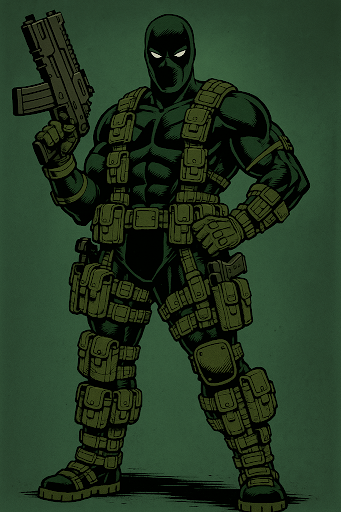
Deep Pockets
Aliases: Mister Pockets; Captain Pockets; Pouch Man; The Walking Armory, The Green Guerilla
Real Name: Jace Gosling
Home: Toronto, Ontario, Canada
Birthplace: Hamilton, Ontario, Canada
Gender: Male
Height: 6'0" (183 cm)
Weight: 185 lbs (84 kg)
Build: Lean athletic; weekend-warrior muscle over slacker frame
Hair/Style: Brown, usually under a hood or ballcap; chronically “I’ll fix it later” messy
Eyes: Hazel-green; laugh lines he pretends he didn’t earn
Skin: Fair; powder burns and scrape scars, usually new ones
Occupation: Freelance mercenary/retrieval specialist; dimensional quartermaster-for-hire
Affiliation: Independent; partnered with Harper Security & Recovery (Mike “Gramps” Harper, proprietor)
Current Status: Active; blacklisted by several universities and three defense contractors; popular among clients who like results and receipts
Birth date: 14 May — Taurus
MBTI: ENTP-A
Blood Type: O+
Background
Jace Gosling grew up the way a lot of Canadian boys do—half chores, half controllers—only lazier, funnier, and a little too self-aware to pretend otherwise. Paintball on weekends, action movies on loop, and a secret dream of walking away from explosions without looking back. His dad, a strict “discipline builds character” type, shipped him to a military academy. It didn’t fix the slacker, but it did leave him fluent in small arms, range safety, and the kind of squad tactics you only learn by getting yelled at in the rain.
College was supposed to be his soft reset. Instead, he caught feelings—well, ambitions with cheekbones. The girl worked in a lab studying trans-dimensional anchors. Jace auditioned for “smart guy,” faked it past the door, and kept improvising until someone handed him a task labeled stabilize. He turned what he thought was the right knob. The anchor drifted. Alarms harmonized. A wash of blue light rolled over him like cold soda. The breach made the news; the university made statements; the project made the circular file. No casualties, one scapegoat. Jace got expelled, blacklisted, and—cruelest outcome—ghosted.
The first sign he hadn’t left empty-handed arrived in his jeans. He went digging for change and found elbow-deep space where denim should’ve been. The more he tested, the weirder it got: pockets that swallowed gear without weight, pouches that held five times their volume, a backpack that behaved like a polite black hole. When he thought “multitool,” his hand closed around it—no rummaging, no delay. He could bind containers, make them bigger on the inside, and call their contents to his palm like they’d been waiting for the cue.
Getting hired anywhere respectable was off the table, so Jace leaned into the only dream he’d ever articulated clearly: be the cool guy with too many gadgets. He bought armor he couldn’t afford, a used cargo van, and enough nylon pouches to violate local aesthetics bylaws. Early gigs were bottom-shelf—lost property, bad boyfriend retrievals, warehouse security that paid in envelopes. Word spread anyway. Clients liked a fixer who always had exactly the tool the moment needed, and rivals remembered the guy whose magazines never seemed to run dry.
He met Mike Harper—retired Vietnam vet, stoic, allergic to nonsense—on a job that went sideways at a rural chop shop. Jace kicked a door; three very surprised men discovered their guns had no magazines; a fourth introduced Jace to the floor. Mike cleaned up, hauled him upright, and told him to stop confusing luck with a plan. They’ve been partners since: Harper handles overwatch, boring phone calls, and telling Jace he’s an idiot before the universe does it harder.
Somewhere between “retrieval specialist” and “walk-in armoury,” Jace earned the name Deep Pockets. He didn’t coin it; a fence did, muttering to a client, “That guy’s got deep pockets—don’t ask how.” The tabloids loved it. Jace pretended to hate it until he realized the moniker booked work and looked good on a patch.
Power-wise, he thinks he’s a talented goof with good gear and better timing. Everyone else notices the film-logic that follows him around: bullets graze instead of bury, shrapnel gusts around his silhouette, and the ledge he leaps for is somehow always within an inch of his reach. He calls it “being clutch.” Harper calls it “statistically rude.” analysts call it reactive spatial bias—unconscious micro-warps that keep him alive long enough to crack another joke.
Deep Pockets isn’t noble, exactly, but he’s got a code: don’t hurt civilians, don’t stiff clients, don’t work for monsters even if they pay cash, unless the job is to screw other monsters over. He’ll take the messy job if it means the right people go home. He’ll also eat your snacks, play with your dog, and flip you a business card because "its professional and stuff”
He still tells himself he’s a merc with a gimmick. The truth that keeps almost catching him is bigger: the accident didn’t just make his pouches weird—it bent space around a boy who always wanted to walk away from explosions. One day he might realize he’s not lucky. He’s loaded.
Personality
Quippy, cocky, and terminally self-deprecating, Jace performs the part of “lazy merc with great hair” to keep anyone from noticing how hard he’s actually trying. The expulsion still lives in him as a hot coal of embarrassment; jokes are his heat shield. He’ll roast himself first, flirt second, and volunteer for the stupidly dangerous third—because in motion he never has to look straight at his own doubts.
He’s a thrill-glutton: one more job, one more bang, one more story to tell Mike over diner coffee at 3 a.m. Boredom feels like a trap, so he chases novelty and turns every corridor into a bit. Under stress, though, the slacker burns off and the operator shows—focused, efficient, eerily “lucky.” Afterward he laughs too loud, eats too much, and calls the tremor in his hands low blood sugar.
Morally, Jace runs on merc math: if the money’s clean enough or the target’s a proper bastard, he signs. He’ll happily take a gig from bad guys to wreck worse guys, play villain crews against each other, and laugh all the way through it. He doesn’t cosplay nonlethal—he carries buckets of ammo and weapons for days, and he has zero qualms about putting people down if it ends a threat. Civilians are the single bright line; you touch them, you become the target. He prefers a stylish humiliation when it’s efficient, but if drums and headshots solve it quicker, he’s already swapping mags. He tips big, overarms friends, pays for collateral without being asked, and files the paperwork under “you’re welcome.”
With people he’s equal parts golden retriever and raccoon—affectionate, shameless, and forever rifling through your gear drawers. He flirts hard until a boundary appears, then pivots into pure bit: deliberately awful pickup lines, disaster-tier one-liners, mock-swoons, and “tell HR I’m in love with your operational competence” asides to an imaginary camera. It’s performance, not pressure—the joke’s always on him. He bonds by outfitting—pressing a spare tourniquet into your palm, color-coding your pouches, naming a combat drone “Bleepy” or “Lefty the Shark.” With Mike Harper he’s the mouthy apprentice to the gruff mentor, pretending he doesn’t crave the old man’s nod even as he’s fishing for it every mission.
He hides commitment anxiety behind “bit for the bit,” bails on feelings with a gag, and is suspiciously good at keeping things casual. The growth he dodges: admitting his “luck” is power, training it on purpose, and letting that responsibility make him bigger instead of just cooler.
He counts pouches when nervous; taps magazines twice before stowing; quotes films, cartoons and comics with alarming accuracy; names gear (and sometimes enemies as he sees fit says “that’s fair” when corrected; keeps gummy bears in a specific chest pocket and offers them like a peace treaty.
Real Name: Jace Gosling
Home: Toronto, Ontario, Canada
Birthplace: Hamilton, Ontario, Canada
Gender: Male
Height: 6'0" (183 cm)
Weight: 185 lbs (84 kg)
Build: Lean athletic; weekend-warrior muscle over slacker frame
Hair/Style: Brown, usually under a hood or ballcap; chronically “I’ll fix it later” messy
Eyes: Hazel-green; laugh lines he pretends he didn’t earn
Skin: Fair; powder burns and scrape scars, usually new ones
Occupation: Freelance mercenary/retrieval specialist; dimensional quartermaster-for-hire
Affiliation: Independent; partnered with Harper Security & Recovery (Mike “Gramps” Harper, proprietor)
Current Status: Active; blacklisted by several universities and three defense contractors; popular among clients who like results and receipts
Birth date: 14 May — Taurus
MBTI: ENTP-A
Blood Type: O+
Background
Jace Gosling grew up the way a lot of Canadian boys do—half chores, half controllers—only lazier, funnier, and a little too self-aware to pretend otherwise. Paintball on weekends, action movies on loop, and a secret dream of walking away from explosions without looking back. His dad, a strict “discipline builds character” type, shipped him to a military academy. It didn’t fix the slacker, but it did leave him fluent in small arms, range safety, and the kind of squad tactics you only learn by getting yelled at in the rain.
College was supposed to be his soft reset. Instead, he caught feelings—well, ambitions with cheekbones. The girl worked in a lab studying trans-dimensional anchors. Jace auditioned for “smart guy,” faked it past the door, and kept improvising until someone handed him a task labeled stabilize. He turned what he thought was the right knob. The anchor drifted. Alarms harmonized. A wash of blue light rolled over him like cold soda. The breach made the news; the university made statements; the project made the circular file. No casualties, one scapegoat. Jace got expelled, blacklisted, and—cruelest outcome—ghosted.
The first sign he hadn’t left empty-handed arrived in his jeans. He went digging for change and found elbow-deep space where denim should’ve been. The more he tested, the weirder it got: pockets that swallowed gear without weight, pouches that held five times their volume, a backpack that behaved like a polite black hole. When he thought “multitool,” his hand closed around it—no rummaging, no delay. He could bind containers, make them bigger on the inside, and call their contents to his palm like they’d been waiting for the cue.
Getting hired anywhere respectable was off the table, so Jace leaned into the only dream he’d ever articulated clearly: be the cool guy with too many gadgets. He bought armor he couldn’t afford, a used cargo van, and enough nylon pouches to violate local aesthetics bylaws. Early gigs were bottom-shelf—lost property, bad boyfriend retrievals, warehouse security that paid in envelopes. Word spread anyway. Clients liked a fixer who always had exactly the tool the moment needed, and rivals remembered the guy whose magazines never seemed to run dry.
He met Mike Harper—retired Vietnam vet, stoic, allergic to nonsense—on a job that went sideways at a rural chop shop. Jace kicked a door; three very surprised men discovered their guns had no magazines; a fourth introduced Jace to the floor. Mike cleaned up, hauled him upright, and told him to stop confusing luck with a plan. They’ve been partners since: Harper handles overwatch, boring phone calls, and telling Jace he’s an idiot before the universe does it harder.
Somewhere between “retrieval specialist” and “walk-in armoury,” Jace earned the name Deep Pockets. He didn’t coin it; a fence did, muttering to a client, “That guy’s got deep pockets—don’t ask how.” The tabloids loved it. Jace pretended to hate it until he realized the moniker booked work and looked good on a patch.
Power-wise, he thinks he’s a talented goof with good gear and better timing. Everyone else notices the film-logic that follows him around: bullets graze instead of bury, shrapnel gusts around his silhouette, and the ledge he leaps for is somehow always within an inch of his reach. He calls it “being clutch.” Harper calls it “statistically rude.” analysts call it reactive spatial bias—unconscious micro-warps that keep him alive long enough to crack another joke.
Deep Pockets isn’t noble, exactly, but he’s got a code: don’t hurt civilians, don’t stiff clients, don’t work for monsters even if they pay cash, unless the job is to screw other monsters over. He’ll take the messy job if it means the right people go home. He’ll also eat your snacks, play with your dog, and flip you a business card because "its professional and stuff”
He still tells himself he’s a merc with a gimmick. The truth that keeps almost catching him is bigger: the accident didn’t just make his pouches weird—it bent space around a boy who always wanted to walk away from explosions. One day he might realize he’s not lucky. He’s loaded.
Personality
Quippy, cocky, and terminally self-deprecating, Jace performs the part of “lazy merc with great hair” to keep anyone from noticing how hard he’s actually trying. The expulsion still lives in him as a hot coal of embarrassment; jokes are his heat shield. He’ll roast himself first, flirt second, and volunteer for the stupidly dangerous third—because in motion he never has to look straight at his own doubts.
He’s a thrill-glutton: one more job, one more bang, one more story to tell Mike over diner coffee at 3 a.m. Boredom feels like a trap, so he chases novelty and turns every corridor into a bit. Under stress, though, the slacker burns off and the operator shows—focused, efficient, eerily “lucky.” Afterward he laughs too loud, eats too much, and calls the tremor in his hands low blood sugar.
Morally, Jace runs on merc math: if the money’s clean enough or the target’s a proper bastard, he signs. He’ll happily take a gig from bad guys to wreck worse guys, play villain crews against each other, and laugh all the way through it. He doesn’t cosplay nonlethal—he carries buckets of ammo and weapons for days, and he has zero qualms about putting people down if it ends a threat. Civilians are the single bright line; you touch them, you become the target. He prefers a stylish humiliation when it’s efficient, but if drums and headshots solve it quicker, he’s already swapping mags. He tips big, overarms friends, pays for collateral without being asked, and files the paperwork under “you’re welcome.”
With people he’s equal parts golden retriever and raccoon—affectionate, shameless, and forever rifling through your gear drawers. He flirts hard until a boundary appears, then pivots into pure bit: deliberately awful pickup lines, disaster-tier one-liners, mock-swoons, and “tell HR I’m in love with your operational competence” asides to an imaginary camera. It’s performance, not pressure—the joke’s always on him. He bonds by outfitting—pressing a spare tourniquet into your palm, color-coding your pouches, naming a combat drone “Bleepy” or “Lefty the Shark.” With Mike Harper he’s the mouthy apprentice to the gruff mentor, pretending he doesn’t crave the old man’s nod even as he’s fishing for it every mission.
He hides commitment anxiety behind “bit for the bit,” bails on feelings with a gag, and is suspiciously good at keeping things casual. The growth he dodges: admitting his “luck” is power, training it on purpose, and letting that responsibility make him bigger instead of just cooler.
He counts pouches when nervous; taps magazines twice before stowing; quotes films, cartoons and comics with alarming accuracy; names gear (and sometimes enemies as he sees fit says “that’s fair” when corrected; keeps gummy bears in a specific chest pocket and offers them like a peace treaty.


Comments
Author's Notes
All Art is AI generated place holder art, curtesy of Chatgpt