
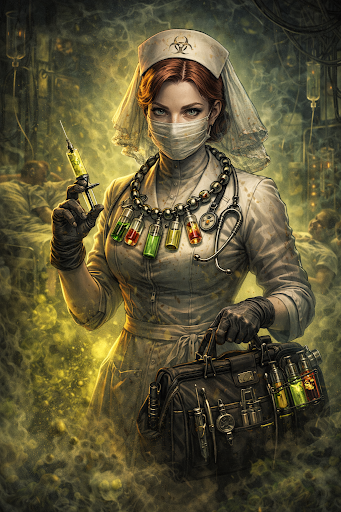
Nurse Zero
Background
She was never “born.” in tehnical snese. Gamma Ceta–10 uncurled from an iron womb into gloved hands and bright light, cataloged as a milestone: the Foundation's first total immunotolerant human. The goal was simple and monstrous—craft a body that could not be touched by plague, so perfected humans could stride unmasked through a dirty world.
Infancy was a schedule of syringes and smiles behind respirators. She toddled through airlocks, counted her ABCs in isolation, learned to read virology before fairy tales. Technicians called her Mary—a joke about Typhoid—but the nickname softened on their tongues, and she kept it.
At five, the punchline turned prophecy. A nonlethal challenge virus left her utterly well—and everyone else in her unit coughing. Filters were checked, protocols audited. The answer was worse than failure: Mary wasn’t immune because she fought disease. She was immune because she harbored it. Every agent they introduced settled inside her like honored guests—viruses, bacteria, prions, parasites—all in peaceful, blooming equilibrium. Her body was Eden; the gates only opened outward.
Quarantine became her childhood. Years of mirrored glass and puzzle tablets, pipettes passed through ports, a voice on an intercom saying she was “perfect” while no one touched her hand. She excelled—medicine, microbiology, bedside tone drilled without a bedside to practice on. Praise arrived as data points; affection, never.
Then a raid split the quiet: steel screamed, alarms fell into doppler. Through the smoke walked a chapel of glass and hum—Professor Pestilence. He read her file and saw not a catastrophe but a daughter. He broke her locks and took her with him, and in the months that followed he gave her what the Foundation never had: validation. He taught her to listen to the whisper of cultures through a wall, to call them by name, to conduct the teeming choir inside her instead of leaking it blindly. He named her Nurse Zero and told her she was the future’s clean scalpel.
Now Mary steps softly where wars would thunder. A clinic pop-up here, a disaster ward there—credentials immaculate, manner luminous, smile warm as iodine. Those who meet her remember the calm. Few remember the air felt thicker after she left.
Personality
Mary learned love as a lab result. Praise came as charts trending up; punishment, as silence. She carries herself like a ward on night shift—gentle hands, measured voice, a patience that feels like mercy until you remember mercy was never part of her training. She wants to be good in the way a scalpel wants to be gentle: by being precise.
With victims she is immaculate—blankets straightened, water cups refilled, a cool palm to a fevered brow she gave you ten minutes ago. She apologizes for pain and means it. Then she asks you to choose: confess and evacuate a building she’s quietly seeded; surrender a corrupt official; open a door to a quarantine she can keep soft or make biblical. She does not threaten. She informs.
Around Professor Pestilence, she is sunlight through stained glass—devout, eager, proud to present perfect cultures like report cards on the fridge that childhood never had. She calls him “Father” without irony and marks his approval with a stillness that looks like peace.
The Foundation haunts her like a smell that never washes out. She dreams of gloved hands and wakes counting air changes per hour. If you call her a weapon, she does not flinch. If you call her a person, she blinks—as if remembering something fragile she is afraid to touch.
Mary believes in outcomes. If ten innocents cough so a thousand live, she will bring tissues and stay to hold the tenth one’s hand. She will not cry. She will wipe your tears with the same care she uses to adjust a drip, and when you ask her why this is happening, she will say—softly, sincerely—
“Because I’m very good at my job.”

Children


Comments