

Reading the Map
Maps within the New Frontier follow similar principles to those found in the Traveller Core Rulebook (version 2022), however there are some differences, and those will be covered in this modified and condensed version of the World Creation section of the Core Rulebook.
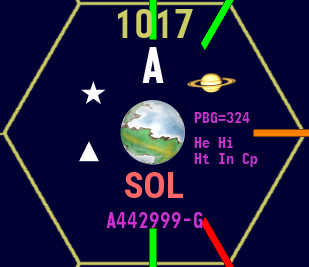
Here we see a sample system 1017 'Sol'. There are certain elements:
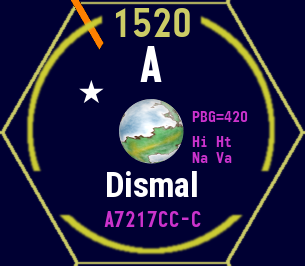
For some zones with a heightened level of danger (often systems with extremely authoritarian governments, particularly dangerous civil wars or virulent plagues). Will be labelled amber zones. In frontier space, this definition can be extended to include worlds that are lethal to the point of certain death but lack some sort of interdiction. Amber zones will have a yellow ring around the system.
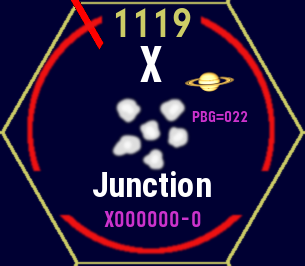
The rarest classification, red zones are reserved for systems that are under active interdiction either by the interstellar governments, star systems themselves, or some automated defensive system. Travellers moving into the system will in the best of circumstances be interdicted, turned around and forced to leave as soon as practical, often they will be detained and interrogated first. Less forgiving actors will outright have kill on sight orders for any intruders. Red zones will have red rings around the system.
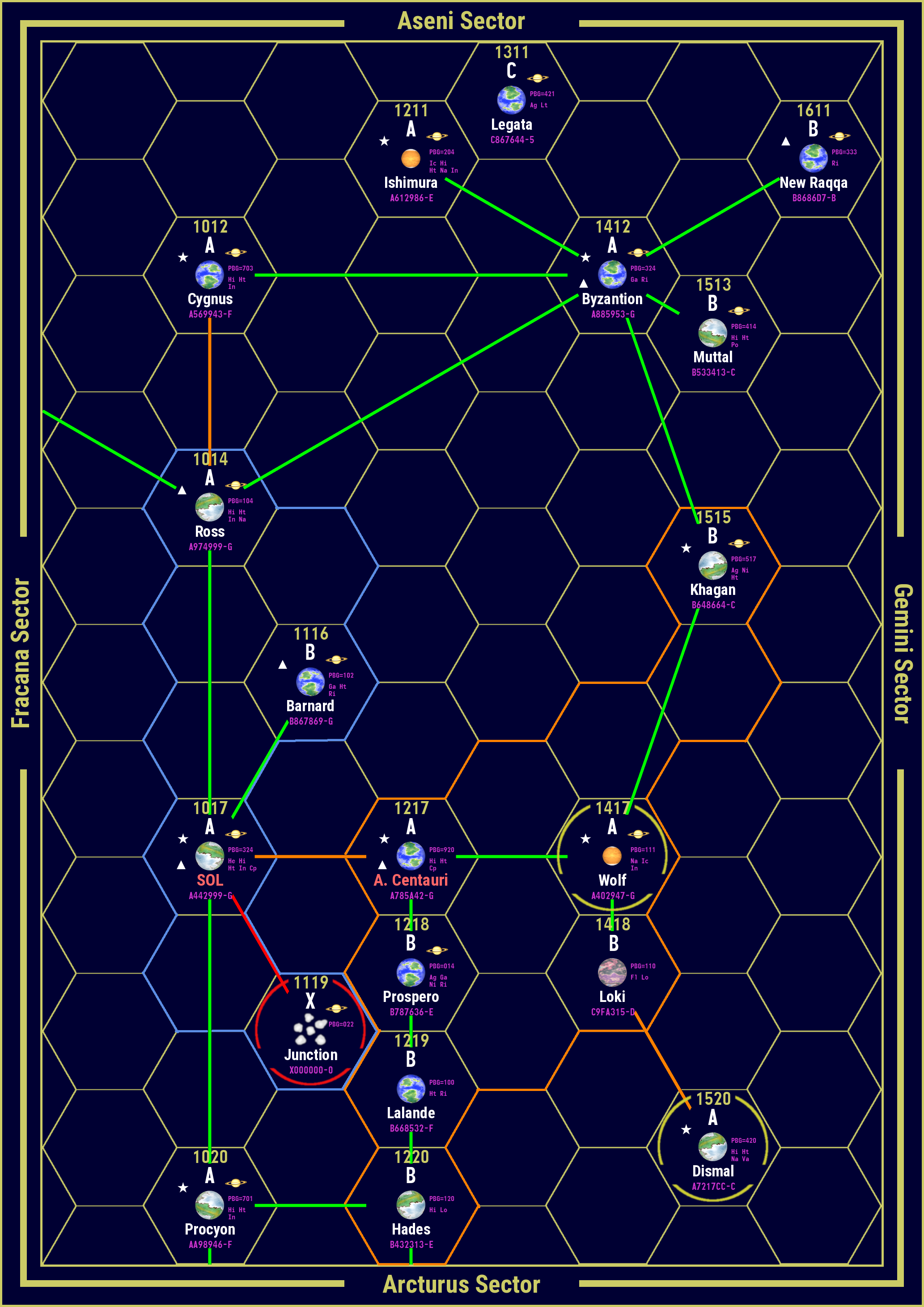
Here we see an example sector, the Sol Sector On a sector map, each hex represents roughly one cubic parsec of space.
Rimward - The “down” direction is reserved for the Rimward orientation. Rimward means towards the edge of the galaxy.
Spinward - The “left” direction is reserved for the Spinward orientation. Spinward means along the spin of star systems in their orbit of the galactic center (and likely Sagittarius A*).
Antispinward - The “right” direction is reserved for the Antispinward orientation. Antispinward means counter to the spin of the galaxy around the galactic center.
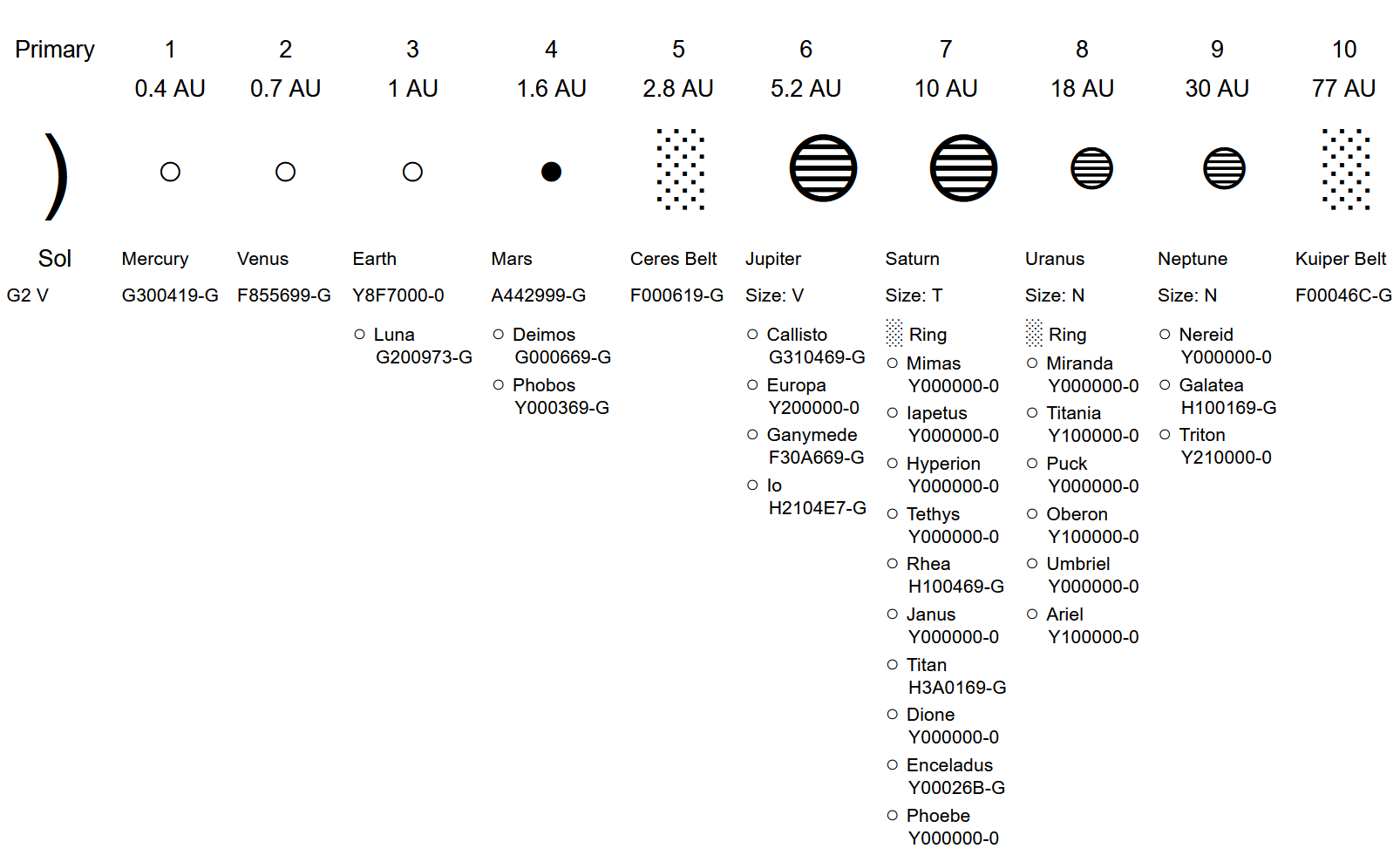
System maps are broadly available for any system in the galaxy, though only a handful of extremely important star systems will have as detailed system maps as those of the Sol System. A star system chart will have the main stars listed by stellar type, and the names, UPPs, and rough orbital distances and positions of every noteworthy body within the system. However, especially in frontier sectors, many bodies, including almost anything within a system’s Comet Belt, Oort Cloud, and many particularly small and empty moons and planetoids will not be noted on Guild maps, except for those intended for use by most dedicated astrographers.
Surveying the Stars
The star charts seen within the New Frontier are generated through the tireless efforts of the Galactic Surveyor's Guild, a powerful nongovernmental organization that took over responsibility from the Stellar League’s Office of Charting and Astrogation during the Long Night. The Guild uses a standardized system that was originally based upon the League’s old star charts, however, it has with time switched over to a more “universal” galactic chart that plots Sectors relative to Sagittarius A* rather than to Sol. However, in practice the “universal star charts” are still reliant on the location of the limited area of the galaxy that humanity has explored and settled relative to the greater size of the galaxy.Star Systems
Open for Sample Image by Javak
Here we see a sample system 1017 'Sol'. There are certain elements:
Astrogation Number
At the top of each hex with a relevant system, there is a number. This is the astrogation number of the system relative to the sector, and the sector cluster, which are themselves scaled to the system’s location relative to Sagittarius A, the supermassive black hole at the center of the galaxy. This will be covered in greater detail in the sector and sector cluster sections of this article.System Name
Below the icon of the primary planet in the system is the system’s name. In most star systems, especially those in the Frontier this will typically be the name of the Primary World, but the name of the primary star is often used as well. In rare cases may have a name entirely disassociated with the primary world, or the star.Starport Type
Of note to most people travelling the stars, the letter right below the astrogation number represents the type of Starport in service around the primary world of the system. Starport types and what services are provided at the starport are mentioned in The Universal Identification System article.UPP
Underneath the system’s name is the UPP of the mainworld. More information on the UPP can be found in the UIS article.Trade Codes
The most important trade codes (up to five) are displayed on the to the right of the planet’s icon. Those trade codes and what they mean can be found on a searchable table in the Trade Classifications article.PBG Code
Located above the trade codes is the PBG Code. This indicates the number of secondary non-moon Planets (P), secondary planetoid belts (B), and gas giants (G) that are present in the system. PBG codes generally don’t note the presence of moons, planetoids that are part of larger belts, or stellar bodies that are unpopulated and deemed economically unviable, or otherwise uninteresting except perhaps for some astronomic or other limited academic interest.Facility and Giant Symbols
These symbols can appear if a system has the requisite facilities or stellar bodies. On the left side there are two possible symbols, a star is present if the star system has a major naval base present, one that can handle the refitting of capital ships. If there is a triangle present there is a significant facility for the Galactic Surveyor’s Guild, typically this is a Guild base, though it could also be a larger Guild Waystation. On the right side the presence of a small planet icon with a ring indicates a gas giant that can support field refueling of spacecraft. Almost always a system with gas giants will have this symbol, but in certain, rare cases none of the present gas giants will be capable of refueling spacecraft and will lack this symbol.Travel Zones
The Galactic Surveyor’s Guild issues a few different travel codes representing different levels of caution one should take travelling to or from a system.Green Zones
Most places in the galaxy are considered green zones. These places are deemed mostly “safe” to travel to, or at least not especially dangerous. Green zones will not have any rings around the system.Amber Zones
Open for Sample Image by Javak
For some zones with a heightened level of danger (often systems with extremely authoritarian governments, particularly dangerous civil wars or virulent plagues). Will be labelled amber zones. In frontier space, this definition can be extended to include worlds that are lethal to the point of certain death but lack some sort of interdiction. Amber zones will have a yellow ring around the system.
Red Zones
Open for Sample Image by Javak
The rarest classification, red zones are reserved for systems that are under active interdiction either by the interstellar governments, star systems themselves, or some automated defensive system. Travellers moving into the system will in the best of circumstances be interdicted, turned around and forced to leave as soon as practical, often they will be detained and interrogated first. Less forgiving actors will outright have kill on sight orders for any intruders. Red zones will have red rings around the system.
Sectors
Open for Sample Image by Javak
Here we see an example sector, the Sol Sector On a sector map, each hex represents roughly one cubic parsec of space.
Cardinal Directions
Coreward - On guild standard charts the “up” direction is reserved for the Coreward orientation. Corward means in the direction towards Sagittarius A*, the supermassive black hole at the center of the galaxy.Rimward - The “down” direction is reserved for the Rimward orientation. Rimward means towards the edge of the galaxy.
Spinward - The “left” direction is reserved for the Spinward orientation. Spinward means along the spin of star systems in their orbit of the galactic center (and likely Sagittarius A*).
Antispinward - The “right” direction is reserved for the Antispinward orientation. Antispinward means counter to the spin of the galaxy around the galactic center.
Star Systems and Astrogation Codes
Star systems that can successfully be navigated to will be marked on the map. There is a host of information on these marked hexes which will be further detailed in the Star Systems section. Of import here is the location code which is a 4 digit code marking a system’s place in the sector, and in the sector cluster. Each sector is eight parsecs along the spinward and counterspinward orientation and ten from the coreward to rimward direction, and therefore there will be eighty possible codes for each sector ranging from 0101 to 2440 depending on where in the sector cluster a specific sector is. While it is possible for multiple star systems to occupy the same parsec, typically only the most important will be marked on star charts.Empty Hexes
In addition to “populated” hexes, there will usually be a number of empty hexes that exist on a map. This usually means that there is no star system present. However, that does not preclude the existence of the vast multitude of interstellar comets, rogue planets (even rogue gas giants), brown dwarfs (sometimes even with their own planetary systems), or even “hermit” red dwarfs (those without planetary systems of note). “Crone Systems” those around stellar core remnants such as white dwarfs, black dwarfs, neutron stars, pulsars, magnetars, and even black holes, can also be found in “empty hexes”. Very often these objects are not recorded on star maps meant for common use because these systems are often dangerous to navigate to, within, or from, especially in the case of pulsar, magnetar, and black hole “Crone Systems”, making discouraging travel a necessity. Also not included are areas where a star system exist, but far enough away from the galactic disk on the Z-axis to be risky to try and jump to.Jump Gate Lanes:
Jumpgate lines are thick, colored lines in between star systems. The represent the Jumpgate network, largely built and maintained by the Galactic Surveyor’s Guild. Transiting through the jumpgate network reduces jump time to one day per jump, and reduces fuel consumption by half to a minimum of a J-1 equivalent usage of fuel. Most Jumpgates will be represented by green lines. These represent gates that are functioning normally. Lines that are orange represent lines under increased scrutiny. Usually this represents an interstate boundary with enhanced customs controls on either side of the gate. Red lines represent interdicted gates, due to the influence of the Guild these are relatively rare even between hostile states, but do exist, particularly in state managed gate networks. Passage through red gates is largely not possible for most people, with unauthorized personnel typically interdicted before or after jumping through an interdicted gate.Borders
Each boundary of a sector has a name associated with a neighboring sector assigned to it. This mark the outside boundaries of each individual sector of explored space. In Civilized Space, there are additional, national boundaries. As interstellar states begin to form, these boundaries are eventually plotted out and marked by guild ships. In sectors with interstellar states, their borders will be marked with colored lines along each of the border hexes that are claimed by a state and their capital world will be noted with a red text name, where two states share borders, their lines will be directly side by side sharing hex boundaries rather than free floating in unclaimed space. In some rare cases states borders traverse sector boundaries, these are marked by "open" borders on a sector map.Within the Star System
Open for Sample Image by Javak
System maps are broadly available for any system in the galaxy, though only a handful of extremely important star systems will have as detailed system maps as those of the Sol System. A star system chart will have the main stars listed by stellar type, and the names, UPPs, and rough orbital distances and positions of every noteworthy body within the system. However, especially in frontier sectors, many bodies, including almost anything within a system’s Comet Belt, Oort Cloud, and many particularly small and empty moons and planetoids will not be noted on Guild maps, except for those intended for use by most dedicated astrographers.

Comments