Tugarin (tʊˈɡarʲɪn)
The Tugarin are an ethnic group of the Zmei who occupy the coasts and lowlands of the island of Buyan. Once spread across the Northern and Northeastern Regions, they were driven from their homelands when the Clarati destroyed Muria. Along with the Balaur, they sought refuge on the strange, vanishing island of Buyan, where they founded the mighty Chudoruhs Empire. The Tugarin have since adapted to their unusual new home, with its otherworldly wildlife and newborn gods. They are especially renowned for their devotion to the Konvetra, the bird-horses they domesticated. Any Tugarin of note is expected to be skilled in riding the Konvetra, and the discussion of their bloodlines and qualities remains a matter of great importance.
Physical Appearance
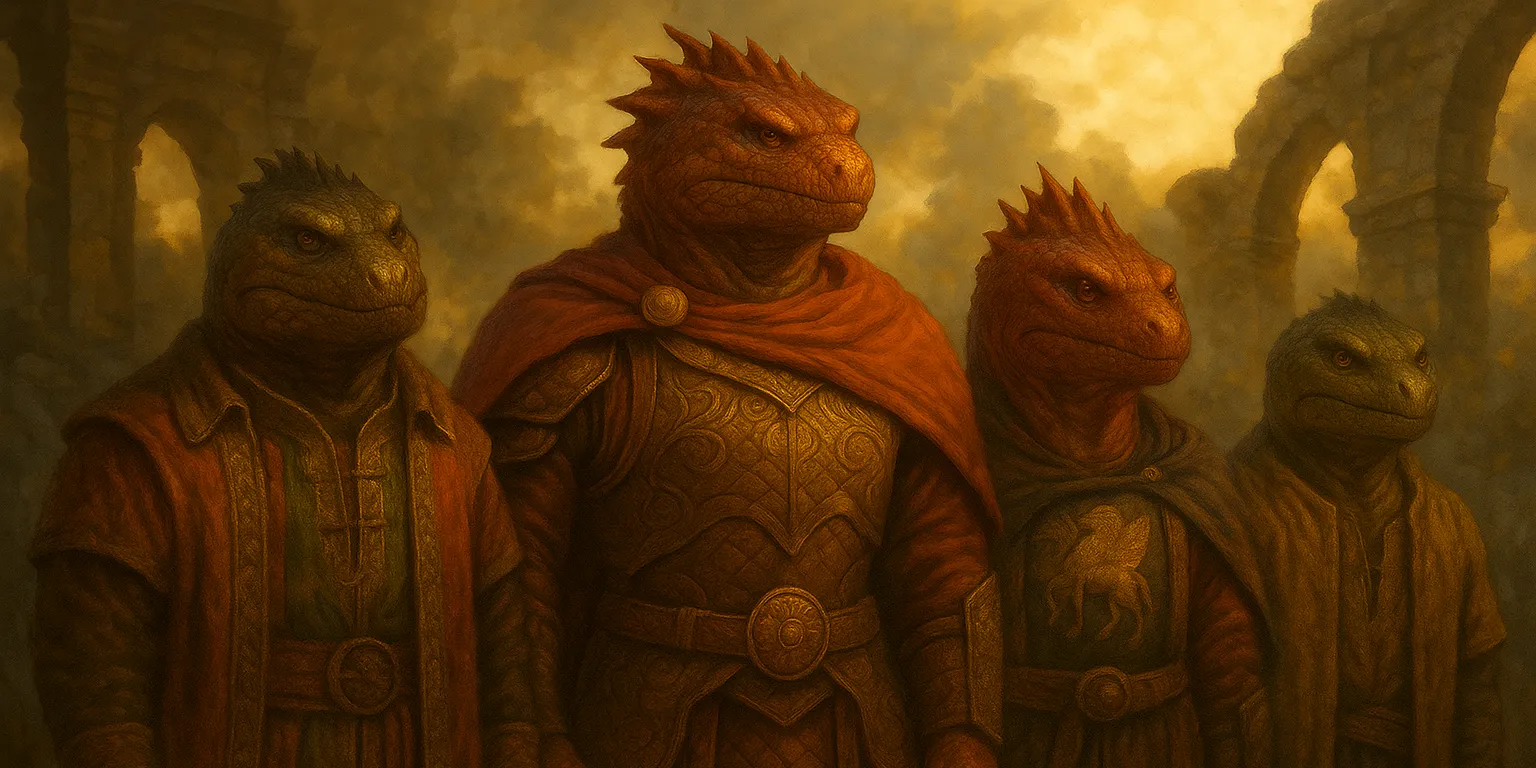
Like all Zmei, the Tugarin are reptilian in nature, with scaled skin and bright, piercing eyes. They particularly prize a draconic appearance. According to their founding myths, their ancestors were gifted a fiery nature by the dragon-god Gorynych, making them more dragon-like than other lizardfolk. Their scales range from olive green to shades of red and orange, and it is not uncommon for a Tugarin to bear a crest of small red feathers running along the crown of the head. They are generally shorter than other Zmei, averaging about 5'5" in height, but their compact builds are notably powerful - many Tugarin are renowned for their exceptional strength.
Common Dress & Style
Tugarin clothing is designed to fully cover the body, as garments that reveal the skin are considered indecent for all members of society. Outfits are typically cut to conceal the figure without being overly wide or voluminous - wearing clothing that displays a fine figure is seen as vain, and only the most powerful or most attractive can carry it off without censure. Fur is used extensively, especially in higher-class attire, serving as both lining and trim. Bright colors are favored, and owning garments in a wide variety of shades is regarded as a mark of wealth and status.
A typical outfit consists of a long shirt and belted trousers, with the trousers tucked into boots or wrapped in cloth around the lower legs. Wealthier individuals may add layers, such as a second shirt or a vest. An outer garment called a svita is commonly worn: it is pulled over the head, belted at the waist, widens toward the hem, and typically falls to the knee or mid-calf. For added warmth, or to protect fine fabrics, a cloak or cape may also be worn.
Jewelry is uncommon among the Tugarin and is worn primarily to signify affiliations or notable achievements. Rings, bracelets, necklaces, or brooches are typically bestowed as marks of belonging to a powerful family or as tokens of victory in battle - serving much the same role as medals in other societies. To wear jewelry is to make a statement about one’s personal status and history, and to wear all of it at once is an unmistakably bold declaration. More often, a Tugarin will wear only a single piece, or none at all, unless it directly pertains to the occasion for which they are dressing.
Social Structure
In most Zmei cultures, the communal nest is the foundational unit of society, and the Tugarin are no exception. In Ostrov, the community built around a shared nest is called a gnezdivo. A person is hatched into their gnezdivo and never leaves it willingly; while exile is possible for the most grievous crimes, it is considered more merciful to execute a Tugarin criminal than to sever them from their nest.
Different gnezdiva occupy different ranks in society. The highest are the noble gnezdiva, whose members rule the empire. Below them are the merchants and tradesfolk, and at the bottom of the hierarchy are the Pravo - peasant gnezdiva bound to the land they inhabit and work. While Pravo cannot be bought or sold directly, they are considered legally tied to the land, which itself may be sold by Tugarin of the higher classes.
Culture
Major language groups and dialects
Foods & Cuisine
Tugarin cuisine relies primarily on fish and other seafood, supplemented with game. Zmei require a diet high in meat - not strictly obligate carnivores, but unable to thrive on a purely vegetarian diet and needing more meat than humans. Soups and stews are especially favored. A classic Tugarin dish is Hyuka, a clear fish soup made with a variety of fish such as bream, catfish, and pike. It is seasoned with black pepper, saffron, nutmeg, and fennel, and may also include root vegetables to balance the abundance of seafood. Hyuka is often served with dumplings stuffed with perch, burbot, or eel, which diners may either float in the soup or enjoy separately.
Related Articles
This article was originally written for Spooktober 2024. You can find all of my Spooktober Articles at Spooktober Central.
This article was originally written for Spooktober 2023. You can find all of my Spooktober Articles at Spooktober Central.

I really love the section about garments and jewellery. Fascinating insight into their culture.
Explore Etrea | WorldEmber 2025
Thank you!