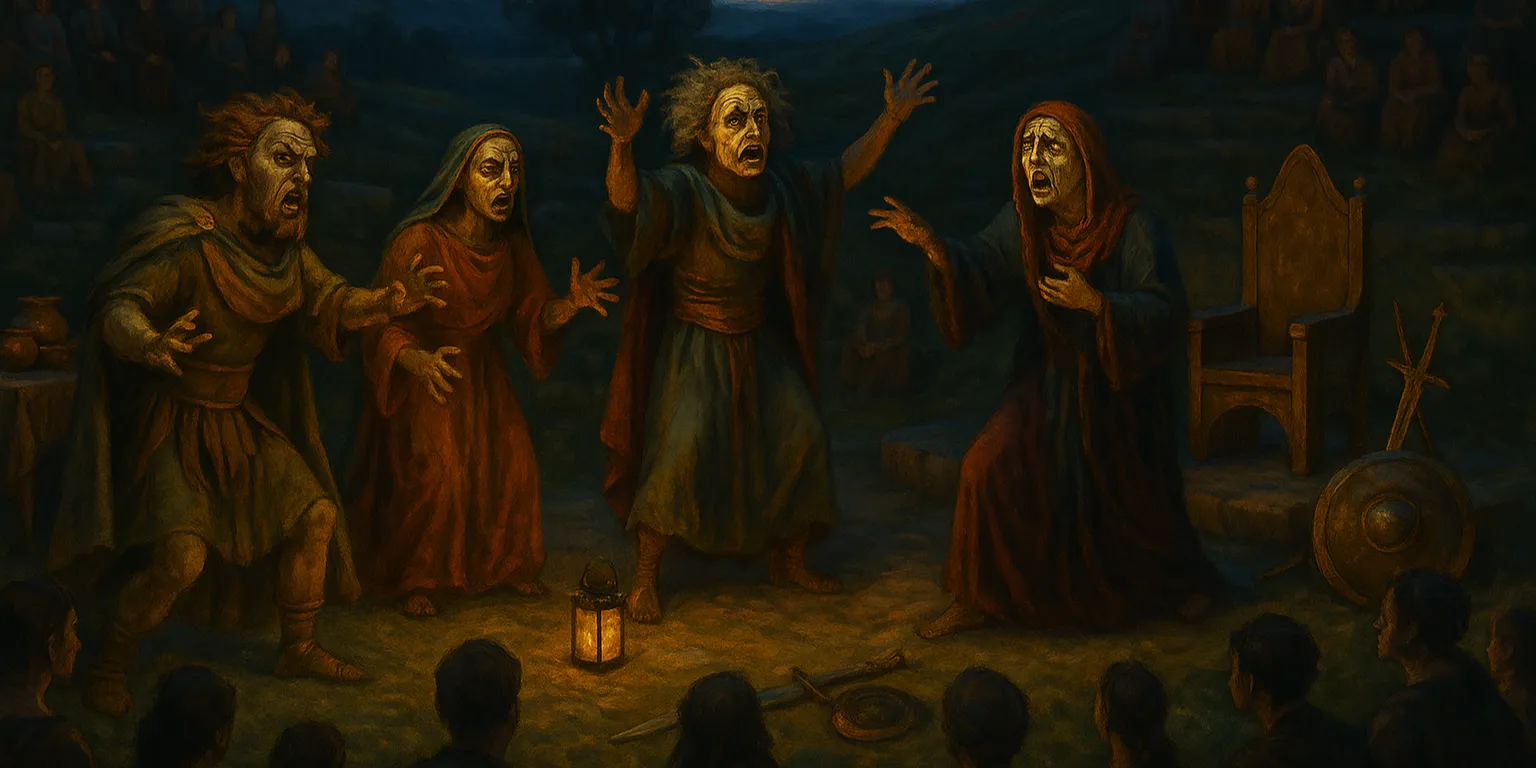
The Tale of Xantates
The Tale of Xantates is a popular play, written by the great playwright Dionýsios Ephýdris and often performed by Masker troupes. It draws upon the life of the famed King Xantates of Chalkós, renowned for his warlike spirit and immoderate love of battle. In the play, Ephýdris depicts Xantates as so consumed by warfare that he neglects his religious and civic obligations - ignoring sacred feasts and holy days, and compelling his soldiers to do the same. In the opening lines, the chorus proclaims how his virtues have soured into vices through excess, leaving his heart bankrupt in the relentless pursuit of courage and glory.
Summary of the Tale
In the first act, Xantates consults the Oracle of Dirfyos on Macris, seeking guidance for his next campaign. Instead, he is warned that his immoderation will bring about his ruin, and that he must learn balance in all things. Scorning the Oracle's counsel, Xantates returns home to find guests - neighboring kings who have come to speak of peace, and whom his wife has welcomed to celebrate the feast of Kērialia, the bawdy festival of the Kaphtori that honors the passing of The Candles overhead. He enters into a scene of raucous merriment, only to be enraged by the presence of the other kings and their talk of peace. In fury, he drives them from his hall with a scourge, hurling imprecations at both his guests and his household for their revelry and for the emptiness of its meaning. Yet when at last all have been cast out, he finds himself confronted by the gods of Chalkós - for in violating the sacred laws of hospitality, he has provoked their wrath.
The second act opens as the gods pronounce judgment upon Xantates. He is condemned to wander in dreams and madness until he learns the value of moderation. Stripped of his finery, he is cast into the Dreamlands, where reason yields to impulse and excess. There he must pass through strange and perilous realms, encountering figures and landscapes fashioned to humble him and lay bare the folly of his ways.
In the first dreamland, he finds himself upon the battlefield. At first he believes this no punishment at all, for it is the place he most loves to be. Yet he soon discovers that this battle can never end. The soldiers, though maimed and slain, rise again from the blood-soaked earth to strike at whoever stands near. No sides remain - or if they once existed, they are long forgotten. Xantates is struck down again and again, unable to distinguish friend from foe, for there are none. Among the chaos he meets several generals from his youth, the very men who first taught him to love war. They have been condemned to this field for their own immoderation. They tell him he may yet escape, for he is not dead, but they are bound to this endless struggle until they fade from all memory - even their own. "War is a noble pursuit," they cry, "but in excess it is emptied of meaning, of glory, and of honor." Xantates breaks into madness at their words, flinging himself across the stage until at last he is seized by a mighty current and swept into a great river, borne deeper into the Dreamlands.
When he emerges from the river, bloodied and battered, Xantates is astonished to find himself before his own hall. He believes the horrors of the battlefield have bought him mercy. Yet when he enters he is a ghost among the living: he hungers and cannot eat, thirsts and cannot drink. Voices are distant and unrecognizable; he sees kin and retainers singing and feasting, but cannot hear them, touch them, or share in any comfort of home. Most damningly, his household does not miss him. When his name is spoken it is only to note that he has long been absent from their celebrations - or, if he has appeared, that he spoiled the mirth. The feast ends and the guests disperse; Xantates is left alone upon the stage to contemplate his fate: "I am shade among the living, and none will spare a prayer for my spirit, nor mourn at my grave."
In the next act, Xantates leaves the empty dream of his home and sets out to find the gods, seeking pardon for his transgression. He discovers that the paths of the world twist beneath his feet, and he cannot choose his own course. Instead, the road delivers him to the mountain of Dirfyos, to the chamber of the Oracle. There he finds the kings he had driven from his home, gathered together to consult the Oracle. They discuss their plans for Chalkós - how the insult Xantates has paid them is more than they can bear, and how they intend to unite to overthrow his kingdom and claim all within it.
Once again, he is a ghost among them, unable to address their threats. The Oracle delivers their prophecy, foretelling doom to Xantates and his kingdom should they march together against him. Xantates wails as the kings depart, lamenting that all his life's work is undone, that his warlike ways have preserved nothing, and that all is lost. The Oracle watches him impassively, then critiques his life, showing how his immoderation and folly have brought him to a state worse than nothing - a destroyer of his own line and people. From the shadows, the gods of Chalkós emerge, silently reinforcing the Oracle's words.
Then the Oracle offers Xantates a choice. A single coin is presented - one that can purchase an hour stolen from eternity, to be relived once more. The gods, for reasons of their own, have granted Xantates a second chance. He may spend the coin to return to the moment before he violated hospitality and make a different choice. His punishment will be but a dream, fleeting and fragile. If he is changed, he can save himself and his kingdom. If not, doom is eternal.
Xantates accepts the coin and swears he will change. In a moment, he awakens outside his house. Though his memory of the dream is uncertain, he feels its importance. At first he is enraged by the scene of ribald revelry, but he masters himself and greets his guests instead. The play closes with him joining the festival, offering the hope that his transformation may endure beyond the span of a single dream.
Xantates in Performance
Part of what has made The Tale of Xantates such a lasting favorite is the spectacle created when it is performed. The Maskers lean fully into every scene - from the bawdy, ribald festival to the gore of the battlefield, and the long, lamentful wails of the cursed king. In many performances, these scenes are interspersed with music and dance numbers, which can last longer than the text of the play itself. Troupes capable of producing the most spectacular and lurid effects often gain fame for their efforts, and the play’s popularity ensures that every player knows at least a portion of Xantates, making it easy to stage with new members. The Tale of Xantates has been performed more or less continuously since its composition and has been adapted to dozens of cultures and languages. It is one of - or perhaps the most - well-known plays in the Great Ring.
Related Articles
This article was originally written for Spooktober 2024. You can find all of my Spooktober Articles at Spooktober Central.
This article was originally written for Spooktober 2023. You can find all of my Spooktober Articles at Spooktober Central.

Sounds like a play that would be quite enjoyable to watch. Reminds me of The Christmas Carol, a little.
Explore Etrea | WorldEmber 2025
I was definitely inspired by the Christmas Carol for this.