Tears
In the practice of Alchemy, materials must be imbued with a specific mystical resonance, one unique to the alchemist and derived from their nature: their life experiences, cultural background, and inner essence. Substances are empowered in part by their Association with the concepts and ideas the alchemist finds significant. It is therefore unsurprising that tears are a useful component in the formulae of most alchemists.
Tears may be harvested from a wide variety of creatures, at different ages and under differing circumstances. The precise conditions under which the tears are shed are of particular importance, for these details determine their exact properties in the hands of an alchemist. Such circumstances shape the associations the alchemist forms with each teardrop, and it is these associations that render them potent in the creation of formulae.
Three Types of Tears
While the circumstances under which tears may be shed are without number, it is common among Alchemists to sort them into three broad categories based upon their origins. The first category is the mundane: tears shed by creatures without supernatural qualities, such as most sapient races, animals, or the occasional plant or stone which may be said to weep.
The second category is the supernatural: tears shed by beings possessed of inherent mystical nature, including gods, spirits, and monsters. Such tears are typically saturated with potent resonance even before the alchemist imposes their own associations upon them.
The final category is the alchemical, sometimes called the symbolic tear. These are not shed by any living creature, but are instead concocted by the alchemist themselves. They are intended to represent tears within a particular metaphysical or symbolic framework, and derive their efficacy entirely from intent, ritual, and conceptual precision.
When preparing a formula, the alchemist will select one or more of the tears available to them, guided by the properties each possesses and the associations they are meant to evoke.
Mundane Tears
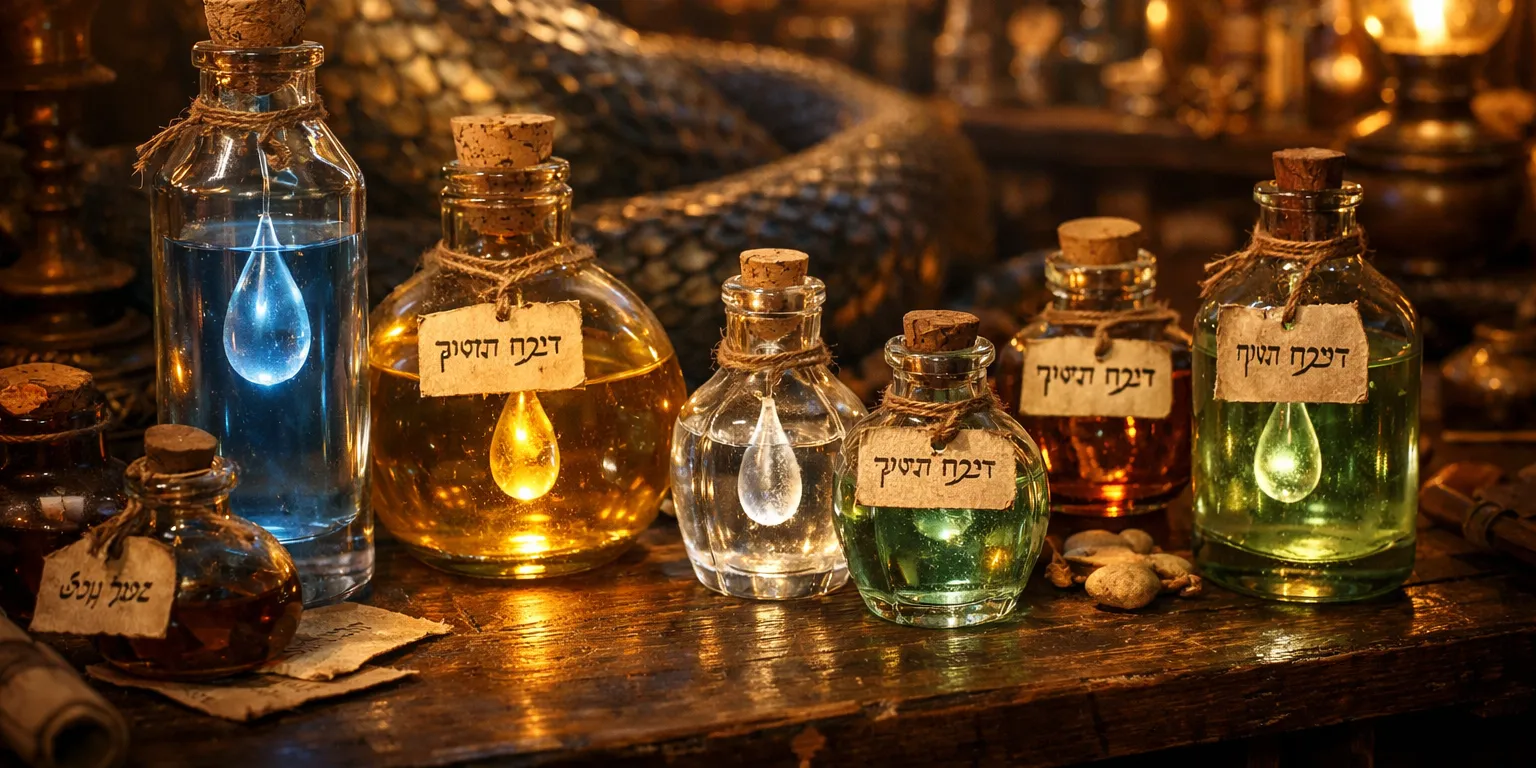
Mundane tears are the easiest to acquire, and thus the most commonly employed. They may be harvested from any creature capable of shedding tears, under whatever circumstances they might do so. An alchemist may possess hundreds of small vials of tears within their laboratory, each carefully labeled with the precise conditions of its origin. While the idiosyncratic nature of Alchemy makes it impossible to catalogue all of their potential applications, the following represent some of the most common varieties of mundane tears and their typical uses.
- One's Own Tears: The most common and most easily acquired of all are the tears of the alchemist themselves. These are typically evoked through a Nadā al-Dam, or "The Call of Tears," a mantra unique to the alchemist and designed to reliably induce weeping. Such tears are rarely stored, and are instead produced as needed. They are particularly useful for limiting the effects of a formula to the alchemist alone, preventing its use by others.
- Child's Tears: Harvested from children, particularly infants, these tears are relatively easy to obtain, though doing so may occasionally result in social awkwardness. They are most commonly employed in the creation of wards and protections, and many alchemists rely upon them to deter hostile intent from their homes and laboratories.
- Crocodile Tears: Though mundane in classification, the tears of crocodiles are far less simple to acquire than those of children. Alchemists frequently hire the brave, the desperate, or the foolish to procure them. Crocodile tears are most valued in formulae concerned with deception, falsehood, and the weaving of glamours.
Supernatural Tears
Tears shed by supernatural beings are far less common, and thus are rarely integral to the everyday work of an Alchemist. When they can be acquired, they are immensely valuable, and an Alchemist may pay handsomely for a vial, if its authenticity can be proven. Most supernatural tears are therefore relegated to the realm of theory rather than practice. Nevertheless, the following are among the most frequently discussed in alchemical texts.
- Manticore Tears: Shed by the terrible monsters said to stalk the Al-Kubra, manticores are known to impersonate the wailing of a child in order to draw the unwary close enough to strike. According to legend, when they mimic these cries they shed tears in great abundance, dampening both their manes and the ground beneath them. Should one succeed in acquiring the tears of a manticore and escape with their life, the substance is said to be extraordinarily potent in formulae intended to deceive. Those who encounter such workings are rendered exceptionally gullible and suggestible.
- Divine Tears: When gods weep, power is spilled into the world. There are exceedingly few accounts of anyone successfully gathering the tears of a divine being, and those that do exist generally describe the god deliberately offering their tears for a specific purpose. If such tears were introduced into a formula, they would almost certainly magnify its effects beyond ordinary alchemical limits.
- Dragon's Tears: If dragons ever weep, which seems doubtful, their tears would be hot enough to scald and nearly impossible to collect. Yet there exists a legendary formula, said to grant eternal youth and perfect health, that requires Dragon's Tears as a key ingredient. For this reason alone, seekers continue their futile efforts to discover a means by which such tears might be obtained.
Alchemical Tears
While mundane tears are the most easily obtained, many alchemists feel that symbolic tears more truly capture the essence of their art and are therefore the most useful in the metaphysical pursuit of Alchemy. These preparations often incorporate mundane tears, blended with other substances to enhance their alchemical qualities. Below are some of the most commonly discussed alchemical tears.
- Alkahest: Also known as the Tears of Dissolution, alkahest is blended from a number of materials, including tears of grief, and possesses the ability to unbind and dissolve all substances. It must be handled with extreme care, as only enough of the solvent should be produced to accomplish the task at hand and then be expended, lest it dissolve the vessel containing the reaction, the table upon which it stands, and anything else nearby. It is also imperative that alkahest be kept cold at all times, for allowing it to vaporize has immediate and disastrous consequences for anything in its vicinity. Some have spoken of immortal Alkahest, which will dissolve without ever expending itself, but this has never been produced, as attested to by the continued existence of the physical world.
- Essence of Catharsis: These tears are idiosyncratic even by the standards of Alchemy, and there is no recipe that can be used more than once. Each must be tailored to the individual for whom it is crafted, as they are at the very moment the formula is prepared. The Essence incorporates the tears of its intended recipient and unlocks faculties of profound inner change. Many believe they will undergo great improvement after consuming it. Certainly, those who do so have their personalities radically transformed by the experience, and often seem like entirely new people. The Essence frees them from their former selves and allows a total reconfiguration of mind and spirit. Whether this outcome is beneficial remains a matter of intense debate among alchemists.
An Idiosyncratic Art
While Alchemy is best known for the magical formulae it produces, this is not why alchemists practice it. To the alchemist, the formula is not the goal; it is merely a means of testing and revealing their understanding of the self. Alchemical work is profoundly dependent on context, including the individual identity of the practitioner.
To achieve a successful formula, each procedure and component must be in harmony with the alchemist themself, requiring a deep and often difficult understanding of one's own inner truth. No alchemist can simply reproduce the formulae of another by copying the same process. Each must use the techniques of Alchemy to discover a personal path, one that only they can walk.
You can read more about the metaphysical art of Alchemy here:
Related Articles
This article was originally written for Spooktober 2024. You can find all of my Spooktober Articles at Spooktober Central.
This article was originally written for Spooktober 2023. You can find all of my Spooktober Articles at Spooktober Central.

Comments