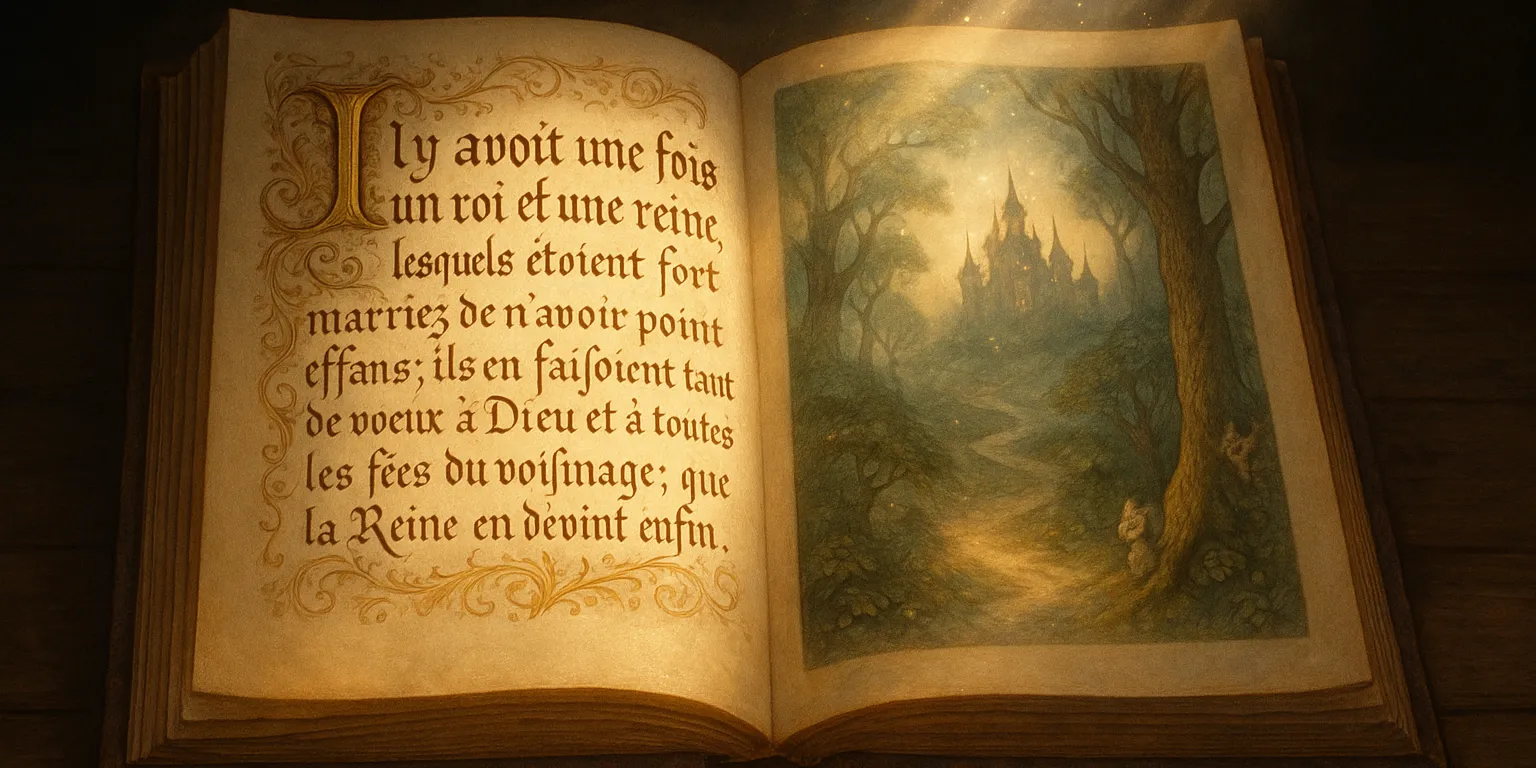
Princière
The language of Princière is unlike any other spoken around the Great Ring. Born from dreams, stories, and the experiments of the sorceress Celestina, it is used in the half-real Dolphin Islands and exists only to serve the narratives that shape that dreamland. Its grammar and vocabulary shift continually, changing to match whatever story is unfolding, and it appears in the minds of those seized by a narrative and pressed into its roles. No one ever learns Princière; it is pushed into the mind when an Invasive Narrative takes hold. Even after the tale ends, its words and phrases linger in the memories of those who endured it, leaving them more vulnerable than before to being drawn in again by the power of story. It is inspired by French - specifically the French of Madame d'Aulnoy.
Dialects
Princière has several dialects, although they are tied not to place but to story. Those drawn into a particular tale naturally adopt the appropriate dialect as the role imposed on them settles into their mind. Scholars of dream languages have found that these dialects do have names, yet they seem to arise from the Dream itself without reasons that make sense to anyone anchored in the physical world. There are hundreds of such variations, but the most common are known as Grimm, Perrault, and Lang.
Interesting Features
Princière is a language of power, with a variety of Folk Magic woven into it. This magic usually acts as a prison for the speaker; they find themselves able to say only certain phrases, respond in particular ways, and slip into the role the story has forced upon them. Yet those who understand both the tale and the language can use the small freedoms it grants to shift the narrative around them. Few stories are simple, with only one version or thread. They are tangled, branching structures that cross and loop, and at certain points the right word or silence can move the tale from one variant to another. By speaking a phrase, or withholding it, the speaker can narrow the path the story will follow to one that is less harmful to its characters. A villain might be exiled rather than torn apart by horses, or a step-sister who is not entirely wicked might be spared.
The pacing of the tale can also be influenced. In many stories shaped by Princière, repetition matters, especially in groups of three, and delaying that third repetition can buy time for the characters to find another branch the narrative could take. In the end, the story will conclude and the characters will meet whatever fate the tale demands, but careful use of the language can guide the ending toward one they can survive.
Related Languages
As a dream language, Princière is not related to other tongues in the usual sense, but because it rises from the collective mind it naturally borrows from many sources. It is most strongly influenced by Lingua Clara, the native language of Celestina, yet it also shows ties to Inselsprach and Amhran. It is not mutually intelligible with any of them, and while these languages contribute a few words and phrases, most of Princière is drawn from linguistic sources unknown to the Million Islands.
Naming Traditions
As with many aspects of Princière, the names of its speakers are fluid. They change as people are drawn into one story or another, and their identities are often absorbed into the roles they are made to play. In many cases they have no name at all, only a title such as King, Witch, or Woodcutter. At other times the names are simple, like Jack or Molly, sometimes paired with a descriptor such as Clever, Charming, or Wicked. In still other tales the names are more ornate, such as Printanière, Belle-Étoile, or Marcassin. Whatever name a person carries at a given moment is unlikely to be the only one they have ever held or the one they will keep in the future.
Writing System
Princière is written in the alphabet found in the books Celestina conjured it from, most notably the legendary "Histoires de fees et de dauphins". This system is related to that used by Lingua Clara but differs in subtle ways. Many characters carry unusual diacritical marks, and some letters are purely decorative, appearing in words without ever being pronounced. In The Dolphin Islands, or in other Dreamlands, this writing is ubiquitous, and encountering a sign or document in the distinctive font and spelling of Princière is a sure sign that an Invasive Narrative is at work.
Geographical Distribution
- "Il etoit une fois" - Once upon a time
- "Et ils vécurent heureux pour toujours" - They lived happily ever after
- "Ouvrez la porte, je vous prie" - Open the door, I beg you
- "Qui frappe a la porte" - Who knocks at the door
- "Gardez votre courage" - Keep your courage
- "Napprochez pas du bois sombre" - Do not go near the dark wood
- "Ne vous écartez pas du sentier" - Don't stray from the path
- "Que la fortune vous sourie" - May fortune smile on you
- "Craignez la sorciere" - Beware the witch
- "Le destin est en marche" - Destiny is in motion
- Printanière
- Belle
- Mariette
- Rose
- Clarine
- Amandine
- Lison
- Floribel
- Colette
- Mirelotte
- Marcassin
- Jack
- Bastien
- Reynard
- Percinet
- Jeannot
- Hans
- Lucaire
- Pierrot
- Milon
Related Articles
This article was originally written for Spooktober 2024. You can find all of my Spooktober Articles at Spooktober Central.
This article was originally written for Spooktober 2023. You can find all of my Spooktober Articles at Spooktober Central.




Fascinating language. I wonder what would happen if you really tried hard to learn it, or would that be completely impossible?
Explore Etrea | WorldEmber 2025
You would have to go to the Dolphin Islands to try - and then you'd be very likely to learn it, since you'd be snatched up by one of the stories to play a role. (I have plans for my players to experience just that scenario)