Loloto (loˈlo.to)
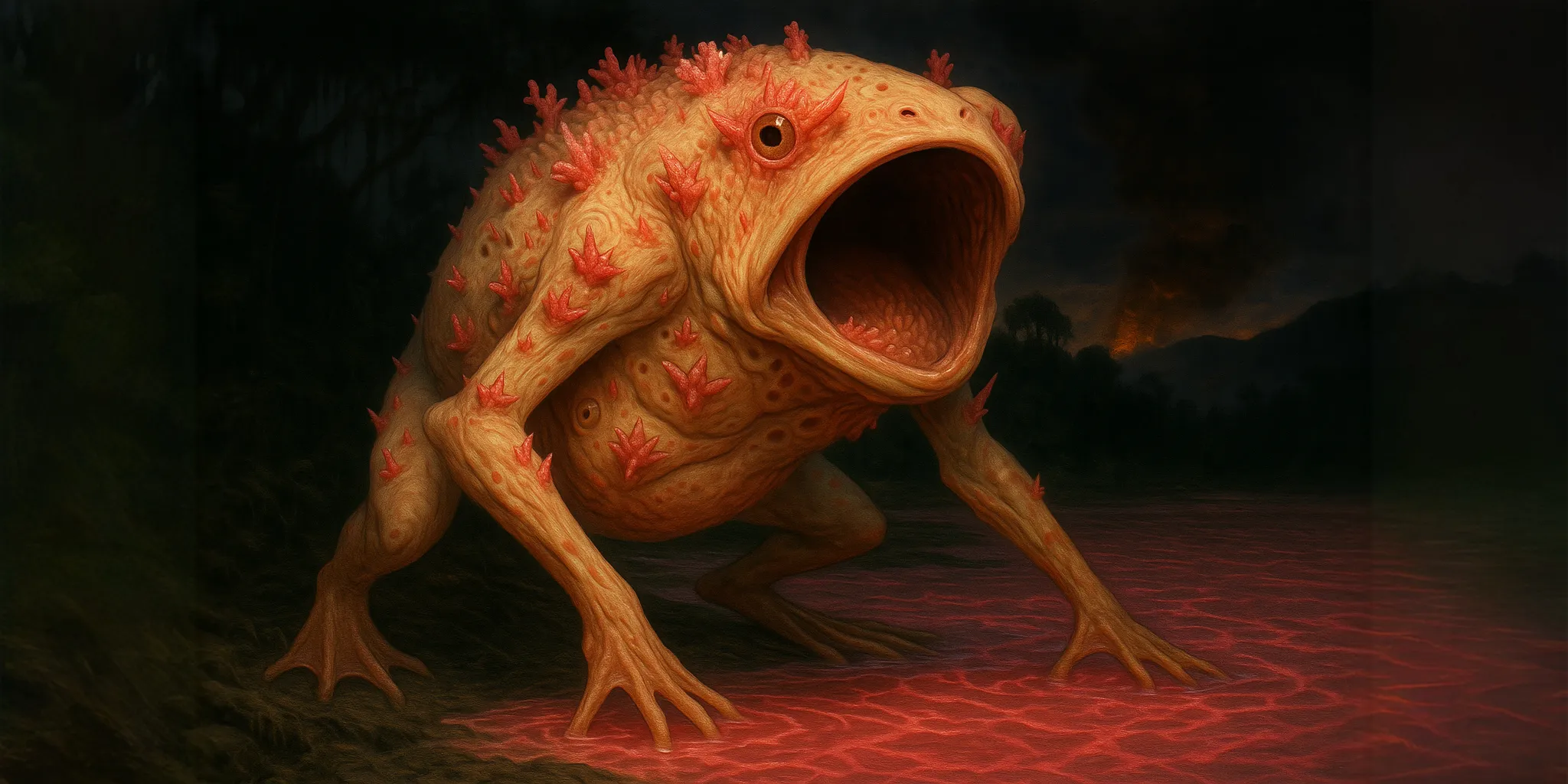
When Pinau and the Mu'o'a first came to Motu, they found a lush, verdant paradise - but it was not uninhabited. The island was ruled by a race they named the Loloto, who nearly ended the story of the Mu'o'a forever. Strange and dangerous, the Loloto could poison with a touch or belch a gritty cloud of dust that drove the Mu'o'a into berserk killing sprees. They did not speak, but instead communicated through eerie whistling noises that emerged from dozens of holes in their bodies, each one bursting open for the purpose before sealing shut again. Their skin could shift in color, though it was typically pallid and translucent, with red and yellow streaks that swirled and drifted across their flesh. When they chose, they could vanish into the jungle, shifting their hues to blend almost seamlessly with their surroundings.
Unwelcome Arrivals
There was never a moment of peace between the Loloto and the Mu'o'a. As soon as Pinau and his people landed, exhausted from their epic voyage, a Loloto struck. It drove the warriors into a fit of mindless rage, then seized Pinau's partner Va'aloloa and vanished into the jungle. When the frenzy passed, Pinau led a rescue mission, only to find more Loloto lying in wait. The Mu'o'a fled the monsters and nearly abandoned Motu altogether - but Pinau was determined to make the creatures pay. Instead, the Mu'o'a withdrew only as far as the nearby island of Ala'o'pinau, where they began to watch and learn the ways of their enemies.
Pinau would later state that the Loloto had been waiting for them to land - not by chance, but as part of an ambush prepared before the Mu'o'a even knew they would come ashore. This uncanny foresight became a recurring theme in the early days of the conflict: the Loloto often seemed to know where the Mu'o'a would be, even before the Mu'o'a themselves did.
Unnaturally Flammable
The Loloto ignored the weapons of the Mu'o'a, simply absorbing spears and clubs into their bodies and consuming them. But they proved strangely flammable, and once Pinau discovered this weakness, he and the Mu'o'a used it to devastating effect. They wrapped their spearheads with burning rags and hurled them at the Loloto, who would erupt into flames the instant the fire touched them. The black, noxious smoke of their burning flesh darkened the skies above Motu, and breathing it could sicken or kill. The war was fought during the dry season, and in their death throes the burning monsters often set the land ablaze. To ensure no camouflaged Loloto lay hidden in ambush, the Mu'o'a would set fire to the surrounding foliage as well.
Vaituloto Lolo
With fire in their vanguard, Pinau and the Mu'o'a advanced across the island of Motu. Consumed by grief at the loss of Va'aloloa, Pinau swore to destroy the Loloto at any cost - and the cost was high. Even armed with fire, the Mu'o'a struggled to overcome them. The Loloto would appear without warning from unexpected directions, seize one or more of the Mu'o'a, and vanish again before they could be set ablaze. At night, sentries would cry out and then be gone. Still, the Mu'o'a did not halt their advance, setting more and more of the island alight to protect themselves from ambush.
South of Papa Ahi, Motu's great plateau, they came upon a vast, shallow lake of pinkish ichor, which they named Vaituloto Lolo. Every approach to its shores was met with a furious Loloto defense; the creatures hurled themselves at the invaders, sometimes wrapping their burning bodies around their foes, engulfing them in fire as well. Pinau quickly understood that Vaituloto Lolo was vital to the Loloto's survival and might hold the key to their defeat.
On the shore, the Mu'o'a saw the lake teeming with long, transparent eels, each as long as a Kikipua tail. They watched them hatch from eggs the Loloto had vomited into the ichor, and saw the largest eels lurch onto land, transforming into adult Loloto. Once certain of the lake's purpose, Pinau ordered it set alight. The first burning spear struck the pink ichor - and, like the Loloto themselves, it caught fire. The hatchery burned for nine days, filling the air with choking smoke and ash that forced the Mu'o'a to abandon the island until the skies cleared.
When they returned, nothing remained of Vaituloto Lolo but bare, scorched stone. Today, the place is known as the Hinekōkō Crater, and its history with the Loloto is not spoken of.
After the Burning
After the destruction of Vaituloto Lolo, the Loloto seemed to go berserk. No longer content to lie in ambush, they charged recklessly at Mu'o'a war parties - and were easily set alight. After a year of war, the Mu'o'a had survived, but at an enormous cost: more than half of those who had endured the journey to Motu were slain by the Loloto. Rumors persisted of giant eels fleeing the island, yet in all the years since the war, no Loloto has been seen in the physical realm. The Dream proved another matter entirely.
Long after the last of the physical Loloto had burned, the Mu'o'a Fai Tala reported encounters with them in the Dream. They believed these to be manifestations of the nightmares carried by survivors of the war - but in this realm, freed from the limits of flesh, the Loloto were even more dangerous. To combat this plague, the Fai Tala sought to suppress their memory, burying stories and silencing accounts. They did not forget the Loloto, but they did not speak of them; the history of that war is withheld from the community. Today, few outside the Fai Tala even know the creatures' name.
And yet, the dreams persist. Children who have never been told of the Loloto wake from nightmares of burning monsters. Ghost stories are whispered in the dark about beings that wait on the far side of shadow and time. The Fai Tala warn against repeating these tales - but they surface again and again. Not all encounters are in sleep: strange, distant whistles are heard across the island, stopping the instant they are noticed. Lone Mu'o'a stumble into drifting clouds of black smoke that make them cough and flee, though no fire is ever found. And in certain places - most of all at Hinekōkō Crater - there lingers a sense of being watched by a hateful, unseen enemy that never steps into the light.
Amorphous Anatomy
The Loloto were strange creatures, their flesh moist and spongy, lacking any permanent bones. When they moved, coral-like structures would form and dissolve beneath their skin, creating temporary supports that caused the surface to bulge and split - wounds that healed as soon as the pinkish coral was reabsorbed.
They had large, toothless mouths like those of frogs, capable of swallowing a full-grown Kikipua whole; their entire body could reshape and contort to contain their prey. Across their bodies bulged multiple eyes - usually around a dozen - which could migrate beneath the skin. An eye would recede into the flesh, creating a shifting bulge that slid across the Loloto’s body before emerging elsewhere. Most of these eyes had wide, horizontal slit pupils, but a few on each Loloto bore stranger shapes, such as diamonds or triangles.
Most of the time, they possessed four limbs, which they could extend to great lengths. Early accounts from the Mu'o'a describe them walking on all fours, but later sightings note a bipedal stance, as though they had learned it by imitating the newcomers. Occasionally, they would extrude an additional limb, and in their final days they were almost always seen with long tails as well.
Beneath their mouth hung a transparent sac, filled with black and white orbs suspended in a red gel - the eggs of the Loloto. They carried these within their bodies until they were ready to be vomited into the Vaituloto Lolo.
Related Articles
This article was originally written for Spooktober 2024. You can find all of my Spooktober Articles at Spooktober Central.
This article was originally written for Spooktober 2023. You can find all of my Spooktober Articles at Spooktober Central.




Gently horrifying. But also, they probably didn't deserve to be wiped out.
Explore Etrea | WorldEmber 2025
Well - probably. But maybe they'll come back and earn it this time. :)