
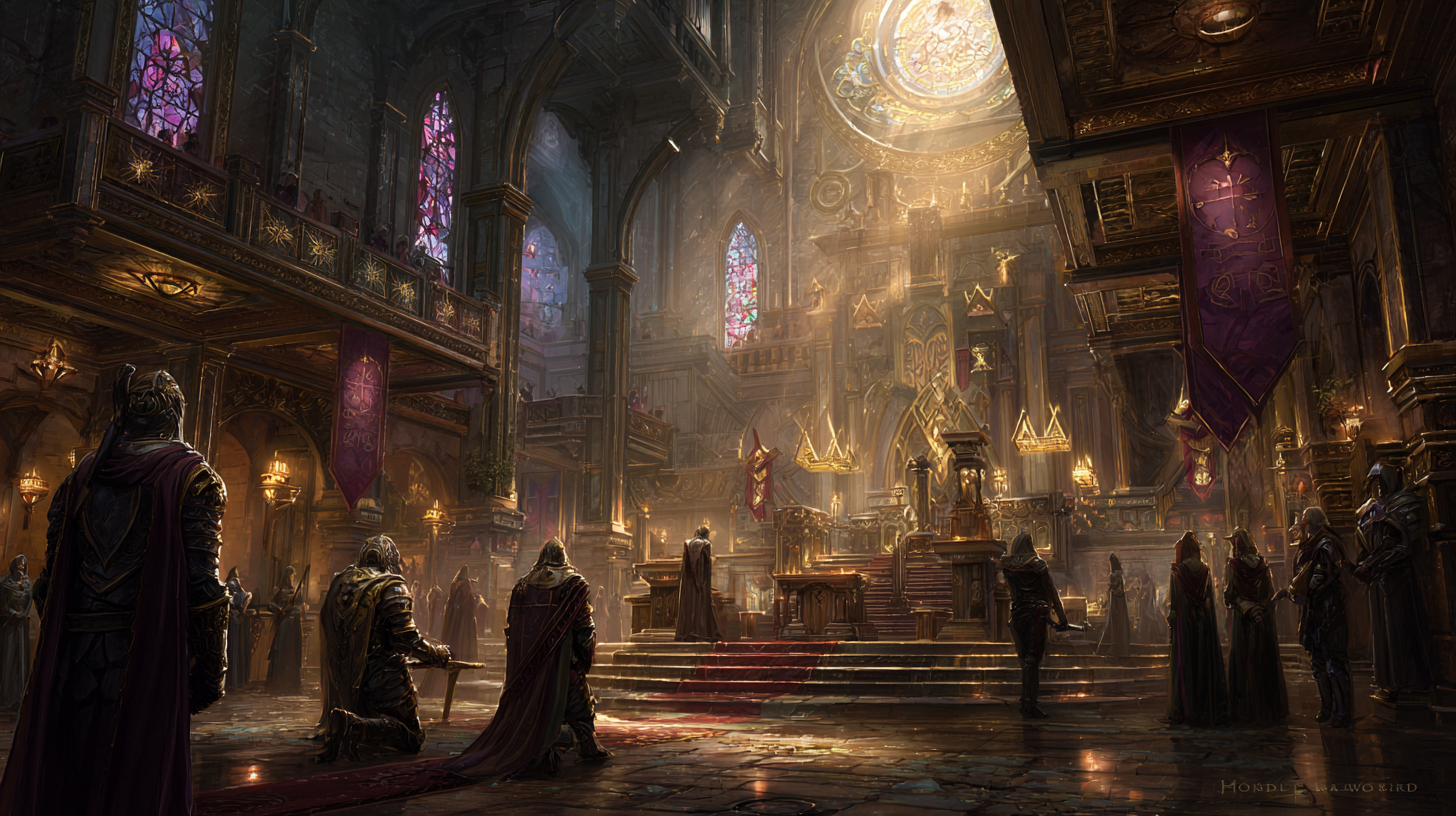
Religion & Law
Every god has its priests, every priest their temple. The question is not whether worship is allowed, but which worship is welcome
In Faerûn, worship of the gods is not optional — every soul must align with a deity for the afterlife. What varies from city to city is which gods are recognized and how much legal authority their clergy hold.
A religion’s influence in a settlement depends on:
- Recognition — Whether the faith is permitted (see Right of Faith in the local Law Block).
- Rank within the church — Whether the character is a common worshipper, ordained priest, or high-ranking authority.
Privileges by Rank
- Common Worshippers
- Legal Standing: Same as commoners.
- Benefits: Access to rituals, sanctuary in temples (if wealthy enough), and assurance of afterlife under their god.
- Restrictions: Do not gain automatic legal rights from their faith.
- Ordained Clerics & Paladins
- Legal Standing: Treated as if they hold licenses for Arms and Spellcasting within any settlement that recognizes their faith.
- Benefits: Can cast divine magic openly (subject to local restrictions), bear arms as servants of their deity, and invoke temple authority in disputes.
- Restrictions: If their god is not recognized, they lose these rights and may be treated as unlicensed adventurers.
- High-Ranking Church Officials (bishops, abbots, temple heads, hierophants)
- Legal Standing: Often treated equivalent to minor nobility within settlements that recognize their faith.
- Benefits: May sit on councils, influence judgments, or override minor officials.
- Restrictions: Status vanishes outside regions that honor their god; in hostile territory they may be hunted as subversives.
DM Guidance
- Recognition First: Always check the settlement’s Right of Faith in its Law Block.
- If the faith is permitted (U, P, PG, or R), the clergy gain privileges.
- If not (X or hostile Special), the clergy have no legal protections and may face prosecution.
- Rank Modifiers:
- Common Worshipper = no special rights.
- Cleric/Paladin = Spellcasting + Arms treated as Licensed.
- High-Ranking Official = treated as Nobility, may affect Right of Status & Justice.
- Cults: Twisted sects, heresies, or worshippers of outlawed gods never gain privileges, even if their parent faith is recognized.
Example: Waterdeep
- Faiths must be Registered (R).
- A cleric of Tyr may openly bear arms and cast spells as though licensed, provided they carry temple papers.
- A common worshipper of Umberlee may pray at sea but has no rights in court.
- A high priestess of Mystra is treated as near-nobility, often called to consult with the Lords themselves.
Religion & Law Quick Reference
| Rank in Faith | If Religion Recognized | If Religion Not Recognized | Notes & Benefits |
|---|---|---|---|
| Common Worshipper | No special rights beyond entry into afterlife. May claim sanctuary in temples (if church can afford). | No benefits; may face fines or suspicion. | Sanctuary depends on temple wealth; does not change Arms/Spellcasting rights. |
| Cleric / Paladin | Treated as if Licensed for Arms & Spellcasting. May openly bear arms and cast spells within local restrictions. | Treated as Unlicensed Adventurer; spellcasting and arms use may be prosecuted. | Core divine casters automatically gain authority if faith is recognized. |
| High-Ranking Official | Treated as Minor Nobility. May sit on councils, influence judgments, or bypass common courts. | May be targeted as a subversive or cult leader. | Titles: abbot, high priest, bishop, hierophant. Status varies by settlement wealth. |
Faith-Based Rights Modifiers (Examples)
- Waukeen (God of Trade) → Right of Trade: Always at least T (Tariffed) for her clergy; few rulers risk offending her temples.
- Tymora (Lady Luck) → Right of Arms: Adventurers in her service often granted relaxed Arms restrictions; she is patron of risk-taking.
- Umberlee (Queen of the Depths) → Right of Faith: Usually proscribed inland, but tolerated in port cities; sailors often gain informal protection when honoring her.
- Tempus (Lord of Battles) → Right of Arms: His clerics may openly wield weapons of war even under Regulated conditions.
- Mystra (Lady of Mysteries) → Right of Spellcasting: Her hierarchy may be granted exemptions from local restrictions, particularly in arcane cities like Waterdeep.
- Chauntea (Great Mother) → Right of Trade: Her temples may move grain and foodstuffs even during monopolies or tariffs, as famine is politically dangerous.
- Tyr (God of Justice) → Right of Status & Justice: His clergy may serve as judges or override common courts, effectively holding Noble privilege.
DM Guidance
- Start with the local Law Block (Right of Faith determines if the religion is recognized).
- Apply the rank in the faith (worshipper → no privileges, cleric → licensed, high priest → noble).
- Then layer on domain-specific modifiers (e.g. Waukeen → Trade, Tyr → Status).
Divine Domains & Rights Influence
| Domain | Likely Rights Influenced | Examples |
|---|---|---|
| Life / Nature | Trade (food/livestock), Beasts | Chauntea may override tariffs on grain (Trade: T). Silvanus may permit druidic companions without license (Beasts: U). |
| Light / Knowledge | Spellcasting, Status | Oghma grants his scribes broad leeway in spell use (Spellcasting: Licensed). Lathander’s high priests often treated as Nobility (Status: N). |
| War | Arms, Status | Tempus clergy may bear heavy arms even under restriction (Arms: U). Commanders of holy orders may sit as nobles in council (Status: N). |
| Trickery / Luck | Arms, Movement | Tymora encourages adventurers; her clerics often gain relaxed Arms rights. Mask’s worshippers may bypass curfews with the right bribes (Movement: C → U unofficially). |
| Forge / Craft | Trade | Gond and his priests often receive exemptions from tariffs on crafted goods (Trade: T). |
| Grave / Death | Faith, Spellcasting | Kelemvor clergy may wield necromantic magic under license (Spellcasting: H → L). Myrkul cults never recognized but always lurking. |
| Order / Tyranny | Status, Movement | Tyr’s priests often sit as judges (Status: N). Bane’s faithful may impose curfews in lands under his sway (Movement: C/X). |
| Tempest / Sea | Faith, Trade (ports) | Umberlee tolerated in ports (Faith: PG/R). Talos cultists may be banned inland but feared at sea. |
| Arcana | Spellcasting | Mystra grants her hierarchy Spellcasting privileges even in restrictive cities (Spellcasting: U). |
How to Use
- Check the settlement’s Right of Faith code.
- If the god is recognized, apply baseline clergy benefits:
- Worshippers = no extra rights.
- Clerics/Paladins = Arms & Spellcasting treated as Licensed.
- High priests = treated as Nobility.
- If the god’s domain matches a Right, consider giving extra perks:
- Trade gods like Waukeen → Trade rights.
- War gods like Tempus → Arms rights.
- Death gods like Kelemvor → Spellcasting necromancy exceptions.

Comments